
There is something intriguing, if frightening, yet hopeful, about transitions. When change is in the air, we can hope it will be good. Dawn and dusk are poignant times of the day as we see a new beginning with the sunrise and, strangely, a new beginning with the sunset that signals another day coming. Midsummer’s Day is a day of transition as it is the longest day of the year before the days shorten. Surely, it is this symbolism that caused this day to be assigned to the transitional character St. John the Baptist.
Such a transitional figure lives on the margins of society. Like Elijah, like Isaiah, John lived in the wilderness. Like Isaiah, he was a voice crying in the wilderness. Like both prophets, he preached truth to power. Like Isaiah, he prophesied that God was about to do something stupendous, something unheard of. So what does John the Baptist teach us about what it is like to live on the margins?
When one lives on the margins, especially on the temporal axis, a time of transition, one does not really know what one is doing. The main thing John did, besides preach repentance, was baptize the people who came to see him. Did he know what baptism would come to mean for Christians? How could he? But the Jewish custom of the mikvah symbolizes new beginnings in obeying the Torah, and John knew that his preaching was about a new beginning.
By hindsight, John is seen by Christians as a forerunner of Jesus, the one who prepared the way for him. But did John know it at the time? The Gospel record is equivocal. When Jesus comes to John to be baptized, John demurs, sensing that this is one person who does not need to repent, and Jesus has to insist on John’s doing the baptism to fulfill all righteousness. (Mt. 3: 15) But later, after Jesus’ own ministry gets under way, John seems not to be sure if this is the one he paved the way for or not, and he sends some disciples to ask Jesus if he is the one to come, or if he should seek another. In response, Jesus heals several people, suggesting, without saying anything, that he might be the real deal. (Lk. 7: 19–21)
So, one thing we can do while living on the margins is find a way to reapply something in the tradition that points the way forward. Not everybody can be so inspired, but another thing we can all do is prepare the way for the Lord as did Elijah and Isaiah. This is a matter of emptying ourselves so that we give God the room to move in and do God’s work, whatever it should turn out to be. If we are to empty ourselves so as to prepare the way for God, we must make our own the words of John the Baptist: “He must increase, but I must decrease.” (Jn. 3: 30) It is always the one who is to come who is greater than the one for whom one preparing the way. If we try to be the greater one, we will prepare the way for nobody.
It is possible that John died without knowing if he had seen the one he was preparing the way for or not, but it seems likely he thought it possible that he had. In any case, he certainly did not foresee what Jesus would do to recreate the world. That wasn’t John’s job. His job was to prepare the way, to wait for the dawn from on high to break upon us, (Lk. 1: 78) and he did that by decreasing so that Jesus could increase.


 John the Baptist is so closely associated with the beginning of Jesus’ ministry that it’s easy to see them as two of a kind. Both preached repentance. Both died the death of a martyr.
 Luke stresses the contrast between John the Baptist and Jesus much more than the three other evangelists. Most strikingly, Luke does not specifically say that John himself baptized Jesus. Luke describes John’s ministry and then says Herod added to all his other crimes by putting John in prison. (Lk. 3: 19–20) Then Luke puts Jesus front and center by saying the he was baptized “when all the people were baptized.” (Lk. 3:21)
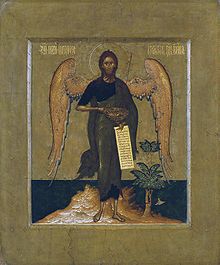 Although John burned with a conviction that God was going to do something new, he had only the models of past prophets to guide him in opening a way to the great new thing. He lived in the desert, wore a camel hair coat and ate wild locusts and honey in imitation of Elijah. Like the prophets of the past, he warned the brood of vipers of the wrath to come if people did not shape up and turn back to God. (Lk. 3: 7) Again like the prophets, he told soldiers not to oppress vulnerable people. Yet again like the prophets, he rebuked his ruler, Herod. And like so many of the prophets, he was put to death.