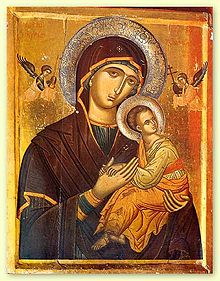
Few words of Mary, the Mother of Our Lord, are recorded in scripture. Among these few words, the most momentous are: “Let it be to me according to your word.” With these words, Mary accepted the conception of the Christ Child in her womb. It is a deep wonder that God, the Master of the Universe, would deign to be dependent on a human being in order to enter the world. It is this same deep wonder that God continues to depend on us to let the Christ Child continue to be born and live in the world that God has made.
In his poem The Blessed Virgin compared to the Air we Breathe, Gerard Manley Hopkins explores this mystery among many others with these lines:
Of her flesh he took flesh: He does take fresh and fresh, Though much the mystery how, Not flesh but spirit now And makes, O marvellous! New Nazareths in us, Where she shall yet conceive Him, morning, noon, and eve; New Bethlems, and he born There, evening, noon, and morn Bethlem or Nazareth, Men here may draw like breath More Christ and baffle death; Who, born so, comes to be New self and nobler me In each one and each one More makes, when all is done, Both God’s and Mary’s Son.
Note that Hopkins is telling us that saying Yes to God is not something done once and for all; saying Yes is something that must be said time and time again, every day, every hour, without ceasing. The New Self, the nobler us takes time.
Pope Gregory I is a most fitting patron saint for an Episcopalian Benedictine monastery. After all, he is the one who sent a Roman mission to the English people in 597, arguably making him the founder of the English Church. One might wonder why Gregory would have been so concerned about an obscure people of little significance in a distant part of the known world when there were so many pressing problems right in Rome where he was serving as the Pope. In his own neighborhood, he had to deal with a plague, which had carried off his predecessor Pelagius II, economic hardships, and invading Lombards.
Although neglect of needs close at hand in favor of needs far away is a favorite target of satirical jabs, that is hardly the case with Pope Gregory. He took initiatives in food relief and in diplomatic negotiations with the Lombards. In distributing alms throughout the city, he showed great competence in accounting to make sure that his distributions were as efficient as possible. He was also attentive to the needs of the Church in many ways. He is credited with important reforms in the Roman liturgy and Gregorian chant is named after him. That doesn’t mean he wrote the music himself, but it does mean that he encouraged the development of the music. He also enjoined protection of Jews and their traditions, setting up the Papal tradition of sustaining these protections in the centuries to come.
As if all this is not enough, Pope Gregory was important to the development of monasticism. He lived the life himself when he could by founding a monastery on one of his inherited estates. Although he had to lead a more active life than he would have preferred, first as a papal ambassador to Constantinople, and then the Pope, he continued to practice contemplative prayer and he left us many teachings on the subject. He is also credited with writing the only biography of St. Benedict that we have.
As both a monk and a church leader, Gregory certainly followed the teachings of the Book of Wisdom by praying for wisdom and receiving it, (Wis. 7: 7) a quality that shows in his own teaching ministry. As is particularly clear from his Gospel Homilies, Gregory also followed St. Paul’s example of not preaching himself, but preaching Jesus Christ. (2 Cor. 4: 5) He was strict with others in matters of honesty and devotion to truth, but he was at least as strict with himself as he was with others. He also followed the example of Jesus in being uncommonly diligent about being among us as one who served. (Lk. 22: 27) The untiring social work he accomplished attests to this.
Fundamental to Christianity is caring for the least of people, which brings us back to the English mission that Gregory arranged for with great care. The Venerable Bede has preserved some of Gregory’s correspondence with St. Augustine of Canterbury to show his concern that the mission be carried out with dedication and good sense. According to Bede, Gregory was inspired to order the English mission by seeing some young men and boys in a slave market and being told they were Angles, from an obscure island at the end of the known world. Why should the sight of a few slaves inspire such a thing? Because even such as these are as important as the poor in a beleaguered Rome that he was also serving.

 Imaginary Visions of True Peace