
Blueprint of the Kingdom

buddingTree1The blueprints for a building are a lot less exciting and interesting than the building itself. However, blueprints are useful for showing the fundamental shape and structure of the building at a glance. The readings for Epiphany 3A are more like a blueprint for the Kingdom of God than a tour of the Kingdom in its fleshed-out form.

In Mt. 4:17, Jesus says:  “Repent, for the kingdom of heaven has come near.” Repenting does not mean to make a laundry list of our little sins and try to stop doing them. Repenting means to turn around, to switch our minds and our hearts, to see life in a new way. This is the fundamental thrust of the Kingdom. But what specs can we get from the blueprint?

The quote from Isaiah, especially the part about Zebulun and Naphtali may not seem exciting but they show some important shapes in the blueprint. These places in Galilee are Gentile territory, lands of the enemies of Israel, lands that were occupied by the Assyrians in their invasion of Israel. The darkness has to do with the power and might of military occupation and enmity between peoples. Isaiah’s saying that God broke the rod of the oppressor as on the day of Midian suggests that God’s Kingdom will free us from military force that inevitably creates darkness. Reconciliation with the Gentiles involves forgiveness for past wrongs, even past atrocities such as those committed by the Assyrians and then the Romans in Jesus’ day. Matthew notes that Jesus moved to this area of Galilee after Herod’s arrest of John the Baptist, another instance of Roman oppression. One might feel this is not applicable to most of us because most of us are not high government officials or military leaders. However, all of us live either in a country bursting with military might or in a country that is in some way, perhaps economically, occupied by another. That means we need to turn away from anything that contributes to the enmity this situation creates and start breaking the yokes we impose on each other.

In First Corinthians, Paul gives us another example of darkness that is very close to everyday life for all of us. The church is in conflict with its members using slogans such as: “I belong to Apollos!” “I belong to Cephas!” One could say that this is war on a small scale but the darkness is the same as that created by the Assyrians and the Romans. Paul suggests that the light of the kingdom which Jesus is bringing near is to be “united in the same mind and the same purpose,” which for Paul is the mind of Christ, whose cross is foolishness for those who are perishing in the darkness of violence but is the power of God for those being saved.

The “power of God” doesn’t look much like power as we usually understand it. It isn’t exactly a large-scale military invasion like D-Day. In fact, it is quite the opposite. But the cross is power in the sense of shedding light in the darkness which John says the darkness cannot overcome. The light reveals the darkness of the military might of the Assyrians, the Romans and all else who imitate them. The light also reveals the hatred of victims for their oppressors, however understandable, for what it is: a wall of enmity that perpetuates divisions between people. As I struggle with my almost constant anger at many politicians in this country for their misuse of power and the public trust, I have to repent of this anger minute by minute.

Where does this darkness come from? Isaiah and Matthew are not portraying darkness as part of the created order in the sense that night time is natural. This is not darkness that God made, or in fact had anything to do with. This is darkness as a human creation. It is human beings who organize armies to oppress people or who tear congregations apart with petty party politics. This sort of behavior is highly contagious. The more people build walls or fight, the more people feel the need to build walls and fight.

What does the Kingdom of God, founded on the foolishness of the cross look like? The blueprint we have in these readings doesn’t look like much, but then a crucified criminal in Roman times doesn’t look like much either. When we read just a bit further in Matthew, we enter the real-life rooms of the Kingdom outlined in the blueprint. We find many rooms, many mansions, all of which offer contagious possibilities such as being blessed for being poor or for being a peacemaker, or turning the other cheek or walking the extra mile, and then finding in these weaknesses the rock that supports the house of faith we are building against the storm of Rome and Assyria and the power brokers of our time.

Whose Axe? Whose Winnowing Fork?

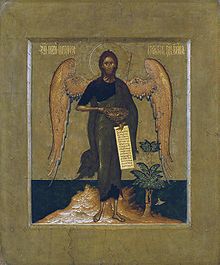
220px-John_the_Baptist_Prokopiy_ChirinAfter centuries without a prophet, a wave of expectation flooded Judea and Galilee. A man dressed the way Elijah was dressed rode this wave and pushed it along with his boisterous preaching. “Repent, for the Kingdom of Heaven is near.” What sort of kingdom did he expect? The call to repent tells us only that we must turn from the direction we are going and move into a different direction. Question the ways we live and look for a different direction.

Two astounding prophecies by Isaiah offer us intriguing, inspiring, but puzzling hints about what the Kingdom might be when he urged us to turn “swords into plowshares” and “spears into pruning hooks” so that we “study war no more” as the spiritual says and that “the wolf shall live with the lamb.” So, now we have all of creation at peace? Not quite. Isaiah tells us that the “shoot from the stump of Jesse” will “smite the earth with the rod of his mouth, and with the breath of his lips he shall slay the wicked.” Apparently taming lions and tigers and bears is easier than taming predatory humans. In calling the Pharisees and Sadducees, “that brood of vipers,” and asking who told them to flee the “wrath to come” while an ax was “laid at the trees” and his successor would have “a winnowing fork in his hand” suggests that they were not as tamable as predatory animals. The predatory lenders of today seem just as untamable. However, surely the kingdom of Heaven was not wrath of this sort, even if John, like the prophets before him, thought such wrath might clear the way for Heaven’s Kingdom.

As soon as he is baptized by John, Jesus cries out precisely the same words: “Repent, for the Kingdom of Heaven is near.” By saying these same words, is he perhaps telling us that John the Baptist, of whom there is none greater born of woman, hasn’t quite set the right direction either. His baptism has taken him on a very different track: the Paschal Mystery. That may seem a bit anachronistic, but from the preaching the Sermon on the Mount on, Jesus takes the direction of absorbing violence rather than inflicting it. Not only does the Kingdom not consist of threshing out the bad guys with a winnowing fork and burning them, but such threshing doesn’t even pave the way to the kingdom. If anything, this violence only blocks the way for everybody as, in our righteous indignation against predatory lenders and their ilk, the axes and fires for burning chaff multiply. One might argue that Jesus himself had some choice words for the Sadducees and Pharisees. However, Jesus called them whitewashed tombs filled with people’s man’s bones. Jesus wasn’t chopping off their heads or burning them up; he was warning them about how dead they were. If Jesus isn’t a thunder deity carrying a battle axe, whose axe is laid to the tree?

In his lectionary commentary, Paul Nuechterlein provocatively suggests that the axe is wielded by us. It isn’t God but we who are chopping down trees all over the world. That is indeed what happened on Mount Calvary. Moreover, according to Isaiah, it is from the stump that new life emerged. So, whose wrath should we flee? Ours. What should we run to? How about the chopped stump from which the new Tree of Life is growing?

Baptism: Overwhelmed by Christ’s Love (1)

lakeGray1“We were buried therefore with him [Jesus] by baptism into death, so that as Christ was raised from the dead by the glory of the Father, we too might walk in newness of life.”  Rom. 6:4

If baptism is our initiation into Christ, our entry into the Paschal Mystery, then baptism is the underlying, ongoing dynamic of our lives in Christ. Dying and rising with Christ is something we need to do every day. The Greek word baptismo means to be overwhelmed, inundated. In baptism we are overwhelmed by and inundated with the Paschal Mystery. I will explore this mystery by looking at a few key scripture passages that give us variations on this one theme.

Jesus himself was baptized in the River Jordan by John the Baptist. For John, it was a baptism of repentance from the violent society of his time, to prepare for God’s winnowing fork in “the wrath to come.” But when Jesus comes, he does not bring a winnowing fork; he only brings himself and asks to be baptized. As he is baptized, the heavens open, the Spirit descends, and a voice from heaven says “This is my beloved Son with whom I am well pleased.”

These words refer to two key verses in the Hebrew Bible that tell us what baptism is all about. These words ring out in Psalm 2, addressed to the king, the Messiah, who is being singled out from the nations that are raging together and rising up against the Lord and his anointed. The inundation of baptism draws Jesus out of the inundation of the nations raging with each other. In Jesus, we too are drawn out of this inundation in the sense of being freed from raging against everybody else. We are not freed from being the target of these raging nations when they unite against the one who has been freed from their wrath. These same words also refer to Isaiah 42:1, the first line of the first song of the Servant of Yahweh. Throughout these songs, we find that the servant has been called out of a violent society and becomes the victim of that society’s violence. Unlike the psalmist who threatens the raging nations with a rod of iron, the Servant does not retaliate in any way against the violence inflicted on him. In baptism, we too are overwhelmed by the Servant’s suffering but then we are overwhelmed by the Servant’s vindication by God.

John’s Gospel does not narrate the baptism of Jesus but, as in so many other instances, John shows us the underlying story in a different key. When Nicodemus approaches Jesus by night, Jesus tells him that one cannot see the kingdom of God without being “born anew,” born “from above” by water and the Holy Spirit. Jesus seems only to compound Nicodemus’ puzzlement (and ours!) by suddenly shifting to Moses raising the bronze serpent in the wilderness. However, the bronze serpent was raised during a social crisis in the form of a plague. (Both the disease and the violence against Moses were contagious.) The phrase “lifted up” refers to Jesus being raised on the cross and then being raised from the dead. The bronze serpent, then, becomes an image of Jesus being raised on the cross to draw all people out of the society overwhelmed by violence into a new society as free of the violence as Jesus is himself.

This is the context of the famous words that follow: “For God so loved the world that he gave his only Son, that whoever believes in him should not perish but have eternal life.” If God so loves the world, then God is not bringing a winnowing fork or a rod of iron, but is bringing only himself, wounds from the cross and all, to lift all of us out of the world’s overwhelming violence to overwhelm us with his love.

See Part 2

Prepare a Way for the Lord: an Advent Meditation

field1John the Baptist calls out to us with Isaiah’s words: “Prepare the way of the Lord, make his paths straight.”  Isaiah here was referring to the return of God’s people to their rightful home from which they had been uprooted by the Babylonians. Even today, we live in exile, not living our lives in God as we ought. The call to repentance (metanoia) in John’s baptism means, literally, to turn our minds. This does mean just filling or minds with new books; it means turning our whole embodied selves in a new direction to see and live in a different way.

Isaiah prophecies a leveling process where the valleys are filled in, the mountains are brought low, and the crooked ways are straightened. That is, the obstacles within ourselves and within our culture that prevent God from coming to us must be removed. The image of leveling seems to suggest a social upheaval where the mighty are brought low and the lowly are raised up so that all are on the same level. This would be to overlook the real obstacle to God: our tendency to compare ourselves with one another without reference to God, preoccupied with being better than others or fretting that others are better than us. This preoccupation and the resentments they foster maintain the isolating barriers of valleys and mountains and block the way to God.

The repentance that Isaiah calls for is the renunciation of our rivalrous entanglement with others and allow for God’s leveling process that holds everybody in the same regard without exalting some or lowering others. Unfortunately, while God is smoothing out the way for us, we prefer to maintain the barriers that we think protect us. Opening a highway for God makes us vulnerable, not only to God but to all of God’s people. Take out the valleys and mountains and anybody could come deeply into our lives! Isaiah gives us fair warning by declaring that “all flesh shall see the salvation of God.”

Like all analogies, the analogy of smoothing out the landscape has its liabilities. Flat ground makes for boring scenery. Valleys and mountains make for beautiful scenery. God doesn’t destroy the landscapes God has made. That means, if we turn our embodied minds, we see that God’s leveling process is to rejoice in the valleys and mountains and twists of the road without rivalry or resentment.