
Is there such a thing as an ordinary meal with little or no sacramental value? When one thinks of the many people who routinely pick up something at a fast food place on the way to work, the answer seems to be Yes. However, the weight of anthropological and historical evidence is a resounding No. From the dawn of humanity, myth and ritual have been connected with food. Hindus call food prasad, offered to the gods because received from them. Moses told the Israelites that they were fed manna in the desert to teach them that people do not live by bread alone.(Deut., 8: 3) There is always more to bread than bread.
Many years ago I saw the play The Dining Room by R.A. Gurney. In twelve vignettes, glimpses are given of how problematic the dining room has become in suburban American culture. Among these scenes, we see children suffering from overbearing parents, two parents surreptitiously carrying on an illicit relationship while chaperoning a children’s birthday party, and a woman too senile to recognize the dining room where she had served her family for so many years. However, the impact of this play depends on the transcendent meanings of meals from which contemporary life has fallen.
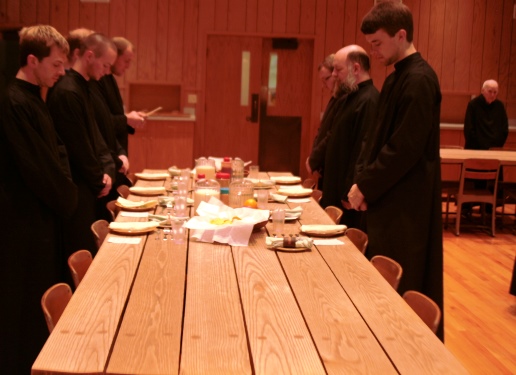
This play resonated with me in many ways since I grew up in a suburban household in the fifties. The dining room was a kind of sacred space, and not just because we always said grace at the beginning of the meal. My brother and I were taught proper table manners. If the phone rang, my father told the caller to call back later. And yet the most traumatic experiences of my childhood took place at the dinner table. Perhaps it was the sacred aspect that aggravated human fault lines. Although these bad experiences were few, their impact was disproportionately strong. It is only in my old age that I realize how important the stabilization of dining was in my formation. I am grateful for the stability of common meals at the Abbey.
The Eucharist as presented by Paul brings together sacred meals from both the Jewish and Roman traditions. It seems likely that Paul connected the Last Supper with Passover since he called Jesus the Passover sacrificed for us. Although the Passover was the most sacred meal in the Jewish tradition, feasting was also connected with other sacrificial rites as the story of Hannah the mother of Samuel shows. Banquets held by the Romans were sacred even when they weren’t held in temples because libations to the gods took place. The shadow side of the Roman banquets was that banquets depended on slave labor and slaves did not participate in the feasting except for the Saturnalia, the social safety valve of one topsy-turvy day a year, a type of custom that pops up in almost all developed cultures. It is noteworthy that slaves held by Jews were included in the Passover celebration if they were circumcised.
Paul recounts the Institution of the Eucharist in the context of berating the Corinthians for their insensitivity to the poorer members of the congregation whose labor caused them to come late, when the feasting, connected with the ritual, left little or northing for them. Again, the sacred meal intensifies human fault lines. For Paul, the Eucharist should be the occasion of a social revolution for how vulnerable people were treated.
The Eucharist is short on actual food but heavily weighted in meaning and substance. After all, we are fed the Body and Blood of our Lord. We don’t live on bread alone; we live on Jesus. Even when we have to eat on the go, we can make an act of thanksgiving to God for the food that sustains us. More importantly, we can try to have at least some special meals with special people in our lives. For all of the human fault lines we struggle with, the Eucharist shows us that every meal is, to quote the prayer we use at the Abbey to bless the incoming servers for the week, a sign and pledge of the heavenly banquet.

