

When Jesus calls Herod “that fox,” (Lk. 13: 32) many associations, especially those from childhood, come to mind. In my case, there are the Uncle Remus stories of Br’er Rabbit and Br’er Fox and, of course, Aesop’s Fables. The animal stories by Thornton W. Burgess were among the first story books I heard as a small child, and they were the among first books I read for myself. Would Jesus have heard any such stories as a child? In the case of Aesop, it’s possible. It seems that children everywhere grow up with animal stories with foxes often being prominent.
The quality of being a cunning predator, often transformed as a trickster of sorts, is basic to many of the anthropological portrayals of foxes in the legends. In one of Aesop’s Fables, a fox tells a cock how much it wants to hear the bird sing. Indulging in pride over his voice, he is vulnerable to being carried off for the fox’s next meal. The townspeople, however, chase the fox because the cock belongs to them. So the cock suggests that the fox tell the people the cock belongs to it. Of course, when the fox opens its mouth to say that, the cock escapes. So the fox is outfoxed. Br’er Rabbit is always finding ways to outwit Br’er Fox, most famously by getting Br’er Fox to throw him into the brier patch where he can disentangle himself from the tar baby. In the Burgess books, Reddy the Fox goes from one flamboyant trick to the next. When I was an adolescent and Igor Stravinsky became a favorite composer, I listened to the short dramatic work Renard. Renard, another trickster fox, spanned several European traditions including the Russian version Stravinsky used. One of Renard’s tricks is to dress up as a nun and offer to hear the cock’s confession and give absolution. There seems to be some ecclesiastical confusion here, not least the ongoing problem of a predator posing in clerical garb. The cock makes himself vulnerable by being—well, cocky, and the cock needs to be rescued by the Cat and the Goat. It is not simply a case that a fox, like a rooster, has to eat. Reddy the Fox literally bites off more than he can chew by running off with the farmer’s plump hen, not for his supper, but for bragging rights.
Stories of trickster foxes and other animal tricksters are funny, They certainly tickle the funny bone of small children who feel overwhelmed by the power everybody else has over them. Since these stories reflect human behavior, they give us a chance to laugh at ourselves, if we are wise enough to see when the shoe fits. In the case of the Burgess books, just about every animal gets a story for itself, so that sympathy shifts from one character to another. A child might root for Reddy the Fox when he runs off with a plump hen, but roots for Danny Meadow Mouse when he is chased by an owl.
In short, these stories reflect the rivalrous relationships humans carry on with each other in all their comic dimensions. Not surprisingly, vanity is constantly the downfall of one rival or the other. But there is a sobering side to the comedy if we reflect that it is based on rivalry between predator and prey (and some characters are both.) It is no accident that the same dynamics come up time and again. When human relationships become rivalrous, it becomes a perpetual motion machine that keeps on going, just as the stories keep on coming with Renard up to his old tricks and his rivals up to theirs to outwit him in turn. In calling Herod “that fox,” Jesus is indicating that Herod, certainly a predator if not necessarily a trickster, is perpetuating the same old rivalry game as Renard and all other foxes in the fables. When Jesus laments the destruction of Jerusalem, he is showing us that all Jerusalem is caught in the fox’s game.
But instead of acting like a cocky cock or attacking the fox as the Cat and Goat do, Jesus yearns to gather Jerusalem’s children “as a hen gathers her brood under her wings.” (Lk. 13: 34) But we are not willing. After all, we would have to give up our predator/prey games that seem to give life so much of its meaning. But Jesus has already thrown a monkey wrench into the fox’s game by his gesture. Jesus pushes the monkey wrench deeper into the heart of the cosmos when he opens wide his arms on the cross, like a hen gathering its young.
When Paul tells the Philippians to imitate him, (Phil. 3: 17) he himself is imitating Jesus as the Mother Hen who renounces the fox’s games and makes himself vulnerable. Another example Paul holds up for imitation is Abraham in his act of faith. (Rom. 4: 3–5) When he has no heir and no hope of an heir, it is hard to be consoled by the countless stars in the sky. When we are overwhelmed by predatory foxes, we yearn for the Lion of Judah, not a Mother Hen with wings extended. But Abraham “believed the Lord; and the Lord reckoned it to him as righteousness.” (Gen 1 5: 6) Can we hold steadfast in such faith? There is much need for the embrace of love in the face of so much widespread predatory trickery today. Can we even go so far as to join Jesus’ embrace of all foxes that they, too, may live in the Kingdom?
See also: The Prophet between the Fox and the Hen
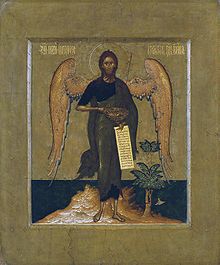 Although John burned with a conviction that God was going to do something new, he had only the models of past prophets to guide him in opening a way to the great new thing. He lived in the desert, wore a camel hair coat and ate wild locusts and honey in imitation of Elijah. Like the prophets of the past, he warned the brood of vipers of the wrath to come if people did not shape up and turn back to God. (Lk. 3: 7) Again like the prophets, he told soldiers not to oppress vulnerable people. Yet again like the prophets, he rebuked his ruler, Herod. And like so many of the prophets, he was put to death.
 Tonight, we celebrate the birth of a child. Usually, there is rejoicing when a child is born. One of my family stories is that my grandmother was so excited about my birth that she burned two pots of beans.


 Imaginary Visions of True Peace