Eating the Being of Jesus

AndrewWashingFeet - CopyThe Holy Eucharist has been accused of being a cannibalistic rite. René Girard would accept the accusation. In a snippet from an unpublished interview, he suggests that the Eucharist recapitulates the entire history of sacrifice and its violence and that history includes cannibalism. When I took a college course on African and Oceanic religions, one of the essay questions I was confronted with on the final exam was to discuss a few anthropological eyewitness accounts of cannibalistic practice. This was the first time I had encountered anything like it. What struck me about the accounts was how these people were intentionally absorbing, through ingestion, the being of the person, sometimes in mockery but more often in respect. (My take on these documents was affirmed by my professor with a top grade.) This is also Girard’s take. He ties this data into his analysis of the dynamics of mimetic rivalry where a rival moves beyond envying the possessions of another to envying the very being of the other. Interestingly, Jesus himself seems to agree with Girard and the anthropologists on this matter. In John 6, he uses strong language when he tells us that we must eat his body and drink his blood, words that suggest cannibalism and seem to have been interpreted as such by his grossed out hearers who, for the most part, went away so as not to hear anything more about it.

Cannibalistic language is often used figuratively in human speech and that is true of Holy Scripture as well. The psalmist affirms God’s deliverance from people who assail and devour his or her flesh (Psalm 27:2). St. Paul warns the Galatians that if they “bite and devour another,” they should take care that they “are not consumed by one another” (Gal. 5: 15). These examples refer to situations of serious mimetic rivalry and even if the psalmist’s enemies and the people of Galatia are “civilized” enough to rescind from literal cannibalism, they are indulging in the essence of that practice.

In what I have called the First Supper, Jesus reverses the cannibalism of devouring another person by freely offering himself, body and blood, in the bread and wine so that we may receive the being of Jesus as a free gift rather than as the spoils of a violent victory. This implies that his death on the cross is a Gift he gives to humanity and is not booty taken away from him against his will as is the booty taken by a conqueror.

What kind of personal being are we receiving when we receive the being of Jesus? In the early human centuries, people were absorbing the bravery and fighting skills of a worthy enemy who was defeated. With Jesus, what we get is something very different. This something very different is demonstrated in Jesus’ act of washing the feet of his disciples as a sign that we should serve one another in all ways. The personal being we receive in the Eucharist is one who, far from wishing to devour another person figuratively, would wish to build up another person in actuality. When we receive the being of Jesus, we receive personal courage beyond imagining, but it is not the courage of one who fights and wins battles against violent foes, but the courage of one brave enough to serve others, even to death on the cross.
God So Loved the World

NicodemusRight after Jesus had turned over the tables of the money changers in the temple and driven out the sacrificial animals, Nicodemus, a member of the Sanhedrin approaches Jesus by night. In the strange dialog that follows, we see Jesus reaching out to a member of the establishment that he has just challenged, but we also see this same establishment figure stammering as he tries to understand Jesus and fails. This is a time for stammering as it is a time of transition. Jesus has just ended the sacrificial age with his actions in the temple. The question is: What is the new age going to be?

Nicodemus is confounded when Jesus tells him that he cannot see the kingdom of God without being “born anew,” born “from above” by water and the Spirit. The water and the Spirit both suggest baptism. The Greek word baptizmo means to be overwhelmed and just as Jesus was overwhelmed by both water and Spirit in the river Jordan in the account in the synoptic Gospels. Jesus wishes for Nicodemus and all of us to be overwhelmed by both. In this dialogue, however, Nicodemus is overwhelmed with puzzlement and perhaps, so are we. Jesus then compounds Nicodemus’ puzzlement (and ours!) by suddenly shifting to Moses raising the bronze serpent in the wilderness, a mysterious event recorded in Numbers. The bronze serpent was raised during a social crisis driven by a plague. (Both the disease and the violence against Moses were contagious.) The phrase “lifted up” refers to Jesus being raised on the cross and then being raised from the dead. The bronze serpent, then, becomes an image of Jesus being raised on the cross to draw all people out of the society overwhelmed by violence into a new society as free of violence as Jesus is himself. It seems that being born “from above” entails being born from the raised up cross, which is the entry into a new way of living, what John calls “eternal life” several times in his Gospel. After all, St. Paul said that “we were buried therefore with him [Jesus] by baptism into death, so that as Christ was raised from the dead by the glory of the Father, we too might walk in newness of life” (Rom. 6:4).

This is the context of the famous words that follow in John’s Gospel: “For God so loved the world that he gave his only Son, that whoever believes in him should not perish but have eternal life.” (Jn. 3:17) These words echo, in a different key, the acclamation of the voice from heaven after the sky opened up declaring that Jesus is God’s beloved son in whom God is well pleased. Baptism, then, initiates us into this love of the heavenly father. If God so loves the world, then God is not bringing a winnowing fork or a rod of iron as John the Baptist expected, but is bringing only himself, wounds from the cross and all, to lift all of us out of the world’s overwhelming violence to overwhelm us with his love.

John goes on to assure us that God did not send the Son into the world “to condemn the world, but that in order that the world might be saved through him” (Jn. 3:18) These two verses should be strong enough to prevent us from thinking that the solemn verses that follow concerning condemnation take back even a smidgeon of the proclamation of God’s love. The judgment is not God’s judgment but the self-judgment of those who “loved darkness rather than light.” If God’s very Being is light and we don’t like it, what else can God do but keep on being the light until, hopefully, we learn to like it and then love it and so turn away from the darkness in our hearts and turn to the cross that gives us a new birth from above?

Treasures in Clay Jars: Veiled Missions

GregoryIcon1When Paul says that “we do not proclaim ourselves; we proclaim Jesus Christ as Lord and ourselves as your slaves for Jesus’ sake,” (1 Cor. 4: 5) he is forcefully rooting his identity not in himself but in Christ. We are easily prone to the illusion that we each have a self that belongs to me and is mine to do whatever I please with it.

This illusion of an individualistic self is the veil “that has blinded the minds of the unbelievers who are perishing.” It is the “god of this world” who has cast this veil. The veil is what René Girard identified as the persecutory mechanism that has marred humanity since the dawn of civilization. It was precisely this system that was exposed in the Gospels’ narratives of Jesus’ death and Resurrection. When Paul says that the Gospel is veiled to those who are perishing, he does not mean that God is casting people into hell; he means that as long as the Gospel is veiled, we perish in our own violence without even realizing it. When we are not rooted in Christ so as to proclaim Christ rather than ourselves, we are caught in the winds of human desires that carry us in all directions, all of them prone to collective violence. Moreover, we fall into cunning and falsification of God’s word and the shameful things we hide. These reflections seem to continue Paul’s discussion in the previous chapter of this epistle of the veil that covers the faces of Jews when they read the Torah, but by universalizing the veiling, Paul moves the unkind words about his own people. Universalizing the veil has the great advantage of showing that neither Jew nor Gentile has the thicker veil; all of us have it when we fall into systemic scapegoating violence.

Paul appeals to creation as providing the light that takes away the veil and gives us a glimpse of the world as it is meant to be. “For it is the God who said ‘Let light shine out of darkness’ who has shone in our hearts to give the light of the glory of God in the face of Jesus Christ our Lord” (2 Cor. 4: 6). It is the fall into systemic violence that has obscured this glory. It is inspiring that this glory of the created world shows us the face of Christ, a hint that Jesus planned to enter into Creation to enjoy the world with us and didn’t come up with the plan to be incarnate just to make repairs when things went wrong.

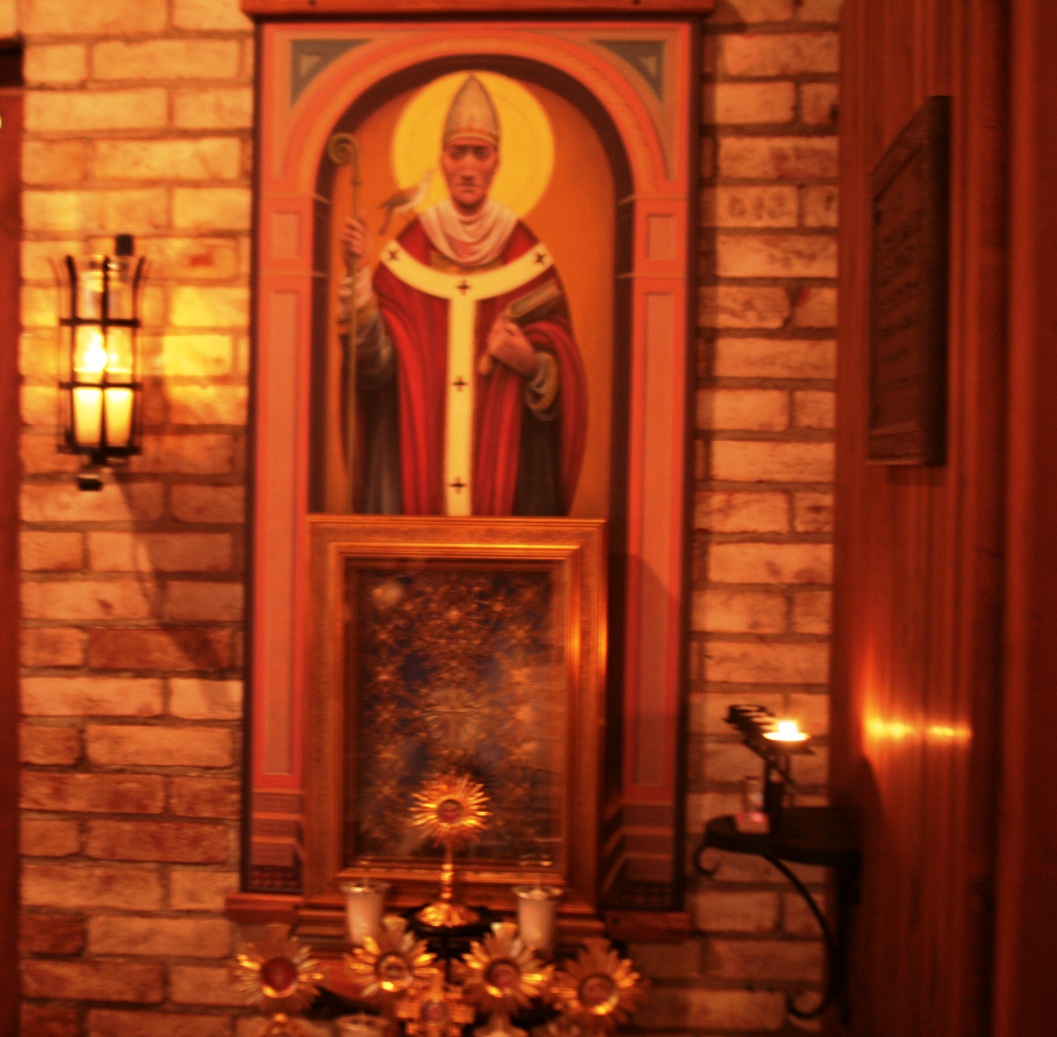
It is perhaps this vision of creation unveiled that inspired Pope Gregory to discern what elements of the English culture could be converted rather than rejecting them wholesale. He advised Augustine of Canterbury to convert the temples rather than destroy them. Of course, just as we have to practice discernment as to what must and can be converted and subverted in another’s culture, we have to practice the same discernment with the veils placed over our own faces by our own culture. The famous story of how Gregory, before he became pope, was inspired to promulgate an English mission is a case in point. Upon seeing some fair youths in the slave market in Rome, Gregory asked who they were. On being told that they were Angles, Gregory, in uttering one of the most famous of puns, said that instead, they should become angels. If anything embodies the persecutory mechanism, it is slavery. Chesterton suggested that Gregory could (or should) have meant: “not slaves, but souls.” The veil lifted enough for Gregory to see the youths as humans in need of salvation and, as pope, he sent a mission to do just that, but the veil did not lift enough for Gregory to agitate for the abolition of slavery, much as he was willing to be a slave himself for the sake of those in need of his pastoral care. That job was left to an energetic descendent of the people converted by Gregory: William Wilberforce.

Preaching in the face of such veils, not least our own, is a daunting task and it is no wonder Paul urges us not to lose heart in the process. It is enough to make us feel like clay and Paul tells us that feeling like clay is exactly the way we should feel when faced with the task of preaching the Gospel. When we realize that we are made of clay, as Genesis 2:7 teaches us, we appreciate what a great gift are the treasures inside the clay jars that are us, a gift from God so that we can “commend ourselves to the conscience of everyone in the sight of God” (2 Cor. 4:2).

Liturgical Animals (2)

eucharist1In his first letter to the Corinthians, St. Paul brings us to the heart of Christian worship that Jesus inspired at what we call his Last Supper. His followers were doing what he told them to do: Do this in memory of me. While both the myths and rituals obscured the sacrificial stories on which they were based, the Eucharist clearly tells the story on which it is based:  the betrayal of Jesus, his subsequent crucifixion, and his rising from the dead.  This earliest account of the Eucharist, predating all of the Gospels, enshrines the Words of Institution that are repeated in celebrations of the Eucharist two thousand years later. The Eucharist teaches us through its story but it also teaches us at a deeper, more substantial level through actually feeding us with the Word of God so tangibly that we chew on it and swallow it. Celebrating the Eucharist places our desires into Jesus’ Desire for us to gather with him and the other Persons of the Trinity.

The meal is probably the oldest of rituals performed by liturgical animals. Eating is the first activity that immerses us into mimetic desire as we imitate the desires of our caregivers to desire food and, by the time we are old enough to be conscious of what we are eating, to desire certain foods because those around us desire them. However, as much as meals have to do with providing necessary bodily nourishment, they are always more than that. An intrinsic part of learning to eat is learning how to eat in the company of others. It may be culturally arbitrary whether we use eating utensils and plates or large leaves and fingers, but in every culture I have ever heard of, there is always a way of eating that is learned. The shared desire for food extends to a shared desire for the way of eating it. By rooting liturgy in a meal, the Eucharist roots worship in the sensuous act of eating; of tasting food and drink on our tongues.

In this same letter, Paul brings up the manner of table manners in regards to the Eucharist. He berates the richer members of the congregation for their insensitive treatment of those who are more economically challenged. To flaunt their superior food in front of those who cannot afford it without offering them anything was a serious violation of everything the Eucharist stands for. This desire shared by one group in the congregation to demonstrate their superiority over others, to put them in their places, breaks the unity the feast is supposed to create and strengthen. Paul makes it clear that there is much more to worship than saying or singing words together while celebrating a sacrifice. If people are not treated well, worship is diminished if not rendered nonexistent.

John’s version of the feeding in the wilderness brings all of these themes together. The event is explicitly brought into the context of Yahweh’s feeding the Jews in the wilderness after their escape from Egypt. Raymond Brown pointed out that rabbinic teaching interpreted the manna as symbolizing the Torah, thus uniting food and teaching, something the Eucharist also does. While Matthew and Mark recount two feedings in the wilderness, one for the Jews and one for the Gentiles, John has one story of feeding for all people. Jesus’ blessing of the bread and fishes has ritual overtones although the feeding is taking place in the open air, away from temples, synagogues and churches. The social unity that Paul enjoins is embodied in John’s vision where it gains a deep universality. Unfortunately, the people then unite in trying to make Jesus king, which destroys the social vision as surely as the Corinthians did.

The Eucharist teaches us that we don’t outgrow our earliest lessons: table manners. Without them, we don’t grow up.

Christian Community (3)

vocationersAtTable1The best-known image of the Church in the New Testament is the analogy of the human body with the Church which is the Body of Christ (1 Cor. 12:12-28). The implication is that as the various parts of a body add up to a unity, the various members of the church, different as we are, also make up a body. This analogy suggests each part must be well-coordinated with all the others. We can see this readily—and impressively—in athletic maneuvers such as acrobatics or in the artistry of a ballet dancer or musician. This image suggests a deep intuition on St. Paul’s part into mimetic desire. Just as each part of the human body must be sensitive and synchronized with each other, so must each member of Christ’s Body resonate with one another. As with the body, this resonance needs to be preconscious, an ongoing awareness of and sensitivity to the other members. The most essential elements of this sensitivity are accepting the other members and not overstepping limits. St. Paul says one part cannot say it doesn’t need another part. His extension of the analogy to a list of various ministries in the church makes it clear that if a foot wants to be a hand, the body won’t walk very well. Neither will the body work well if a foot is amputated. These destructive outcomes happen if the parts of the body fall into mimetic rivalry. The comic character Bottom in Shakespeare’s Midsummer Night’s Dream is a perfect example of overstepping boundaries. At the rehearsal of the play to be performed before the Duke’s court, Bottom first accepts the part assigned to him but then demands every other part as it is doled out to the cast. The absurdity of Bottom’s demands is clear enough if we try to imagine him doing all the parts in the play himself. It is the same absurdity if the neck tried to do all the walking.

Another image of the Church comes in the First Epistle of Peter. The author envisions the community of Christ as a “holy house” made out of “living stones.” (1 Pet. 2: 5) This image reminds us of St. Paul’s admonition that individually and corporately we should each be a Temple of God. (1 Cor. 3:16) It is significant that Peter calls the building a house and not a temple although it is a place where priestly ministry takes place. I see here a hint that Christ’s household is not a place set apart but a place for everyone, sort of like the City of God that doesn’t have a temple because the whole place is one. We have a sense of unity-in-diversity in this image as well. There are many stones and each has to be in its proper place or the house collapses. The stones are not inert but living, vibrant. Again each living stone should resonate with all the other living stones, another powerful image of mimetic desire working constructively.

Another biblical image that I don’t recall seeing used as an image of the Church, but one that could be, is that of the vine and the branches (John 15: 1-9).Here, we are all to be connected with one another through our rootedness in Christ. This image stresses our resonance with the Desire of God but also our connectedness with others through God’s Desire.

These images of the Church complement one another. The Body of Christ has possible pantheistic overtones if taken too far so that the distinction between us and Christ is blurred. But we are, all of us, called to act the part of Christ in the world. The body is dynamic. It can be still for a time to meditate, but usually it is going places and doing stuff. This body and should go out and minister to people in need. The image of the holy house made of living stones is more static. The dynamism is in the living stones while the building stays in one place. This holy house is to be open for the Holy Spirit to fill it and just as open for people to enter and be in it. That is, we are to be living stones creating a loving environment of hospitality for all. The image of the vine and the branches is the most contemplative. While the other two images emphasize the relationships between the members, the image of the vine and the branches emphasizes the grounding of all members in God. It is an important corrective to the pantheistic pitfall of the Body of Christ image.

In themselves, these images are inspiring ideals. The reality is something different. St. Paul himself knew this full well. Just before presenting the Church as the Body of Christ, he had castigated the Corinthians for their disorderly and exclusionary suppers where some gorge themselves in front of their poorer and hungrier brothers and sisters. This same epistle began with Paul’s outrage over the divisions within the church with its party slogans that reinforced the divisions. Likewise, Luke’s claim that “the whole group of those who believed were of one heart and soul, and no one claimed private ownership of any possessions, but everything they owned was held in common” (Acts 4:32) was wishful thinking as the subsequent story of Ananias and Sapphira makes clear. Rather than throwing out these images as unrealistic, we need to keep them before us as models we constantly fail to live up to. Without these images, we would just act like the Corinthians without a second thought. We will have to look again at the reality in relationship to these ideal images.

Then there is the matter of the stones. These living stones aren’t just any stones. The cornerstone had been rejected by the builders. What does this mean for the other living stones we are supposed to be? That is another question for further reflection.

Go to Christian Community (4)

The Nonviolent Messiah

KatrinaCrossAbraham1Simon Joseph’s book The Nonviolent Messiah is another helpful study on the question of whether or not Jesus truly preached peace and is a complementary study to A Peaceable Hope by David Neville. Whereas the latter worked from the final version of the New Testament and made a mathematical study of how much violence there was and how much peace, with peace being much the more preponderant element, Joseph uses examination of the Q document and the Adamic model of the Messiah in Enochic literature to argue that the historical Jesus consistently preached peace.

Like some atomic particles that are never seen but are inferred from visible reactions, Q has never been seen but is inferred from a study of the canonical Gospels and other non-canonical material. There may be some guess-work and there remains controversy as to what actually is in Q but there is enough evidence to work with what we have so far.

With a stress on the inaugural sermon in Q which would include the proclamation of the Jubilee and material used in the Sermon on the Mount in Matthew and the Sermon on the Plain in Luke, Joseph builds a case that Jesus preached nonviolence and a violent eschatology was added later by the Q community.

The lesser known Enochic literature is examined for a lesser-known element: the Adamic model that emerged in some of this literature in contradistinction to the Davidic Messiah who would be a political and military figure. The Adamic model posits the hope of a renewed creation that would involve all people and would be achieved by totally peaceful means. The Animal Apocalypse, so-called because animals signify the figures, is a particularly strong example of this. We can easily see the influence of this model on Paul’s use of the New Adam in his epistles. Joseph provides much evidence to suggest that this Adamic model, which was very well-known at all levels of Jewish society in Jesus’ time, strongly influenced Jesus’ self-understanding of the kind of Messiah he was.

If we take Joseph’s historical-critical work and bring it to the final result analyzed by Neville, he get the following plausible historical trajectory on the issue of peace in the formation of the New Testament: 1) The early Q community with its collections of sayings by Jesus preaching peace, 2) The community of Mark’s Gospel proclaiming the peaceful, crucified Messiah, 3) the preaching of Paul stressing peace & using the Adamic model of Messiah, 4) a later stage of the Q community where persecution and rejection led to a vengeful eschatology where God would do the vengeance, 5) The community of Matthew’s Gospel using Mark & Q, including the vengeful material but also the peace teachings, 5) The community of Luke’s Gospel mostly rejecting the violent eschatology & stressing peace with many unique elements stressing peace, 6) community of John’s Gospel with a very strong emphasis on peace.

Although a meticulous examination, the book is readable and is an important contribution to the investigations on Jesus’ attitude to peace and violence.

The Difficulties of Forgiveness (1): Jacob and Esau

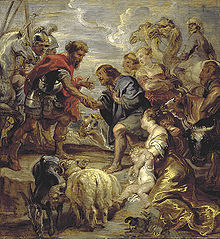
220px-Rubens_Reconciliation_of_Jacob_and_EsauWe are commanded to forgive by the teaching of Jesus and Jesus taught us to pray that we forgive those who wrong us as we forgive them for their wrongs against us. The petition in the Our Father for forgiveness suggests that accepting forgiveness can be at least as difficult as forgiving. Remaining oblivious to this latter difficulty reflects our prior difficulty in forgiving and I suspect it makes it all the harder for us to forgive. The two stories that conclude the book of Genesis help us move through our own difficulties by following through the difficulties experienced by Jacob and his son Joseph. We all know how difficult it is to forgive. We tend to overlook how difficult it can be to accept forgiveness.

The story of Jacob and Esau is a telling illustration of the difficulty in believing in forgiveness, let alone accepting it. Jacob had patently wronged his brother Esau in stealing Esau’s blessing and Jacob fled for his life with a guilty conscience. Years later, after similar wrangling with Laban, Jacob returns with his wives, his children and his flocks which had all grown too plentiful for Laban’s taste. Jacob has every reason to fear what will happen when he meets up again with Esau. Hearing that Esau is coming with four hundred men was not reassuring. The nighttime struggle with a dark figure seems to project Jacob’s combatant personality. Still the shifty coward he’s always been, Jacob puts the wives and children he cares about least in the most vulnerable positions in the front so that he can escape with his favored sons if need be.

What happens is an amazing surprise. Esau embraces Jacob with no reservations and not the slightest sign of resentment. No matter how many times one reads or hears the story, it is hard to believe. Jacob doesn’t believe it. Repentance and forgiveness aren’t really Jacob’s things. Jacob’s words: “truly to see your face is like seeing the face of God” are among the most profound words in the entire Bible for the ultimate revelation is Divine Mercy in a human face. But, as I said, Jacob can’t believe it even after this warm greeting. Jacob turns down the invitation to travel with Esau, using the excuse that he can’t drive his flocks too hard in one day. (Benedict quoted this verse in his Rule to illustrate the need for the abbot not to drive his monastics too hard!) Jacob, still shifty and cowardly, manages to avoid ever meeting up again with his brother for the rest of his life. Think of the years of friendship and companionship they missed out on!

The story is complicated by the later history of Edom, the people descended from Esau which reach a climax in Paul’s quoting, In Romans, Malachi 1:3: “Yet I have loved Jacob, but hated Esau.” In spite of Esau’s forgiveness narrated in Genesis, Edom has not been forgiven by Israel for its siding with their enemies in several wars. That Edom never recovered from the Assyrian invasion seemed to confirm that. The unflattering portrayal of Esau as a stupid, hairy oaf who sells his birthright for a pot of soup is perhaps another way of expressing Israel’s grudge against Edom. And yet this stupid hairy oaf suffered a terrible wrong from his unrepentant brother, moved on and built up his own flocks rather than spending his life in resentment, and forgave his brother. The story of these two brothers is often presented, including by Paul, to illustrate the mystery of God’s election. Jacob is the one chosen to carry on the Covenant, but the rejected brother, Esau, is the one much more in the place of Christ both in his rejection and in his forgiveness. Can repentance and forgiveness be strong enough in our lives for us to believe forgiveness when we see it?

See also Mimetic Blessing through Abraham (2)

The Power of the Ascended Lord

Human_headed_winged_bull_facingAscension Day is a feel-good celebration of Jesus seated at God’s “right hand in the heavenly places, far above all rule and authority and power and dominion, and above every name that is named, not only in this age but also in the age to come.” If Christ is reigning like that and we are reigning with Him and sharing in Christ’s power, then we too are over everybody else just as Jesus is over everybody else. Sounds like a good deal. Or is it? Let’s take a closer look at what this power of Christ is all about.

Getting a sense of how power and especially omnipotence applies to God is tricky. After all, we dream of being omnipotent and invulnerable so we assume that the Master of the Universe wishes the same thing. Not a good assumption.

René Girard noted that power is attributed to the primordial victims of collective violence. (See Violence and the Kingdom of God) That is, the victim was powerful enough to be the cause of the social meltdown and also powerful enough to be the solution to the violence. (The reality, of course, is that such victims were normal humans with no supernatural powers.) The Gospels reveal Jesus as a vulnerable human being who clearly did not cause the social crises of first-century Jerusalem and whose death brought about no solution to it. Whatever power Jesus has, it isn’t this power. The illusion of the power of the victim should make us suspicious about how we attribute power to God.

A second and more common image of power is the imperial structure. In the days of Isaiah and other prophets, Assyria was such an image. The statues and friezes of winged bulls are symbols of this kind of power. This is the kind of power the apostles seem to have been thinking of when they asked Jesus: “Lord, is this the time when you will restore the kingdom to Israel?” (Acts 1:6) Jesus’ ascension right after hearing this question was a firm No.

When Paul says that Jesus is far above all rule and authority and power and dominion, and above every name that is named, not only in this age but also in the age to come,” he is saying that Jesus is far above and beyond all cultures that rely on sacrificial violence and the Assyrian-Roman impositions of power. That is, the power of Christ is to bring us out from these cultural practices. But are we being brought out of the world to escape these cultural entanglements? Sorry if you were hoping for that.

crosswButterfliesPaul concludes this section of Ephesians with powerful irony: “God has put all things under [Jesus’] feet and has made him the head over all things for the church, which is his body, the fullness of him who fills all in all.” Paul is using the common image of military victim where the victor lays his foot on the head of the vanquished, making the loser his footstool. But under Jesus’ foot is not the head of the vanquished but Jesus’ own Body, the Church. This is the Body of the crucified one who was raised from the dead and returned as the forgiving victim. Jesus’ reigning in Heaven at the right hand of the Father is coterminous with Jesus living with us here on earth, sharing our vulnerability to the imperial structures of power who continue to act like the Assyrians and the Romans.

If we are the Body of the forgiving victim, then forgiveness, not rulership, is what reigning with Christ is all about. This power to forgive was the gift the risen Christ breathed into the disciples (Jn. 20:23)  In John, Jesus says that it is this “Spirit of truth” who abides in us. When we keep Jesus’ words, he and the Father and the Spirit will come and dwell within us to empower us with their love for one another and for us and for all those whose sins (including our own!) need forgiving.


Principalities and Powers

WilliamGuestsChurch1Jesus was not crucified by just one person; he was crucified by a social system. The Gospels and the apostolic preaching in Acts show clearly how hostile social systems in Jerusalem came together to create a larger social system that was united solely by the agreement to put Jesus to death. By quoting from the persecution psalms, these sources suggest that persecutory social systems have always been a part of humanity. René Girard has demonstrated how mythology covers up and yet still points to this same persecutory mechanism. It is such social systems that Paul calls the “principalities and powers” of the world. These principalities get their power from the collective cohesiveness of persecution. This collective power is overwhelming to the individual within this system. Hence the transcendent power they have for Paul. However, Paul also says that the principalities and powers have been dismantled and nailed to the cross by Jesus. The forgiving victim is gathering a radically different social system that not only does not require the sacrifice of the victim but totally precludes such a thing. Paul says that if the principalities and powers had known, they would not have crucified the Lord of Glory. Because they did, we have some ability, by the grace of God, for seeing the fundamental signs of a society that is still run, at least in part, by the principalities and powers and for seeing what are the signs of the Kingdom that the Risen and Forgiving Victim has opened up for us.

A society run by the principalities and powers is punitive. Some people may think that is a good thing, but in  a punitive society, somebody must be to blame whenever anything goes wrong or even seems to go wrong. That is, somebody must be punished. When a society needs to have somebody punished, then this need takes precedence over justice. It is better for an innocent person to suffer than for the corporate rage of the society to suffer for lack of an object of that rage.  It follows that the Law of Tit for Tat reigns. There is no room for mercy. Every offense must be met in equal measure. As long as this Law reigns, there is no end in sight to the spiral of retaliation. In Jesus’ Kingdom, restoration of relationships is the corporate desire when things go wrong. The pain of this restoration might feel like punishment for some, but the pain is remedial, moving toward reconciliation.

In the society of the Principalities and Powers, somebody is always expendable. Caiaphas’ dictum that it is better that one person die than that the whole nation should perish is “gospel.” Collateral damage is an acceptable price to pay for objectives deemed good to those who are running the show. Jesus’ parable of the lost sheep that the shepherd seeks until he finds it and brings it back to the fold shows that in Jesus’ Kingdom, nobody is expendable.

The society of the Principalities and Powers is dualistic.  There has to be an “in” group and an “out” group. The society’s identity is based on what is wrong with those people, the enemy.  If we are to love our enemies, as Jesus teaches, then enemies do not define us in any way.

Most devastating of all, the society of the Principalities and Powers is mendacious. The need to cover up the truth of collective violence in primitive societies carries over to the most sophisticated of modern societies. Part of this mendacity is to blame the victim. The blame that many US politicians cast on women who are raped is a particularly grisly example. Victims of lynching, too, were blamed for what happened to them.

Here is the choice. Where is our treasure? Where is our heart?

Blueprint of the Kingdom

buddingTree1The blueprints for a building are a lot less exciting and interesting than the building itself. However, blueprints are useful for showing the fundamental shape and structure of the building at a glance. The readings for Epiphany 3A are more like a blueprint for the Kingdom of God than a tour of the Kingdom in its fleshed-out form.

In Mt. 4:17, Jesus says:  “Repent, for the kingdom of heaven has come near.” Repenting does not mean to make a laundry list of our little sins and try to stop doing them. Repenting means to turn around, to switch our minds and our hearts, to see life in a new way. This is the fundamental thrust of the Kingdom. But what specs can we get from the blueprint?

The quote from Isaiah, especially the part about Zebulun and Naphtali may not seem exciting but they show some important shapes in the blueprint. These places in Galilee are Gentile territory, lands of the enemies of Israel, lands that were occupied by the Assyrians in their invasion of Israel. The darkness has to do with the power and might of military occupation and enmity between peoples. Isaiah’s saying that God broke the rod of the oppressor as on the day of Midian suggests that God’s Kingdom will free us from military force that inevitably creates darkness. Reconciliation with the Gentiles involves forgiveness for past wrongs, even past atrocities such as those committed by the Assyrians and then the Romans in Jesus’ day. Matthew notes that Jesus moved to this area of Galilee after Herod’s arrest of John the Baptist, another instance of Roman oppression. One might feel this is not applicable to most of us because most of us are not high government officials or military leaders. However, all of us live either in a country bursting with military might or in a country that is in some way, perhaps economically, occupied by another. That means we need to turn away from anything that contributes to the enmity this situation creates and start breaking the yokes we impose on each other.

In First Corinthians, Paul gives us another example of darkness that is very close to everyday life for all of us. The church is in conflict with its members using slogans such as: “I belong to Apollos!” “I belong to Cephas!” One could say that this is war on a small scale but the darkness is the same as that created by the Assyrians and the Romans. Paul suggests that the light of the kingdom which Jesus is bringing near is to be “united in the same mind and the same purpose,” which for Paul is the mind of Christ, whose cross is foolishness for those who are perishing in the darkness of violence but is the power of God for those being saved.

The “power of God” doesn’t look much like power as we usually understand it. It isn’t exactly a large-scale military invasion like D-Day. In fact, it is quite the opposite. But the cross is power in the sense of shedding light in the darkness which John says the darkness cannot overcome. The light reveals the darkness of the military might of the Assyrians, the Romans and all else who imitate them. The light also reveals the hatred of victims for their oppressors, however understandable, for what it is: a wall of enmity that perpetuates divisions between people. As I struggle with my almost constant anger at many politicians in this country for their misuse of power and the public trust, I have to repent of this anger minute by minute.

Where does this darkness come from? Isaiah and Matthew are not portraying darkness as part of the created order in the sense that night time is natural. This is not darkness that God made, or in fact had anything to do with. This is darkness as a human creation. It is human beings who organize armies to oppress people or who tear congregations apart with petty party politics. This sort of behavior is highly contagious. The more people build walls or fight, the more people feel the need to build walls and fight.

What does the Kingdom of God, founded on the foolishness of the cross look like? The blueprint we have in these readings doesn’t look like much, but then a crucified criminal in Roman times doesn’t look like much either. When we read just a bit further in Matthew, we enter the real-life rooms of the Kingdom outlined in the blueprint. We find many rooms, many mansions, all of which offer contagious possibilities such as being blessed for being poor or for being a peacemaker, or turning the other cheek or walking the extra mile, and then finding in these weaknesses the rock that supports the house of faith we are building against the storm of Rome and Assyria and the power brokers of our time.