
Jesus the Rejected Cornerstone among the Weeds

field1Jesus’ parable of the wheat and the weeds inflicts on us the discomfort of being told that we have to put up with the people we don’t like but the end of the parable and the explanation of it afterwards give us the comfort of knowing that the people we don’t like will get it in the end. But does Jesus really mean to give us this “comfort?”

When we consider the workings of mimetic desire, the image of a field densely filled with plants intertwined with each other is easily seen as an image of our entanglement with the desires of other people, some of whose desires we covet, others we try to separate ourselves from. Of course, each person who wants something we want and we don’t think it can be shared, is an enemy, a weed who should be pulled out, expelled from the garden. In such a situation, each of us is prone to considering ourselves to be one of the intended, desirable plants while the others are weeds. Of course, when we are preoccupied with how “weedy” everybody else is, we are totally wrapped up with them in our hostility. It is easy, then, to understand this parable as teaching us to mind our own business and not worry about everybody else. The trouble with this interpretation is that we are all in the thick of this garden whether we like it or not and we need to find a constructive way to live with everybody else in it. A deeper interpretation that is often offered, and one I have much sympathy with, is that we should commend everybody else to God and let God deal with them. To make this work, we have to commend ourselves to God as well, or we think we are commending those bad guys to God but we are good guys who can take care of ourselves. Moreover, the word for “letting” the weeds grow is aphete, which also is used in the New Testament to mean “forgive.”

If we give this parable a Christological interpretation, everything looks different. In being the stone rejected by the builders, Jesus was a weed. That’s the way Caiaphas and Pontius Pilate and Herod saw him. Jesus identified himself with a lot of “weeds” on the way to the cross such as the woman with a bad name in town who washed his feet at Simon the Leper’s house and the tax collectors Zacchaeus and Matthew. Every planter knows that it can be difficult to tell an intended plant from a weed. This is why well-intentioned but uninformed “helpers” are the bane of gardeners. If we try to weed out the garden based on our own judgment, we are likely to weed out Jesus himself.

The explanation of the parable seems to be at cross-purposes with the parable itself. Many scholars absolve Jesus of having ever given it, relegating the explanation to a later redactor to the text finalized in Matthew, as Simon Joseph argues with such vengeful texts in The Nonviolent Messiah. Or, we can argue that Jesus was giving us a parody of what an obtuse listener who lacks ears to hear takes away from the parable, as Paul Nuechterlein suggests on his site Girardian Reflections on the Lectionary. The trouble is, self-righteousness takes us to such extremes that it is impossible to parody. Let’s take a look at where the “explanation” takes us. First, we become preoccupied with weeding out the undesirable plants. Second, we identify with the angels who weed the garden. Third we think we shine in righteousness that blinds us to our self-righteousness. That is, we play the role of God, which is idolatry. The end result is weeping and wailing and gnashing of teeth for everybody and no harvest for anybody.

If we look forward to harvesting as opposed to weeding, we get a totally different scenario that fits well with the parable itself. When it comes to harvesting, weeds just don’t matter. The only thing that does matter is picking the fruits and bringing them in so they can offer sustenance to others. When it’s all about harvesting, things start to look a lot like the heavenly banquet that all of us can share without worrying about who is wheat and who is a weed.
A Peaceable Hope

KatrinaCrossAbraham1The strongest tension in the New Testament is that between the teachings of non-retribution and forgiveness on the one hand and eschatological retribution threatened for those who fail to follow the way of forgiveness and non-retribution on the other. The first problem is that it sets up a double standard between God and humans. We should be meek and mild but God will throw the bad guys into unquenchable fire where there will be wailing and gnashing of teeth. The second problem is that Jesus’ accepting death on the cross turns out not to be the ultimate revelation of God that Christianity usually teaches; violent retribution at the end of time is the last word. The third problem is that if violent retribution on the part of God is the last word, the hard practice of non-retribution doesn’t seem to be worth it.

David Neville’s fine book A Peaceable Hope is an indispensable examination of precisely these issues. He sees the divide primarily between some parables and some retributive sayings in Matthew and pretty much the rest of the New Testament. The tension, then, is strongest in Matthew since it includes the Sermon on the Mount and a stress on Jesus being the silent lamb led to the slaughter but also has many threats against those who do not live by these standards. So lopsided a division suggests that the weight of the New Testament as a whole comes down firmly on the concept of God as totally without violence. Neville draws the tension in Matthew and contrasts this Gospel with the three other canonical Gospels, all of which are strongly peaceable in its eschatological teaching to various degrees with John being the strongest on peace themes. The reception history of Revelation has often taken the book to teach retributive violence by God but Neville builds a strong case that the slaughtered lamb is the guiding image for the book as a whole.

Neville doesn’t try to speculate why Matthew would have as vindictive an eschatology as he does. We can make some educated guesses based on our own experiences with rejection and injury. If we can’t or won’t strike back, we like to think somebody bigger than we and our adversaries will come and tear them to pieces on our behalf. There are alternate ways of understanding these violent passages in the New Testament, among them the suggestion that they use firm imagery to show the consequences of rejecting Christ and Christ’s way. Raymund Schwager, for example thinks along these lines in Jesus in the Dram of Salvation. In such a reading, God is not actively acting out revenge on those who reject him; they are suffering the alienation and violence by which they have lived.

Neville’s careful and thoughtful exploration of this difficult issue is valuable for anybody who wants a firm biblical basis for believing in and teaching a God of peace.

Accepting the Cross

crossRedVeil1Jesus’ words that “whoeverdoes not take up the cross and follow me is not worthy of me” (Mt. 10:37) are disturbing on two counts. We don’t like the idea of taking up the cross and we don’t like the idea of being rejected by God for not doing it.

It is worth pausing to note the question of whether or not Jesus could have said these words since they seem to read Jesus’ future back into this point in his life. As with the predictions of his suffering and death on the cross, I think it highly plausible that Jesus knew what was going to happen to him if he continued to teach and minster as he did if most people, especially those in power, persisted in rejecting his teaching and ministry. After all, Jesus had the example of Jeremiah and the other prophets to warn him. He did not need a crystal ball nor did he need to tap into his divine omniscience to foresee his destiny.

When Jesus said that “a disciple is not above the teacher,” he implied that we should expect the same results of imitating Jesus that Jesus himself had. This is a hard choice, one that entails renouncing worldly power and embracing the helplessness of the victim, but the alternative is to side with the oppressors either by actively joining them or silently allowing them to oppress others without challenging them.

The harsh words in Matthew suggest that God will definitively reject any of us who ever fall beneath this standard but the way Jesus treated Peter who failed miserably in this regard, not to speak of Paul who actively persecuted Jesus’ followers, suggests quite the opposite. There is a strong element of self-selection and self-judgment in rejecting the way of the cross. It is as when we speak badly of somebody or deny somebody, it tells a whole lot more about us than it does about the one we are speaking badly about. As the examples of Peter and Paul make clear, such states are not necessarily permanent unless we persevere in our rejection. It is simply the case that Jesus has a certain way of living that eschews violence and power in favor of weakness and the place of the victim. If we do not accept this way of Jesus, then we are simply not on Jesus’ way. Blaming Jesus for rejecting those who deny him is like blaming Jesus for the division his teaching and life brings about when such division is not Jesus’ intent but human decisions. (See Human Swords, God’s Peace.)

Jesus knows how hard it is to choose the way of the cross from his own experience and his sensitivity to any who might follow him. This is why he reassures us by saying that every sparrow that falls to the ground is known by the Father and that every hair on our heads is counted. Maybe the notion of sparrows falling to the ground is not so comforting but Jesus, in saying that we humans are worth more than sparrows, is assuring us that even when we fall to the ground, we are counted. This is what Jesus is getting at when he says that by trying to save our lives by denying the cross, we lose our lives and that by losing our lives we gain them when God catches us, just as Jesus catches every sparrow that falls to the ground. It is out of love for us that Jesus embraces the cross and it is our love for Jesus that leads us to do the same. Maybe we are worth more than sparrows, but sparrows are worth an awful lot as well.

Vainglory – Enslavement to the Admiration of Others

garden1Although pride is usually posited as the opposite of humility, the early eastern monastics distinguished vainglory from pride. (Some translations use “boasting” or conceit.”) It is not always easy to see the distinction between the two but vainglory tends to be seeking glory from humans while pride is more directly related to our relationship with God; thinking, or acting as if we don’t need God. In terms of mimetic theory, vainglory is seeking to stir up the desire of other people for our own actions. Vainglory is acting like the hypocrites who make a public display of almsgiving “that they may be praised by others” (Mt. 6:2) or of their fasting for the same reason. Jesus says they have “received their reward,” which presumably is to be praised by other people. John Cassian says that vainglory “has many styles, forms, and “variations” as it can strike at everything we do since every action or even every inaction can be motivated by vainglory. (John Cassian, Monastic Institutes, p. 163)

This is a tough one because it is difficult not to want to be admired. Moreover, although it is vainglorious to want people to acclaim books we write or our other accomplishments, there is no sense and no edification in writing badly or doing bad work. When Benedict says that readers in church or at table should read well enough to edify the hearers, or that the guest quarters should be well prepared for visitors, he makes it clear that we should try to do every task assigned to us well, whether it is writing a book or vacuuming the hallway.

Some of the desert monastics were ruthless with themselves in their attempts to stifle vainglory. This was difficult because they were admired by many people who heard about their lifestyles. When a group of admirers came to see Abba Moses, they asked a monastic where he could be found. The monk told them to go away because Abba Moses was a fool and not worth seeing. They turned away, only to find out from some other monastics that it was Abba Moses himself who had driven them away. Some people take this reverse strategy to the extreme by assuming that if “men revile us and persecute us and utter all kinds of evil against us falsely on Jesus’ account than we are blessed. Maybe, but in a talk I heard Gil Bailie give, he said that we aren’t blessed if people revile us for being a clod. The problem is that we are still preoccupied with the opinions of others.

Jesus gives us a clue when he follows his admonition not to trumpet our almsgiving and other good deeds by adding: “do not let your left hand know what your right hand is doing, so that your alms may be in secret” (Mt. 6:3-4). In his commentary on the Sermon on the Mount in Cost of Discipleship Dietrich Bonhoeffer notes the tension with the admonition: “Let your light so shine before others, that they may see your good works and give glory to your father who is in heaven” (Mt. 5:17) Bonhoeffer suggests that the trick is to hide our good works from ourselves. To do this, we must hide any admiration we get from them as well.

As John Cassian has pointed out, we can be haunted by vainglory when we write a book or vacuum the hallway or do anything else. The best we can do is concentrate not on ourselves or the admiration of others but upon the work itself. As an act of charity, we should try to write a good book that is helpful to others and vacuum the hallway to make the house nicer for those who live there. Benedict has the table reader pray the verse “Lord open my lips” before reading for the week to drive away pride (RB 38:3). Again he wants to reader to concentrate on reading well and not on how well one is reading. Perhaps the best advice Benedict has to offer is: “Do not aspire to be called holy before you really are, but first be holy that you may more truly be called so” (RB 4: 62).

The Earthquake that Saves

abyssIn Matthew’s Gospel, the Resurrection of Jesus causes an earthquake. Just as an earthquake shakes up the earth, the Resurrection shakes us up, fatally undermines the way we have lived our lives, and gives us a radical reorientation. But did the Resurrection have to be an earthquake? Could it possibly have been a smooth transition from a good quality of life to a better one?

According to seismology, an earthquake is caused by one or more faults under the surface of the earth. A fault can hold its position for some time but it is inherently unstable and it will slide sometime or other and cause the earth to shake. The Resurrection could not help but cause an earthquake because there were faults in human culture just waiting to shift when the event occurred. A look at the Old Testament readings we read during the Vigil can point out where the faults were and still are.

The story of the Flood shows us what Cain’s murder of Abel led to: a society overwhelmed with violence. They did not need God to create a flood to carry them away; their own violence had overwhelmed them like a flood. The near-sacrifice of Isaac by Abraham refers to the institutionalization of sacrifice to stave off the meltdown of the Flood. The people were convinced that somebody must die in order that the people might be saved. That is what Caiaphas said to justify the execution of Jesus. Abraham thought somebody must die until an angel (messenger) of God told him otherwise. In Jesus Risen in our Midst Sandra Schneiders points out that God wanted neither Isaac nor Jesus to die, but while Abraham obeyed God, Caiaphas and Pontius Pilate decided otherwise. Pharaoh’s Egypt was a society held together through institutionalized sacrifice: the enslavement of the Hebrews. When plagues struck, Pharaoh blamed the Hebrews and drove them out. God transformed the event into a deliverance from slavery. Like the people in Noah’s time, the Egyptians were overwhelmed by their own violence. (When Jesus welcomed the children that his disciples tried to keep away, he showed for all time that God is not a child killer.) These are the fault lines that could only slip and shake the earth when the angel of the Lord “descending from heaven, came and rolled back the stone and sat on it.” The guards, representatives of the sacrificial culture, became “like dead men.” Death is what sacrificial cultures lead to.

The angel’s words “Do not be afraid” are at least as earthshaking as the earthquake. These words of peace turn us upside down and around in circles. What is the man we killed to stabilize society going to do to us now that he is out and about again? Why would he tell us not to be afraid? What is this world coming to? Two women both named Mary who live on the margin of the society of their time, a society that would not let them testify in court as witnesses, are asked to be witnesses to this momentous news, to the momentous presence of life. They run off with “fear and great joy.” Mary and Mary don’t get far before they meet up with Jesus who greets them and repeats the angel’s words: “Do not be afraid.” Jesus de-centers us once again by taking us from the center of religious and political power to that backwater Galilee where he will start a new life for us. St. Paul says of the Hebrews who were delivered from Egypt that we all “passed through the sea and all were baptized into Moses in the cloud and the sea.” (1 Cor. 10:2) When we renew our baptismal vows, we renewed our commitment to being overwhelmed by God’s deliverance from a sacrificial culture that creates fault lines to a new culture based on the forgiving victim. These words are spoken not just to the two women but to the two guards and to each one of us. Sandra Schneiders says: “In the Resurrection God gave back to us the Gift we had rejected. Can we accept the gift of peace this time around? Can we spread the news to others and, most important, to ourselves that we have been delivered from the flood waters of our violence to a new land, a new way of living where we do not need to be afraid?

The Transfigured Glory of God’s Children

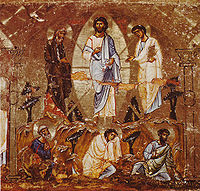
transfigurationThe glory of God revealed on Mount Tabor is dazzling. It is rightly seen as a vision of the glory of the created universe in all its materiality as well as a vision of the glory of the resurrected life. The presence of Moses and Elijah, representing Torah and the prophets, adds the weight of Jewish history to the moment and the voice from Heaven proclaiming Jesus as the beloved son entwines itself into this glory. But this turns out to be a strange glory as the world understands glory.

Moses was hounded out of Egypt after killing the Egyptian who was oppressing a fellow Jew and then was the object of threatened violence several times from the people he liberated from Egypt. Elijah was a persecuted prophet who lived only because he fled the wrath of Ahab and Jezebel. God proclaimed the king to be God’s son in in whom God delighted in Psalm two where the nations raged against each other and the other kings rose up against God and God’s anointed, i.e. the beloved son. The servant in Isaiah was declared God’s son in whom God delighted and this same servant was despised and rejected by his own people and “cut off from the land of the living.”

On the way down from the mountain, Jesus tells the disciples who came with him not to tell anyone until the “Son of Man” is raised from the dead. The disciples remind Jesus that it was believed that Elijah should come first. Jesus then says that Elijah has already come and people did to him “whatever they pleased,” something Herod saw to.

Jesus is reminding his disciples, and us, that death through collective violence is an old story that has been enacted since Abel to John the Baptist as a current event, and it is a story that is going to continue on in the lives of the apostles and on into our lives as well. It is through following Jesus who followed the prophets before him that we enter the glory of the transfigured life of the created world which explodes into the glory of the resurrected life filled with God’s love for those who do whatever they please with God’s beloved children.

Blueprint of the Kingdom

buddingTree1The blueprints for a building are a lot less exciting and interesting than the building itself. However, blueprints are useful for showing the fundamental shape and structure of the building at a glance. The readings for Epiphany 3A are more like a blueprint for the Kingdom of God than a tour of the Kingdom in its fleshed-out form.

In Mt. 4:17, Jesus says:  “Repent, for the kingdom of heaven has come near.” Repenting does not mean to make a laundry list of our little sins and try to stop doing them. Repenting means to turn around, to switch our minds and our hearts, to see life in a new way. This is the fundamental thrust of the Kingdom. But what specs can we get from the blueprint?

The quote from Isaiah, especially the part about Zebulun and Naphtali may not seem exciting but they show some important shapes in the blueprint. These places in Galilee are Gentile territory, lands of the enemies of Israel, lands that were occupied by the Assyrians in their invasion of Israel. The darkness has to do with the power and might of military occupation and enmity between peoples. Isaiah’s saying that God broke the rod of the oppressor as on the day of Midian suggests that God’s Kingdom will free us from military force that inevitably creates darkness. Reconciliation with the Gentiles involves forgiveness for past wrongs, even past atrocities such as those committed by the Assyrians and then the Romans in Jesus’ day. Matthew notes that Jesus moved to this area of Galilee after Herod’s arrest of John the Baptist, another instance of Roman oppression. One might feel this is not applicable to most of us because most of us are not high government officials or military leaders. However, all of us live either in a country bursting with military might or in a country that is in some way, perhaps economically, occupied by another. That means we need to turn away from anything that contributes to the enmity this situation creates and start breaking the yokes we impose on each other.

In First Corinthians, Paul gives us another example of darkness that is very close to everyday life for all of us. The church is in conflict with its members using slogans such as: “I belong to Apollos!” “I belong to Cephas!” One could say that this is war on a small scale but the darkness is the same as that created by the Assyrians and the Romans. Paul suggests that the light of the kingdom which Jesus is bringing near is to be “united in the same mind and the same purpose,” which for Paul is the mind of Christ, whose cross is foolishness for those who are perishing in the darkness of violence but is the power of God for those being saved.

The “power of God” doesn’t look much like power as we usually understand it. It isn’t exactly a large-scale military invasion like D-Day. In fact, it is quite the opposite. But the cross is power in the sense of shedding light in the darkness which John says the darkness cannot overcome. The light reveals the darkness of the military might of the Assyrians, the Romans and all else who imitate them. The light also reveals the hatred of victims for their oppressors, however understandable, for what it is: a wall of enmity that perpetuates divisions between people. As I struggle with my almost constant anger at many politicians in this country for their misuse of power and the public trust, I have to repent of this anger minute by minute.

Where does this darkness come from? Isaiah and Matthew are not portraying darkness as part of the created order in the sense that night time is natural. This is not darkness that God made, or in fact had anything to do with. This is darkness as a human creation. It is human beings who organize armies to oppress people or who tear congregations apart with petty party politics. This sort of behavior is highly contagious. The more people build walls or fight, the more people feel the need to build walls and fight.

What does the Kingdom of God, founded on the foolishness of the cross look like? The blueprint we have in these readings doesn’t look like much, but then a crucified criminal in Roman times doesn’t look like much either. When we read just a bit further in Matthew, we enter the real-life rooms of the Kingdom outlined in the blueprint. We find many rooms, many mansions, all of which offer contagious possibilities such as being blessed for being poor or for being a peacemaker, or turning the other cheek or walking the extra mile, and then finding in these weaknesses the rock that supports the house of faith we are building against the storm of Rome and Assyria and the power brokers of our time.

Bewitched, Bothered, and Repentant

???????????????????????????????????????????The persecution of so-called witches in Salem Massachusetts in 1693 is well-known as a notorious event in American history. Not so well-known is the spiritual journey of one of the judges on the panel that ordered the execution of the twenty convicted prisoners. The biography of him by Eve Laplante is not a particularly good book with its chronological skips and copious details that are of not great interest, but she does bring the remarkable land telling story to light.

Samuel Sewall was a good and generous and devout man. Bracket out his voting for the twenty executions and one finds nothing reprehensible about him and much to commend. What happened?

The type of Calvinistic spirituality in colonial Boston posited a God of boundless mercy but a god who could just as quickly break out in wrath. When several of his children died in infancy, Sewall wondered what he had done to deserve this grief. When the English government revoked the colonial charter and  then French and Indians attacked and destroyed coastal cities to the north, he wondered what the community had done to deserve these calamities.

Laplante describes Salem Village as “beset with squabbles” where “neighbor battled neighbor over land boundaries, crops, and grazing rights.” Moreover, the congregation habitually battled with successive ministers over due compensation for their work. Not surprisingly, the witchcraft accusations started in the home of the incumbent minister, Samuel Parris. Many of those accused were involved in the various ongoing disputes and many of the accusers were servant girls suddenly empowered to get back at those who were normally their social betters.

Samuel Sewall, accepting the social advancement that came with the appointment to the panel of judges, was among those trying the cases. All of those condemned were convicted on what was called “spectral evidence.” This was the phenomenon of one or more witnesses seeing a spectral image of the accused person committing foul deeds of the devil. There can be no more powerful image for the mirage thrown up by what René Girard calls the skandalon, the stumbling block. One’s rival has been transformed into a spectral image of wickedness.

In the days of the primitive sacred, according to Girard, one death was enough to reconcile a community. In Salem, twenty deaths and counting wasn’t nearly enough. Girard leads us to expect this to be the case in the wake of the Gospel’s unveiling of the truth of collective violence. There are two fundamental reasons the witch trials ceased and the remaining prisoners were all freed. 1) There was never any unanimity that the witches were guilty. One judge had resigned early on in protest. Sewall’s own minister at Third Church was among the clergy who opposed the persecutions. 2) There was no end in sight if the persecutions continued. Anyone at all could be accused regardless of social position.

Although Sewall kept a thorough diary of events and thoughts, the months during these witch trials are surprisingly and dismayingly empty. This is a huge disappointment for one who would like more insight into Sewall’s reflections at the time, but the empty pages speak volumes that no amount of words could tell. Sewall could not face what he was doing.

There are some hints as to what lead to Sewall’s public declaration of guilt and remorse during worship at Third Church. Sewall had been publically snubbed by his minister on more than one occasion. That probably made him think. During a family funeral service for yet another dead child, his eldest son read from Matthew the verse that includes: “”I will have mercy and not sacrifice,” a key verse for the unequivocal love of God and total rejection of persecutory violence.

Through this sobering experience, Sewall went on to show insight into two major issues way beyond that of almost all of his contemporaries. 1) In spite of the Indian attacks that had been the scourge of the colony, Sewall wrote of the inherent dignity of native Americans as worthy of salvation on an equal footing with his own race. 2) Sewall wrote the first anti-slavery treatise composed on North American soil, using the story of Joseph as his proof-text.

Like St. Paul, Samuel Sewall learned some things about victimization from being a persecutor. We can all learn from the man who stood in the midst of his congregation with his head bowed while his minister read his confession.

Human Swords, God’s Peace

vocationersAtTable1Jesus’ words that he came not to bring peace but a sword (Matthew) or division (Luke) are startling, coming from a man who is commonly referred to as “the Prince of Peace.” Does this mean that Jesus is a war-god of some sort after all? Since Jesus never used a sword and rebuked Peter from using one at Gethsemane, and died rather than call on legions of angels to defend him and beat up his enemies, and approached his disciples and even the persecutor Paul with forgiveness after rising from the dead, it is fair to assume that Jesus is not in the least encouraging swords and divisions, but is warning us that we will have both as long as we experience the world in terms of us vs. them.

The approach to scripture inspired by René Girard and colleagues such as Raymund Schwager and James Alison is strongly committed to an unequivocally loving God who seeks only peace as opposed to any two-faced Janus-like deity who is capriciously loving one moment and wrathful the next. This approach tends to interpret “wrath” associated with God as human projections that distort the truth of God’s unconditional love. Basic to Girard’s thinking is the conviction that humans tend to unify conflictive societies through scapegoating vulnerable victims with collective violence. Society has regained peace—for a time—but at a cost to at least one person. This sort of a peace simply has to be disrupted once and for all by a God who is unequivocally loving and who wishes that not even one person be lost. According to Girard, this is precisely what Jesus did by dying on the cross and exposing the reality of collective violence for what it is.

As a result, we now have a world where there is an ever heightening awareness of victims, but a serious lack of anywhere near a corresponding awareness of the need for forgiveness. Without forgiveness, awareness of victims increases resentment and escalated conflict. Since the awareness of victims does not allow collective violence to bring peace to a society, there is nothing to stop the escalation of violence. As resentment grows rampant, it infects every level of society including the family so that family counselors are in great demand to try and talk people into giving up their resentment against those closest to them. They often fail as much as conflict mediators in political hotspots and for the same reason. Resentment becomes a defining factor of many lives and defining factors are not easily given up. So it is that the coming of Jesus the forgiving victim has brought swords and divisions.

The offer of peace and forgiveness, for all of the divine love behind it, inevitably causes division between those who accept it and those who don’t. There are two possible reactions to such a choice and a unanimous conversion to God’s peace wasn’t in the cards then any more than it is today. (Of course we humans stack the deck heavily against peace.) For those of us who seriously try to choose peace, it is tempting to think we are on the “peaceful” side of this division but we need to realize that the Word, the forgiving victim, is a divisive two-edged sword “piercing to the division of soul and spirit” and “discerning the thoughts and intentions of the heart” as the author of Hebrews puts it. That is, the pure forgiveness of the divine victim shows up the least bit of resentment we allow ourselves to harbor in the farthest, darkest, corners of our souls.

The escalation of violence occurring right at the time of this writing is a sure cause of discouragement. What we can do is take hope, primarily for ourselves, but also for our personal relationships and for humanity as a whole that the offer of peace from the forgiving victim remains open to all of us at every time of day and night and this offer will never end no matter what we do with our swords and divisions.

How Are We Saved?

yellowTulips1The New Testament and two thousand years of Christian preaching has consistently proclaimed that the death and resurrection of Jesus Christ has opened the way of salvation for all humanity. Precisely how this mysterious, earthshaking event has done that   has raised more questions than answers. It is understandable that the focus would tend to be on the death of Jesus since the event is so dramatic and creates intense emotional effects in Jesus’ followers. However, understandings of the atonement of Jesus through this route have raised long-standing problems that cry out for a fresh approach. The growing realization that the killing of Jesus was just plain wrong on the part of many Christians, and not just those influenced by the thought of René Girard,  opens a way for a re-thinking of atonement theology that can support a deep spirituality grounded in God’s unconditional love for all people. As article I wrote for the Abbey Letter Saved By the Life of Jesus contributes to this re-thinking that actually reclaims the Gospel for us. It is included in the collection of articles in Come Let Us Adore. You can read it here.