
Jesus’ Yoke

eucharist1Jesus’ invitation to come to him with our burdens so that he can give us rest and take his easy yoke upon ourselves sounds like an irresistible blessing. But the troubling words skipped by the lectionary suggest that Jesus’ offer is highly resistible. Here, he bemoans the rejection of Chorazin, Bethsaida and Capernaum. Given the horrifying hardness of heart shown in the story of Sodom and Gomorrah’s destruction, it boggles the mind that Jesus thought those people might have responded better than the people of Capernaum who witnessed Jesus’ first miracles of healing.

How can Jesus’ offer to free us of our burdens be so resistible? We get some hint of this in the powerful, if dense, passage in Romans 7 where Paul cries out against the burden of sin that makes him do what he does not want to do. Most of us think the problem is that the burden of sin renders us powerless. There is something to that, especially in the case of addictions. But the deeper problem is that we have great difficulty knowing what we really desire. The French thinker René Girard has helped us greatly towards an understanding of this problem with his insight into what he called “mimetic desire.” That is, although we tend to be addicted to the illusion that our desires originate from within ourselves, Girard suggests that our desires originate from without: i.e. from other people. That is, we copy the desires of other people. Since the same is true of other people, they are imitating our desires as much as we are imitating theirs. No wonder desires are so complicated. It is telling that Paul says: “I would not have known what it is to covet if the law had not said, ‘You shall not covet.’” (Rom. 7: 7) Covetousness is precisely the sin most driven by mimetic desire. This phenomenon can lead to a spiral of desire that reinforces each others’ desires in love. This is what Jesus us getting at in offering to relieve us of our burdens and take his yoke upon us. But usually, we imitate each other in a downward spiral of rivalry, anger, and vengeance. In this spiral, we become more and more convinced that our anger and rage are our own even as the rage and anger of others overtakes us like a flood. When this happens, we are yoked to our rivals and they to us. This is the yoke Jesus would relieve us of.

Girard argues that a society caught in a downward spiral either implodes into mutually assured destruction (MAD) or channels its common rage against a victim who is scapegoated. The latter is the story told in the four Gospels. However, it is not only the story of the Gospels; it is the story told numerous times in the Hebrew Bible starting with the dawn of humanity. The establishment of violence as the engine of society is what Jesus was getting at when he said, in another verse not included in the lectionary: “From the days of John the Baptist until now the kingdom of heaven has suffered violence and the violent take it by force.” (Mt. 11: 12)

Although we are prone to clinging to the illusion of our individuality, Girard has shown us that we are yoked to others through the matrix of our intertwining desires. Where we can take some responsibility for our lives is to choose how we wish to be yoked and to whom we will be yoked. In rabbinic literature, the yoke is used as an image for a Jewish student’s relationship with his or her rabbi. Jesus, as a rabbi, offers such a yoke. Being yoked to Jesus means being yoked to a Messiah who rides on a donkey in fulfillment of Zechariah’s prophecy. The Greek word translated as “gentle” is praus, the same word used in Matthew’s quote from Zechariah to describe Jesus’ entry into Jerusalem.

Jesus’ yoke may be easy but it is challenging. The temptation to give way to fear, anger, and vengeance, especially when that is all around us, is very strong, but the yoke of vengeful anger is very heavy and it entraps us in the power of sin within us that prevents us from doing what we really want to do. Escaping this trap can seem impossible. As Paul discovered, it is impossible without the grace of Christ who offers us his yoke in place of the yoke of sin. The harsh words against Capernaum and neighboring towns actually offer us hope. If Jesus could envision the possibility of Sodom and Gomorrah converting to Jesus’ yoke if they had seen the wonders done at Capernaum, although the people in these towns united to persecute Lot and his guests, surely Jesus can envision the same for our persecutory society. Can we cast the burdens of fear, anger, and vengeance on Jesus and accept the yoke he offers us, a yoke that burdens us with compassion and love?

[For an introduction to René Girard see Violence and the Kingdom of God.]
On Following the God of All Victims

WilliamGuestsChurch1In our readings for today, we celebrate the Week of Christian Unity with the short narrative of Jesus calling his first disciples (Mt. 4: 18–22) and Paul’s rebuke to the Corinthians for their discord and divisiveness (1 Cor. 1: 11–13). The light in the darkness proclaimed by Isaiah (Is. 9: 2) shines brightly on the first scenario but is much obscured in the second.

The situation in Corinth is aptly described by René Girard’s term “mimetic rivalry.” That is, the rivals are mirror images of each other. It is significant that Paul does not mention any issues of disagreement, even though we know from other sources that he had issues with Cephas (Peter.) Girard has taught us that when mimetic rivalry escalates, the issues fall away and we get the chaos of rivalry for the sake of rivalry. Girard goes on to suggest that in ancient societies this chaotic rivalry repeatedly resolved itself through suddenly focusing on one victim who was put to death. Peace, for a time, followed this atrocity. Girard goes on to aver that when this same scenario was committed against Jesus of Nazareth, the truth of this collective violence was unveiled to the extent that it could never again create peace, not even for a time, as it did before. Through Christ, God has presented us with the challenge of either renouncing our participation in chaotic mimetic rivalry or participating in the total destruction of civilization. [For an introduction to René Girard see Violence and the Kingdom of God.]

When we look at the scenario in Corinth denounced in Paul, a scenario we can all recognize in our families, social groups, work places, charity organizations, and even (sometimes especially!) in our parish churches, it appears that Christianity has failed. Actually, the situation is more complicated than that. A big part of the problem is that Christianity has succeeded too well. Or perhaps we should say Christianity has succeeded in a way that threatens to make the situation worse and more dangerous.

The unveiling of collective violence by the Cross has led to an ever-accelerating increase in sympathy for victims. We see this early in Christianity through the charitable work to relieve poverty and disease with hospitals being one of the great Christian inventions. We fret, quite rightly, about serious problems with racism in contemporary America but we do well to remember that racism has been practiced by all people of all times and places and it is only in places where the Gospel has had an influence that anybody has seen racism as a problem and acted on that perception.

While to be a victim was such an unmitigated disgrace in the ancient world that one would do anything to avoid that stigma, preferably by victimizing somebody else, to be a victim has become a badge of honor. This is indeed a badge of honor for people like those who generously risked their well-being and lives during the Civil Rights Movement in the 1960’s, but it looks like shameless exploitation of real victims by those who feel victimized when called to account for injustices and crimes inflicted on others.

This division between real victims and imposters, a division that is often far from clear, is not the problem of division that concerns me during the Week of Christian Unity. The deeper problem is what I am inclined to call a chaos of victims. We have today a plethora of real, legitimate victims, even if the plight of some might seem more urgent than others. Here is the rub. Not only do we have the social chaos of those who continue to victimize others through brute force such as rape or economic exploitation, and the social chaos of many who just don’t care, we have the social chaos of advocates for victims and victims trying to ameliorate their own circumstances. Put in a nutshell: we have a chaos of mimetic rivalry between the favorite victims of some advocates against the favorite victims of other advocates. Here is the heart of the most serious divisions within Christianity in our time. This is not a chaos of those wanting or willing to hurt others; this is a chaos among those who willingly sacrifice themselves for the benefit of others.

In such a situation, it is inevitable that those of us concerned with the vulnerable and the helpless will be more sensitive to some victims more than others. This increased sensitivity to some victims can look like indifference to others and can become downright hostile in situations where equal advocacy between causes is difficult and sometimes impossible.

I am not saying this from outside the fray. I am very much inside it, very much involved in all the mimetic issues I am describing. I know that I respond to the needs of some victims more than others. The complexity of this tension among those of us who wish to help others is enough to lead to despair but we have a light in the darkness in the calling of Jesus to follow Him. Jesus is not a Messiah divided among many victims and their advocates; Jesus is a Messiah for all victims and their advocates. It is surely this call and not any intellectual or moral perspicacity of my part that makes it possible for me to even define this problem as I have. The call to discipleship is a call for repentance on many levels, ranging from our moral own violence and lassitude to the rivalry for the sake of rivalry such as at Corinth, to our rivalry over the causes of real victims. It is this very complexity that requires us to seek a conversion of society and not just our individual selves. Here is where I see the biggest challenge to Christian unity.

Sharing God’s Riches

creche1-copyLike every culture, the Jews had to face fundamental decisions as to how open or closed they would be to others. The default mechanism tends to be flight or fight. In discussing remaining social groups living close to the level of what he calls “traditional” societies, Jared Diamond observed this phenomenon. A stranger wandering into the territory of a different tribe had better come up with a common ancestor or the encounter could prove fatal.
The type of encounters with other nations has an effect on such decisions. In the case of the Jews, most encounters were bad. Slavery in Egypt was followed by both cultural and military threats from the Canaanites who tempted the Jews to forsake the God who had delivered them from Egypt. Encounters with the Assyrians and Babylonians were catastrophic. But then the Persians destroyed the Babylonian Empire and invited the Jews to return to their homeland and revive their cultural and religious traditions. It is surely no accident that the return from Babylonian exile and resettlement back in their homeland coincided with the first expressions of openness to other cultures on the part of the Jews such as we have when Isaiah proclaims: “Nations shall come to your light, and kings to the brightness of your dawn.” (Is. 60:3) With Isaiah, we have the breakthrough insight that the God who brought them out of Egypt and then delivered them from Babylon was the God for all people and not just them. Although Adam Smith took the title of his famous book The Wealth of Nations from Isaiah 60:5: “the wealth of the nations shall come to you,” the prophet encourages a much more profound exchange than that of capital: an exchange of the riches of the Jews’ religious tradition for the riches other nations can bring to that same tradition. Unfortunately, retrenchment followed, climaxed by the expulsion of all foreign wives at about the time of the building of the second temple.

At the time of Jesus’ birth, the relationship between the Jews and the Gentiles, the other nations, was complex and tense. Their religious traditions were mostly tolerated but at times menaced by the Romans. Although some individual Gentiles became God-fearers, practicers of Jewish piety such as the Centurion who built the synagogue at Capernaum, (Lk. 7: 4-5) there were few friendly relations between Jews and Gentiles. And yet in the face of this tension, Matthew sees in the visit of the Magi to the infant Jesus a fulfillment of Isaiah’s prophecy of the exchange of wealth between the two peoples.

It was for St. Paul to return the gifts to the Magi. After his dramatic conversion, he was called to preach the Good News of Jesus, a Jew, to the Gentiles. To the surprise of many Jews who followed Jesus, “the Gentiles have become fellow heirs, members of the same body, and sharers in the promise in Christ Jesus through the gospel.” (Eph. 3: 6) That is, Jesus dissolved the fundamental division between Jew and Gentile when he was crucified by a collaboration between the two peoples who had suddenly come together for that brief moment. But when Jesus was raised from the dead as the forgiving victim, he bridged the gap between nations with one comprehensive act of forgiveness.

Ever since Paul’s commission, the Church has been tempted to retrench herself as the Jews did after building the second temple. This is to fall back into the default hostility to the stranger that Jared Diamond saw as part of “traditional” humanity. What the feast of Epiphany celebrates is the generosity of God who shares God’s riches with all so that all people can share this same richness with all others, not least with strangers who can then soon cease to be strangers.

On Welcoming a Thief in the Night

crucifix1A thief is not usually thought of as a good type of person and a thief in the night is worse. And yet Jesus characterizes himself as a thief when he says: “if the owner of the house had known in what part of the night the thief was coming, he would have stayed awake and would not have let his house be broken into.” (Mt. 24: 43) The expression that God will come like “a thief in the night” also comes up in 1 Thessalonians 5:2 and 2 Peter 3:10. Since Jesus commends the dishonest steward who defrauds the master who is firing him and the unjust judge who gives the widow a fair hearing just to stop her from pestering him, it seems that Jesus has a soft spot in his heart for rogues. Maybe he was a bit of a trickster rogue himself.
But surely it isn’t good to be a thief is it? A thief is someone who takes what belongs to somebody else for personal gain at the expense of the thief’s victim. That is not good. However, before we get too self-righteous about other people who are thieves, we should pause to take note that one can steal the reputations of other people through misrepresentation and downright lying. Worse, we can steal the dignity of other people by treating them with disrespect. With these considerations, we begin to see that thieves aren’t just other people.

The context of this verse in Matthew strengthens this uncomfortable realization. Jesus refers to the Flood of Noah’s time, noting that people were going about their business as if nothing was wrong. But Genesis says that the whole society had become a flood of violence that was sweeping everybody away. The implication is that the society of Jesus’ time was likewise being swept away in a flood of violence while most people thought things were just going along normally. And what about our own time? We go about our business while reputations and human dignity are being stolen right and left by both right and left. All of us have become thieves and we will never get out of this social flood until we realize this truth.

So, is Jesus a good thief while the rest of us are bad thieves? Let’s take a look at how Jesus acts like a thief in the night. Does Jesus steal our things for personal gain? Jesus does steal everything we have but he does not steal our things for his personal gain but for our personal gain. More important, Jesus steals everything in us and about us that destroys our relationships with other people and God. That is, Jesus steals our thieving ways that we are so attached to. How else can we feel good about ourselves if we can’t steal the reputations and dignity of other people? But while a human thief leaves nothing for the thief’s victim, Jesus gives us the full richness of God, the richness bestowed on humankind at the dawn of creation.

How can we be ready for a thief like this? St. Paul tells us to “live honorably as in the day” by giving up “quarreling and jealousy.” Then, “put on the Lord Jesus Christ.” (Rom. 13: 13–14) Then, as Isaiah teaches us: beat our “swords into plowshares” and our “spears into pruning hooks.” (Is. 2: 4) Then we won’t have so much thievery and violence for Jesus to take away from us when he sneaks into our lives.

Luke tells us of a thief who became good because he repented and, in so repenting, realized that Jesus had been unjustly swept away by society’s violence. Will we choose to repent and become good thieves?

In Exile with Jesus

Flight_into_EgyptIn his book Banished Messiah, Robert Beck argues that Matthew frames his Gospel narrative of Jesus as a story of exile and return. With the two passages from early in Matthew’s Gospel, we can see where Beck got this idea. Before he is old enough to know what is going on, Jesus has been exiled twice. First to Egypt to escape the slaughter Herod intended for him, and then to the backwater up at Nazareth where, according to Nathaniel, nothing good could come. All this after Jesus had been born in Bethlehem, the city of David, close to Jerusalem where the action was. Not until the end of his life does Matthew have Jesus reach Jerusalem where he enters as the rightful king who is unjustly put to death.

Exile is how Empire sustains itself. The Jews knew this only too well as their exile to Babylon was one of their most formative experiences as a people. It was during their exile that the Jews came to understand fundamentally how Empire and its pagan religion operates and it was through this learning that the Jews began to really understand who really rules the world and has done so since the time of creation.

Jeremiah’s oracle that God was going to “ransom Jacob” and “redeem him from hands too strong for him” are as stirring as similar oracles of return in Second Isaiah, but Jeremiah’s oracles are all the more remarkable because he made them when he was just about out the door on his way to exile in Egypt as the Babylonians took over Jerusalem.  More remarkable yet, Jeremiah had redeemed a piece of family property just before the axe fell on his people.

Exile, then, is the condition of the powerless, the one rejected by Empire. Exile is the fate most of us fight against tooth and nail starting with our earliest socialization as children. We want to be in an in group, not an out group. We want to be at the center of power, not the periphery. And yet the periphery was where Jesus found himself by the time he was old enough to find himself. The Empire knew it could not welcome Jesus and Jesus knew that just as well.

All of this suggests that if we want to be where the action is, we’ll miss out on the real action. The real action may not seem very exciting: growing up as a human being in a backwater somewhere, where nothing good can come. And yet it is by growing up with Jesus, away from the centers of power, that we come to learn of what is important in life. We learn to value other people as people, not for what power that can broker for us. Here is where we find the lost coin, the lost sheep, the lost everything else, including what has been lost within each of us until we find Jesus where nobody else is looking.

On Gathering with Those who Keep Oil in their Lamps

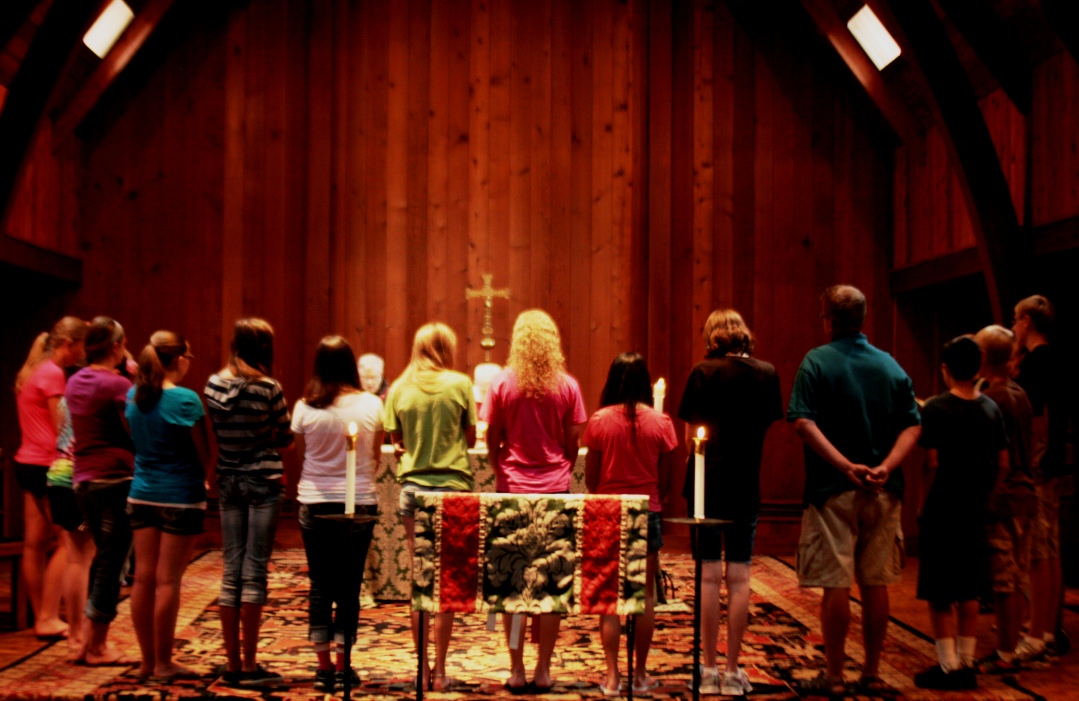
eucharist1Like many parables, the Parable of the Wise and Foolish Maidens is obvious and yet puzzling in some respects. The notion of forfeiting eternal life for failing to be prepared at a certain level is oppressive, but we can lift this degree of oppression by noting that the Kingdom of God is something we are supposed to be living NOW, in this life. This is what we are to be prepared for. If we are prepared NOW for the kingdom, entering more deeply into the Kingdom when we die will take care of itself.

It is worth noting that just before this parable, Jesus has thrown out the parable of the household where the wicked servant beats his fellow servants and gets drunk with the drunkards. Here we have an image of the violence humanity commits and suffers for not being alert to God’s Kingdom. Ironically, the wicked servant thinks the Master is delayed when the Master is already there in the servants he is beating. In contrast, the Foolish Maidens do not commit violence, but they fail to do anything that would stand up to violence such as that of the wicked servant.

I also think it significant that the parable is about two groups of maidens rather than just two maidens. As one who uses the thought of René Girard as a tool for interpreting scripture, I am inclined to interpret this parable in turns of contrasting human groups, each governed by a collective desire they share within that group. The wise maidens who have extra oil for their lamps are a community whose members encourage one another so as to keep their lamps burning. When they care about the Bridegroom and those the Bridegroom identifies with, their lamps burn yet more. I know how valuable it is to live in a community of men who all encourage me to remain ardent in prayer and kindness to those who come here, which makes it easier for me to encourage them in turn. The Foolish Maidens are quite the opposite. Here is a community, if one even wants to call it that, where the members encourage each other to remain apathetic and so strengthen apathy among themselves. Apathy is just as contagious as ardor, if not more so. When the people around us act (or fail to act) out of apathy, our own lamps are sure to burn lower and lower and eventually go out.

When the Wise Maidens say there is not enough oil to share when the Bridegroom comes, they are wrong in one respect. The strengthening of ardor among themselves could easily catch the foolish Maidens into its burning. The problem is that it is very difficult to extricate oneself from a group whose process has a strong grip on us and it is even much more difficult yet to change a whole group around all at once. Not even with the best will in the world could the Wise Maidens have enough oil burning to do that. The Foolish Maidens are like the drunkards in the previous parable who let the wicked servant beat the other servants and then drink with him. The Wise Maidens have the strength to stand up to the violence and witness to a nonviolent way of living. The Foolish Maidens may not be violent themselves, but they will be swept away by violence when it comes. We really do have to pay attention to the company we keep and how we keep it. The Wise Maidens do need to find ways to reach out to their Foolish sisters without getting caught in their apathy.

Finding themselves flatfooted when they realize the Bridegroom is here, the Foolish Maidens compound their foolishness by running off to the store in the middle of the night. With some stores open 24/7 these days, this act isn’t quite as irrational now as it was then but it is irrational enough. What they are doing is running away from the Maidens who have their lamps lit and away from the Bridegroom. They would have better off to stay with the Wise Maidens and the Bridegroom. It may have been humiliating to have empty unlit lamps but the Bridegroom is the one who lights the lamps of those who hold them out. They also would have been in a position to start catching the ardor of the Wise Maidens. By running off, they get plenty of oil but they have missed the chance to encounter the Bridegroom and those the Bridegroom identifies with. All of this is a perfect image of the kind of crowd panic in reaction to a problem that ensures that it only gets worse.The foolish maidens will almost certainly just let the oil run out all over again.

As with the wicked servant who thought the Master was delayed, the Maidens think the Bridegroom is delayed. The truth is that the Bridegroom is always already HERE. We can turn to the Bridegroom in love at any time and we can respond to the least of those the Bridegroom identifies with at any time they show up. THIS is what we have to be alert to and prepared for. There is lasting damage to being unprepared through apathy for the Bridegroom’s presence. I’m sure all of us can think of opportunities that we squandered and there is now no way to go back and make them good. The Forgiving Victim will still redeem all of us, but the diminishment and needless pain we have allowed always remains. Let these memories that we regret motivate us to stay close to the Bridegroom who lights our lamps in the company of others who will encourage us to keep our lamps lit.

Celebrating the Saints in our Lives

GuestsoutsideAll Saints is a feast for all of us. Does this mean we are all sanctified in the sense of perfected in Christ? No, but it is a feast that celebrates the true glimpses of Christ that others have given us. What does Christ look like in the actions and bearing of those people who have had an effect on us?

The Beatitudes in Matthew give us a sense of direction and a daunting one at that. Hungering and thirsting for righteousness, being merciful and making peace are clear signs of sanctity in the sense of imaging Christ who was and is all of the above. But what about meekness? What is so holy about that? In this context, meekness seems not to be about obsequiousness, which is not holy, but about being out of the loop of the power brokers. Being poor goes with meekness in this respect. Being poor and meek does not guarantee that one will image Christ and it is important not to trash the movers and shakers out of resentment. Jesus did not resent the young rich man’s wealth; he felt sorry for the guy because that wealth prevented him from becoming a follower. By adding the phrase “in spirit” to being poor, Matthew gives us a loophole that Luke’s version doesn’t. A rich and powerful person can be a saint if that person is willing to be a peace maker and merciful and to thirst after righteousness.

Being pure of heart so as to see God is an inner virtue. In his Epistle, John says that “what we will be has not yet been revealed” but when it is revealed, “we will be like [God], because we will see him as he really is.” (1 Jn. 3: 2) One of the fundamental things that purity of heart means is being empty of self so as to give room for God. This is a big part of what being “poor in spirit” is all about. The more we see God, the more visible God will be to others who see us.

Being persecuted and hated and reviled on Jesus’ account is not something that we normally think of as a blessing, but if we thirst for righteousness, we will prefer to be vilified than to be praised for betraying our principles. Making peace, or trying to, is a good way to make enemies. The poor and meek are targets for persecution because they are vulnerable. In Revelation, John the Divine assures us that when we come through such ordeals, we will be given white robes and will be among the pure in heart celebrating before the Lamb who was slain. (Rev. 7: 14)

Many have suffered badly at the hands of people in the Church. Many of those who came through “the ordeal” suffered it not from pagans but from fellow Christians. Such suffering that amounts to scandal can make some of us think there are no saints in the church. Elijah thought he was the only faithful person left in Israel until God told him of seven thousand prophets who had not bent their knee before Baal. Likewise, the uncountable multitude of people from all tribes, languages and nations shows us that there have been and are many saints than we sometimes think.

In my own life, four such come to mind most prominently. During my college years, my parents transferred to an Episcopal Church they thought would be more responsive to our pastoral needs than the one we left. It was. I visited the rector of this church every time I came home for vacation. He listened generously to everything I said although much of what I said was outrageous. His kind listening made it easier for me to see through my silliness than if he had called me out on it. Meanwhile, at college, I had a religion professor who not only taught me how to think theologically, but was a model of gentle listening and gentle prodding to nudge me in better directions of thinking. At the abbey, I was nurtured by a novice master who was one of the most self-effacing people I have ever known, self-effacing to a fault that some people take advantage of. He gently provided the space for me to grow as a monk. During a tough time at the abbey, we had an oblate who was like a grandmother to many of us. She couldn’t solve any of our problems but she could listen and encourage us and strengthen us to seek constructive solutions. None of these people cared about making waves in the world; they were content to be themselves. Let us celebrate this feast by remembering the saints that the “world” may not know about but we do.

King’s Banquet — God’s Banquet

wineTableFeast1The parable of the Wedding Banquet has often been understood as illustrating God’s offer of salvation that some people reject and so miss out on the fun. That understanding seems to work in Luke’s version but it doesn’t work out so well in Matthew’s. Here, the king’s invitation is met with violence which the king reciprocates with interest and then he bounces a man who isn’t dressed properly and has him thrown out into outer darkness. The severe dissonance of these details inclines me to consider alternate interpretations of this parable.

Marty Aiken has written a detailed paper arguing for just such an alternative understanding. (See “The Kingdom of Heaven Suffers Violence: Discerning the Suffering Servant in the Parable of the Wedding Banquet.” He argues that Jesus’ listeners would have immediately thought of King Herod when they heard the parable. The king in the parable certainly acts like Herod. These listeners would have remembered Herod bringing an army to Jerusalem and asking the people to accept him as king. If the offer was accepted, Herod would have consummated the deal by marrying the granddaughter of the high priest Hyrcanus. There’s our wedding feast. The people of Jerusalem turned down the offer. Herod withdrew but then came back with his army and stormed the walls without stopping to negotiate. Antigonus, a descendent of the royal family, gave himself up to quell a violent situation. He was carried off in chains and beheaded by the Romans to give him a particularly humiliating death.

With this background in mind, we can see the guests who “made light of” the invitation as representing those who went home when Herod came calling and hoped everything would blow over and they could get on with business as usual. The other invited guests represent those who resisted Herod with violence. Both groups of guests are met with violent reprisals from the king in the parable. The rounding up of guests to replace the first lot is not, then, an act of charity for the poor but a forced gathering of whoever the king’s slaves could find.

With this interpretation, the cryptic scene of the man without a proper wedding garment makes sense as being the second part of the same parable and not a separate parable tacked on to this one. The king seems to be looking for a victim and he finds one handy, one who stands out by his attire. Like most kings, this one knows that the quickest way to unite a people is to focus on a victim. Moreover, this guest seems to be what we might call a nonviolent protestor, which obviously is threatening to the king. This guest’s eerie silence suggests Jesus’ silence before Pilate which Matthew emphasizes. Aiken points out that grammatically, the king could have been the speechless one, which would refer to Isaiah 52: 15 which says that kings will “shut their mouths” because of the suffering Servant. The fate of this guest is the fate Jesus himself suffers which had already been the fate of Antigonus. The Kingdom of Heaven, then, is not the banquet but the place of the victim who is cast out. Aiken recalls Jesus words in Mt. 11: 12, that up to this time, the kingdom has “suffered violence.” And so it does.

All of this is disappointing for those of us who are edified by the idea that God throws a heavenly Banquet and invites all of us to it. I find this image appealing and I don’t want to give it up. We don’t need to. The theme of what scholars call “the Messianic Banquet” is very real. The reading from Isaiah 25 is one example but treading the Moabites down into the dung pit smacks of Herod more than God. The invitation to the banquet in Isaiah 55 is much more positive and clearly is extended to everybody, presumably even the poor Moabites.

The real image of the Messianic Banquet in the Gospels is the feeding of the five thousand and four thousand in the wilderness. Here is a generous feeding to all comers with no reprisals for anybody who happened to stay away. No political force is exerted in the invitation. Nobody gets thrown out for being badly dressed. The poor are not afterthoughts, invited only the replace ungrateful aristocrats. The poor as well as the rich are all invited right from the start. The banquet offered by Jesus in the wilderness, away from the centers of worldly power, shows up the king’s banquet in the parable for what it is. Instead of an offer we cannot refuse, we are given an offer that we do not wish to refuse. This really is a cause for rejoicing always in the Lord, as St. Paul admonishes us.

Binding and Loosing

AndrewPreaching1How many of us listen to Jesus’ words about correcting fellow members of the church and think they are about punishing people and casting them out? (Mt. 18:15-20) Checking ourselves for such reactions is a good way of taking note how instinctive punishing and excluding are to us and how less instinctive is forgiving and including and welcoming others. It is precisely this instinct to punish that makes it difficult to have ears to hear what Jesus is saying and hear what the Spirit is saying to the churches.

If we take a step back and ask ourselves what our instinctive reaction to being wronged is, we find that the first instinct is to seek revenge. If somebody hits you, hit him back. Simple. But Jesus tells us to go to the person and tell that person what they have done to us. This action puts a serious break on the revenge mechanism and moves in the opposite direction. After all, going to the person peacefully and honestly is the first step towards reconciliation, which is the last thing a person bent on revenge wants. If speaking one to one does not resolve the matter, then the circle widens to two or three and then the whole assembly. What is easily overlooked in this process as described here is that it presupposes that each of us is expected to take responsibility for the community and for each other. This is why we should warn a person who is acting destructively, but it is also why we should be open for others to approach each of us to correct us. Of course, anyone who has ever corrected another person knows that this can result in learning about our own shortcomings. One of our favorite slogans at St. Gregory’s Abbey is” “You do it too.”

Treating an unrepentant person like “a Gentile and a tax collector” sounds straightforward enough. We kick the person out and that is that. But that is not that. For one thing, this is not an act of vengeance, or at least it’s not supposed to be. It is an act of distancing, an act that, when used rightly, shows that the reproved person has distanced him or herself from the community. It is realistic in that some people make themselves impossible and a peaceful parting is necessary. But that is far from the end of that matter. Matthew himself was a tax collector. How was he treated? Jesus called him to follow him and be a disciple. We need to keep in mind the context. Immediately preceding this list of instructions for dealing with a delinquent person is the Parable of the Lost Sheep. All this suggests that the way to treat a Gentile or a tax collector is to try to bring them into the Christian community, which entails forgiveness.

Forgiveness? But we are told that those we loose on earth are loosed in heaven and those who are bound on earth are bound in Heaven. Sounds like we have the power to bind other people for all eternity and God’s hands are tied for as long as we want them to be. How much power is that? But not so fast. Why is it that we so easily assume we are being allowed to bind on earth when we are being encouraged to loose on earth? We need to note what follows immediately after this verse: Peter’s question about how many times he must forgive an offender and Jesus’ parable of the unforgiving debtor. If we have to forgive others as God forgives us, and that without limit, as Jesus’ saying we have to forgive seventy-seven times means, then we are indeed being encouraged to loose on earth and are being warned that if we do not loose on earth, we are bound to our resentment for what others have done to us (or we think they have done to us) and we will be so bound even in Heaven since God’s hands are indeed tied for as long as we refuse to let God untie us.

See also: The Sin against the Holy Spirit

The Sin Against the Holy Spirit

???????????????????????????????????????????The Parable of the Unforgiving Servant takes us to the heart of the question of forgiveness in Matthew’s Gospel. A dialogue between Jesus and Peter sets the stage and gives us a sense of direction for interpreting the parable. When Peter asks if he should forgive someone who offends him seven times, he seems to think he is putting a high ceiling on the matter. Forgiving somebody seven times seems an awful lot but Jesus breaks his bubble by saying that he has to forgive an offender seventy-seven times, or seventy times seven, in some manuscripts. Taking the higher number, one might think that counting up to 491 offenses legitimizes taking revenge after the magic number is passed, but that obviously misses the point. Jesus’ reply is an allusion to Lamech’s savage song where he boasts that if Cain is avenged seven times, then he is avenged seventy-seven times. The working of revenge cycles indicates that the revenge is infinite. Jesus’ counters the infinite revenge cycle by making forgiveness just as infinite.

Then Jesus launches into the parable of the unforgiving debtor. After being forgiven outright a large sum of money owed to the master, the forgiven servant refuses to forgive a much smaller sum by a fellow servant. Having just been forgiven a large debt, the servant hardly has the excuse of being desperate for money. The point of the parable is clear enough: if you don’t forgive, you won’t be forgiven. But there is a small hitch here. The “forgiving” master suddenly becomes unforgiving. The forgiving Father in Heaven is not forgiving either, at least for this offense. Not forgiving is the unforgivable sin.

Elsewhere in Matthew, Jesus says that every sin and blasphemy can be forgiven with the exception of “blasphemy against the Holy Spirit” which is the one thing that cannot be forgiven (Mt. 12:31). It seems odd that God’s hands should ever be tied in any circumstances in forgiving anybody for anything, so what gives? Saying that unforgiving people cannot be forgiven suggests that withholding forgiveness would be the sin of the Holy Spirit. In Jesus’ final discourse, he promises that when he leaves, he will send the Advocate to guide them in all truth. An Advocate is a lawyer for the defense. So the Advocate Jesus sends is the defender of all who are accused. The Advocate “will prove the world wrong about sin and righteousness and judgment” (Jn. 16:8). Of course, the world runs by the fuel of accusation and revenge. If we bring Jesus’ words about the Advocate to his words in Matthew, it appears that sinning against the Holy Spirit by not forgiving others cuts us off from our Advocate who would plead our case.

In the parable, the unforgiving servant is handed over to be tortured until he has paid his entire debt. The servant had been invited to a new way of living based on forgiveness and rejected it. Living without forgiveness, which is tantamount to living by vengeance, is torture. It isn’t God who is unforgiving; it is the servant. If refusing the way of forgiveness is the sin against the Holy Spirit, then we do not need to worry about what thing we might do wrong that brings us to eternal damnation. Forgiveness is a process and so is vengeance. Clinging to vengeance in the face of God’s forgiveness tortures us with our vengeance for as long as we are imprisoned in it. All the while, the Advocate continues to defend us, hoping that we will allow the Advocate to prove us wrong about sin and righteousness and judgment. Ultimately, Jesus and the Heavenly Father forgive us our unforgiveness in the hope that we will accept this free gift. Likewise, St. Paul says that Christ is at the right hand of God interceding for us (Rom 8:34). Just ahead of the parable, Jesus has told the Parable of the Lost Sheep for whose sake the shepherd left the ninety-nine to seek out the lost. Surely God searches out each one of who tortured by vengeasnce. Then, immediately before this the Parable of the Unforgiving Servant, Jesus has instructed his disciples about seeking reconciliation and treating delinquent members like Gentiles and tax collectors. Judging by the parable that follows that we have examined, the way to treat Gentiles and tax collectors and all other people is to forgive them. Truly accepting this free gift of forgiveness entails passing this free gift on to others. We are all thrown into the same world together. The question is whether we will be tied up in vengeance or bound by forgiveness.