
 When the angel Gabriel announced to Mary that the child she was about to conceive in her womb would be the heir of the House of David, making him a second David, one might have thought that the child would be named David after his forebear. But the angel said the child should be named “Jesus” and he was given that name when he was circumcised on the eighth day.
This name tells us that not only was this child another David, a fulfillment of what royalty means in the eyes of Jesus’ heavenly Abba, but another savior. How so? In the many times that Israel’s God Yahweh was called a “savior,” there was usually an act of violence. That is, God “saved” God’s people by defeating the enemies who were oppressing Israel. In some cases, as in the Psalms, an individual was delivered from a violent mob. More often than not, the delivered victim called on God to commit violence on the oppressors. But saving God’s people in that way didn’t change the violent structure of human culture.
The name Joshua, Jesus’ earlier namesake, means”Yahweh saves.” Joshua “saved” Israel by violently destroying the peoples of Canaan. But just as Jesus was to prove to be a different, even contrary king than David, Jesus was to be a different, even more contrary savior. To the disappointment of many, Jesus did not “save” Israel by scattering the Roman armies and ruling in Caesar’s stead. (See The Naming of Jesus.)
Come Easter, we will see that Jesus saves by dying on a cross. That’s an odd way to save anybody. Perhaps it is that oddity that led to the notion that God saved us by suffering our punishment. But God was not suffering our punishment, Jesus was suffering from human violence in order to save us from our violence. It isn’t the crucifixion in itself that saves us from our violence but the Resurrection and, crucially, Jesus’ forgiveness that saves us from our violence.
If it is by forgiveness and not violence that Jesus saves us, then we cannot participate in Jesus’ gift of salvation though violence but only through forgiveness. By forgiveness, Jesus has given us an escape route from our own vengeful rage if we are willing to take it. We are inclined to shrink from this challenge when we think about how vulnerable that makes us. We would rather use our rage to seek out the vulnerability of others. Can we, instead, take heart and take the risk by recalling how vulnerable Jesus was as a baby born into a violent and vengeful world?
 I have discussed the Parable of the Evil Workers in the Vineyard in my book Moving and Resting in God’s Desire where I suggest that Jesus was warning his listeners of impending collective violence. I also have used this parable as Exhibit A for René Girard’s thesis that humans have a tendency to establish culture in the midst of social crisis through rounding on a victim who is killed or expelled. This time I want to take the parable in a different direction.
 I am not going to write much on this Sunday’s Gospel. I have already done that on my blog post
 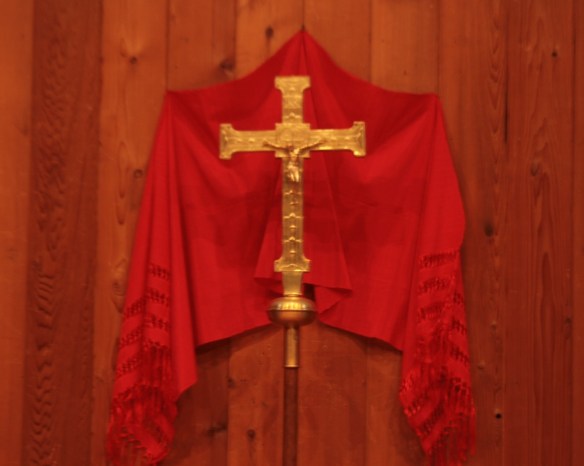 We rightly meditate on the sufferings of Jesus during Holy Week. But in Matthew 25, Jesus made it clear that the sufferings of others were also his sufferings. So it is also suitable to meditate on the sufferings Jesus bears with others.
 The disciples’ demand (not a request) that Jesus increase their faith, (Lk. 17: 5) with a hint of desperation that such a demand entails, seems to come out of nowhere when it begins the Gospel reading. So let us look at the preceding paragraph for some context.
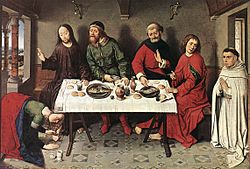 We have a tendency to think of salvation as a personal matter. To some extent it is, but the way salvation is presented in scripture, it is never personal in an individualistic sense. In the case of the famous story of “The Sinful Woman,” we easily focus on the woman whose dramatic action is enough to grab our attention. However, her act is a public drama. Moreover, in very few words, Luke paints the social context of the woman’s behavior. She is a “sinful woman.” We are not told the nature of her sinfulness, so that is not relevant to what we should learn from the story. Simon, Jesus’ host at the dinner, assumes that Jesus should have known that the woman was a sinner and he should not have allowed her to anoint and dry his feet with her hair, actions that further proved the woman’s sinfulness in Simon’s mind. Simon may have been expecting Jesus to have supernatural discernment, but he may have simply expected Jesus to know who had a bad reputation and who didn’t. In any case, it is a social judgment that has labeled this woman as sinful. That is, this woman shows all the signs of being the community scapegoat who helps everybody else feel good about themselves.
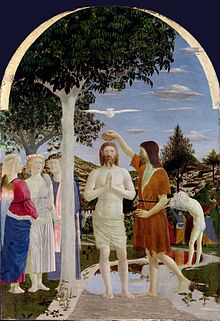 There is much theology that treats the Trinity as a mathematical game, trying to work out how three can be one and one can be three. But math, important as it is for many things, is not the way of salvation.


 Imaginary Visions of True Peace