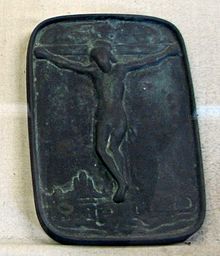
Fumie
Shusaku Endo’s novel Silence has haunted, troubled, and uneasily edified many readers, me among them, since it was written. Scorsese’s film does the same, although the visual effects amplify the haunting, troubling and uneasy edification. The novel follows the book very closely. Very little, perhaps nothing, has been left out of the book by the movie. This review is primarily a response to the movie but it is a review of the book as well.
Certain dimensions of the novel/movie are brought out with the help of the French thinker René Girard. Girard discovered the anthropological trait of what he called “mimetic desire” in the greatest of Western novels, such as Don Quixote and Brothers Karamazov and in the plays of Shakespeare. Mimetic desire is imitating, not the actions of another, but the desires of another. Girard goes on to analyze ways that mimetic desire becomes conflictual and escalates to rivalry, not over a boy friend or a girl friend but ultimately to a struggle for power. Girard called this “mimetic rivalry.” Endo was one of those great novelists who revealed deeply the workings of mimetic rivalry.
SPOILER ALERT: The plot is discussed in much detail, including the ending.
We this mimetic rivalry at work in the opening scene. Rodrigues and Garupe, zealous young Jesuits, wrangle with their superior over whether he will grant permission to go to Japan in spite of the persecution so that they can search for their beloved teacher Ferreira. The superior acts like a battle ax who is used to commanding others but the young Jesuits wear him down. Those in religious orders know how common it is for one to practice religious “obedience” by persuading the superior to grant permission to do what the person under vows wishes to do. This scene reveals both the generous fervor of the young priests and the arrogance of their delusion that they can take on Imperial Japan. Much later, the Japanese inquisitor, Inoue, says of Rodrigues: “The man is arrogant—he will break.” And he does.
There is no mimetic rivalry but only generous love on the part of Rodrigues in his ministry to his small village congregation. In playing the role of the priest, Andrew Garfield lets the love for the people flow and overflow from his face. The people were desperate for tokens and Rodrigues gave them all he had and then had to detach all the beads of his rosary in a prophetic divestment of his prayer discipline.
Once Rodrigues (who had separated from Garupe) is apprehended, the mimetic game becomes very complex and deadly. Rodrigues is very sure of himself and of his faith. He thinks he can meet any challenge. The arrogance of his stout defense of the Faith overflows from Garfield’s face as strongly as did his love for his congregation. He challenges the doddering old man who is questioning him to take him to the chief inquisitor, only to set the old man and his attendants into a soft chuckling fit. When Rodrigues asks what’s so funny since he had not told a joke, the old man tells him he is Inoue, the chief inquisitor. Issei Ogata, who acts the role of Inoue, is quite extraordinary in the way he eyes dance around his dynamic smiles and smirks as he speaks gently but with ruthless cunning.
Inoue presents to Rodrigues a parable of a man who had four wives who quarreled with one another. Finally, he threw out all four of them and lived in peace. Rodrigues said the man was wise. Inoue told him that the wives were Spain, Portugal, England, and Holland. We have here in a nutshell the international situation of mimetic rivalry. The priest, of course, is determined to convince Inoue to accept the one true “wife,” the Church. For a Catholic, this is the truth but Inoue laughs it off as another strand of rivalry threatening Japan.
The pivotal scene is Rodrigues’s meeting with Ferreira, the beloved teacher he had sought. Ferreira had indeed apostatized and he came wearing Buddhist robes. In the book, the silence between the two men is portrayed primarily by Rodrigues being stunned by the clean-shaven face, since Ferreira’s beard had been such an integral part of him. In the movie, Liam Neeson is extraordinary in the way conflicting emotions of guilt, arrogance, shame, and more cross his face. Another mimetic struggle begins as Ferreira has been given the task of convincing the student who had imitated him in Christ to imitate him in apostasy. Rodrigues is angrily self-righteous in his reaction to his teacher, convinced he could never do such a thing. The dialogue is very subtle with multiple meanings to Ferreira’s words. That is, a Christological dimension emerges, but it is undermined by Ferreira’s scorn for the Japanese he had come to convert. He sums it up: “Nothing grows in a swamp.” Ferreira and Inoue had come to agreement that Japan lacks the soil for Christianity to grow.
Ferreira explains how, before his apostasy, he was wrapped and placed upside down in a hole with a small incision cut into side of his head to bleed slowly and slow the flow of blood into the head which could have hastened his death. Rodrigues responds by challenging the inquisitor to do the same to him. He will outdo his superior in endurance.
However, the Japanese had learned some things in their mimetic struggles. It had once been the practice to torture and kill the priests so that they died for their people. Now, they were torturing the Christian people so that they would die for their priest. Rodrigues had already seen three of his followers be crucified in the water and then was forced to see four Christians drowned because Garupe refused commit apostasy. Rodrigues also had to look on as his friend ran into the water to die with his martyred people.
Late at night, Rodrigues heard the moans of the members of his congregation who had been arrested with him as they were held upside down inside the pits. Ferreira was brought in to put more pressure on Rodrigues to apostatize by trampling on the fumie, an image of Christ. As the priest looks down on the image of the crucified Christ, he hears the voice say: “Trample! Trample! It is to be trampled on by you that I am here. ” And so Rodrigues tramples on the fumie and the people are spared an agonizing death. From then on, all the fire drained out of Garfield’s face as the priest became one with the trampled Christ.
Throughout the movie, there is the inner struggle of Kichijiro. Already an apostate hiding in China but longing to return to his own county, he brought the Jesuits to Japan. He committed apostasy again and then ran to Rodrigues to make his confession. Then he betrayed Rodrigues and then came again to confess and receive absolution. He comes again after Rodrigues has apostatized. The priest says nothing, but his face says that is because he no longer feels qualified to absolve him. But when Kichijiro runs off, Rodrigues makes the sign of the cross.
The Japanese persecutors “won” the mimetic match, but Christ, by urging the priest to trample on his image, has embraced the priest, the persecuted Christians, and the persecutors of Imperial Japan.
Over the years, Rodrigues and the other Christians who had also trampled on the fumie are required to repeat the act time and again as a “formality.” So it is that the persecuted Christ returns time and again for the ceremony to repeat his embrace of the country.
There is much noise in the movie Silence. There is the noise of Rodrigues’s fervent declarations of faith before Inoue which dissolves when he tramples the fumie. There is the roar of the surf that is superbly photographed. There is the excruciating noise of the tortures and the even more excruciating inner noise of the psychological tortures. Then there is the silence of the trampled Christ. Although the book is of modest length, the movie is very long. The length is a strong challenge to the viewer and it guarantees that nobody will be entertained by this movie. But the length also creates space for the silence of the trampled Christ.
In the silence of the trampled Christ, there is no mimetic rivalry.
A Musical Note
The Scottish composer James MacMillan, one of the greatest living composers, and a Roman Catholic, wrote his large third symphony as a response to Endo’s novel. There are the sounds of Japanese percussion instruments. There are snarky musical figures that suggest the mockery of the inquisitor. There are grinding discords suggesting the tortures of persecution. The music is as consistently tense as the story the book tells. The silence of the trampled Christ is barely audible.

 Jesus’ famous words in John: “I am the way and the truth and the life” (Jn. 14: 6) have inspired many Christians, including me, but they tend to cause some consternation in an age where many seek to be inclusive and affirming of diversity. Now that René Girard has greatly increased our awareness of mimetic rivalry, the worry grows that we might understand a verse such as this as meaning “my god is better than your god.” Such a reading projects our own rivalry onto Jesus so as to make Jesus a rival against other “gods.” Which is to turn Jesus into an idol of our own making.
 Easter is a great celebration, but it is a strange celebration. It isn’t like celebrating an election won or winning the World Series. It most certainly isn’t like celebrating victory in war. But if we have trumpets and kettle drums to augment the shouts of Alleluia!” we might forget the strangeness sometimes and get carried away by a sense of triumphant victory.
 We rightly meditate on the sufferings of Jesus during Holy Week. But in Matthew 25, Jesus made it clear that the sufferings of others were also his sufferings. So it is also suitable to meditate on the sufferings Jesus bears with others.
 When I last posted a
  Jesus’ teachings on the right and wrong ways of fasting are true and important but I would rather talk about treasure and our hearts. Treasure is a much brighter and exciting thing to think about then renunciation and fasting. What child doesn’t like a treasure hunt? Why else is Treasure Island such an archetypal novel?
 The Feast of the Presentation of Jesus in the Temple is a belated closure to the Christmas Season. Since the excitement of Christmas and New Year’s Day is long past, we may have assumed Christmas was over, but the Presentation of Jesus is the last of the Infancy Narratives. The Christmas Cycle began with Advent, the time of expectation of God’s coming to us. In Simeon and Anna, we come full circle with two more people who were waiting for the consolation and redemption of Israel. Anna had been waiting for 57 years, with nothing to show for it until that day.
