
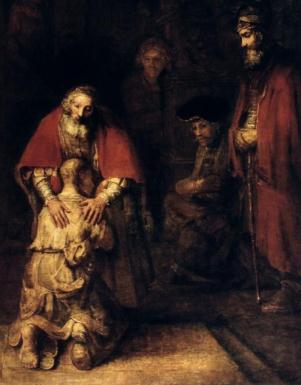
 Kenneth Bailey’s book Jacob & the Prodigal overlaps with important sections of my own book Moving and Resting in God’s Desire: A Spirituality of Peace. In using the thought of René Girard and his colleagues to explore ways of renewing Christian spirituality (see Violence and the Kingdom of God for an introduction to Girard), I comment at length on the stories of fratricidal strife in Genesis and Jesus’ Parable of the Prodigal Son in Luke. (The Parable is better titled something like “The Prodigal Father and His Two Sons.”
Wee both see Jesus’ Parable as seeking to resolve the strife between brothers although, like the story in Genesis, the Parable is left open, leaving the possibility of resolution open but not fulfilled in the text. Having grown up in the Near East, Bailey has much knowledge of Semitic culture that many of us in the West do not have. As a result, Bailey offers many important insights into the Parable and the earlier narrative that pass many of us by. For example, Bailey emphasizes the foolishness of the Father in the Parable in running to meet his son at the edge of the village. For a grown man to run for any reason was considered shameful and to run for such a purpose especially so. This is just one example among many of the new insights Bailey has to offer us. Bailey treats the Parable as the climax of a trilogy of parables in Luke 15 which begins with the Parable of the Lost Sheep and continues with the Parable of the Lost Coin before concluding with the Parable of the Prodigal Son. By studying the parables together, Bailey explores the Christology of the Parables where the shepherd, the woman searching for her coin and the father all become images of Jesus Himself as he reveals how overwhelming and unimaginable the Love of God is.
The final portion of the book is a comparison of the Parable with the Saga of Jacob and Esau. Many of the parallels are contrasts which are at least as illumining as the likenesses. In both cases we have two brothers in strife. Isaac, however, in his in ineptness in being tricked is a huge contrast to the father in the Parable. Another contrast is that Jacob does well in the foreign country while the Prodigal Son does not. Another likeness is that neither Jacob nor the Prodigal Son repent of wrongdoing. (Bailey explains at length that the Prodigal Son is only scheming to get set up in a craft to get enough money to live on; he is not repenting of asking his father for half the estate, brutal as that was to his father.) Bailey argues that Esau doesn’t really forgive Jacob as I argue in my take on the story. The number of armed men Esau brings could suggest an aggressive meeting but it could be a defense measure, not knowing how many armed men Jacob might have. Bailey argues that the vowels of the Hebrew word for “kiss: are the same as the vowels for “bite,” leaving open the possibility that Esau bit Jacob. I can’t argue the linguistic case but it seems to me that so aggressive an act would have led to a more violent reaction than we have. In any case, I see Jacob not believing in Esau’s forgiveness and rather than a reconciliation, the story ends in a permanent separation.
In the Parable, the two brothers are separate at the end, thus keeping up the conflict that I see between them dating back to before the younger brother leaves. In the Parable, however, the central separation is between each of the brothers and their father. The younger son does seem to have accepted his father’s welcome, although we don’t know if he persevered in his gratitude. The older son is at odds with his father as well as with his brother. The challenge is whether or not the older son will accept his father’s love for his younger son. In like manner, Bailey demonstrates that this challenge is thrown out to the scribes and Pharisees who criticized Jesus for eating with “sinners.”
Bailey’s book is a valuable source of new insights that deeply refresh our understanding of a Parable that we think we understand so well that we have let it go stale. Most important, Bailey’s study makes the Love of God revealed in Jesus “full of sap, still green.”
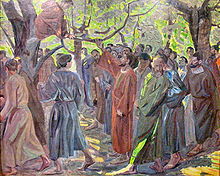 The French thinker René Girard has argued that since the dawn of humanity, we have tended to solve social tensions through persecuting a victim who absorbs these tensions and suffers for them. Girard has also argued that the Gospels unveil the truth of this scapegoating mechanism in their narratives of Jesus’ death and Resurrection where Jesus opens up new possibilities for humanity to gather through the forgiveness of the Risen Victim. It happens that the Gospels show Jesus unveiling these very same dynamics in his earthly ministry. I analyzed our such stories in my book
  The disciples’ demand (not a request) that Jesus increase their faith, (Lk. 17: 5) with a hint of desperation that such a demand entails, seems to come out of nowhere when it begins the Gospel reading. So let us look at the preceding paragraph for some context.
 There is only one simple qualification for being a disciple of Jesus: give up everything. That’s one whale of a qualification. So hard is this qualification that earnest Christians have thought of many ways to soften Jesus’ words without washing all meaning and challenge out of them. My New Testament professor at Nashotah House, O.C. Edwards, suggested that this qualification means we have to give up everything that comes between us and God. That is, if parents, children, spouses, friends, or fellow members of a community help us draw closer to God, we don’t have to give them up. The same would go for material possessions. Even Benedictine monks have to use things in this world in order to live so we can’t give up having anything at all. The trick is to use things in such a way that the work and recreation we do with them draws us closer to God rather than farther away.
 Back when I was a seminarian at Nashotah House, a student from the South transferred there in the middle of the academic year. Not surprisingly, given Nashotah’s Anglo-Catholic tradition, several students ganged up on him and tried to convert him to an ardent devotion to Our Lady. This student’s response was: “I thought Mary was just a little Jewish girl.”
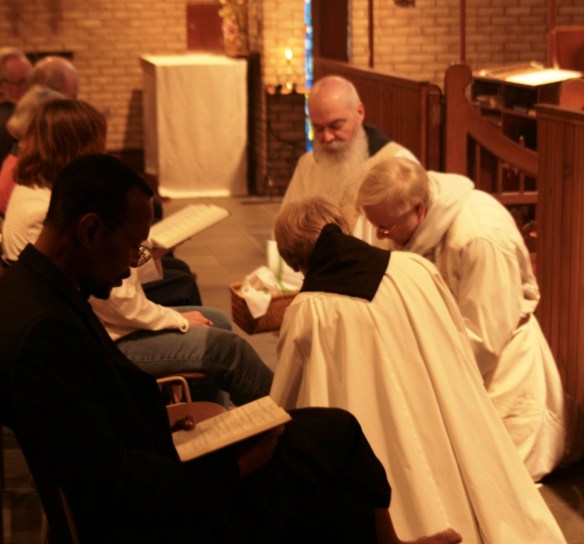 The first verses of today’s Gospel (Lk. 12: 32–34) pick up from where we left off last week. That reading ended with Jesus’ little parable about the rich fool who tore down his barns to build bigger barns (Lk. 12: 12–21) only to find that his life was being demanded of him. This reading begins with Jesus’ soothing admonition to “sell our possessions and give alms” and “make purses for yourselves that do not wear out, an unfailing treasure in heaven, where no thief comes near and no moth destroys.” (Lk. 12: 32-33) This is quite a contrast to two brothers fighting over an inheritance or a rich person gloating over fabulous amounts of wealth. Lest we think Jesus is asking us to make ourselves miserable, Jesus assures us that it is our heavenly Abba’s pleasure to give us a treasure that is the kingdom. If this treasure, the kingdom, is the Abba’s pleasure, then it is our pleasure as well.
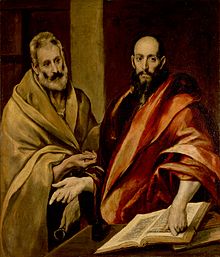 It is interesting and a bit ironic that we celebrate Saints Peter and Paul on the same day. Although there are famous icons of the two embracing one another in Christian love, the two seem not to have had an easy time getting along in real life. Although the two appeared to have been somewhat reconciled at the Council of Jerusalem in Acts 15, in his letter to the Galatians, Paul says that he opposed Peter “to his face” for backing down from what he thought they had agreed on. (Gal. 2: 11) The final chapters of John’s Gospel suggest tensions between the “Beloved Disciple” and Peter, and/or some tension between the two communities derived from them. The Beloved Disciple rests on Jesus’ breast at the Last Supper while Peter stubbornly tries to prevent Jesus from washing his feet. In her book Courting Betrayal,” Helen Orchard argues that Peter was resisting the slavish action of Jesus in washing his feet because he did not want to stoop so low himself. The episode of the Empty Tomb in John shows a rather awkward dance between the two where the Beloved Disciple gets there first but waits at the entrance and allows Peter to go in first. In this little tangle of a narration, both seem to have been first but not in the same way; which suggests some attempt to overcome the tension. In the final chapter of John, after the threefold question to Peter: “Do you love me?,” Peter points to the Beloved Disciple and asks” What about him?” Jesus answer basically tells us it is none of his business.
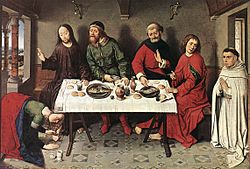 We have a tendency to think of salvation as a personal matter. To some extent it is, but the way salvation is presented in scripture, it is never personal in an individualistic sense. In the case of the famous story of “The Sinful Woman,” we easily focus on the woman whose dramatic action is enough to grab our attention. However, her act is a public drama. Moreover, in very few words, Luke paints the social context of the woman’s behavior. She is a “sinful woman.” We are not told the nature of her sinfulness, so that is not relevant to what we should learn from the story. Simon, Jesus’ host at the dinner, assumes that Jesus should have known that the woman was a sinner and he should not have allowed her to anoint and dry his feet with her hair, actions that further proved the woman’s sinfulness in Simon’s mind. Simon may have been expecting Jesus to have supernatural discernment, but he may have simply expected Jesus to know who had a bad reputation and who didn’t. In any case, it is a social judgment that has labeled this woman as sinful. That is, this woman shows all the signs of being the community scapegoat who helps everybody else feel good about themselves.
 There is much theology that treats the Trinity as a mathematical game, trying to work out how three can be one and one can be three. But math, important as it is for many things, is not the way of salvation.
 Imaginary Visions of True Peace