
 There is much theology that treats the Trinity as a mathematical game, trying to work out how three can be one and one can be three. But math, important as it is for many things, is not the way of salvation.
The Church, of course, didn’t preach the Trinity just to solve a mathematical puzzle; the Church preached the Trinity because that seemed to be the best, maybe the only way, to preach salvation. Jesus, a human being, was so god-like that his followers concluded that he wasn’t just like God but was God when, among other things, Jesus exerted divine power to walk on water and still the waves of the Sea of Galilee. Then Jesus sent the Holy Spirit, the Advocate, to do the godlike things he had done. So it was that the disciples experienced three Persons acting like God in a way that only God could act. That’s why theologians have been trying to do the math ever since. We shall reflect on one of the most important of the godlike acts of Jesus and the Holy Spirit.
Jesus got in trouble with the religious authorities for many things, but probably the most serious of them was claiming the power to forgive sins. He did this when the paralytic was brought down through the roof by his friends so that he might be healed, (Mk. 2:5) and he did it again when the Sinful Woman poured perfume over his feet at the house of Simon. (Lk. 7: 47) The Pharisees were incensed because Jesus, a human being, was doing what only God could do. The Gospel writers agreed that only God could forgive sins and Jesus had, in fact, done what only God could do. Before he died, Jesus promised to send the Holy Spirit to be an Advocate who would lead them further into the truth of who Jesus was. When the risen Jesus breathed on the disciples in the upper room, he passed on to them and, through them to us, the ministry of forgiveness of sins. (Jn. 20: 22–23) Fifty days later, Peter exercised this power to forgive sins when his listeners asked him what they needed to do to be saved. (Acts 2: 38)
The Trinity, then, is not a mathematical puzzle but a story of sin and forgiveness. In spite of some outbursts of anger, Yahweh claimed to be a God who was chesed, a Hebrew word meaning full of loving kindness and mercy. The attitude of the Pharisees towards the paralytic and the Sinful Woman suggests that they thought forgiveness should stay up in the heavens where it belonged and not get mixed up with humans on the earth. In our angrier moments we tend to feel the same way. But Yahweh’s hesed did get mixed up with humanity: first in the person of Jesus and then in the disciples through the Gift of the Holy Spirit. So it is that we humans are given the Gift, not only of having our sins forgiven, but we have the Gift of forgiving the sins of other people. Note that it isn’t we who forgive, but it is God who forgives through us. That is, the divine act of forgiveness that came the earth in the person of Jesus has, like the Holy Spirit, spread throughout the whole world.
Forgiveness is the air we breathe. Unfortunately, just as we can pollute the air, we can pollute the breath of the Holy Spirit through our own wrath. But fortunately, there is no getting rid of God’s hesed. It is all around us and we can breathe it any time we wish. And when we wish it and breathe in the Spirt, we share the life of the Holy Trinity with other people and so help them share the same forgiving life.

 An early Easter throws many things awry, not least the saints’ calendar. St. Benedict’s day is normally celebrated on March 21, but this year, it was transferred to Monday after Easter Week. Thinking about St. Benedict in terms of Easter reminds me of what he said about Lent in Chapter 49 of his Rule.
 Luke’s version of Jesus’ Resurrection is much the gentlest among the synoptic Gospels. No earthquakes and no women running off so afraid that they can tell nobody what they had seen at the empty tomb. The women were, indeed, terrified of the two men in “dazzling clothes” who appeared to them. But by the time, but before long they have remembered, with prompting from the men in white, Jesus’ words to them.
 Jesus’ prayer in the garden of Gethsemane may well have been the loneliest moment of all for Jesus. His disciples were not able to stay awake with him. Much worse, his disciples still seem not to have understood anything of what Jesus had tried to teach them. At what he knew would be his last meal with his disciples, a meal when he had poured himself into the bread and wine to give his life to his disciples and all others who would follow him, his disciples fought yet again about who was the greatest. (Lk. 22:24–26) As he had done many times before, he told his disciples that the one who would be first would be the one who served, but he must have realized his words had had the same effect as before.
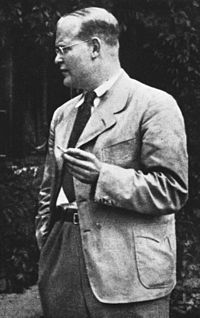 Passiontide is an appropriate time to reflect on the life and witness of Dietrich Bonhoeffer. Charles Marsh’s book A Strange Glory is a great resource for this.
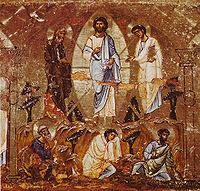 We celebrate the Transfiguration of Jesus at the end of Epiphany to prepare ourselves for Lent. This is a joyous feast where the Light of Mount Tabor should inspire us for the days of penance and then entering into the Paschal Mystery of Christ. However, there is a discordant element in the reading from St. Paul that I want to focus on. He, too, writes of the inspiring light of the Transfiguration, but he also writes about the veil over Moses’ face. This refers to the story in Exodus where Moses put a veil over his face when he came down from Mount Sinai with the tablets of the Law because his face shone too brightly for his fellow Israelites to look upon. (Ex. 34: 29–34) Paul goes on to say that the Jews remain veiled when they hear the words of the Law. In light of Holocaust, this verse causes much uneasiness, all the more so as it has been used to justify anti-Semitic attitudes and behaviors.
 Paul’s famous Hymn of Love zeroes in on what love, as agape, is all about: “Love is patient; love is kind; love is not envious or boastful or arrogant or rude. It does not insist on its own way; it is not irritable or resentful; it does not rejoice in wrongdoing, but rejoices in the truth.” (1 Cor. 13:4–6) In these qualities, we can see love as a deep renunciation of mimetic rivalry. Insisting on our own way, being resentful, rejoicing in the shortcomings of others, are all ways of putting ourselves on top of other people. Surely this short list is meant to stand for any attempt to put ourselves above other people. As long as we try to “win,” we lose at love. When we are willing to “lose,” we win at love.
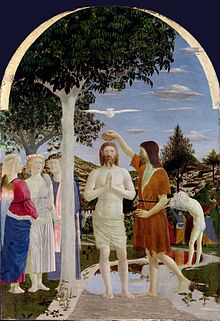
 At his baptism, Jesus heard a voice from Heaven saying: “You are my Son, the Beloved; with you I am well pleased.” (Luke 3: 22) These words ring out in Psalm 2, addressed to the king, the Messiah, who is being singled out from the nations that are raging together and rising up against the Lord and his anointed. Similar words are spoken to the Servant of Yahweh in Isaiah 42:1. Throughout these songs of the Suffering Servant, he is being called out of a violent society to become instead the victim of that society’s violence. Unlike the Psalmist who threatens the raging nations with a rod of iron, the Suffering Servant does not retaliate against the violence inflicted on him. Jesus begins his mission, then, with a powerful acclaim of unconditional love from his Heavenly Father, a sense of unconditional love he will offer to all who will listen.
