Seeing with More than the Eyes

churchDistanceBlossoms - CopyJesus’ healing of a man born blind in John’s Gospel (chapter 9) is much more remarkable than fixing the eyes so that they can see. In order to really see, the healed man would have needed a radical overhaul of his neurological system so that his brain could grasp what was being seen. John didn’t know about neurology but he did know that really learning to see involves at least as radical an overhaul of our human system to heal our deeper levels of blindness.

John shows us the blindness surrounding the blind man when the disciples ask Jesus if it was the man’s own sin or the sin of his parents that caused him to be born blind. The notion that the poor guy sinned before he was born should be enough to show us how blind this attitude is. This blindness was compounded by excluding the blind man from the religious practices of Judaism because he was blind. Neither the Jewish leaders nor even Jesus’ disciples could see any potential worth in the blind man.

That Jesus shows the intention to take the man’s blindness as an occasion for revealing God’s work rather than for blame by putting mud on everybody’s eyes to recreate the world for us. The Jewish leaders react to the healing with anger. They seem determined from the start to discredit the healing rather than change their own way of seeing. Their search for blaming was rewarded when they discovered that the healing was done on the Sabbath.

It is important not to let Gospels stories such as this discredit the Jewish practice of the Sabbath. It was a great gift for Jews and for Christians who treat Sunday in a similar fashion, a day for renewal. That is the key: a day for renewal. The use of mud paste clearly refers back to the creation of humanity out of moist clay. The blind man is being recreated. In sharp contrast to the paralytic in John 5 who remained as paralyzed as he ever was no matter how much he carried his mat, the formerly blind man shows himself to be renewed at a very deep level. The clever way he handles the hostile questions from the Jewish leaders reveals a man with sharp intelligence and wit. Meanwhile, the Jewish leaders make it clear that their initial judgment that the blind man was a sinner and an outcast was immutable. As long as he was blind he was an outcast and once he could see, he was cast out for being healed by the wrong person in the wrong way. There can, of course, be no renewal, no re-creation if we insist on being immutable, neither can we see renewal or re-creation even when it takes place right under our noses.

But the man shows even more. James Alison’s concept of the “intelligence of the victim” suggests that the blind man had insight into what life was about and what God was about because he was blind and an outcast. He was given the opportunity of repudiating Jesus the way the paralytic did, which would have brought him approbation from the community, but instead, he staunchly defended Jesus, which landed him in the precise place of blame and expulsion as Jesus himself. It is in this place that the man really sees.

The disciples fade from the story after their question about who sinned, but far from really disappearing, their circle expands to include all of us who read and hear the story. This expansion forces us to choose: will we let Jesus re-create us in the place of shame shared with the man born blind, or will we hop out of the circle so that our lives will continue to be etched in stone?


Quixotic Reading

Don_Quijote_and_Sancho_PanzaIt is both interesting and significant that the mimetic desire revealed in two of the novels discussed by René Girard in Deceit, Desire & the Novel are derived, not from other people, but from characters in literature.

Don Quixote famously went mad with a desire to imitate Amadis of Gaul in the medieval romances of this knight errant, while Madame Bovary’s desires were fueled by the sentimental novels she read. The literature consumed by both characters gives them distorted visions of reality. Don Quixote mistakes windmills for evil giants and a barber’s basin for a knight’s helmet. Madame Bovary sees the lovers of her life through the lens of the romance novels and fails to see them as they really are until it is too late.

Of the two, Don Quixote is much more removed from “reality” than Madame Bovary. Yet, although the novels Madame Bovary has read seem to mirror “real life” and are thus “realistic,” it is she who seems to be even more confused about “reality” than Don Quixote, to the point of being smothered by fantasy so that what self she has disappears. C.S. Lewis offers us a key insight here when he says : “Children are not deceived by fairy tales; they are often and gravely confused by school stories. Adults are not deceived by science fiction; they can be deceived by the stories in the women’s magazines.” Lewis seems a bit sexist here but the underlying point is clear enough. “Realistic” stories present models and stir up desires that seem realistic but are traps that catch the unwary reader.

Curiously, Don Quixote’s fantasies have a contagion of their own. An unnamed man accuses Don Quixote of having a “talent for making anyone who has anything to do with you mad and senseless.” It is curious that Don Quixote is blamed for the insanity of others, as the other people are arguably making themselves insane by staying on Quixote’s case to the point of obsession. In the second part of the novel, a duke and duchess spend huge amounts of time and expense to mirror Don Quixote’s desires in theatrical fakery. They themselves seem to be caught up in Quixote’s madness as much as their victim.

In both cases, there is something of a collective violence around a victim. In the case of Don Quixote, his singularity provokes a spontaneous, improvised conspiracy to bring him to his senses. In the case of Madame Bovary, the social system of mimetic desire is fully developed to the extent that both Madame Bovary and her irresponsible husband and lovers all act like puppets of the ambient fantasy fueled by the novels and the culture industry.

Novelists such as Cervantes and Flaubert are faced with the enormous challenge of revealing the truth of mimetic desire in a medium that is normally used to reflect and fuel mimetic desire. After all, it is the latter tendency that makes huge profits for the producers of this and other media. In the second part of Don Quixote Cervantes does not disguise his indignation over copycat offshoots of his work and other ersatz imitators. Perhaps the main thrust of the second part was to mirror the misunderstandings of his readers in the Duke and the Duchess.

It isn’t enough to write novels revealing mimetic desire. Also needed are readers who can truly see what these novels reveal. If Cervantes was exasperated by the readers of his time, imagine his apoplexy over a musical featuring an inspirational song about following impossible dreams. For Cervantes was showing us in his novels that successfully imitating fictional characters is truly impossible. Don Quixote could not live Amadis of Gaul’s life any more than Emma Bovary could live the lives of heroines in the novels she read. They could only live their own lives, which they failed to do.

Werther is another fictional person who was widely imitated for a time. Heartsick and overwhelmed by his mimetic desire for a woman already promised to another man, Werther kills himself. The publication of Goethe’s novella was followed by an epidemic of suicides throughout Europe. This phenomenon is still called the Werther effect. Drowning in the mimetic desire of fictional characters can be deadly.

So how do we read in a way that is life giving? The short answer is to seek life where it can be found, where Don Quixote found it at the end, in repentance. I will give a slightly longer answer in my next blog post.

The Servant of the Servants of God

GregoryIcon1For anybody to fight about who is the greatest at any time is a disgrace. For the disciples of Jesus to fight about who is the greatest is especially ludicrous, making one wonder if they had understood a word Jesus had said. Very possibly they hadn’t. That they should fight over who is the greatest at table the night before Jesus died is beyond ludicrousness. If they had fought in this way after Jesus had washed their feet, as recounted in John, then their fight is transfinitely ludicrous.

Jesus shows transfinite patience to the disciples by not acting the way most of us in authority would. An argument among people under our authority as to who is the greatest has the potential to spill over into a dispute with the one in authority over the same question. But Jesus explains that it is the Gentiles who wish to exercise lordship over others and it should not be that way with them. Stepping on toes and maybe even necks is what most worldly authorities would have done in Jesus’ position but that is precisely what Jesus did not do. There is an edge to Jesus use of the word “benefactors” for those practicing lordship; such people used their benefactions more to assert their superiority and social control than to be charitable to others. Jesus goes on to say that he has come among the disciples as one who serves, not one who lords it over them.

Our patron saint, Pope Gregory the Great, did not coin the phrase that the Pope is the servant of the servants of God, but he was the first to make extensive use of the phrase and thus make it such a quotable quote through the ages. The phrase certainly picks up the meaning of Jesus’ words to the apostles as captured in Luke.

A deeper sign of Jesus’ infinite patience with his disciples (and us) is his assurance that they will sit on twelves thrones to judge the tribes of Israel. This assurance is startling since it seems to go counter to what Jesus had just been talking about. But does it? If being a ruler means being a servant, as Jesus suggests and Gregory the Great averred, then maybe sitting on a throne to judge a tribe of Israel is not such a good deal for the judge. We tend to think that being a judge means being judgmental; that judging the Twelve Tribes of Israel means accusing them of their wrongdoings. But what if a judge is a servant? In his response to the disciples’ infighting, Jesus is surprisingly unjudgmental, although he makes it clear that they haven’t gotten it right just yet. Jesus continues to serve them through his example, such as washing their feet and leading them gently but firmly to a new way of seeing the world and, more importantly, living in it.

The thing is, Jesus didn’t judge the disciples (and us) by browbeating them; Jesus judged them by serving them humbly. The twelve tribes of Israel is an expression for a renewed Israel, Gentiles and Jews alike. Judging them, then, means serving them the way Jesus served them and the way Jesus serves us. It is our acts of loving service that will judge all people who exercise lordship by browbeating others. The Pope isn’t the only one called to be a servant of the servants of God. All of us are so called. The trouble with calling Jesus the King of Kings is that we are tempted to swell with pride with being part of this imperial court. We do much better to call Jesus the Servant of Servants.

Human Weakness the Cornerstone

peter healing cripple_RembrandtThese days we take ramps and handicapped parking spaces for granted. However, such considerations for people with special needs are quite a flip-flop from what such people experienced in the early days of humanity. In the social crises at the dawn of humanity as envisioned by René Girard, when everybody was at everybody’s throat, the choice of the victim was usually arbitrary, almost like a lottery. It could be anyone. However, if any person in this melee of undifferentiation should stand out in any way, that person would be the most likely victim. The person who stood out might be the most talented; a scenario often repeated today. (See Ignominious Glory, Glorious Ignominy: A Doxology) Many mythological victim/deities were great musicians or poets. Another way a person might stand out is by being handicapped. René Girard points out that a predatory animal will spot the weakest member of a herd and go for that one and that the same holds true of a society in crisis. One need only think of the many lame victims such as Oedipus or deities like Odin with only one eye.

The flip-flop started as soon as the Church, inspired by Jesus’ healing ministry, had the resources to build facilities for the sick and disable. As far as I can tell, hospitals are a Christian invention. We are so used to infirmaries that we think nothing of Benedict’s provision for an infirmary in his Rule, but Benedict was an innovator in his time. The teaching and ministry of Jesus that involved reaching out to the weak, the people formerly rejected by society, had become the cornerstone of Benedict’s monastic vision that consideration should always be shown to the weak. Of course, Benedict meant far more than sick and handicapped people with this admonition, as Benedict well knew that we all experience weakness in many ways. I have discussed care of the sick and its ramifications at length in my book Tools for Peace.

Many years ago, when I was a seminarian taking CPE (Clinical Pastoral Education), one of the chaplains, who was legally blind, gave a talk on issues involving handicaps. He helped us greatly in sensitizing us to how people in his position felt with being helped either too much or not enough. He was also very honest about himself and he admitted that being handicapped did not necessarily make him any more sensitive to other handicapped people than anybody else. As an example, he told us of how he recoiled when introduced to a person with a withered arm.

To this day, even those of us who care for others experience this kind of recoil when we encounter others who are a bit different, especially if the difference is grotesque. But our treatment of alleged nerds and celebrities shows us that a difference in conspicuous talent raises the same sort of dread. If we notice ourselves in this respect, we can experience a kinship with our brothers and sisters who made sacrificial victims and then deities out of the likes of Odin.

Respecting All Things that God has Made

buddingTree1The Book of Common Prayer gives us an important focus for Lent by starting the collect for the Ash Wednesday Eucharist with “Almighty and everlasting God, you hate nothing you have made and forgive the sins of those who are penitent.” So often, we blame the material world for our sins and then hate what God has made which God also loves. In a sense, the material world becomes a scapegoat for our own disordered desires. If we eat too much, it isn’t really the fault of the food, though we quickly blame it for our own lack of self-control. Women, of course, have been blamed for being “tempting” as if it is their responsibility to control the desires of men while men need take no responsibility for themselves.

To complicate the picture, René Girard has demonstrated many times in his books that our desires are intertwined with the desires of others in a dense network of mutual imitation. If we become ensnared in desires for certain things or certain people because others desire them, we are in a frustrating situation and, again, it becomes convenient to blame the other people and other things for the pickle we are in.

We need to remember that God is our model for perfect love for all that God has made. That means that, unlike Zeus and many other mythological deities, God does not lust after humans but loves all humans with perfect respect. The more we respect other people and all things in the world, the more restraint we have in relation to them. So it is that when we repent and turn to God, we also turn to all things and to all people that God has made with new respect and love.

Sacrificing the Aztecs

Teotihuacan9The sacrificial rites of the Aztecs at the time of their conquest give a rich example of the institutionalizing of sacrifice. The horrific quantity of children sacrificed to bring on rain with their tears, and the men whose hearts were cut out to keep the sun alive leads us to dismiss them as civilized human beings. But they were highly civilized. In the book Sacrifice and Modern thought, two stimulating articles help us understand Aztec sacrifice. Both Laura Rival and David Brown help us sympathize with the Aztecs as human beings. Rival points out that human sacrifice was modeled on the deities who threw themselves into the primordial fire to create the fifth sun and set it in motion. This myth points to a noble disposition behind the sacrifice. It is not hard, however, to see this as a typical myth that hides the collective violence that laid the foundations of their culture.

David Brown summarizes clearly the “flower wars” that were part of the sacrificial system. These wars had become as highly ritualized as the sacrifices performed on the top of the pyramids. The whole purpose of these wars was to capture sacrificial victims in fair fights. The initial chaos leading to the myths and sacrificial rites had led to a complex, highly restrained structure of warfare.

Brown quotes a moving statement by an Aztec leader who says that the Spaniards did not understand “how vital it is for us to give blood to the gods.” As selfless as the sacrifices were, and the Aztecs believed they were rewarded in the afterlife, they were convinced that if they failed to continue these sacrifices, the gods would become angry and turn away from them. Here we have it: as with so many other early cultures, the Aztecs were caught in a sacrificial system that allowed no escape. If the gods are subject to anger and capriciousness, one does not dare turn away from the only rites that had a chance of deflecting the divine wrath.

The structure and restraint of the Aztecs is a dramatic contrast to the chaotic overrunning of their country on the part of the Spanish Conquistadors. Cortes justified these measures out of repulsion at the sacrifices carried out by the conquered people, but in a cruel irony, the Spanish made a cruel holocaust of the sacrificers. A comparison with the lynching of blacks in the United States shows us the same chaotic mob violence. (See Selling Postcards of the Cross.) In The One by Whom Scandal Comes, René Girard contrasts the fundamental way Satan works in archaic cultures and in modern cultures where some awareness of the Gospel has occurred. Among the Aztecs, as with so many other peoples, Satan was the transcendent principal of order. But with Satan cast out of the sky during the ministry of the Hebrew prophet Jesus, Satan acts imminently within human cultures as a disrupter.

In my last post, I noted how killing twins became part of a package of maintaining a satanic social order. (See Twin Killings.) All twins can be thankful that this order has been dismantled. Likewise, we can be grateful that we don’t have pyramids where people’s hearts are torn out. We are free of the satanic order, but we are not free of the chaotic violence that has been unleashed on to the world unless we actively seek the freedom we gain from being grounded in the God of Love who has gathered all Aztec victims into the divine fire that fills us all with eternal life.

Twin Killings

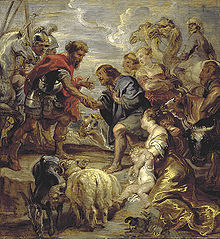
220px-Rubens_Reconciliation_of_Jacob_and_EsauIn baseball a twin killing is a double play: two outs on one batted ball. “Two for the price of one,” as the great Detroit Tigers great sportscaster Ernie Harwell called it. Double plays are a legitimate part of baseball. But there is another kind of twin killing that has been a part of humanity until close to the present day that is not legitimate: the killing of twins.

Why was one, and sometimes, both twins been killed in early societies? René Girard suggests that it was the fear of what he called “mimetic doubles,” two people united through conflict. After the social chaos was resolved by collective violence, societies created structures to prevent the repeat of the chaos as much as possible. Twins, especially identical twins, were too much of an image of the indifferentiation that lead to conflict. They could not be allowed to live. During the time of chaos, indifferentiation was precisely the problem as differences between people melted in the heat of conflict. It is obvious to us now that these babies were innocent victims of society’s fear of mimetic doubles, but in today’s society where social differences are dissolving, perhaps we should fear, not twin babies, but mimetic doubles.

The authors of Genesis had no illusions about the danger of mimetic doubles. Brothers paired off against each other are the driving force of the book, culminating in Joseph’s brothers ganging up on him. Jacob and Esau were twins. The conflict that kept them apart for many years finally resolved in an uneasy reconciliation as Esau turned out to be more forgiving for the wrongs done him than Jacob ever believed possible.

Lois Lowry’s chilling dystopia The Giver also has a twin killing. The society is shown to be peaceful but colorless. (Literally so, as we learn when the protagonist, Matthew, begins to see colors.) It becomes apparent that everything is designed to prevent conflict. There is no courtship or sex; medication stifles the latter and babies are grown in test tubes, implanted in adolescent girls, and distributed to couples, each of whom gets one boy and one girl. Not surprisingly, the cost of this “peaceful” society is high. When Matthew is apprenticed to the Giver, he learns that it is his job to keep track of everything that is happening via TV monitors but to do nothing unless asked, as the job is consultative only. A day or two before Matthew makes his escape, he watches his own father “release” one of two twin babies with a lethal injection, the normal way of releasing somebody. (The elderly are so released at a certain age after a celebration of their lives.)

Much else is shown to be wrong with this society but the killing of a twin shows clearly enough that preserving the peace by squelching mimetic doubles inevitably institutionalizes violence, even if, as in Lowry’s society, it is kept invisible. René Girard would argue that one of many effects of the Cross and Resurrection is that we don’t kill twins and we have the freedom to build God’s kingdom where we actualize the freedom shown by Esau to forgive and then later by Joseph to his brothers. It is no longer possible for social structures to contain the potential violence of mimetic doubles in conflict. It is possible, and in our times, necessary to renounce conflict, even if it means forgiving the theft of a blessing. This renunciation leads to its own blessings. After all, Esau had done pretty well for himself while Jacob was away.

The Cross as a Crisis of Faith

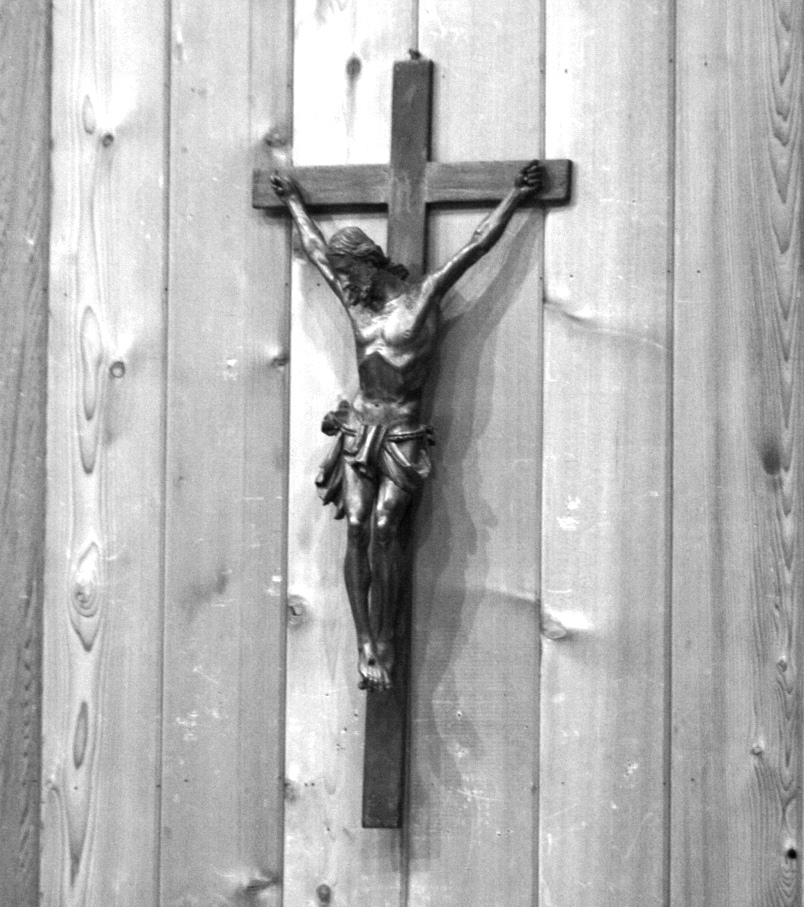
crucifix1Rachel Held Evans recounts her spiritual journey from fundamentalist Christianity to a Christian stance with many more nuances and much more depth in her book Evolving in Monkey Town, the town being Dayton, TN where the famous Scopes Trial, or Monkey Trial, took place. One event made a particularly deep impression on me as it showed how a growing instinct for the Paschal Mystery broadened her vision of a terrible news story she witnessed on TV.

The story was shown in 2001, just before the US invasion of Afghanistan, obviously for the purpose of justifying the invasion on the grounds of the Taliban’s callous treatment of women. (Never mind that if every country that has people who commit atrocities towards women deserve to be invaded, then every country in the world would deserve it!) The video showed a woman named Zarmina, dressed in a burqa, being dragged into a soccer stadium during halftime where she was executed before the capacity crowd. She had been charged with murdering her abusive husband, although a confession extracted after two days torture is rather suspect.

It is very important to note that Rachel’s reaction had nothing to do with criticizing Islam as a religion. Rachel’s problem had to do with Christianity. She had been taught all her life that only those who consciously accept Jesus as savior can be saved. But seeing a woman suffering such an atrocity on TV made it very hard for her to believe that a woman who had suffered so badly should have her suffering compounded by spending eternity in hellish torment because she had died a Moslem. That Zarmina had said her Moslem prayers in the face of what her co-religionists were doing to her speaks strongly for the power of Islam as a source of deep spirituality.

It became very hard for Rachel to believe that a loving god would predestine a woman like this to hell. When she thought about the Killing Fields of Cambodia, the gassing of Iraqi Kurds and the Jewish victims of the Holocaust, Anne Frank among them, it became harder than ever for Rachel to believe this of God who had sent his only begotten Son, not to condemn the world, but to save the world. She noted that in Sunday school, hell had been presented as a place for people like Hitler, but with no mention of his victims. Yet, all of Hitler’s victims who were Jewish were excluded from Heaven according to what she had been taught.

This event precipitated a crisis of faith that lasted several years. The irony is, this crisis was caused, not by a self-centered doubt about God, but by a deepening formation within her of the Paschal Mystery. If the risen and forgiving Jesus is the “living interpretive principle,” as James Alison says, then Jesus does not just interpret the scriptures, although obviously he does that, but Jesus interprets everything everywhere through the Paschal Mystery. So it is that all victims from Abel to the latest youth killed in urban gang warfare are brought into the Cross, and from there, raised to the life of the Resurrection. What Rachel had experienced as a crisis of faith was really a deepening of faith in the scope of the Paschal Mystery. So it is that Zarmina was surely gathered into deeper and greater life blossoming from the Moslem prayers she recited just before she died.

Principalities and Powers

WilliamGuestsChurch1Jesus was not crucified by just one person; he was crucified by a social system. The Gospels and the apostolic preaching in Acts show clearly how hostile social systems in Jerusalem came together to create a larger social system that was united solely by the agreement to put Jesus to death. By quoting from the persecution psalms, these sources suggest that persecutory social systems have always been a part of humanity. René Girard has demonstrated how mythology covers up and yet still points to this same persecutory mechanism. It is such social systems that Paul calls the “principalities and powers” of the world. These principalities get their power from the collective cohesiveness of persecution. This collective power is overwhelming to the individual within this system. Hence the transcendent power they have for Paul. However, Paul also says that the principalities and powers have been dismantled and nailed to the cross by Jesus. The forgiving victim is gathering a radically different social system that not only does not require the sacrifice of the victim but totally precludes such a thing. Paul says that if the principalities and powers had known, they would not have crucified the Lord of Glory. Because they did, we have some ability, by the grace of God, for seeing the fundamental signs of a society that is still run, at least in part, by the principalities and powers and for seeing what are the signs of the Kingdom that the Risen and Forgiving Victim has opened up for us.

A society run by the principalities and powers is punitive. Some people may think that is a good thing, but in  a punitive society, somebody must be to blame whenever anything goes wrong or even seems to go wrong. That is, somebody must be punished. When a society needs to have somebody punished, then this need takes precedence over justice. It is better for an innocent person to suffer than for the corporate rage of the society to suffer for lack of an object of that rage.  It follows that the Law of Tit for Tat reigns. There is no room for mercy. Every offense must be met in equal measure. As long as this Law reigns, there is no end in sight to the spiral of retaliation. In Jesus’ Kingdom, restoration of relationships is the corporate desire when things go wrong. The pain of this restoration might feel like punishment for some, but the pain is remedial, moving toward reconciliation.

In the society of the Principalities and Powers, somebody is always expendable. Caiaphas’ dictum that it is better that one person die than that the whole nation should perish is “gospel.” Collateral damage is an acceptable price to pay for objectives deemed good to those who are running the show. Jesus’ parable of the lost sheep that the shepherd seeks until he finds it and brings it back to the fold shows that in Jesus’ Kingdom, nobody is expendable.

The society of the Principalities and Powers is dualistic.  There has to be an “in” group and an “out” group. The society’s identity is based on what is wrong with those people, the enemy.  If we are to love our enemies, as Jesus teaches, then enemies do not define us in any way.

Most devastating of all, the society of the Principalities and Powers is mendacious. The need to cover up the truth of collective violence in primitive societies carries over to the most sophisticated of modern societies. Part of this mendacity is to blame the victim. The blame that many US politicians cast on women who are raped is a particularly grisly example. Victims of lynching, too, were blamed for what happened to them.

Here is the choice. Where is our treasure? Where is our heart?

Blueprint of the Kingdom

buddingTree1The blueprints for a building are a lot less exciting and interesting than the building itself. However, blueprints are useful for showing the fundamental shape and structure of the building at a glance. The readings for Epiphany 3A are more like a blueprint for the Kingdom of God than a tour of the Kingdom in its fleshed-out form.

In Mt. 4:17, Jesus says:  “Repent, for the kingdom of heaven has come near.” Repenting does not mean to make a laundry list of our little sins and try to stop doing them. Repenting means to turn around, to switch our minds and our hearts, to see life in a new way. This is the fundamental thrust of the Kingdom. But what specs can we get from the blueprint?

The quote from Isaiah, especially the part about Zebulun and Naphtali may not seem exciting but they show some important shapes in the blueprint. These places in Galilee are Gentile territory, lands of the enemies of Israel, lands that were occupied by the Assyrians in their invasion of Israel. The darkness has to do with the power and might of military occupation and enmity between peoples. Isaiah’s saying that God broke the rod of the oppressor as on the day of Midian suggests that God’s Kingdom will free us from military force that inevitably creates darkness. Reconciliation with the Gentiles involves forgiveness for past wrongs, even past atrocities such as those committed by the Assyrians and then the Romans in Jesus’ day. Matthew notes that Jesus moved to this area of Galilee after Herod’s arrest of John the Baptist, another instance of Roman oppression. One might feel this is not applicable to most of us because most of us are not high government officials or military leaders. However, all of us live either in a country bursting with military might or in a country that is in some way, perhaps economically, occupied by another. That means we need to turn away from anything that contributes to the enmity this situation creates and start breaking the yokes we impose on each other.

In First Corinthians, Paul gives us another example of darkness that is very close to everyday life for all of us. The church is in conflict with its members using slogans such as: “I belong to Apollos!” “I belong to Cephas!” One could say that this is war on a small scale but the darkness is the same as that created by the Assyrians and the Romans. Paul suggests that the light of the kingdom which Jesus is bringing near is to be “united in the same mind and the same purpose,” which for Paul is the mind of Christ, whose cross is foolishness for those who are perishing in the darkness of violence but is the power of God for those being saved.

The “power of God” doesn’t look much like power as we usually understand it. It isn’t exactly a large-scale military invasion like D-Day. In fact, it is quite the opposite. But the cross is power in the sense of shedding light in the darkness which John says the darkness cannot overcome. The light reveals the darkness of the military might of the Assyrians, the Romans and all else who imitate them. The light also reveals the hatred of victims for their oppressors, however understandable, for what it is: a wall of enmity that perpetuates divisions between people. As I struggle with my almost constant anger at many politicians in this country for their misuse of power and the public trust, I have to repent of this anger minute by minute.

Where does this darkness come from? Isaiah and Matthew are not portraying darkness as part of the created order in the sense that night time is natural. This is not darkness that God made, or in fact had anything to do with. This is darkness as a human creation. It is human beings who organize armies to oppress people or who tear congregations apart with petty party politics. This sort of behavior is highly contagious. The more people build walls or fight, the more people feel the need to build walls and fight.

What does the Kingdom of God, founded on the foolishness of the cross look like? The blueprint we have in these readings doesn’t look like much, but then a crucified criminal in Roman times doesn’t look like much either. When we read just a bit further in Matthew, we enter the real-life rooms of the Kingdom outlined in the blueprint. We find many rooms, many mansions, all of which offer contagious possibilities such as being blessed for being poor or for being a peacemaker, or turning the other cheek or walking the extra mile, and then finding in these weaknesses the rock that supports the house of faith we are building against the storm of Rome and Assyria and the power brokers of our time.