
Abolishing Sacrifice to Establish Mercy

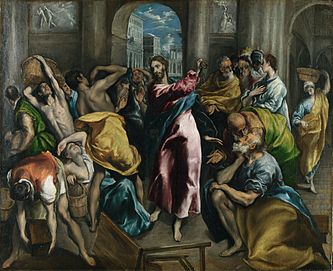
Jesus_cleansing_templeThe story of Jesus knocking over the tables in the temple and driving out the animals shakes us up but then we wonder what we should be all shook up about. Jesus’ act can be seen as the climax of repeated protests of the Hebrew prophets against the sacrificial cult in the temple. Jeremiah mocked his listeners who jabbered: “This is the temple of the Lord! The temple of the Lord! The temple of the Lord!”  (Jer. 7:4). Then there is God’s mocking question from Psalm 50 and repeated elsewhere: “Do you think I eat the meat of bulls and drink the blood of goats?” Amos proclaims God’s hatred of festivals. Most telling are the words of Hosea that Jesus quoted: “I desire steadfast love and not sacrifice, the knowledge of God rather than burnt offerings” (Hosea 6:6.) There is much debate as to whether the prophets wanted the abolition of the sacrificial cult or a reformation that would bring it in line with moral values. In driving out not only the money changers but also the animals about to be sacrificed, I think Jesus is doing a bit of guerrilla theater to prophecy the end of the temple cult, a prophecy fulfilled in 70 A.D. when the combined violence of militant Jew and the imperialistic Romans resulted in its destruction.

When asked to explain his actions, Jesus said: “Destroy this temple and in three days I will raise it up” (John 2:19) This literalist interpretation is promptly debunked by the evangelist when he says that Jesus was “speaking of the temple of his body” (John 2: 21). So much for biblical literalism. The implication that Jesus is replacing the temple with his risen body is a strong indication that he intended to abolish the sacrificial cult. What was wrong with the sacrificial cult? The quote from Psalm 69 “zeal for your house will consume me” shows us the problem if we note the context. Psalm 69 begins with “Save me O God for the waters have risen up to my neck.” The psalmist tells God that he is suffering the same reproach people level against God: “the insults of those who insult you have fallen on me.” This psalm is referred to as one of the “passion psalms” and has been interpreted as a prophecy of Christ. However, I don’t think the psalmist was gazing into a crystal ball and seeing Christ’s Passion; I think the psalmist was complaining about collective violence that was happening to him at the time. The number of persecution psalms and the fate of many prophets, suggests that the Gospels are revealing the human tendency to solve social conflicts by uniting against a victim which is precisely the outcome Jesus predicts when he explains his actions at the temple. T

he prophets consistently denounced the sacrifices made on the “high places,” pagan sacrifices to deities like Moloch who even required the sacrifice of their children. The sacrifice in the temple was more humane in that it was restricted to animals, but the practice derived from the notion that “god” was angry and would be appeased only by sacrifices. The prophets’ denunciations of the temple cult were consistently coupled with denunciations of social violence and injustice where the poor were sold for a pair of sandals as Amos complained. Although it is argued that the prophets thought the temple sacrifices were acceptable, maybe even laudable, if accompanied with righteous actions in the social sphere, but they seem to have a sneaky suspicion that the practice of sacrifice tends to encourage social injustice. The temple setup was, after all, a terrible financial burden on the poor. (I think Jesus was not edified but outraged over the widow who gave the last two coins she had to live on.) The logic of sacrifice was that some living being was always dispensable precisely as the victims of collective violence at the times of social crises were dispensable and their deaths “necessary.” Caiaphas stated the sacrificial logic baldly when he said that it was better “to have one man die for the people than to have the whole nation destroyed” (John 11:50) In modern times this sacrificial logic is expressed by the regretful term “collateral damage.” These considerations suggest that the prophets were convinced that something was fundamentally wrong with sacrificial rites.

Jesus, on the other hand, has a totally different, opposite logic; a logic that Paul says is foolishness to the rest of the world. In John 6, Jesus says that everybody the Father gives him will come to him and nobody who comes to him will be driven away. The parable of the lost sheep makes the same point that it is not the will of our Father in Heaven that even one of his “little ones” should be lost. Jesus believed this so strongly that he would accept death on the cross to make the point and, more important, return as the forgiving victim to gather all who will come to him so that none of us should be lost. The pagan deities wanted sacrifices made to them. The prophets kept trying to get it across to everybody that God pours out sacrificial love to all of us through creation and redemption and that God wants the mercy God gives us in return, not sacrifices .  Caiaphas was willing to sacrifice Jesus and anyone else who put a spoke in the wheel of the sacrificial logic. Jesus was willing to sacrifice himself rather than sacrifice any of us. That is why we do not slaughter bulls on this altar but pass around the bread and wine through which Jesus gives His very self to each one of us.

Above the Circle of the Earth

treespath1The Babylonian exile was traumatic for the Jews. Those who were taken to Babylon had to live in an alien environment quite contrary to everything they believed in. But an interesting thing happened during this exile. The sages and prophets who were living in exile came to close quarters with the mythology and sacrificial religion of their captors. When the Jews had come close to the Canaanite religion earlier in their history, the clash had taught them a few things about what the God they worshipped was all about. When the prophets saw the sacrifices of children to Moloch, they knew that this was not the kind of sacrifice Israel’s God wished and they protested these sacrifices with all their might. In Babylon, they came up against a mythology of a violent creation that took place with the dismemberment of Tiamat who, of course, was the deemed the cause of all the problems among the deities and who had to be punished. Moreover, the reason for creating the world was to make servants who would serve the gods. The sages and prophets learned from this mythology that this was not what their God was about. The God who had delivered them from the Red Sea was freeing slaves; not making them. This God had created a people by delivering them from violence and from a violent culture. They were hoping their God would do it again, and God did just that when the Persians defeated Babylon and allowed the Jews to return to their home.

The Creation narrative that begins the book of Genesis can easily be read as a refutation of Babylonian mythology. Far from creation emerging from violence, creation emerges from the Word of God which allows creation to be. The prophet we call Second Isaiah also proclaims Israel’s God to be far different, fully Other, than Marduk and his pantheon. “With whom then will you compare me, or who is my equal?” asks Israel’s God in a question so rhetorical that it stops all human mouths (Is. 40: 25.) The violence in Babylonian mythology mirrors the violence of Babylonian culture and other human cultures as both deities and humans live in the same system of retributive violence. But Israel’s God “sits above the circle of the earth” (Is. 40:22.) That is, God is outside the system. From God’s vantage point, we are all like little grasshoppers. This God is the creator “of the ends of the earth.” Not only that, but God “gives power to the faint, and strengthens the powerless” (Is. 40: 29.) Far from creating servants, God serves the creatures God has made and God serves most especially the powerless, like a rabble of slaves in Egypt and an exiled people in Babylon. Grasshoppers may be small in size but they are great in God’s care.

This vision of God as one who serves is embodied in Jesus as presented by Mark. Coming from outside the human system of violence, Jesus exorcises those who are possessed by their violent culture. Jesus serves Peter’s mother-in-law by healing her of a fever, thus allowing her to imitate Jesus by serving him, the disciples, and her family. Meanwhile, Jesus goes on to serve the many people who come to be healed of sickness and violence. Now God has come from “high above the circle of the earth” to serve us grasshoppers size.

Both Isaiah and Mark are showing us that creation is not a one-shot deal. Creation is a continuous process. God renews the strength of those who wait on God so that we can “mount up with wings like eagles.” Jesus uses the same creative power to heal sicknesses and drive away the violence that possesses us.

The question then is: Will we allow Jesus to bring us out of the exile into which violent human culture has captured us so that we can return to the world God created from the beginning—outside the System—or will we prefer to stay in exile?

Liturgical Animals (1)

monksinChoir1The reality of mimetic desire guarantees that we will engage in liturgical activity. What kind of liturgical activity and for what end leads to many possibilities. However, since we instinctively react to the desires and intentions of others, we also instinctively move and sing with each other and act together. Since we are mimetic animals, we are also liturgical animals. Much liturgy takes place in churches and temples but liturgy can be done anywhere at any time and it is indeed done all over the place. René Girard’s theory of scapegoating violence places the origins of ritual and liturgy in the spontaneous mob violence against a victim that “solves” a massive social crisis. At first thought, one would think there is nothing liturgical about collective violence; it just happens. But actually collective violence is a very predictable phenomenon that consistently works in a certain way once it gets started. We all know that once the persecutory ball gets rolling it is almost impossible to stop until blood has been spilled. The relatively few instances where the persecutory wave is stopped short of bloodshed also follow a predictable pattern. In essence, the mimetic contagion of a mob has to be redirected into another direction, one less destructive. This is what Jesus did when the Jewish elders were gathered around the woman caught in adultery. This is what Christians do to this day when celebrating the Holy Eucharist. Although I think it likely that sacrificial rituals have their origins in collective violence as Girard suggests, I think that ritual in itself is rooted more deeply in human nature. Since we humans are imitative creatures, we would instinctively coordinate our bodily movements with those of others. This sort of mirroring is instinctive to mothers especially in their interactions with their babies. It is this coordination of movement that would unify a family and then a clan and then a tribe. These coordinated movements would naturally turn into communal dancing and singing. Such coordinated action would naturally move into reenactments of primal collective violence once that occurred, but there is nothing in this instinct for coordinated movement that requires that it move in that direction. This is to say that collective violence and its continuations in sacrifice and institutionalized violence are not of the essence of humanity. There is nothing necessary about it; it’s just something that happens most of the time. What is necessary in the sense of being of the essence of humanity is coordinated movement. Our built-in mimetic desire guarantees that it will happen. There are practical reasons for this trait, among them coordinating movements during hunting expeditions, the way soldiers do military drills to facilitate coordination in battle, and the way football teams synchronize their actions, not to speak of the rituals performed by their fans. Singing together over common work such as gathering fruits and preparing meals might not be as necessary for success as the coordinated movement of hunting parties, but perhaps are as necessary at another level. Maybe nobody dies of boredom but we often feel that we can, and maybe we do in the sense that lack of interest in life isn’t conducive to living a long life. It is singing and dancing together and moving together in other ways that would have given our earliest ancestors an interest in living and it is these activities that spark our interest in life today. Many people today may think they are dismissive of liturgy because they think of stuffy church services or masonic rituals. But the ways we greet people, especially when introducing people to strangers or meeting them, are little rituals that we take so much for granted that we don’t think of them as rituals. When I was young, many people who never darkened the door of a church linked arms in the streets and sang the hymn “We Shall Overcome.” All this is to say that humans are liturgical animals. Gathering with others always has some liturgical overtones in the sense of repeating actions we are used to doing together. Drinking parties tend to follow the same patterns for those groups in the habit of gathering for that purpose. Given this human trait to gather through ritual, it is inevitable that any who wish to gather with others in memory of Jesus would gather liturgically. Liturgy is discussed at length in my book Tools for Peace.

Proceed to Liturgical Animals (2)

Christian Community (5)

guestsNarthex1Unfortunately, I can’t discuss Church without saying something about institutions called churches. I also can’t overlook the unfortunate fact that although the word “church” has six letters in it, for some it is a four-letter word.

A common distinction is made between the visible Church and the invisible Church. The former is made up of people who wear clerical collars and vestments and those who sit or stand or kneel in pews and sing hymns or songs of praise. The latter is made up of those who actually have their hearts and minds conformed to Christ regardless of whether or not they place their bodies in buildings with a cross on it. In such a distinction, the invisible Church is the real Church, although people invested in the visible church (sorry about the pun!) hope that at least some of them are in the real, invisible Church as well. Of course, this invisible church isn’t really invisible. It is perfectly visible to God and it is visible to all people who have eyes to see. In my earlier posts on the subject of Church, I have suggested that the essence of Church is to be aligned with the forgiving love of Christ that brings us to the place of the victim in opposition to the principalities and powers that feast on victims. Acting out the role of Church in this way is quite visible, just as visible the people who sing hymns and preach in buildings that we call churches. Again, we hope there is at least some overlap between the two, but we all know that the two hardly coincide.

The Church is, then, visible in acts of worship and in charitable acts such as ministering to the poor. The disconnect between these two visibilities is a cause of dismay and downright confusion. Some people who are devoted to both might find that the people they worship with and the people they work with in ministry are very different. This problem becomes particularly acute when a “church” openly allies itself with Empire. To this day, there is concern that when the Roman Empire theoretically converted to Christianity, Christianity was actually converted to the Empire. The establishment of what was called “Christendom” tended to institutionalize the violent tactics of Empire. The Inquisition was a particularly notorious example of this. In more recent history, the Nazi government of Germany ordered the Evangelical (Lutheran) Church to expel all members of Jewish descent from leadership positions. Complying with this demand was a betrayal of their own members and of Christ. The Confessing Church which seceded in protest was a remnant of the Body of Christ.

The disunity and discord among Christians is a further cause of scandal to many. That there should be many ecclesiastical bodies with long or sometimes short traditions is not a problem to me. People are different and cultures are different. It is sad, however, that most churches, were founded in protest against the ecclesiastical body they left. Many of the long-standing debates have been resolved and many ecclesiastical bodies work together charitably in matters such as world relief. Many of the divisions, however, smack of emulating the disciples who argued about who is the greatest and/or the slogans in 1 Corinthians: “I am of Apollos!” “I am of Cephas!” Many of the theological debates in the early Christian centuries over the Trinity and the Natures of Christ could have been carried on with less rancor if church leaders had not been so afraid that God would eternally torture anyone who didn’t get the formulas just right. Getting the theology right just isn’t enough when we get the Love of God wrong.

The scandal of Church for so many of us tempts us to chuck it all and try to go it alone. If Girard’s theory of mimetic desire is true, that is simply not possible. We are affected by the desires and intentions of others whether we like it or not. If we set ourselves over against everybody else in defiance, that very defiance makes us totally dependent on the people we are defying. After all, if we aren’t defying people, we aren’t doing much in the way of defying. The deeper problem is that when we make ourselves that dependent on other people, we are easily sucked into the power of persecutory mechanisms when they occur. A lone individual can’t hold out against such a thing.

So there is need to connect with others. This is a point I illustrate in some of the stories I’ve written, most particularly in Merendael’s Gift. The protagonist can’t stand up to social pressures of the kids he hangs out with until he allies himself with other children who band together to befriend this strange visitor from another planet. This group becomes an analogy for the Church as the Body of Christ. In real life, we have to be alert to the people who are sincerely and humbly entering the place of the Victim. (I say “humbly” because some people pridefully use “victimhood” to manipulate others.) We can only hope that some of these people actually are in a church in the ecclesiastical sense.

Girard’s theory of mimetic desire and the rivalry and sacrificial violence it can lead to suggests that they greatest division among Christians is along the lines of a theology and practice that is sacrificial on the one hand and one that is grounded in Jesus the Forgiving Victim on the other. Girard’s theory shows us how easily followers of Jesus’ Kingdom could easily slide back into remnants of the primitive sacred. The Body of Christ looks like the Body of Christ when it is embodied by people who stand up to the persecutory mechanism whenever it occurs. Unfortunately, any of us can easily fall into embodying instead the Satan who is the Accuser. That is to say, this schism between sacrificial and forgiving members can split right down the middle our own selves. This is why we need to strengthen ourselves with the practices of Church such as worship and interior prayer and mutual encouragement.

On Gathering with Those who Keep Oil in their Lamps

eucharist1Like many parables, the Parable of the Wise and Foolish Maidens is obvious and yet puzzling in some respects. The notion of forfeiting eternal life for failing to be prepared at a certain level is oppressive, but we can lift this degree of oppression by noting that the Kingdom of God is something we are supposed to be living NOW, in this life. This is what we are to be prepared for. If we are prepared NOW for the kingdom, entering more deeply into the Kingdom when we die will take care of itself.

It is worth noting that just before this parable, Jesus has thrown out the parable of the household where the wicked servant beats his fellow servants and gets drunk with the drunkards. Here we have an image of the violence humanity commits and suffers for not being alert to God’s Kingdom. Ironically, the wicked servant thinks the Master is delayed when the Master is already there in the servants he is beating. In contrast, the Foolish Maidens do not commit violence, but they fail to do anything that would stand up to violence such as that of the wicked servant.

I also think it significant that the parable is about two groups of maidens rather than just two maidens. As one who uses the thought of René Girard as a tool for interpreting scripture, I am inclined to interpret this parable in turns of contrasting human groups, each governed by a collective desire they share within that group. The wise maidens who have extra oil for their lamps are a community whose members encourage one another so as to keep their lamps burning. When they care about the Bridegroom and those the Bridegroom identifies with, their lamps burn yet more. I know how valuable it is to live in a community of men who all encourage me to remain ardent in prayer and kindness to those who come here, which makes it easier for me to encourage them in turn. The Foolish Maidens are quite the opposite. Here is a community, if one even wants to call it that, where the members encourage each other to remain apathetic and so strengthen apathy among themselves. Apathy is just as contagious as ardor, if not more so. When the people around us act (or fail to act) out of apathy, our own lamps are sure to burn lower and lower and eventually go out.

When the Wise Maidens say there is not enough oil to share when the Bridegroom comes, they are wrong in one respect. The strengthening of ardor among themselves could easily catch the foolish Maidens into its burning. The problem is that it is very difficult to extricate oneself from a group whose process has a strong grip on us and it is even much more difficult yet to change a whole group around all at once. Not even with the best will in the world could the Wise Maidens have enough oil burning to do that. The Foolish Maidens are like the drunkards in the previous parable who let the wicked servant beat the other servants and then drink with him. The Wise Maidens have the strength to stand up to the violence and witness to a nonviolent way of living. The Foolish Maidens may not be violent themselves, but they will be swept away by violence when it comes. We really do have to pay attention to the company we keep and how we keep it. The Wise Maidens do need to find ways to reach out to their Foolish sisters without getting caught in their apathy.

Finding themselves flatfooted when they realize the Bridegroom is here, the Foolish Maidens compound their foolishness by running off to the store in the middle of the night. With some stores open 24/7 these days, this act isn’t quite as irrational now as it was then but it is irrational enough. What they are doing is running away from the Maidens who have their lamps lit and away from the Bridegroom. They would have better off to stay with the Wise Maidens and the Bridegroom. It may have been humiliating to have empty unlit lamps but the Bridegroom is the one who lights the lamps of those who hold them out. They also would have been in a position to start catching the ardor of the Wise Maidens. By running off, they get plenty of oil but they have missed the chance to encounter the Bridegroom and those the Bridegroom identifies with. All of this is a perfect image of the kind of crowd panic in reaction to a problem that ensures that it only gets worse.The foolish maidens will almost certainly just let the oil run out all over again.

As with the wicked servant who thought the Master was delayed, the Maidens think the Bridegroom is delayed. The truth is that the Bridegroom is always already HERE. We can turn to the Bridegroom in love at any time and we can respond to the least of those the Bridegroom identifies with at any time they show up. THIS is what we have to be alert to and prepared for. There is lasting damage to being unprepared through apathy for the Bridegroom’s presence. I’m sure all of us can think of opportunities that we squandered and there is now no way to go back and make them good. The Forgiving Victim will still redeem all of us, but the diminishment and needless pain we have allowed always remains. Let these memories that we regret motivate us to stay close to the Bridegroom who lights our lamps in the company of others who will encourage us to keep our lamps lit.

Christian Community (4)

AndrewPalmSunday2I am becoming more and more convinced that we have to pay close attention to the historical fact that Christianity began in the shadow of an empire. Not just any empire but the Roman Empire, the biggest Empire in world history up to that point. This is also true of the Jews. Although they had a brief period of some independence under David and Solomon, the rest of the time, Juda was under the thumb of one empire or another at best and squashed by the boots tramped in battle at worst.

Of the Gospel writers, Luke in particular takes pains to locate the life of Jesus in history. He says that Jesus was born under the reign of the Emperor Augustus when Quirinius was governor of Syria. Some scholars have doubted the historicity of this particular census, but it is the sort of thing Empires do for the sake of social control and it sets the stage for the story. Later, Luke says that the word of God came to John son of Zechariah in the wilderness “in the fifteenth year of the reign of Emperor Tiberius, when Pontius Pilate was governor of Judea, and Herod was ruler of Galilee, and his brother Philip ruler of the region of Ituraea and Trachonitis, and Lysanias ruler of Abilene, during the high priesthood of Annas and Caiaphas.” (Luke 3: 1) Here we have a list of the very people who ordered the crucifixion of Jesus. These were the builders who rejected the cornerstone, the body of a man who is the Body of Christ.

Most people don’t like to think of cold hard politics at Christmas time, but the angels’ song to the shepherds was a political statement. Augustus Caesar claimed to be the peace broker for the Empire. Luke claims that the new-born Christ is the real peace broker. Thirty-three years later, it becomes clear that the Roman peace is kept through tactics such as crucifixion. Jesus’ parable of the Wedding Banquet in Matthew’s version helps us draw the contrast between Church and Empire.

Jesus also draws the distinction between Church and empire in his reply to the question designed to entrap him: Must we pay taxes to the emperor or not? The most important element of this little story is that Jesus asks his questioners to bring a coin because he does not have one. He has withdrawn from the economical system. This reminds us that Empire isn’t necessarily about politics; it is also about economics. Jesus’ lack of a coin suggests that the Parable of the Talents, in Luke’s version that portrays the master as violent, the servant who buried his talent might be the figure of Christ who dropped out of the economic order and was cast out. (I believe we should make the most of the talents given us by God; I’m just not so sure any more that this parable, at least in Luke’s version, teaches us that Jesus does not teach that God demands that his enemies be torn to pieces—a sacrificial act.)

What Empire is about fundamentally is power that must be sustained by sacrifice. This brings us back to the first post in this series where I discussed the contrast between Jesus’ way of gathering people and the Empire’s. Empire isn’t just about size. We all know of little fiefdoms all over the places, including (especially!) religious institutions. Since Empire is all over the place in all sizes, we need Church (not limited here to a single faith tradition) of all sizes in all places.

Being Church is not about dropping out of an imperial society. Jesus was living in the Roman Empire whether he liked it or not (and he probably didn’t) and we live in empires whether we like it or not, which I hope we don’t like. The fundamental thing to do is live and act grounded in the love and forgiveness of Jesus, the Risen Forgiving Victim. Virgil Michel, a Benedictine monk at St. John’s Collegeville during the Depression years was a strong advocate of creating parallel economic structures that would be nurturing for everybody involved. If I remember a lecture I heard about him some years ago rightly, Michel invented, or helped invent the credit union. As a leading member of the Roman Catholic Liturgical Movement, he envisioned liturgy as a springboard to social action.

Most fundamentally, Empire cannot be resisted in the Empire’s terms, which is the use of violence of any kind. This is what Jesus showed us in his silence before Pilate. If Jesus really is the wedding guest thrown out into the outer darkness and the penniless servant thrown out in the same way, then we can all join him in the outer darkness which will then lighten up with some help from the Light of the World.

See also: Stupid Galatians, Stupid Us

Go to Christian Community (5)

King’s Banquet — God’s Banquet

wineTableFeast1The parable of the Wedding Banquet has often been understood as illustrating God’s offer of salvation that some people reject and so miss out on the fun. That understanding seems to work in Luke’s version but it doesn’t work out so well in Matthew’s. Here, the king’s invitation is met with violence which the king reciprocates with interest and then he bounces a man who isn’t dressed properly and has him thrown out into outer darkness. The severe dissonance of these details inclines me to consider alternate interpretations of this parable.

Marty Aiken has written a detailed paper arguing for just such an alternative understanding. (See “The Kingdom of Heaven Suffers Violence: Discerning the Suffering Servant in the Parable of the Wedding Banquet.” He argues that Jesus’ listeners would have immediately thought of King Herod when they heard the parable. The king in the parable certainly acts like Herod. These listeners would have remembered Herod bringing an army to Jerusalem and asking the people to accept him as king. If the offer was accepted, Herod would have consummated the deal by marrying the granddaughter of the high priest Hyrcanus. There’s our wedding feast. The people of Jerusalem turned down the offer. Herod withdrew but then came back with his army and stormed the walls without stopping to negotiate. Antigonus, a descendent of the royal family, gave himself up to quell a violent situation. He was carried off in chains and beheaded by the Romans to give him a particularly humiliating death.

With this background in mind, we can see the guests who “made light of” the invitation as representing those who went home when Herod came calling and hoped everything would blow over and they could get on with business as usual. The other invited guests represent those who resisted Herod with violence. Both groups of guests are met with violent reprisals from the king in the parable. The rounding up of guests to replace the first lot is not, then, an act of charity for the poor but a forced gathering of whoever the king’s slaves could find.

With this interpretation, the cryptic scene of the man without a proper wedding garment makes sense as being the second part of the same parable and not a separate parable tacked on to this one. The king seems to be looking for a victim and he finds one handy, one who stands out by his attire. Like most kings, this one knows that the quickest way to unite a people is to focus on a victim. Moreover, this guest seems to be what we might call a nonviolent protestor, which obviously is threatening to the king. This guest’s eerie silence suggests Jesus’ silence before Pilate which Matthew emphasizes. Aiken points out that grammatically, the king could have been the speechless one, which would refer to Isaiah 52: 15 which says that kings will “shut their mouths” because of the suffering Servant. The fate of this guest is the fate Jesus himself suffers which had already been the fate of Antigonus. The Kingdom of Heaven, then, is not the banquet but the place of the victim who is cast out. Aiken recalls Jesus words in Mt. 11: 12, that up to this time, the kingdom has “suffered violence.” And so it does.

All of this is disappointing for those of us who are edified by the idea that God throws a heavenly Banquet and invites all of us to it. I find this image appealing and I don’t want to give it up. We don’t need to. The theme of what scholars call “the Messianic Banquet” is very real. The reading from Isaiah 25 is one example but treading the Moabites down into the dung pit smacks of Herod more than God. The invitation to the banquet in Isaiah 55 is much more positive and clearly is extended to everybody, presumably even the poor Moabites.

The real image of the Messianic Banquet in the Gospels is the feeding of the five thousand and four thousand in the wilderness. Here is a generous feeding to all comers with no reprisals for anybody who happened to stay away. No political force is exerted in the invitation. Nobody gets thrown out for being badly dressed. The poor are not afterthoughts, invited only the replace ungrateful aristocrats. The poor as well as the rich are all invited right from the start. The banquet offered by Jesus in the wilderness, away from the centers of worldly power, shows up the king’s banquet in the parable for what it is. Instead of an offer we cannot refuse, we are given an offer that we do not wish to refuse. This really is a cause for rejoicing always in the Lord, as St. Paul admonishes us.

Receiving Forgiveness

buddingTree1As we have noted several times, granting forgiveness and receiving forgiveness go hand in hand. Although receiving forgiveness wasn’t listed in the process of forgiveness, it is receiving forgiveness that completes the new cycle and breaks the cycle of revenge. In looking at the Parable of the Unforgiving Servant, we stressed the need to grant forgiveness in order to receive forgiveness. The circle works in the other direction just the same. We have to receive forgiveness in order to grant it.

Receiving forgiveness as a free gift sounds like a good deal until we remember that receiving forgiveness necessarily entails becoming aware of what we are being forgiven for. If we are convinced we have done nothing wrong, then we do not receive forgiveness no matter how often and ardently forgiveness is given us. If somebody tells us we have been forgiven, it implies that we have done something wrong to merit punishment as well as the forgiveness that is given us instead. That is to say, receiving forgiveness only makes sense when one is penitent. This does not negate the peremptory forgiveness given by God and imitated by those who imitate God as deeply as this. God’s peremptory forgiveness reveals the truth of the wrongs we have done and this forgiveness strengthens us to live up to the challenge to amend our lives.

I noted earlier that a major component of granting forgiveness is to renounce mimetic rivalry. The desire for revenge is a desire to win a victory against the person who has “defeated” us through personal injury. It is this desire to “win” that is renounced with forgiveness. There is a similar, but not identical renunciation of mimetic rivalry in accepting forgiveness. In committing sin that requires forgiveness, mimetic rivalry in the sense of seeking to dominate other people is often involved. This quest for dominance is one of the major things that need to be repented of in receiving forgiveness. Just as one becomes a “loser” in granting forgiveness, one becomes a “loser” in receiving it. This is the difficulty that Javert had in Les Miserables. (See A Miserable Gospel.) This gendarme had placed himself in perpetual mimetic rivalry through his determination to catch out Jean Valjean and bring him back to prison. This vendetta started at the moment of his release, without giving Valjean any opportunity to prove himself worthy of his release—or not. This mimetic rivalry on the part of Javert, which was never reciprocated by Valjean, made Javert relentlessly unforgiving and it made him just as relentlessly incapable of receiving forgiveness. He could not renounce his irrational quest to “win.” And so he lost everything.

Receiving forgiveness is essential for one who grants forgiveness. The temptation in granting forgiveness is to claim the higher moral ground over the one forgiven. If we think we have no need for forgiveness ourselves when we forgive others, we put ourselves above those we forgive, which is pride and, more importantly, a short-circuiting of forgiveness. This is why the Lord’s Prayer pairs praying for forgiveness with praying to receive it.

These considerations help us understand the puzzling verse in Romans 12:20. Paul tells us feed our enemies who are hungry and give water when they are thirsty for by doing this we will heap “burning coals on their heads.” Paul is quoting Proverbs 25: 22 here, which only pushes the puzzle back to the Wisdom Sage. If we are truly forgiving one who has wronged us and have renounced the desire for revenge or for someone else (God) to avenge us, then we truly wish to restore connections to the person who wronged us and to enhance that person’s well-being. Feeding and giving water to such as these as much as we give them to our own family and friends is enhancing their well-being. But what of those who cannot or will not forgive and cannot or will not receive forgiveness? Javert is an example of one who experienced a free act of forgiveness as the heaping of burning coals on his head. Valjean’s forgiveness seared his soul. Paul, and the Wisdom Sage before him, realized that forgiveness will burn the person who does not accept it. Such is the teaching of Jesus in the Parable of the Unforgiving Servant who was not tortured by the master but by his own inability to give and therefore receive forgiveness.

Receiving any kind of gift puts us in an inferior position to the one who gives the gift. Since forgiveness is rooted in God’s Desire, receiving forgiveness as a free gift always puts every one of us in an inferior position before God. Likewise, receiving forgiveness keeps us on the same level with other people as we forgive them and receive forgiveness from them. The Satan’s kingdom, the Empire, is fueled by the cycle of revenge. God’s Kingdom is fueled by the cycle of forgiveness. Both cycles are just as infinite but the cycle of forgiveness is infinitely larger than the other.


American war Sacrifice

crossRedVeil1The escalation of militarized violence has reached bewildering levels in the USA. Kelly Denton-Borhaug gives us an important theological response centered on the theme of sacrifice.

First, Denton-Borhaug surveys the militarization of our society which will be an uncomfortable eye-opener for most of us. Recruitment is taking place in our public schools and has infiltrated our computer games which are being more and more designed to train us for real war that is no game—or shouldn’t be.

One of the most disconcerting elements of our society’s militarization is the large number of Christians who are avidly supporting our wars. Denton-Borhaug zeroes in on the rhetoric of sacrifice which she suggests is the keystone of the presidential speeches since 9/11. The sacrifice being made on our behalf by those serving in the military is noble, sanctified. How dare we oppose those who make these great sacrifices? Well, there is the matter of the countless people “over there” who are being sacrificed without having enlisted with the US military for the job. These deaths are countless because the US military does everything it can to prevent counting their deaths.

Denton-Borhaug analyzes the Christian theologies of sacrifice, especially substitutionary atonement, that makes Jesus’ death a sacrifice required by the Father, or at least the cosmos. What has been happening is that political rhetoric is syphoning off the Christian resonances of sacrifice, corralling the sacrifices required of war as if the god of war were the God of Christ. Much of this works on subliminal levels.

Those of us working with the thought of René Girard and his colleagues see ourselves in a different place regarding sacrifice, but Denton-Borhaug has problems here as well. Girard himself she mentions almost in passing, only to suggest that Girard sees it as human nature to be violent so not much can be done with it. Mark Heim’s fine book Saved from Sacrifice is examined in some depth. Although Denton-Borhaug respects Heim’s attempt to get away from a theology of sacrifice, she thinks he fails. The failure hinges on Heim’s (and Girard’s) notion that only through his sacrificial death could Jesus reveal the truth of sacred violence.

I think Heim and Girard are right about this but Denton-Borhaug has pointed to an important point. If Jesus’ death is considered “necessary” in any way whatever, then it is vulnerable to the military rhetoric that proclaims the sacrifices of war as “necessary.” Girard avoids philosophical and theological terminology and so does not consider the category of contingency. This is where theological analysis is necessary for Girard’s anthropological insights. Granted, the power of mimetic desire analyzed by Girard was highly likely to lead to the violent outcomes of collective violence leading to sacrificial rites. But to retain any sound doctrine of Original Sin, we must insist that this violent outcome at the dawn of humanity was contingent. The same applies to Heim’s analysis of the Atonement. Heim is as clear as it can be that Jesus’ death was not necessary as far as God was concerned. If it was “necessary,” it was “necessary” for humans. Given the weight of history and the situation in Judaea at the time Jesus lived, it seems highly unlikely any other outcome was possible for Jesus’ earthly ministry but we have to insist that the death of Jesus was contingent. That is, the truth of sacred violence could have been (and actually was) revealed through Jesus’ teaching. It was not “necessary” for Jesus to be killed to reveal this truth, but that is what happened. Knowing Mark Heim as I do, I am almost certain this is his position. I have taken the time to go over this section of the book in more detail to show how the challenge from Denton-Borhaug can help those of us who use Girard’s thought to sharpen our thinking in this area.

In a broader sense, Denton-Borhaug has trouble with sacrifice and for good reason, since the militarized rhetoric is such a powerful form of emotional and spiritual blackmail that really has ruined many of the brightest and best of our younger generation. One need only note the traumatized lives, high rate of homelessness and suicides of our veterans to see how thoroughly they have been made sacrificial victims. Denton-Borhaug has trouble understanding the nobility of Christian martyrdom in the early centuries, not realizing the degree to which it was nonviolent resistance to the Empire. In fact, her practical suggestions are along the lines of actively making peace, a “theology of work” she calls it which amount to much sacrifice as well as resistance to violent political structures.

A thought-provoking and important book that helps us grapple with a major ongoing crisis in our time.

For an introduction to René Girard’s thought see Violence and the Kingdom of God