
 Jesus’ famous words in John: “I am the way and the truth and the life” (Jn. 14: 6) have inspired many Christians, including me, but they tend to cause some consternation in an age where many seek to be inclusive and affirming of diversity. Now that René Girard has greatly increased our awareness of mimetic rivalry, the worry grows that we might understand a verse such as this as meaning “my god is better than your god.” Such a reading projects our own rivalry onto Jesus so as to make Jesus a rival against other “gods.” Which is to turn Jesus into an idol of our own making.
In mimetic rivalry, as Girard articulates it, two rivals become mirror images of one another as they become so entangled in their struggle that the original bone of contention disappears. The two rivals are no longer fighting over a car or a dating companion but are directly tearing each other down and apart. Even ( perhaps especially) with people not so caught up in fighting for material possessions, rivalry over seemingly threatened beliefs can be extraordinarily fierce as we often stake our very being on our beliefs—whatever they are. If we engage in rivalry with people who hold beliefs other than our own, or with people with different understandings of Jesus, we lose sight of Jesus in the very act of defending Jesus as the way, the truth, and the life. Jesus rebuked his disciples when they fought over who was the greatest. Surely Jesus himself was not fighting with anybody over who was the greatest and he doesn’t want us to do that on his behalf.
I think we start to get a better understanding of this verse when we note that it leads up to Jesus’ proclamation: “Anyone who has seen me has seen the Father.” (Jn. 14: 9) This verse tells us that there is not the faintest trace of mimetic rivalry between Jesus and the Father. That is why Jesus is so transparent that we can see the Father through his actions and words. Later in this chapter, past what was read for today’s Gospel, Jesus promises to send “another advocate” to guide them into the truth. (Jn. 14: 16) This fills out the Trinitarian dimensions of divine transparency that attests even further to the lack of mimetic rivalry in God. Since Jesus says that he is sending “another advocate,” the implication is that he also is an advocate for us and his advocacy images the Father’s advocacy as well. This means we have three advocates who are advocates for everybody, including any person we might be in rivalry with. Not only is there no mimetic rivalry within the Trinity, there is no mimetic rivalry on the Trinity’s part with us. Any mimetic rivalry we experience comes from our human relationships.
To follow Jesus as the Way, the Truth, and the Life is to renounce all mimetic rivalry. This is a huge challenge because we feed on our rivalries so constantly that we often can’t imagine life without them. Much is said by theologians about how mysterious and incomprehensible God is. Often this mystery is couched in terms of God’s infinity and our finite minds. That is true, but for practical purposes, the divide between our mimetic rivalry and God’s total lack of it is the source of our incomprehension of God in our daily lives. This is why we are so prone to pitting God as a rival with others with whom we just happen to be in rivalry with. Renouncing rivalry is one of the ways we die to sin so as to rise to new life. Insofar as we manage to renounce our rivalries so as to follow Jesus as the Way that leads to life, we ourselves become life-givers who show the way and the life and truth that we receive from the Persons of the Trinity.
For an introduction to René Girard, see my essay Violence and the Kingdom of God.
 Easter is a great celebration, but it is a strange celebration. It isn’t like celebrating an election won or winning the World Series. It most certainly isn’t like celebrating victory in war. But if we have trumpets and kettle drums to augment the shouts of Alleluia!” we might forget the strangeness sometimes and get carried away by a sense of triumphant victory.
 We rightly meditate on the sufferings of Jesus during Holy Week. But in Matthew 25, Jesus made it clear that the sufferings of others were also his sufferings. So it is also suitable to meditate on the sufferings Jesus bears with others.
 The Feast of the Presentation of Jesus in the Temple is a belated closure to the Christmas Season. Since the excitement of Christmas and New Year’s Day is long past, we may have assumed Christmas was over, but the Presentation of Jesus is the last of the Infancy Narratives. The Christmas Cycle began with Advent, the time of expectation of God’s coming to us. In Simeon and Anna, we come full circle with two more people who were waiting for the consolation and redemption of Israel. Anna had been waiting for 57 years, with nothing to show for it until that day.
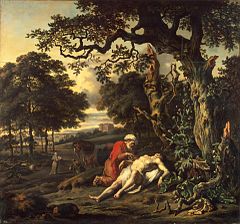 Many of us instinctively think that knowing is something we have in our heads, something we can recite, like a catechism. This is the sort of knowing that the lawyer demonstrates when he recites, correctly, the two great commandments when Jesus encourages him to answer his own question as to what he must do to inherit eternal life. (Lk. 10: 27) But then the lawyer shows a certain ignorance, a missing piece. He doesn’t know who or what his neighbor is. Jesus answers this question by telling a story that pinpoints exactly the missing piece in the lawyer’s cognition.
 There is much theology that treats the Trinity as a mathematical game, trying to work out how three can be one and one can be three. But math, important as it is for many things, is not the way of salvation.
 Luke’s version of Jesus’ Resurrection is much the gentlest among the synoptic Gospels. No earthquakes and no women running off so afraid that they can tell nobody what they had seen at the empty tomb. The women were, indeed, terrified of the two men in “dazzling clothes” who appeared to them. But by the time, but before long they have remembered, with prompting from the men in white, Jesus’ words to them.


