
 The introduction to the Parable of the Unjust Judge tells us that we should keep on praying and never give up. At the end of the parable, Jesus tells us that we should keep on praying even when our prayers go unanswered for so long that we think we are praying to one who does not care and perhaps is not even just.
It happens that in life, nagging and nagging is often the only way to get justice, or what we think is justice. There are some people who are eager to help and will hop to a request as soon as it is spoken, but many people are rather slow to do what is asked of them, and many people have vested interests in denying pleas for justice. These are the people who have more power than others and they usually use that power to take advantage of those who are weaker. Do the people with power take an initiative in renouncing their power for the benefit of others? Do people with power renounce it when politely requested to do so? We all know that doesn’t happen very often. Even in the top-down case of Czar Alexander II freeing the serfs in Russia, the class structure in Russia didn’t change very much.
Most of us instinctively identify with the widow who is trying to get justice. As widows, we expect that God’s granting of justice involves God strong-arming the unjust judges of the world until all of us widows get our rights. But that is not what happened with Jesus. Far from dismantling the unjust rule of the Romans, Jesus himself was condemned to death by the unjust judges among the Jewish leaders, the Roman governor, and the rest of us in the crowd. As the culmination of the persecuted prophets, Jesus reveals God to be the widow who is pleading with us, for justice.
That is. we are the unjust judges. Even people with little power overall tend to be unjust judges over those (such as children) who have even less power. This portrait of humanity raises the question as to whether it is God who delays justice. If humans act unjustly and delay justice to the point that injustice is a longstanding epidemic, then God could have been working overtime since the dawn of civilization and still have no hope of keeping up with the injustice.
Jesus as the crucified widow who died at our hands, the unjust judges, is not what we were looking for when we thought of ourselves as widows. But that is what we got. Not only that, but we also got the resurrected widow who still pleads for justice without ceasing. As the resurrected widow, Jesus has offered us, the unjust judges, forgiveness and the offer to enter into the kingship of Jesus. The parable suggests that we enter as importunate widows who plead with forgiveness and love for the unjust judges as some of our greatest leaders have done, leaders such as Mahatma Gandhi, Martin Luther King, Jr. and Desmond Tutu. But we also enter the kingship of Heaven as repentant unjust judges. In the parable, the Unjust Judge only relents because he is more miserable from being hassled by the widow than he is with any power he might lose by giving her justice. But at least the Unjust Judge finally does the right thing, even if his motives are as selfish as those of the Dishonest Steward in the earlier parable. (Lk. 16: 10–13) Maybe if we start to do the right thing, however grudgingly, we might find that doing the right thing, of granting justice to those weaker than we, isn’t so bad after all. Maybe giving justice can become a habit.
What does this parable teach us about prayer? It surely teaches us to pray constantly like the importunate widow, and to thirst for justice, as the Sermon on the Mount would have us do. However, we are not praying to a strong man who will manhandle the bad guys for us. (We would be among those so manhandled in that case.) We are praying with God the Crucified and Risen Widow who offers us freedom from our own injustice so that we can spread justice to others with a burning desire.
See also Jesus the Helpless Widow for another post developing the same ideas with a different slant or two.
 Can a charming rogue be an example of how to enter the Kingship of God? Jesus’ Parable of the Dishonest Manager invites us to explore that question.
 Jesus’ healing of the woman who had been crippled for eighteen years (Lk. 13: 13–17) is one of many healing miracles where the Evangelist emphasizes its occurrence on the Sabbath. These healings were provocative to the Jewish leaders because they interpreted the Sabbath law to preclude any kind of work. Jesus clearly intended to challenge that interpretation but there is a deeper teaching about the Sabbath that he wants us to learn.
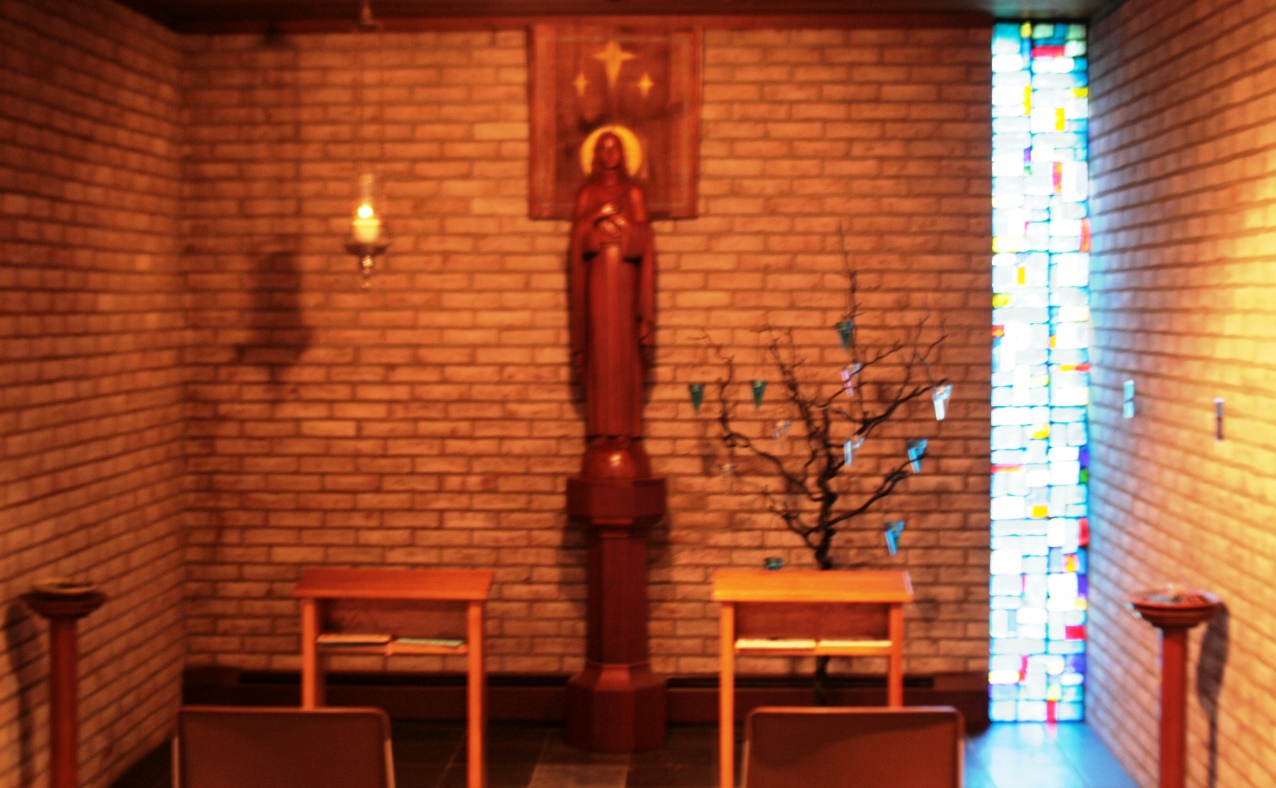 In most churches, the Blessed Virgin Mary is either given very high honor, sometimes exuberantly so, or she is cast out of mind except at Christmas where she might be allowed in a manger scene.
 When Jesus’ disciples asked their master how they should pray, he taught them a prayer that has us learn by doing. We are taken aback by Luke’s shorter version of this prayer (Lk. 11: 2–4) since the liturgical use of Matthew’s version with an added doxology causes us to think it is the only form it has. We will find, however, that this shorter version has the main elements of the longer one.
 When called by the prophet Elijah, (1 Kings 19: 19–21) Elisha asks to kiss his mother and father first. When he is rebuked for this demurral, he slaughters his oxen, breaks the yokes and burns them, and then follows Elijah. That is, he burns his bridges in making a clean break. Elisha makes this break, however, to join a brotherhood of prophets who have set up an alternate community to the violent and idolatrous kingdom of Ahab and Jezebel. Unfortunately, this community is also compromised by violence as Elijah calls fire down on his enemies (2 Kings 1: 10–12) and one of the prophets anoints Jehu to pull of a violent coup d’état. (2 Kings 9)
 The Feast of Saints Peter and Paul celebrates the pastoral ministry of the Church initiated by two different personalities with some differences of opinion. Celebrating two formative pastors already points to pastoral ministry as one of relationships. Then there is the whole matter of shepherds, as we often call pastors, in relationship with their flocks.
 The last wishes of a dying person are traditionally considered sacred and binding on that person’s survivors. Although it is the seven recorded words on the cross that are considered the last words of Jesus, the prayer uttered by Jesus in John 17 constitute the last words of Jesus before he was handed over to be crucified. He prays that we disciples “may all be one. As you, Father, are in me and I am in you, may they also be in us, so that the world may believe that you have sent me.” (Jn. 17: 21) These words have been systematically disobeyed by those of us who are Jesus’ followers from that day until now.
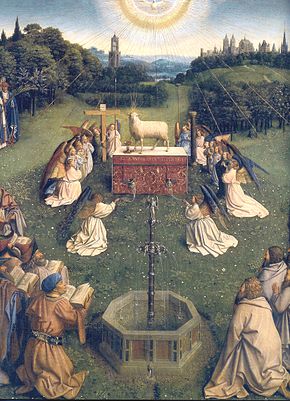 We usually understand a shepherd to be one who leads a flock of sheep and protects it from harm. But in Revelation, the author proclaims “the Lamb at the center of the throne” to be the shepherd of the multitude of worshipers from all nations. The worshipers are praising this Lamb whom they follow and the Lamb “will guide them to springs of the water of life.” (Rev. 7: 17) Their white robes have been made white in the blood of this Lamb because the Lamb has lead his followers through the ordeal. This is an odd sort of shepherd since normally it is the job of the shepherd to protect the flock from danger, not lead the flock into it.
 Easter is an occasion of great rejoicing with bells, boisterous singing, and feasting. But do we really know what we are celebrating? The Gospel reading, doesn’t exactly ring out with Christmas joy of angels filling the skies with songs of God’s glory. Instead, we get “two men in dazzling clothes” who tell the women who came to the grave to anoint Jesus’ body that Jesus was not there but had risen. They had come to the wrong place.
 Imaginary Visions of True Peace