

The brief story of Jesus visiting Martha and Mary, when Martha serves Jesus and Mary sits at his feet, listening to him, (Lk. 10: 38-42) has been interpreted as contrasting the active and contemplative lives since the early church. The contrast between Martha being so frantically active and Mary so still a listener firmly calls for attention. In any case, the relationship between activity and contemplation is one with which Christians have struggled since the Early Church. Although the Desert monastics embraced an ardent contemplative lifestyle, there are stories about the need for Martha, such as the amusing story of a visitor to a monastery who said he would not help with the work because he had, like Mary, chosen the better part, but was upset when he wasn’t called to dinner.
On the face of it, though, the contrast of action and contemplation doesn’t seem to be an issue for Luke or the other Gospel writers, which raises the question of whether or not the use of this story for evaluating the relationship between action and contemplation might be a bit anachronistic, even if congruent to the story. So I thought about what the story might have met to Luke–-but came up empty. I couldn’t think of any other meaning than the traditional one, which raises the question of whether it is so anachronistic after all.
First, I reflected on the pace of each of the four Gospels. Mark, considered the earliest, is very fast paced, breathlessly narrating the healing miracles and overwhelming the reader (or listener) with the power of Jesus’ ministry. Matthew and Luke slow the pace considerably, mainly by including long episodes of Jesus’ teaching, teachings that require reflection to begin taking them in. Although Luke’s pace is roughly the same as Matthew’s, it is instructive that he stresses more the times Jesus went off alone to pray, suggesting that Jesus had to balance his active life with contemplation. John, most likely the latest Gospel, is much the most contemplative Gospel as it unfolds at a very slow pace and suggests deeper meanings to the events in the narration. Such a progression suggests a growing awareness of those who developed the Gospel traditions of the need to contemplate the meaning of Jesus’ life that culminated in the shocks of the crucifixion and Resurrection, as well as absorbing the teachings which seem to have puzzled Jesus’ closest followers at the time. So, the traditional interpretation of this brief story doesn’t seem anachronistic after all.
When we look at the opening chapter of the Epistle to the Colossians, we encounter profoundly contemplative insights on the part of Paul, or whoever else might have written the epistle. (I favor Pauline authorship, but if somebody else shared the same contemplative insights as Paul demonstrated in his undoubted epistles, that attests all the more to the contemplative development of the early church.) Paul connects Jesus, whom he encountered on the Road to Damascus, to the Creator of the world, (Col. 1: 15–17) perhaps sensing the same creative activity on the part of God in Genesis as in the re-creation Paul experienced when Jesus called him out. This same Jesus is also the head of the Church, (Col. 1: 18) the specific group of humans who have responded to Jesus as Paul has. All this convinces Paul that the fullness of God dwells within Jesus. (Col. 1: 19) Most important, Paul realizes that Jesus’ reconciliation with him, who had formerly been hostile to Jesus, is part of a general reconciliation Jesus has made with all people, a reconciliation made not through the military, political, and cultural force of the Pax Romana, but the Peace of Christ who suffered at the hands of the Roman Empire. (Col. 1: 20) The very persecution Paul engaged in was flipped to a reconciliation by the suffering of Jesus. In this dense passage, we see the fruits of profound contemplation, a sitting at the feet of Jesus in quiet prayer. This gives us all the more reason to believe that Luke, probably writing two or three decades later than Paul, was passing on a caution traced back to Jesus that the action required by charity, such as in the Parable of the Good Samaritan that directly precedes this story of Mary and Martha, and the need to proclaim the Kingdom of God, be grounded in quiet contemplation of what the Kingdom ix really about.
In Genesis, we have the incident when Abraham and Sarah welcome three men who turn out to be angels. (Gen. 18: 1–10) Although there is much activity, we don’t see the frantic movements of Martha, and certainly not a trace of the resentment on Martha’s part. Starting with the Early Church, there has been a tendency to interpret the angels as the Holy Trinity come to visit the patriarch and matriarch. That interpretation really is anachronistic, but Paul’s proclamation that “the mystery that has been hidden throughout the ages and generations but has now been revealed to his saints” (Col. 1: 26) suggests that some interpretations of scripture will transcend time. The well-known icon of the Trinity by Andrei Rublev, inspired by this scene, leads us into the deep contemplation, not only of the hospitality of Martha, Sarah, and Abraham, but also of the hospitality of Mary who invited Jesus deeply into her heart. Such a presence of God within us can never be taken away from us and will remain with us for all eternity.
 The Holy Spirit is the most obscure of the three Persons of the Trinity, not that the other Persons aren’t mysterious as well. One reason is that the Son is said to show the Father, and the Holy Spirit is said to show the Son, but that leaves nobody to show the Holy Spirit. So obscure is the Holy Spirit that it is difficult to think of the Holy Spirit as a Person at all. It is not uncommon to hear the Holy Spirit referred to as “it,” although both masculine and feminine pronouns also fall far short of the Holy Spirit’s personhood.
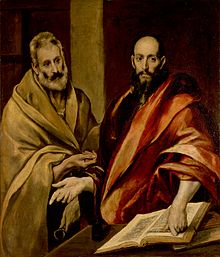 It is interesting and a bit ironic that we celebrate Saints Peter and Paul on the same day. Although there are famous icons of the two embracing one another in Christian love, the two seem not to have had an easy time getting along in real life. Although the two appeared to have been somewhat reconciled at the Council of Jerusalem in Acts 15, in his letter to the Galatians, Paul says that he opposed Peter “to his face” for backing down from what he thought they had agreed on. (Gal. 2: 11) The final chapters of John’s Gospel suggest tensions between the “Beloved Disciple” and Peter, and/or some tension between the two communities derived from them. The Beloved Disciple rests on Jesus’ breast at the Last Supper while Peter stubbornly tries to prevent Jesus from washing his feet. In her book Courting Betrayal,” Helen Orchard argues that Peter was resisting the slavish action of Jesus in washing his feet because he did not want to stoop so low himself. The episode of the Empty Tomb in John shows a rather awkward dance between the two where the Beloved Disciple gets there first but waits at the entrance and allows Peter to go in first. In this little tangle of a narration, both seem to have been first but not in the same way; which suggests some attempt to overcome the tension. In the final chapter of John, after the threefold question to Peter: “Do you love me?,” Peter points to the Beloved Disciple and asks” What about him?” Jesus answer basically tells us it is none of his business.



 Imaginary Visions of True Peace