Love as Ultimate Respect

???????????????????????????????????????????We saw that the substance of faith and hope consists of actions on the part of God. (See Faith as Faithfulness and Hope as Inheritance.) The substance of faith is the Paschal Mystery of Jesus’ fidelity to the Heavenly Father and all humanity in dying on the cross and rising from the dead. The substance of hope moves further back in time, to the beginning of time, in that hope is grounded in God’s adopting all people as adopted sons and daughters to inherit the vineyard God laid out at the dawn of creation. Love goes further back past the beginning of time to Eternity. It is God’s love that was poured out at the Creation of the world. In God’s eyes, the “vast expanse of interstellar space,” as Eucharist Canon C in the Book of Common Prayer has it, is small in God’s eyes, “a little thing, the size of a hazel nut” as Julian of Norwich images it. But God loves that little thing and “in this way everything hath its being by the love of God.” Julian goes on to explain, based on her visions, that God loves “that little thing” so much that when that little thing in the form of a servant goes on a mission and falls into a ditch, God sends a second servant to get the fallen one back out of the ditch, an act that causes all of the dirt and grime of the pit to stain the clothes of the saving servant. So it is that Julian is convinced that it was love and pity that motivated the Father to send the servant to suffer for the fallen one and that there was no trace of wrath whatever in the process.

God’s love precedes and quickens God’s deeds. God’s love transcends time and will never end and will certainly never change, but the effects of God’s love in time can change. We see this with the actions of embracing the cross on Jesus’ part and in the process of inheritance. It is this abiding act of love that we are invited to participate in as the means of being clothed in God’s Desire.

Rebecca Adams, a feminist colleague of Girard, offers us a compelling articulation of what God’s love is all about. In an act of authorial generosity (more love in action) Vern Redekop created space in his fine book From Violence to Blessing for Adams to articulate her understanding of love at some length. It was Adams who, noting how Girard tends to stress the negative side of mimetic desire, prodded him in an interview to admit that there was such a thing as “positive mimesis” where mimetic desire works among humans for constructive and humane purposes.

Interestingly, Adams gained her inspiration from a Star Trek episode where the pivotal character is a metamorph from another planet. A metamorph is all mimetic desire to the extent that such a person is incapable of any subjectivity so as to be nothing but a perfect mirror of the other’s desires. Such a culture is mimetic desire gone mad. We can see that however mimetic desire works, it is not intended by God to be the destruction of the core of another’s personhood. This metamorph, a woman, is a pawn in an interplanetary marriage arrangement where she will be married to a callous corrupt official. Captain Picard of the Star Trek crew wants to save her from this fate but she can’t even imagine wanting any other alternative, let alone fight for it. Picard solves the problem by desiring that the metamorph have a subjectivity of her own. Because of her susceptibility, she is so engulfed in Picard’s desire that she does begin to desire a subjectivity for herself and thus achieves the beginning of independence. This is sort of like being the “tiny little thing” becoming a hazel nut with the potential to grow into something large (like the mustard seed becoming a large tree). Picard proves to be a fine model of willing the subjectivity of another person, something he must have been doing habitually with the people in his life all along.

Adams sees this Star Trek episode as providing a third alternative to attempting to be autonomous or having a subjectivity completely derived from another. This relational willing of the subjectivity between persons gives each “the capacity to participate fully in a loving dynamic of giving and receiving in relation to others.” This willing of the subjectivity of another is something that will spread so that if two people “start desiring not only their own and each other’s subjectivity,” they will also “desire the subjectivity of others as well.” p. 267) As opposed to the closed system of mimetic rivalry, we have an “open system of intersubjectivity with its own creative, generative dynamic which potentially could expand to include everyone and everything.” God, of course, already and always wills the subjectivity of all. This helps to explain why I insist that respect is the essential prerequisite to love. (See Respect.) Adams’ vision is a model of love is ultimate respect for the other, a respect that gives the other a self as a gift as we all receive a self from God as gift. When respect reaches this level, we can say that it has become love grounded in God’s Desire. It is also what Paul admonishes us to in Romans 12: 12: “love one another with mutual affection; outdo one another in showing honor.”

There is one thought that gives me pause. What if the subjectivity of another person is evil. Adams can’t possibly mean to embrace such an evil subjectivity. For one thing, the mutuality is lost because an abuser tries to destroy the subjectivity of another rather than will it to flourish. Besides, Adams says that she has suffered such abuse so clearly she does not affirm this kind of subjectivity. On the contrary, this experience has taught her the importance of respecting the other’s subjectivity as a mutual process. However, the question that poses itself is: does an abusive person have a subjectivity, or much of one? If all of us can truly be a self when that self is received as gift, then anyone who tries to take away the self of another inevitably takes away one’s own self at the same time. This mutual losing of selves is what happens in the dissolution of advanced mimetic rivalry.

The great author of fantasy, J.R.R. Tolkien can help us here. In The Lord of the Rings he powerfully portrays the emptiness of evil in the ringwraiths and Sauron whom they serve. The ringwraiths have enough substance to be covered with black cloaks, ride black horses, and try to seek out the ring bearer who happens to be the hobbit Frodo. But there is otherwise no substance to the ringwraiths just as there is no substance to Sauron who wishes to repossess the ring of ultimate power and bind everyone and everything to his own empty desire. We see the same destruction of hobbithood in Gollum who is just as consumed with desire for the ring as Sauron.

Can one possibly will the subjectivity of a ringwraith or Sauron or Gollum? Frodo does respect the subjectivity of Gollum to the extent that he feels enough pity that he will not kill the creature no matter how painful Gollum’s constant nagging presence is. It is this pity and not Frodo’s strength to destroy the ring, which in the end he does not have, that saves the day, for it is when Gollum grabs the ring from Frodo and falls into the volcano that the ring is destroyed. Gollum is pitiable, but can we try to will subjectivity for Sauron? I would answer “yes” with much trepidation for I can hardly imagine going up to a ringwraith to offer him a dose of subjectivity let alone Sauron. Even Captain Picard would be challenged to be this brave. But God does will that a person empty of a self receive a self as a gift so as to be a self. When God so offer the likes of Sauron a self, we can tiptoe into God’s offer to share in it in our own small ways. At this point, love as ultimate respect is forgiveness, another gift of God grounded in God’s love. Let us not speculate on whether or not Sauron ever consents to receive a self from God. Let us ask ourselves if we are willing to receive this ultimate respect ourselves from God and offer it to others.
Liturgical Animals (3): Stories and Ritual

eucharist1Ever since stories started to be told it has been known that we resonate with them and with the actions of the characters at a very deep level. Aristotle famously called it catharsis where our own emotions are purified when we identify with the emotions of a character on stage. Girard’s theory of mimetic desire gives us increased awareness of the phenomenon. It is no accident that Girard discovered that the best novelists and playwrights had discovered it, not least Sophocles who had inspired Aristotle’s concept of catharsis. (See Human See, Human Want.)

The discovery of mirror neurons adds further scientific and anthropological understanding to the way we resonate with stories. (See Mirroring Desires.) Realizing that our mirror neurons are activated by the intentions of others, we now know that the actions of actors on stage or on the screen also activate our mirror neurons. This is why we are so affected by what they do and most particularly what they desire. By identifying with a thief who is the protagonist of a story, we easily find ourselves desiring the thief’s success although in real life we would normally not desire that at all. But then again, perhaps the story has revealed a hidden desire to steal successfully. Or, perhaps a desire that wasn’t there has been created by the thieving action. Or a combination of both.

This is where the debate about whether or not violence or any reprehensible actions should be allowed in movies or on the stage of even in books. Does the violence observed or read about make one more violent or does it cause a catharsis, thus acting as a safety valve that prevents violence in real life? As far as I can tell, the answer goes both ways. After the Columbine school shooting, a video game was blamed for motivating the killers to go on a shooting spree, but this accusation overlooks the huge number of boys in the same age bracket who did no such thing. What we are left with, I think, is the need for us to take some responsibility for what we watch and read and more important, for how we react to them. For some, watching cops and robbers programs are mild entertainment. For others, it is more a thrill of surrogate righteous violence. If it is the latter, is this surrogate thrill enough or does it lead to inflicting violence against the “bad” guys in real life and feeling righteous about it? Or, do we act these feelings of righteous indignation without knowing what we are doing? Which puts us in the position of those who crucified Jesus.

Which brings us back to liturgy. It is worth noting that Greek plays were performed as parts of religious festivals, making the expulsion of Oedipus, for example, a liturgical event. To this day, plays and classical concerts often have a quasi-liturgical atmosphere with dimmed houselights and norms for audience decorum similar to what is usually expected in church. The more raucous and extroverted actions at rock concerts and Pentecostal services are liturgical in their own right with different liturgical norms. The thing is, liturgies and plays and concerts all stimulate the same mirror neurons in similar ways.

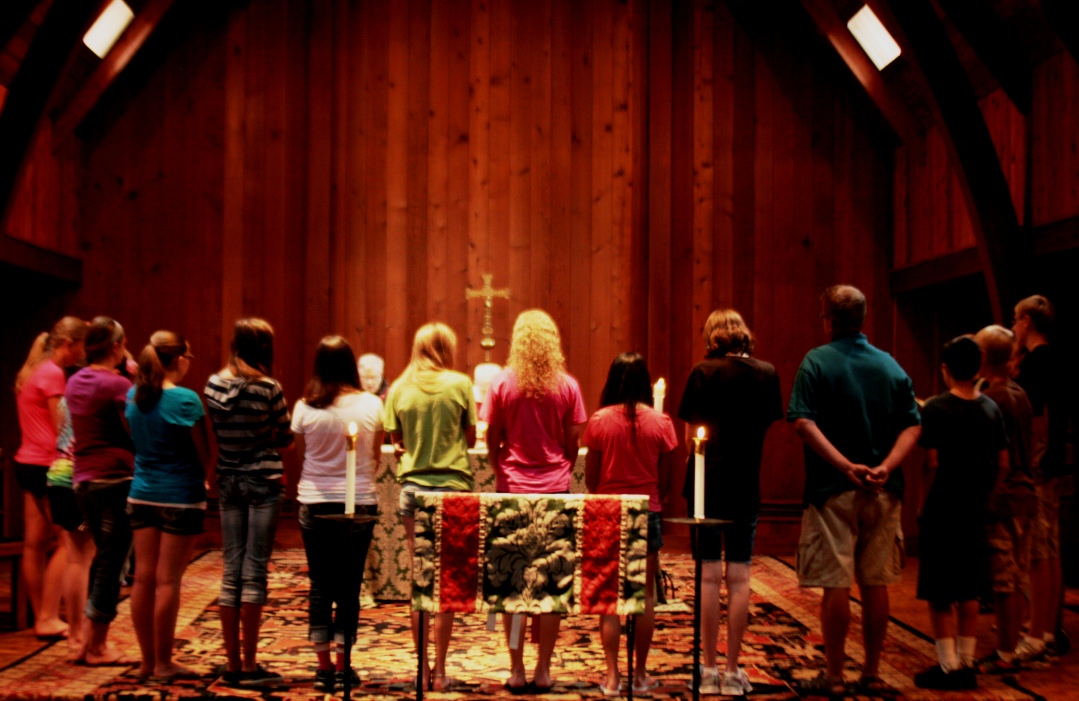
In Christian worship, the liturgical action is bound up with stories about Israel and most particularly, the story of Jesus. The stories are drawn out in the readings from scripture and the central story of Jesus, the Paschal Mystery, is compressed in the Eucharist where the story is fed to us literally in the bread and wine. Listening to the Word activates the mirror neurons, hopefully making us identify with the heroes and heroines of faith and most particularly with Jesus. Even from ancient times, certain people have been held up as good examples to imitate. As for Jesus settling a good example, since he compared himself to a burglar at one point, we can feel naughty and subversive in following his example and yet also feel righteous about it (Mt. 24;43). The pitfall is that we might identify with the owner of the house, and so try to keep Jesus out so that our lives aren’t subverted and turned upside down. This is just one example of how a story can twist us around in several directions, leaving us to wonder which end is up.

In general, plays and concerts are not repetitious the way the Eucharist is, which tells the same old story time after time to make it sink more deeply into us each time. It should be noted, though, that many people like to hear the same symphonies time after time and some people have favorite movies they see more times than they can count. Children have a ritual sense with their favorite bedtime stories that they want to hear night after night at the same time each night. In the Paschal Mystery, there is disclosure of the deepest truths about the way we humans live but also how we ought to live and could live by absorbing the character of Jesus. This is a story that never ends.

mimetic scarcity (2)

outsideSupper1The loosening of family and tribal bonds was a second and much longer term strategy for diffusing violence resulting from mimetic rivalry. (See mimetic scarcity 1 for context.) Up to the present day it has been effective enough to be considered a good thing. But it has its disadvantages. It has led to what Norman Geres, a writer cited by Paul Dumouchel, calls “a contract of indifference.” This contract has released from obligations for violence, such as the vendettas that have scarred many social groups. That is good. But this contract as also released us from obligations to care for the misfortunes of other people. That is, we are no longer our brother’s keeper. As an instinctive reaction to violence, the various effects were never planned out and they are still not easily visible. Most seriously, the contract of indifference is deleterious to social conscience. We don’t easily see a connection between our individual actions and their social consequences. To take one example: polluting the environment just doesn’t seem to get on the radar of those who use technology at a level that does just that. It supports an individualist spirituality where saving one’s own soul is the main thing and broader social issues are off the radar.

It is the scarcity created by this “solution” that forms the founding dynamic of capitalism. The basic argument, as I understand it, is that the scarcity gives humans an incentive to try and overcome the scarcity by increasing production so that there will be more material goods than there were. This works in the sense that more material goods are produced that can be consumed by people. But scarcity is not overcome because the increase of production increases desires for goods and when this leads to more increased production, desires increase still more. Material goods never catch up with desire. Mimetic desire, where we desire things because other people desire them, further intensifies this frenzy because whole inventories of perfectly wearable shoes disappear if only a few designs are in fashion. This is how this “peaceful” solution to violence leads directly to the quiet, hidden, sacrifice of many people on the hidden altars of indifference. Indifference is just as contagious as mimetic violence. The ennui of modern humanity analyzed by legions of philosophers and social commentators witnesses to the extent of this contagion.

If Paul Dumouchel is right in suggesting that creating scarcity has roots in early humanity, created scarcity has become much more prominent in modern times. I will make only a brief historical detour to consider the Jewish tradition. The prophets exposed the truth of collective violence much more deeply and clearly than other cultures, thus attenuating the efficacy of sacrificial religion. (“I desire steadfast love, not sacrifice” Hos. 6:6) Did this prophetic exposure increase use of the solution of scarcity to limit violence? The countless oracles against oppression of the poor suggest that scarcity was alive and well in early Jewish society. Perhaps the surrounding cultures, still grounded in sacrificial religion, still had stronger social bonds for caring for each other’s’ needs. Maybe. An historical study of this matter would be welcome.

In pleading for the poor and oppressed, the Jewish prophets were clearly aware of the problems created by scarcity and loosening social bonds and so were trying to increase the scope of “family.” That is, far from loosening ties, we are to strengthen them and extend them. By inviting all of us into being siblings of him, Jesus also encouraged us to be brothers and sisters of one another: the whole church, all of humanity is family. Jesus is most explicit in this teaching in Matthew 25 where “the least of these” are all part of Jesus’ family and therefore ours as well. It is this sense of family that motivated St. Paul to take up a collection in his various churches so as to give famine relief to the brothers and sisters in Jerusalem.

This is a hard saying. First the Jewish prophets and then Jesus, by his death as a result of collective violence, throws a monkey wrench into the first “solution” to violence. But before he died, Jesus, along with the prophets who preceded him, threw another monkey wrench into this second solution. We are given an ascetical double whammy. We have to renounce the solidarity that leads to mimetic strife and then to collective violence, but not only must we retain these same ties, we must strengthen and extend them when it comes to providing for others. That is, the borders that made providing for family tenable have been exploded. Not only that, but if these are “solutions” to violence resulting from intensified mimetic rivalry, and both have been exploded, then we have to discipline ourselves to renounce that rivalry. In analyzing the land enclosures in England, Dumouchel noted the mimetic rivalry of the lairds that caused them to desire better productivity of their lands that brought on scarcity without reducing any material goods in their environments. Make no mistake. I am not suggesting we have to renounce capitalism. We have to exchange goods and services somehow. But renouncing mimetic strife will change the social complexion of capitalism as it changes everything else.

One of the reasons this social demand for social solidarity seems so onerous is because we tend to hear it through the filter of “the contract of indifference.” That is, we think the entire burden falls on each of us individually. We forget even before we hear it that we are invited into a family, a family that is the Body of Christ. We do not have to take responsibility for others, each on our own little lonesome. That would be rugged individualism all over again. Instead, we are encouraged to take responsibility as members of a Body. Jesus reaches out to everyone through each and every one of us. Our personal responsibilities are collective responsibilities.

Christian Community (2)

guestsNarthex1In essence, the kingdom Jesus encouraged his followers to enter is based on peace and forgiveness. In his inaugural sermon in Luke, Jesus announced that the kingdom was about bringing good news to the poor, proclaiming release to the captives, recovery of sight to the blind, letting the oppressed go free, and proclaiming the Lord’s favor, to use the summary Jesus draws from Isaiah in his inaugural sermon in Luke. The year of the Lord’s favor refers to the Jubilee year, the year that debts were to be forgiven. We should not forget that the petition in the Our Father about asking forgiveness of our sins is also about forgiving our debts. Letting the oppressed go free refers to God’s command to Pharaoh to let God’s people go. This command applies to all of us insofar as we keep even one person in bondage to us in any way, including emotional blackmail. Years ago, at a Benedictine abbots’ workshop, I head a series of conferences on biblical spirituality by Demetrius Dumm, a seasoned monk of St. Vincent’s Archabbey. He said with deep solemnity that he was afraid that at the Judgment, we would each be asked one question and one question only: “Did you let my people go?”

These teachings are the primary blueprint for a community based on Christ, what some call Church, but this community that Jesus clearly tried to form did not happen in his lifetime, as recounted in my earlier post. (See Christian Community (1) This suggests that, important and fundamental as Jesus teachings are, they are no enough to form a community based on these teachings. What did form such a community was Jesus’ Resurrection from the dead. But it was not just the Resurrection itself that formed the community; it was the radical preemptive forgiveness with which Jesus approached his scattered followers. If Jesus had just bashed in the heads of his persecutors, everything would have been the same and we humans would still have no alternative but to cohere through the persecution of a victim. The church was not founded on the teachings of Jesus; the Church was founded by Jesus himself acting on his teachings. In short, Jesus forgave the Church into existence.

Note that Jesus did not forgive individuals and leave them as individuals. Jesus forgave all of us as the community of humanity. Jesus could stand alone against the persecutory crowd. We cannot. Only a community gathered on a radically new principle can counteract the old human community gathered the old way. This is what St. Paul was getting at when he said we have to become members of a new humanity in Christ.

I am not talking about the church as a set of institutions with their paraphernalia of miters, Geneva gowns, pointed steeples and mega buildings. I am talking about people who consciously seek to gather in the radical forgiveness of Jesus, a gathering that precludes the persecutory mechanism as a means of binding people together. This radical act of forgiveness on the part of Jesus was made for all people at all times. This means that everybody everywhere and any time who gathers in forgiveness is within the Church regardless of what ecclesiastical cards one might or might not carry in one’s wallet. Of course, most of us gather through forgiveness some of the time at best. That means that most of us are partly in the Church and partly outside of it. The Parable of the Wheat and the Weeds is about the world, the institutional church and each one of us. (See Christ  the Rejected Cornerstone among the Weeds.)

The New Testament word for Church, ekklesia, literally means “calling out of.” In this respect, everybody is in the church because everybody, without exception, is being called out of human community based on persecution and called into human community based on forgiveness. Of course, some people respond to this call and some don’t. Actually, most of us respond to the call some of the time at most. Such is the case of those of us who are members of an organized church and those who wouldn’t go through a church door under any circumstances. Not even as unifying an act as pre-emptive forgiveness by the risen Jesus can avoid causing division for the simple reason that each of us is divided by a choice we have to make day by day. There is much more to a theology of Church than this, but without the attempt to gather in the risen Jesus’ radical forgiveness there is no real church at all.

 Go to Christian Community (3)

Jesus the Rejected Cornerstone among the Weeds

field1Jesus’ parable of the wheat and the weeds inflicts on us the discomfort of being told that we have to put up with the people we don’t like but the end of the parable and the explanation of it afterwards give us the comfort of knowing that the people we don’t like will get it in the end. But does Jesus really mean to give us this “comfort?”

When we consider the workings of mimetic desire, the image of a field densely filled with plants intertwined with each other is easily seen as an image of our entanglement with the desires of other people, some of whose desires we covet, others we try to separate ourselves from. Of course, each person who wants something we want and we don’t think it can be shared, is an enemy, a weed who should be pulled out, expelled from the garden. In such a situation, each of us is prone to considering ourselves to be one of the intended, desirable plants while the others are weeds. Of course, when we are preoccupied with how “weedy” everybody else is, we are totally wrapped up with them in our hostility. It is easy, then, to understand this parable as teaching us to mind our own business and not worry about everybody else. The trouble with this interpretation is that we are all in the thick of this garden whether we like it or not and we need to find a constructive way to live with everybody else in it. A deeper interpretation that is often offered, and one I have much sympathy with, is that we should commend everybody else to God and let God deal with them. To make this work, we have to commend ourselves to God as well, or we think we are commending those bad guys to God but we are good guys who can take care of ourselves. Moreover, the word for “letting” the weeds grow is aphete, which also is used in the New Testament to mean “forgive.”

If we give this parable a Christological interpretation, everything looks different. In being the stone rejected by the builders, Jesus was a weed. That’s the way Caiaphas and Pontius Pilate and Herod saw him. Jesus identified himself with a lot of “weeds” on the way to the cross such as the woman with a bad name in town who washed his feet at Simon the Leper’s house and the tax collectors Zacchaeus and Matthew. Every planter knows that it can be difficult to tell an intended plant from a weed. This is why well-intentioned but uninformed “helpers” are the bane of gardeners. If we try to weed out the garden based on our own judgment, we are likely to weed out Jesus himself.

The explanation of the parable seems to be at cross-purposes with the parable itself. Many scholars absolve Jesus of having ever given it, relegating the explanation to a later redactor to the text finalized in Matthew, as Simon Joseph argues with such vengeful texts in The Nonviolent Messiah. Or, we can argue that Jesus was giving us a parody of what an obtuse listener who lacks ears to hear takes away from the parable, as Paul Nuechterlein suggests on his site Girardian Reflections on the Lectionary. The trouble is, self-righteousness takes us to such extremes that it is impossible to parody. Let’s take a look at where the “explanation” takes us. First, we become preoccupied with weeding out the undesirable plants. Second, we identify with the angels who weed the garden. Third we think we shine in righteousness that blinds us to our self-righteousness. That is, we play the role of God, which is idolatry. The end result is weeping and wailing and gnashing of teeth for everybody and no harvest for anybody.

If we look forward to harvesting as opposed to weeding, we get a totally different scenario that fits well with the parable itself. When it comes to harvesting, weeds just don’t matter. The only thing that does matter is picking the fruits and bringing them in so they can offer sustenance to others. When it’s all about harvesting, things start to look a lot like the heavenly banquet that all of us can share without worrying about who is wheat and who is a weed.

Accepting the Cross

crossRedVeil1Jesus’ words that “whoeverdoes not take up the cross and follow me is not worthy of me” (Mt. 10:37) are disturbing on two counts. We don’t like the idea of taking up the cross and we don’t like the idea of being rejected by God for not doing it.

It is worth pausing to note the question of whether or not Jesus could have said these words since they seem to read Jesus’ future back into this point in his life. As with the predictions of his suffering and death on the cross, I think it highly plausible that Jesus knew what was going to happen to him if he continued to teach and minster as he did if most people, especially those in power, persisted in rejecting his teaching and ministry. After all, Jesus had the example of Jeremiah and the other prophets to warn him. He did not need a crystal ball nor did he need to tap into his divine omniscience to foresee his destiny.

When Jesus said that “a disciple is not above the teacher,” he implied that we should expect the same results of imitating Jesus that Jesus himself had. This is a hard choice, one that entails renouncing worldly power and embracing the helplessness of the victim, but the alternative is to side with the oppressors either by actively joining them or silently allowing them to oppress others without challenging them.

The harsh words in Matthew suggest that God will definitively reject any of us who ever fall beneath this standard but the way Jesus treated Peter who failed miserably in this regard, not to speak of Paul who actively persecuted Jesus’ followers, suggests quite the opposite. There is a strong element of self-selection and self-judgment in rejecting the way of the cross. It is as when we speak badly of somebody or deny somebody, it tells a whole lot more about us than it does about the one we are speaking badly about. As the examples of Peter and Paul make clear, such states are not necessarily permanent unless we persevere in our rejection. It is simply the case that Jesus has a certain way of living that eschews violence and power in favor of weakness and the place of the victim. If we do not accept this way of Jesus, then we are simply not on Jesus’ way. Blaming Jesus for rejecting those who deny him is like blaming Jesus for the division his teaching and life brings about when such division is not Jesus’ intent but human decisions. (See Human Swords, God’s Peace.)

Jesus knows how hard it is to choose the way of the cross from his own experience and his sensitivity to any who might follow him. This is why he reassures us by saying that every sparrow that falls to the ground is known by the Father and that every hair on our heads is counted. Maybe the notion of sparrows falling to the ground is not so comforting but Jesus, in saying that we humans are worth more than sparrows, is assuring us that even when we fall to the ground, we are counted. This is what Jesus is getting at when he says that by trying to save our lives by denying the cross, we lose our lives and that by losing our lives we gain them when God catches us, just as Jesus catches every sparrow that falls to the ground. It is out of love for us that Jesus embraces the cross and it is our love for Jesus that leads us to do the same. Maybe we are worth more than sparrows, but sparrows are worth an awful lot as well.

Humility (2)

KatrinaCrossAbraham1[See Humility (1)[

The middle steps of Humility in Benedict’s Rule, the heart of his chapter, take us to the depths of the Paschal Mystery. They involve obedience “under difficult, unfavorable, or even unjust conditions” where  we “quietly embrace suffering,” being “content with the lowest and most menial treatment” and admitting in our hearts that we are “inferior to all and of less value.”

This looks a lot more like groveling before the King of Siam then does holding fast to the memory of God’s presence, but obeying under unjust conditions is what Jesus did during his earthly life, most of all during his last days. This step isn’t about bowing imperious rulers; it is about bowing to everybody, including those we consider the most despicable of human beings. Jesus did it. What about us? When we are being ill-treated, we console ourselves with the thought that at least we are better than those who mistreat us. But that is not what Jesus did. Jesus treated even Pontius Pilate and Caiaphas with respect, although the guards of the high priest didn’t see it that way.

This consideration adds a deeper perspective to the first step of humility that involves being ever mindful of being in God’s presence. There is a bit of a Big Brother is watching us about God’s perpetual mindfulness of everything we do and think, but the very God whose presence we should always remember is the God who accepted the meanest treatment at the hands of human beings like us. Doesn’t sound like Big Brother’s style of watching to me.

We are not easily content with “the lowest and most menial treatment.” We have a tendency to think that the world owes us the good things in life. If and when we don’t get them, we become highly resentful to everybody we hold responsible for what we don’t get. If and when we do get some of the good things in life, we think we only got what was coming to us. Of course, most of us find ourselves having to take the bad along with the good and we are resentful only most of the time. This is the case even if mathematically we get good things more often than not. Bad things always make stronger impressions on us. In short, we are the ones who act like the King of Siam, not God. When we stop expecting the world to give us nothing but the good things in life and become more concerned with those who don’t, and often they don’t have good things because of our inordinate greed, then we become more grateful for what we actually have. Gratitude has a lot to do with humility.

In these middle steps of humility, hard as they are to embrace, we come to grips with the incomprehensible love God has for us. Christ didn’t take time to dwell on how much more righteous he was than those who taunted him and nailed him on the cross. Jesus was too busy thinking about bringing even these people into his kingdom to have room in his heart for anything else.

So it is that at the bottom of humility, we find divine love. Benedict hints at the presence of God’s love that we experience within us when we let go of our pride when he says that, by following these steps, we “arrive at that perfect love of God which casts out fear.” At this level of humility, there is no dread of God because we have dropped our projections on God and have become free within the depths of God’s Desire.

I discuss the chapter on Humility in the Rule of Benedict at length in my book Tools for Peace.

The Cross as a Crisis of Faith

crucifix1Rachel Held Evans recounts her spiritual journey from fundamentalist Christianity to a Christian stance with many more nuances and much more depth in her book Evolving in Monkey Town, the town being Dayton, TN where the famous Scopes Trial, or Monkey Trial, took place. One event made a particularly deep impression on me as it showed how a growing instinct for the Paschal Mystery broadened her vision of a terrible news story she witnessed on TV.

The story was shown in 2001, just before the US invasion of Afghanistan, obviously for the purpose of justifying the invasion on the grounds of the Taliban’s callous treatment of women. (Never mind that if every country that has people who commit atrocities towards women deserve to be invaded, then every country in the world would deserve it!) The video showed a woman named Zarmina, dressed in a burqa, being dragged into a soccer stadium during halftime where she was executed before the capacity crowd. She had been charged with murdering her abusive husband, although a confession extracted after two days torture is rather suspect.

It is very important to note that Rachel’s reaction had nothing to do with criticizing Islam as a religion. Rachel’s problem had to do with Christianity. She had been taught all her life that only those who consciously accept Jesus as savior can be saved. But seeing a woman suffering such an atrocity on TV made it very hard for her to believe that a woman who had suffered so badly should have her suffering compounded by spending eternity in hellish torment because she had died a Moslem. That Zarmina had said her Moslem prayers in the face of what her co-religionists were doing to her speaks strongly for the power of Islam as a source of deep spirituality.

It became very hard for Rachel to believe that a loving god would predestine a woman like this to hell. When she thought about the Killing Fields of Cambodia, the gassing of Iraqi Kurds and the Jewish victims of the Holocaust, Anne Frank among them, it became harder than ever for Rachel to believe this of God who had sent his only begotten Son, not to condemn the world, but to save the world. She noted that in Sunday school, hell had been presented as a place for people like Hitler, but with no mention of his victims. Yet, all of Hitler’s victims who were Jewish were excluded from Heaven according to what she had been taught.

This event precipitated a crisis of faith that lasted several years. The irony is, this crisis was caused, not by a self-centered doubt about God, but by a deepening formation within her of the Paschal Mystery. If the risen and forgiving Jesus is the “living interpretive principle,” as James Alison says, then Jesus does not just interpret the scriptures, although obviously he does that, but Jesus interprets everything everywhere through the Paschal Mystery. So it is that all victims from Abel to the latest youth killed in urban gang warfare are brought into the Cross, and from there, raised to the life of the Resurrection. What Rachel had experienced as a crisis of faith was really a deepening of faith in the scope of the Paschal Mystery. So it is that Zarmina was surely gathered into deeper and greater life blossoming from the Moslem prayers she recited just before she died.

Principalities and Powers

WilliamGuestsChurch1Jesus was not crucified by just one person; he was crucified by a social system. The Gospels and the apostolic preaching in Acts show clearly how hostile social systems in Jerusalem came together to create a larger social system that was united solely by the agreement to put Jesus to death. By quoting from the persecution psalms, these sources suggest that persecutory social systems have always been a part of humanity. René Girard has demonstrated how mythology covers up and yet still points to this same persecutory mechanism. It is such social systems that Paul calls the “principalities and powers” of the world. These principalities get their power from the collective cohesiveness of persecution. This collective power is overwhelming to the individual within this system. Hence the transcendent power they have for Paul. However, Paul also says that the principalities and powers have been dismantled and nailed to the cross by Jesus. The forgiving victim is gathering a radically different social system that not only does not require the sacrifice of the victim but totally precludes such a thing. Paul says that if the principalities and powers had known, they would not have crucified the Lord of Glory. Because they did, we have some ability, by the grace of God, for seeing the fundamental signs of a society that is still run, at least in part, by the principalities and powers and for seeing what are the signs of the Kingdom that the Risen and Forgiving Victim has opened up for us.

A society run by the principalities and powers is punitive. Some people may think that is a good thing, but in  a punitive society, somebody must be to blame whenever anything goes wrong or even seems to go wrong. That is, somebody must be punished. When a society needs to have somebody punished, then this need takes precedence over justice. It is better for an innocent person to suffer than for the corporate rage of the society to suffer for lack of an object of that rage.  It follows that the Law of Tit for Tat reigns. There is no room for mercy. Every offense must be met in equal measure. As long as this Law reigns, there is no end in sight to the spiral of retaliation. In Jesus’ Kingdom, restoration of relationships is the corporate desire when things go wrong. The pain of this restoration might feel like punishment for some, but the pain is remedial, moving toward reconciliation.

In the society of the Principalities and Powers, somebody is always expendable. Caiaphas’ dictum that it is better that one person die than that the whole nation should perish is “gospel.” Collateral damage is an acceptable price to pay for objectives deemed good to those who are running the show. Jesus’ parable of the lost sheep that the shepherd seeks until he finds it and brings it back to the fold shows that in Jesus’ Kingdom, nobody is expendable.

The society of the Principalities and Powers is dualistic.  There has to be an “in” group and an “out” group. The society’s identity is based on what is wrong with those people, the enemy.  If we are to love our enemies, as Jesus teaches, then enemies do not define us in any way.

Most devastating of all, the society of the Principalities and Powers is mendacious. The need to cover up the truth of collective violence in primitive societies carries over to the most sophisticated of modern societies. Part of this mendacity is to blame the victim. The blame that many US politicians cast on women who are raped is a particularly grisly example. Victims of lynching, too, were blamed for what happened to them.

Here is the choice. Where is our treasure? Where is our heart?

Eucharist (3): Discerning the Body

eucharist1St. Paul solemnizes his recounting of Jesus’ breaking bread and passing the cup of wine by saying that he is passing on to the Corinthians what he had received from the Lord. The words Paul uses here are specialized terms for receiving and passing on a sacred tradition. The only other time Paul uses these terms is to testify to Jesus’ Resurrection appearances. Resurrection and eating and drinking to “proclaim the Lord’s death until he comes” go together. After all, does not the Lord come every time we eat the bread and drink the wine?

These solemn words are an island of peace and tranquility in the middle of a storm of human passions amounting to farce. Preceding them is Paul’s denunciation of the insensitive and chaotic eating habits where some people bring opulent meals to church and eat in front of poorer members who have little or nothing to eat. The deterioration of the sharing in the wilderness that began in John’s Gospel has only gotten worse. After holding up Jesus’ shared meal as a model, Paul warns against eating and drinking judgment by “not discerning the body.” Paul may be warning us not to fail to discern Christ’s body in the bread, but he is not thinking in individualistic terms. Christ’s body surely refers to the church and, given the context, Paul is concerned with failure to recognize this corporate body in the way we share, or fail to share what we have with the community. In his fit of tempter, Paul seems to suggest that the Body and Blood of Christ make people sick cause some to die. But considering how strongly Paul insists on God’s freed Gift of grace, Christ Body and Blood can only be more free grace and forgiveness. However, when we fail to see the Body and Blood in Christ in others, sickness, hunger and many more social ills will abound.

With a church in shambles, is the miracle of the Feeding in the Wilderness a distant memory? I noted in the first article in this series that memory is not just recalling something in our heads. Memory is making present. When we eat the death of Jesus, we enter into our own discord that tears the Body apart with cries such as “I am of Cephas!” “I am of Apollos!”  When we eat the Resurrection of Jesus, we eat the forgiveness with which Jesus greeted is disciples to gather them back together. We also eat the feeding in the wilderness and Jesus’ Desire to heal the people brought to him.

We are not left as orphans who have to try to stuff some ideal of human relating into our heads. We are invited to act with others the human drama of entering into God’s Desire for ourselves and all others. Most important, we are fed with the substance of God’s desire to quicken us on the way.

 Eucharist (1): Christ our Passover

Eucharist (2): Feeding in the Desert