
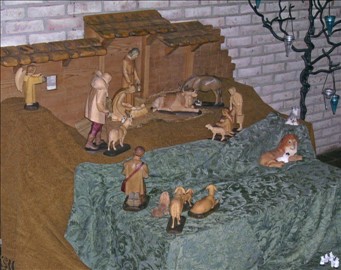
Advent is a time when we anticipate God’s coming into our lives in mysterious ways. But are we really looking forward to God coming to us, or are we expecting business as usual, even if business isn’t all that good? Do we believe that God can affect our lives, or do we live on the assumption that such does not happen?
During a time of crisis, King Ahaz is urged to ask a sign of God but refuses to do so. (Is. 7: 1-12) Why? Asking God for a sign would alert him to the possibility that God might enter his life in some way. Business is bad, with the Assyrians threatening Jerusalem, but maybe he would rather be trampled by a powerful army then open himself up to what God might do. In the face of the king’s closing himself off, the prophet Isaiah announces a sign whether the king likes it or not. The sign doesn’t seem like much up against an invading army. How is a new born child going to solve the problem? Well, it isn’t exactly the baby who solves the problem; it’s God who solves the problem with a nudge that sends the invading army away. The baby was a sign of hope for the future, as babies often are. Nothing happens here that conflicts with the laws of nature. After all, God can accomplish much with the laws of nature. (The old translation that had a “virgin” conceiving in Isaiah’s time is considered by almost all scholars to be a mistranslation.) Now God’s little but decisive nudge wasn’t so bad was it? The only problem was that the king wasn’t in control of the situation. Not letting God control his situation would lead to Assyria controlling the situation. Is it easier to cope with being controlled by other humans that in some mysterious way being controlled, or at least led, by God? That is a particularly good question for us to ask ourselves during Advent.
Fast forward to Joseph confronted with a betrothed woman who has become pregnant, but not by him. Knowing the laws of nature as well as any modern gynecologist, Joseph decides to divorce Mary discretely, but before he can carry out his resolve, he is challenged by a dream to believe that God has intervened directly in violation to normal natural law. One could say it is once again just a little nudge. Once the conception of the child has taken place, the child develops in Mary’s womb like any other child and, when born, is just as fully human as any other child. But this little wedge, or nudge, is a big one, even a cosmic one. It is a nudge that has fundamentally changed the world for all time. And yet this little nudge, in spite of being contrary to natural law, did not send an army away. The Roman army stuck around and did its work, including the crucifixion of criminals, one of whom turned out to be the child conceived by the Holy Spirit. On the surface it doesn’t look like much of an intervention.
At this point we might ask ourselves: Do we need a decisive intervention from God such as Matthew claims to have happened with the conception of Jesus in the womb of Mary? Maybe business as usual has been bad, but at least we’re used to it. St. Paul, however, insisted that humanity had become a train wreck and needed the direct presence of God within humanity before anything could get better. St. Augustine and subsequent theologians have seconded the motion. The modern thinker René Girard has offered us anthropological insights to suggest that we are too entangled in rivalrous relationships for any of them to be disentangled unless there is intervention from outside the system, which to say: from God. So, business is bad, as I said, but do we prefer the bad business as usual to the unknown possibilities that might emerge if we embrace the child born of the Virgin Mary? Christmas is coming. Do we really want Christ to come?

 The story of the Magi’s visit to the newborn Christ Child in Matthew is one of the archetypes of the Christmas season. Most popularly, the Magi are the archetypes of giving because of the gifts they brought to the Christ Child and they are often credited with being responsible for the exchanges of gifts customary during the Christmas season, even among people who otherwise have nothing to do with Christianity.
 John the Baptist is so closely associated with the beginning of Jesus’ ministry that it’s easy to see them as two of a kind. Both preached repentance. Both died the death of a martyr.
 Jesus’ healing of the woman who had been crippled for eighteen years (Lk. 13: 13–17) is one of many healing miracles where the Evangelist emphasizes its occurrence on the Sabbath. These healings were provocative to the Jewish leaders because they interpreted the Sabbath law to preclude any kind of work. Jesus clearly intended to challenge that interpretation but there is a deeper teaching about the Sabbath that he wants us to learn.
 Right after dramatically recalling God’s deliverance of the Jews from the Red Sea, Isaiah proclaims that God is “about to do a new thing; now it springs forth, do you not perceive it?” (Is. 43: 19) By his time, the Red Sea deliverance was an old thing, something the Jews repeatedly recalled, especially at the celebration of Passover. But at the time of that deliverance, it was a new thing that had sprung forth. Delivering escaped slaves through turbulent waters just wasn’t in the play books of deities at the time. God had changed the play book and revealed the hitherto unknown truth that God is a God who delivers victims and outcasts from the rich and the powerful.
 Luke stresses the contrast between John the Baptist and Jesus much more than the three other evangelists. Most strikingly, Luke does not specifically say that John himself baptized Jesus. Luke describes John’s ministry and then says Herod added to all his other crimes by putting John in prison. (Lk. 3: 19–20) Then Luke puts Jesus front and center by saying the he was baptized “when all the people were baptized.” (Lk. 3:21)
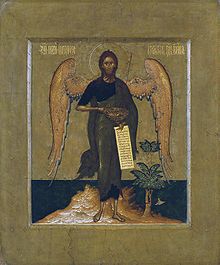 Although John burned with a conviction that God was going to do something new, he had only the models of past prophets to guide him in opening a way to the great new thing. He lived in the desert, wore a camel hair coat and ate wild locusts and honey in imitation of Elijah. Like the prophets of the past, he warned the brood of vipers of the wrath to come if people did not shape up and turn back to God. (Lk. 3: 7) Again like the prophets, he told soldiers not to oppress vulnerable people. Yet again like the prophets, he rebuked his ruler, Herod. And like so many of the prophets, he was put to death.
 Imaginary Visions of True Peace