The Process of Forgiveness (2): Letting Go

purpleFlower1Owning the hurt of injury is the beginning of letting go of the hurt that strangles us. For some people some of the time, letting go and forgiving happen simultaneously so as to seem like one movement.(See The Process of Forgiveness 1)  For most of us most of the time, the two are distinct, though closely related. This is most clearly the case when a kind of reverse psychology allows a letting go that leads to forgiveness. I have already noted that pressuring somebody to forgive horrendous injury such as childhood molestation because it is the “Christian” thing to do intensifies the pain of the injury with guilt for not being able to forgive it. In such cases, absolving the victim of forgiving the hurt allows that person to let go of it. Letting go removes the hurt from the center of our lives where it has been a major, often the central organizing principle of our lives and gives us the freedom to move on. Letting go does not mean that the hurt doesn’t hurt, but letting go loosens the hold the hurt has on us.

The most important element in letting go is non-retaliation. Here is where the famous admonitions in the Sermon on the Mount come into play: turning the other cheek, walking a second mile etc. It is important to note that non-retaliation, in itself, is not forgiveness. Withholding a counter punch that one is capable of delivering does not necessarily mean that one has forgiven the injury to the cheek. What non-retaliation does is push the pause button on violence that keeps it from escalating out of control, a scenario that makes forgiveness harder for everybody.

Letting go, especially in its form of non-retaliation, is a renunciation of trying to “win” a situation and instead assumes the position of the “loser.” This also makes the renunciation of retaliation a renunciation of mimetic rivalry. Remember that seeking revenge is fundamentally an attempt to “win” a struggle against the other and thus it perpetuates mimetic rivalry. In the heat of battle, winning is everything. When the battle is over and we are scarred more than ever or worse, winning turns out to be nothing but the burden of holding on to the hurt. After all, we haven’t let go and so the hurt keeps us in its relentless grip.

This is where humility comes in. Humility is the willingness to be a “loser” in the hope that we might win the person injuring us. Humility is particularly important here because not retaliating tempts us to think we have taken the higher moral ground. The tricky thing is that we have taken the higher moral ground but if we pat ourselves on the back for that, we become obsessed with ourselves and so turn the situation back into a contest of wills, which is mimetic rivalry. This is a case where it is important that the right hand not know what the left hand is doing.

Proceed to The Process of Forgiveness (3)

The importance of non-retaliation is that it gives us a tangible means of letting go that tells us if and when we really have let go of the hurt. If we slug the person back or sincerely wish we had, we have not let go. If we refrain from slugging the person back and don’t wish we had done it, we have let go. Simple as that.

Non-retaliation has been extolled by some, most notably by Walter Wink, as a strategy for resistance to the Empire. Wink suggests, for example, that turning the other cheek puts the aggressor in the awkward position of having to strike back-handedly. This take is attractive to many and it may be right, but insofar as turning the other cheek is intended as a strategy to muck up bullying behavior, it is not forgiveness. On the other hand, insofar as imperial politics requires reciprocal violence, any act that opens the way to forgiveness is an act of resistance to any Empire.

The most important thing to realize about letting go is that we are not cutting the connection between us and those who injure us. Trying to do that is futile. Our mirror neurons see to that. What letting go does is loosen what had been a tight, strangling connection to the other. Letting go gives each of us room to maneuver and to change the situation. We can’t, of course, take responsibility for what the other person does with the room this loosening gives. We can only take responsibility for ourselves. That is all we can handle anyway. More important, non-retaliation provides room for God to enter into the broken relationship and fix it.

After letting go of the hurt, the next step is to make sure we don’t grab it back and that we leave ourselves open to the mystery of forgiveness itself.

Binding and Loosing

AndrewPreaching1How many of us listen to Jesus’ words about correcting fellow members of the church and think they are about punishing people and casting them out? (Mt. 18:15-20) Checking ourselves for such reactions is a good way of taking note how instinctive punishing and excluding are to us and how less instinctive is forgiving and including and welcoming others. It is precisely this instinct to punish that makes it difficult to have ears to hear what Jesus is saying and hear what the Spirit is saying to the churches.

If we take a step back and ask ourselves what our instinctive reaction to being wronged is, we find that the first instinct is to seek revenge. If somebody hits you, hit him back. Simple. But Jesus tells us to go to the person and tell that person what they have done to us. This action puts a serious break on the revenge mechanism and moves in the opposite direction. After all, going to the person peacefully and honestly is the first step towards reconciliation, which is the last thing a person bent on revenge wants. If speaking one to one does not resolve the matter, then the circle widens to two or three and then the whole assembly. What is easily overlooked in this process as described here is that it presupposes that each of us is expected to take responsibility for the community and for each other. This is why we should warn a person who is acting destructively, but it is also why we should be open for others to approach each of us to correct us. Of course, anyone who has ever corrected another person knows that this can result in learning about our own shortcomings. One of our favorite slogans at St. Gregory’s Abbey is” “You do it too.”

Treating an unrepentant person like “a Gentile and a tax collector” sounds straightforward enough. We kick the person out and that is that. But that is not that. For one thing, this is not an act of vengeance, or at least it’s not supposed to be. It is an act of distancing, an act that, when used rightly, shows that the reproved person has distanced him or herself from the community. It is realistic in that some people make themselves impossible and a peaceful parting is necessary. But that is far from the end of that matter. Matthew himself was a tax collector. How was he treated? Jesus called him to follow him and be a disciple. We need to keep in mind the context. Immediately preceding this list of instructions for dealing with a delinquent person is the Parable of the Lost Sheep. All this suggests that the way to treat a Gentile or a tax collector is to try to bring them into the Christian community, which entails forgiveness.

Forgiveness? But we are told that those we loose on earth are loosed in heaven and those who are bound on earth are bound in Heaven. Sounds like we have the power to bind other people for all eternity and God’s hands are tied for as long as we want them to be. How much power is that? But not so fast. Why is it that we so easily assume we are being allowed to bind on earth when we are being encouraged to loose on earth? We need to note what follows immediately after this verse: Peter’s question about how many times he must forgive an offender and Jesus’ parable of the unforgiving debtor. If we have to forgive others as God forgives us, and that without limit, as Jesus’ saying we have to forgive seventy-seven times means, then we are indeed being encouraged to loose on earth and are being warned that if we do not loose on earth, we are bound to our resentment for what others have done to us (or we think they have done to us) and we will be so bound even in Heaven since God’s hands are indeed tied for as long as we refuse to let God untie us.

See also: The Sin against the Holy Spirit

The Process of Forgiveness (1): Owning the Hurt

purpleFlower1When I suggest that forgiveness is a process, the implication is that there are several steps to the process and we take them one at a time. It isn’t as simple as that. There are steps that can be articulated to give us a sense of direction for the process, but they are all so closely interrelated that it is more like disentangling a tangle of yarn than a matter of climbing steps on a ladder or a staircase. The image of the tangled yarn, something that often feels more like a tangled rope around our necks, suggests that the process has a lot to do with loosening something that is tight, which is precisely what the Greek word aphesis, a word often translated as forgiveness, is about. Letting go that which has tied us up simply takes time.

Desmond and Mpho Tutu have written a valuable book called The Book of Forgiving that helps us understand the process of forgiveness. In my own reflections I don’t come up with precisely the same list, but it comes close and the four-step process in Tutu’s book gives us something to work with.

The first two steps listed by the Tutus are: 1) Telling the Story and 2) Naming the Hurt. These two steps are so closely related that they feel like one step to me, albeit a more complex step. I am inclined to call this first step: own the hurt. This step seems simple but it can be difficult emotionally because it means facing the pain and that is—well, very painful. It is, however, pain that is necessary for healing just as an infection has to be opened before it can be healed. Community is important as one almost always needs at least one sympathetic listener and often there is need for many more than that. The importance of telling the story is that when another has invaded us by injuring us, we are suffering on the terms of the perpetrator. The first step of suffering on our own terms is to tell the story, to face the truth of what has happened to us. We cannot forgive what we have not seen and faced for ourselves. As long as the truth of injury is repressed, it holds us in its grip. Over the years I have listened to people tell their stories, some of them about childhood sexual abuse. This listening makes it clear that the very act of telling the story changes the story from what it was before. Something moves within us when we tell our stories.

The many psalms of lament model for us this step of owning the hurt by telling the story. There is a communal element to these psalms as they seem to have had cultic use in Israel, and in fact are sometimes collective laments, and they have a long history of use in public worship in Christianity. These verses from Psalm 31 are one sample among many that could be picked out from the Psalter:

I am the scorn of all my adversaries,
a horror[c] to my neighbors,
an object of dread to my acquaintances;
those who see me in the street flee from me.
                      I have passed out of mind like one who is dead;
I have become like a broken vessel.
                   For I hear the whispering of many—
terror all around!—
as they scheme together against me,
as they plot to take my life. (Ps, 31: 11-13)

The Truth and Reconciliation Commission in South Africa that Bishop Tutu chaired is, to date, the most powerful instant of a communal telling of stories. Everybody who wished was allowed to tell the truth of the injuries they had received during Apartheid. Perpetrators were also invited to tell their stories and were granted amnesty for doing so. Telling the story also makes it clear that much more is at stake that the forgiveness by the victim. Those in South Africa who listened to the testimonials, from the bishop himself to those watching on their TVs, were challenged to forgive what had happened.

There is a danger in telling the story. Doing so does not automatically begin a healing process. It can do quite the opposite. Asking God to blot our abusers from the land of the living (Ps. 69:28) once we have told the story of waters rising up to our necks (Ps. 69:1) hardly moves us in the direction of forgiveness. Telling the story of victimization and listening to it can enrage us and lead us to seek revenge. Worship in Holy Week involves telling the story of Jesus’ sufferings that culminated on the cross. What these observances should do is deepen our compassion for the victim, leading to compassion for all victims. Instead, Jews learned over the centuries that it was dangerous to be walking about during Holy Week if there were Christians around.

This is why I include “own the hurt” as an integral part of this first step. It isn’t enough to tell the story; it is necessary to tell the story in a listening way. That is, we must listen to ourselves when we tell the story. The importance of at least one more person listening is that a good listener can help the teller listen more deeply to him or herself. The mimetic desire to hear the story between two or more people increases the listening that is happening. Since the abuse we have experienced is inscribed in our bodies, we need this deep listening to reach our guts so that the muscles tightened over what has happened can loosen. The act of loosening happens in our bodies before it happens in our heads and we can’t put our hearts into forgiving until our guts have done it. I have listened to enough people to have learned that there is a strong and clear distinction between those who listen to what they are saying and those who don’t. Those who listen well to themselves move towards healing. Those who do not listen to themselves remain stuck with their pain, trapped with no exit until they do learn to listen.

Such deep listening is owning the hurt. Owning the hurt does not make it hurt less and it certainly does not solve any problems, but it is the first step toward healing and forgiveness. Owning the hurt is the beginning of letting go, which is the second step. This shows us how closely related the steps are. We will look at this second step in the next post of this series.

Proceed to The Process of Forgiving (2)

The Sin Against the Holy Spirit

???????????????????????????????????????????The Parable of the Unforgiving Servant takes us to the heart of the question of forgiveness in Matthew’s Gospel. A dialogue between Jesus and Peter sets the stage and gives us a sense of direction for interpreting the parable. When Peter asks if he should forgive someone who offends him seven times, he seems to think he is putting a high ceiling on the matter. Forgiving somebody seven times seems an awful lot but Jesus breaks his bubble by saying that he has to forgive an offender seventy-seven times, or seventy times seven, in some manuscripts. Taking the higher number, one might think that counting up to 491 offenses legitimizes taking revenge after the magic number is passed, but that obviously misses the point. Jesus’ reply is an allusion to Lamech’s savage song where he boasts that if Cain is avenged seven times, then he is avenged seventy-seven times. The working of revenge cycles indicates that the revenge is infinite. Jesus’ counters the infinite revenge cycle by making forgiveness just as infinite.

Then Jesus launches into the parable of the unforgiving debtor. After being forgiven outright a large sum of money owed to the master, the forgiven servant refuses to forgive a much smaller sum by a fellow servant. Having just been forgiven a large debt, the servant hardly has the excuse of being desperate for money. The point of the parable is clear enough: if you don’t forgive, you won’t be forgiven. But there is a small hitch here. The “forgiving” master suddenly becomes unforgiving. The forgiving Father in Heaven is not forgiving either, at least for this offense. Not forgiving is the unforgivable sin.

Elsewhere in Matthew, Jesus says that every sin and blasphemy can be forgiven with the exception of “blasphemy against the Holy Spirit” which is the one thing that cannot be forgiven (Mt. 12:31). It seems odd that God’s hands should ever be tied in any circumstances in forgiving anybody for anything, so what gives? Saying that unforgiving people cannot be forgiven suggests that withholding forgiveness would be the sin of the Holy Spirit. In Jesus’ final discourse, he promises that when he leaves, he will send the Advocate to guide them in all truth. An Advocate is a lawyer for the defense. So the Advocate Jesus sends is the defender of all who are accused. The Advocate “will prove the world wrong about sin and righteousness and judgment” (Jn. 16:8). Of course, the world runs by the fuel of accusation and revenge. If we bring Jesus’ words about the Advocate to his words in Matthew, it appears that sinning against the Holy Spirit by not forgiving others cuts us off from our Advocate who would plead our case.

In the parable, the unforgiving servant is handed over to be tortured until he has paid his entire debt. The servant had been invited to a new way of living based on forgiveness and rejected it. Living without forgiveness, which is tantamount to living by vengeance, is torture. It isn’t God who is unforgiving; it is the servant. If refusing the way of forgiveness is the sin against the Holy Spirit, then we do not need to worry about what thing we might do wrong that brings us to eternal damnation. Forgiveness is a process and so is vengeance. Clinging to vengeance in the face of God’s forgiveness tortures us with our vengeance for as long as we are imprisoned in it. All the while, the Advocate continues to defend us, hoping that we will allow the Advocate to prove us wrong about sin and righteousness and judgment. Ultimately, Jesus and the Heavenly Father forgive us our unforgiveness in the hope that we will accept this free gift. Likewise, St. Paul says that Christ is at the right hand of God interceding for us (Rom 8:34). Just ahead of the parable, Jesus has told the Parable of the Lost Sheep for whose sake the shepherd left the ninety-nine to seek out the lost. Surely God searches out each one of who tortured by vengeasnce. Then, immediately before this the Parable of the Unforgiving Servant, Jesus has instructed his disciples about seeking reconciliation and treating delinquent members like Gentiles and tax collectors. Judging by the parable that follows that we have examined, the way to treat Gentiles and tax collectors and all other people is to forgive them. Truly accepting this free gift of forgiveness entails passing this free gift on to others. We are all thrown into the same world together. The question is whether we will be tied up in vengeance or bound by forgiveness.

Difficulties in Forgiving: Joseph and his Brothers

Joseph_and_His_Brethren_Welcomed_by_PharaohThe story of Jacob’s return to Esau illustrates the difficulty of believing in, let alone accepting forgiveness. (See Difficulties of Forgiveness (1): Jacob and Esau) The story of Joseph and his brothers takes us primarily through the difficulties of forgiving.

As a youth, Joseph is a victim of collective violence. As is often the case with such victims, Joseph has been singled out both for adulation (by his father) and opprobrium (by his brothers). In contrast to the origin of collective violence as envisioned by René Girard there are a couple of cracks in the unanimity to kill the victim. Both Reuben and Judah differ and try to save Joseph but their plans are foiled. If either had had the courage to stand up to the other brothers, each would have had an instant ally and together they would likely have turned the tide and saved Joseph from his near-death in the pit.

Joseph’s serene words that it was God, not his brothers, who had sent him to Egypt and that although they had meant him harm, God had used it for good, taken by themselves, suggest an easy forgiveness on the part of Joseph, but the story is—well—another story.

While Esau welcomed Jacob back with open arms in spite of the harm Jacob had done him, Joseph does no such thing. Like Esau, Joseph has done very well in spite of his brothers’ intent to hurt him, in fact he benefitted in the end from what they had done to him, but Joseph holds back and remembers his youthful dream where his brothers bowed to him. Joseph goes on to play an elaborate series of mind games that amount to torture. It is possible that Joseph’s harsh way of speaking to his brothers was an act, the beginning of an educative process, but I can’t help but feel that the anger was very real and at least a little raw. As a test to see if they can treat the youngest, Benjamin, better than they treated him, it was hardly necessary to lock Simeon in prison for a year and threaten his own family with starvation if they didn’t obey all of the demands that could make little sense to them. Joseph’s father Jacob also suffers because of this treatment, which may also be intentional. In my pastoral experience, I have found that one who was a favored child carries a heavy burden from this favoritism rather than finding it a blessing. Sadly, while Jacob never showed any repentance for the way he treated Esau, Joseph’s brothers have such a guilty conscience that they think that their suffering at the hands of Egypt’s steward is a just punishment for what they had done to Joseph.

As things turn out, it is Judah, not Joseph, who triggers Joseph’s forgiveness by offering himself as a slave to spare Benjamin that fate. Since Judah had wanted to save Joseph in the first place, he is not a reconstructed persecutor but a man showing a compassionate heart for a younger brother that he has always had. The difference is that while Judah was cowardly before, he is brave this time around and his bravery is awarded. Joseph is won over and he forgives his brothers, but not until he has worked through tons of anger on his own part. It was his intention to put his brothers to the test, but in a sense he himself was put to the test by Judah. Fortunately, Joseph had the grace to give up his control of the situation which he had lost anyway and cry on the necks of his brothers.

Following carefully in our own hearts Joseph’s steps to forgiveness: his anger, his pride, his manipulations, and but also his crucial willingness to accept help from a brother when he needed it, can be a way for us to track our own difficulties of forgiving the hurts we have received in life and move through them to an awareness that although certain people intended us harm, God has used these harmful actions for good.

For more on the difficulties of forgiveness see A Miserable Gospel.

The Difficulties of Forgiveness (1): Jacob and Esau

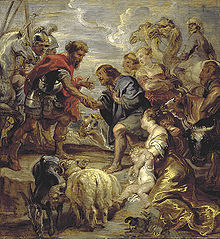
220px-Rubens_Reconciliation_of_Jacob_and_EsauWe are commanded to forgive by the teaching of Jesus and Jesus taught us to pray that we forgive those who wrong us as we forgive them for their wrongs against us. The petition in the Our Father for forgiveness suggests that accepting forgiveness can be at least as difficult as forgiving. Remaining oblivious to this latter difficulty reflects our prior difficulty in forgiving and I suspect it makes it all the harder for us to forgive. The two stories that conclude the book of Genesis help us move through our own difficulties by following through the difficulties experienced by Jacob and his son Joseph. We all know how difficult it is to forgive. We tend to overlook how difficult it can be to accept forgiveness.

The story of Jacob and Esau is a telling illustration of the difficulty in believing in forgiveness, let alone accepting it. Jacob had patently wronged his brother Esau in stealing Esau’s blessing and Jacob fled for his life with a guilty conscience. Years later, after similar wrangling with Laban, Jacob returns with his wives, his children and his flocks which had all grown too plentiful for Laban’s taste. Jacob has every reason to fear what will happen when he meets up again with Esau. Hearing that Esau is coming with four hundred men was not reassuring. The nighttime struggle with a dark figure seems to project Jacob’s combatant personality. Still the shifty coward he’s always been, Jacob puts the wives and children he cares about least in the most vulnerable positions in the front so that he can escape with his favored sons if need be.

What happens is an amazing surprise. Esau embraces Jacob with no reservations and not the slightest sign of resentment. No matter how many times one reads or hears the story, it is hard to believe. Jacob doesn’t believe it. Repentance and forgiveness aren’t really Jacob’s things. Jacob’s words: “truly to see your face is like seeing the face of God” are among the most profound words in the entire Bible for the ultimate revelation is Divine Mercy in a human face. But, as I said, Jacob can’t believe it even after this warm greeting. Jacob turns down the invitation to travel with Esau, using the excuse that he can’t drive his flocks too hard in one day. (Benedict quoted this verse in his Rule to illustrate the need for the abbot not to drive his monastics too hard!) Jacob, still shifty and cowardly, manages to avoid ever meeting up again with his brother for the rest of his life. Think of the years of friendship and companionship they missed out on!

The story is complicated by the later history of Edom, the people descended from Esau which reach a climax in Paul’s quoting, In Romans, Malachi 1:3: “Yet I have loved Jacob, but hated Esau.” In spite of Esau’s forgiveness narrated in Genesis, Edom has not been forgiven by Israel for its siding with their enemies in several wars. That Edom never recovered from the Assyrian invasion seemed to confirm that. The unflattering portrayal of Esau as a stupid, hairy oaf who sells his birthright for a pot of soup is perhaps another way of expressing Israel’s grudge against Edom. And yet this stupid hairy oaf suffered a terrible wrong from his unrepentant brother, moved on and built up his own flocks rather than spending his life in resentment, and forgave his brother. The story of these two brothers is often presented, including by Paul, to illustrate the mystery of God’s election. Jacob is the one chosen to carry on the Covenant, but the rejected brother, Esau, is the one much more in the place of Christ both in his rejection and in his forgiveness. Can repentance and forgiveness be strong enough in our lives for us to believe forgiveness when we see it?

See also Mimetic Blessing through Abraham (2)

The Power of the Ascended Lord

Human_headed_winged_bull_facingAscension Day is a feel-good celebration of Jesus seated at God’s “right hand in the heavenly places, far above all rule and authority and power and dominion, and above every name that is named, not only in this age but also in the age to come.” If Christ is reigning like that and we are reigning with Him and sharing in Christ’s power, then we too are over everybody else just as Jesus is over everybody else. Sounds like a good deal. Or is it? Let’s take a closer look at what this power of Christ is all about.

Getting a sense of how power and especially omnipotence applies to God is tricky. After all, we dream of being omnipotent and invulnerable so we assume that the Master of the Universe wishes the same thing. Not a good assumption.

René Girard noted that power is attributed to the primordial victims of collective violence. (See Violence and the Kingdom of God) That is, the victim was powerful enough to be the cause of the social meltdown and also powerful enough to be the solution to the violence. (The reality, of course, is that such victims were normal humans with no supernatural powers.) The Gospels reveal Jesus as a vulnerable human being who clearly did not cause the social crises of first-century Jerusalem and whose death brought about no solution to it. Whatever power Jesus has, it isn’t this power. The illusion of the power of the victim should make us suspicious about how we attribute power to God.

A second and more common image of power is the imperial structure. In the days of Isaiah and other prophets, Assyria was such an image. The statues and friezes of winged bulls are symbols of this kind of power. This is the kind of power the apostles seem to have been thinking of when they asked Jesus: “Lord, is this the time when you will restore the kingdom to Israel?” (Acts 1:6) Jesus’ ascension right after hearing this question was a firm No.

When Paul says that Jesus is far above all rule and authority and power and dominion, and above every name that is named, not only in this age but also in the age to come,” he is saying that Jesus is far above and beyond all cultures that rely on sacrificial violence and the Assyrian-Roman impositions of power. That is, the power of Christ is to bring us out from these cultural practices. But are we being brought out of the world to escape these cultural entanglements? Sorry if you were hoping for that.

crosswButterfliesPaul concludes this section of Ephesians with powerful irony: “God has put all things under [Jesus’] feet and has made him the head over all things for the church, which is his body, the fullness of him who fills all in all.” Paul is using the common image of military victim where the victor lays his foot on the head of the vanquished, making the loser his footstool. But under Jesus’ foot is not the head of the vanquished but Jesus’ own Body, the Church. This is the Body of the crucified one who was raised from the dead and returned as the forgiving victim. Jesus’ reigning in Heaven at the right hand of the Father is coterminous with Jesus living with us here on earth, sharing our vulnerability to the imperial structures of power who continue to act like the Assyrians and the Romans.

If we are the Body of the forgiving victim, then forgiveness, not rulership, is what reigning with Christ is all about. This power to forgive was the gift the risen Christ breathed into the disciples (Jn. 20:23)  In John, Jesus says that it is this “Spirit of truth” who abides in us. When we keep Jesus’ words, he and the Father and the Spirit will come and dwell within us to empower us with their love for one another and for us and for all those whose sins (including our own!) need forgiving.


Eucharist (3): Discerning the Body

eucharist1St. Paul solemnizes his recounting of Jesus’ breaking bread and passing the cup of wine by saying that he is passing on to the Corinthians what he had received from the Lord. The words Paul uses here are specialized terms for receiving and passing on a sacred tradition. The only other time Paul uses these terms is to testify to Jesus’ Resurrection appearances. Resurrection and eating and drinking to “proclaim the Lord’s death until he comes” go together. After all, does not the Lord come every time we eat the bread and drink the wine?

These solemn words are an island of peace and tranquility in the middle of a storm of human passions amounting to farce. Preceding them is Paul’s denunciation of the insensitive and chaotic eating habits where some people bring opulent meals to church and eat in front of poorer members who have little or nothing to eat. The deterioration of the sharing in the wilderness that began in John’s Gospel has only gotten worse. After holding up Jesus’ shared meal as a model, Paul warns against eating and drinking judgment by “not discerning the body.” Paul may be warning us not to fail to discern Christ’s body in the bread, but he is not thinking in individualistic terms. Christ’s body surely refers to the church and, given the context, Paul is concerned with failure to recognize this corporate body in the way we share, or fail to share what we have with the community. In his fit of tempter, Paul seems to suggest that the Body and Blood of Christ make people sick cause some to die. But considering how strongly Paul insists on God’s freed Gift of grace, Christ Body and Blood can only be more free grace and forgiveness. However, when we fail to see the Body and Blood in Christ in others, sickness, hunger and many more social ills will abound.

With a church in shambles, is the miracle of the Feeding in the Wilderness a distant memory? I noted in the first article in this series that memory is not just recalling something in our heads. Memory is making present. When we eat the death of Jesus, we enter into our own discord that tears the Body apart with cries such as “I am of Cephas!” “I am of Apollos!”  When we eat the Resurrection of Jesus, we eat the forgiveness with which Jesus greeted is disciples to gather them back together. We also eat the feeding in the wilderness and Jesus’ Desire to heal the people brought to him.

We are not left as orphans who have to try to stuff some ideal of human relating into our heads. We are invited to act with others the human drama of entering into God’s Desire for ourselves and all others. Most important, we are fed with the substance of God’s desire to quicken us on the way.

 Eucharist (1): Christ our Passover

Eucharist (2): Feeding in the Desert

Caring for the Dead (Thoughts for All Souls Day)

cemetery1The most solemn and moving chapter in Søren Kierkegaard’s remarkable book Works of Love is “The Work of Love in Remembering One Dead.” Throughout this Book, Kierkegaard models love on God’s agape, love that is not transactional and therefore requires nothing in return. After exploring such self-giving love in live human relationships at length, Kierkegaard avers that “the work of love of remembering one who is dead is a work of the most unselfish love.” This love, according to Kierkegaard is the purest love because it is nonreciprocal; the dead “make no repayment.” This is in contrast with love for newborn children who also cannot repay as the love freely given to newborns has the potential of being repaid in the future as the child matures.

However, the dead are not as dead as Kierkegaard seems to think as the dead continue to live in us in a dynamic way that can be enriching. Caring for the dead, as does caring for any live person, tends to lower resentment if there happens to be any to start with. This often begins when a person dies. We often say we should not speak ill of the dead. The instinct behind this adage is that sympathy for the dead person, warts and all, tends to kick in automatically, making the release of resentment and forgiveness free gifts from God that we can pass on to the dead. There is something about death that helps us see that person as God sees him or her, and God sees everybody, without exception, with forgiveness and freely-given love.

Resentment makes any relationship destructively static. God is completely boxed out of the relationship. Which is a way of saying the resentment creates an idol out of the one who is resented. That is, the resented person becomes central to one’s life and God does not. The lessening of resentment allows a relationship to change. This is just as true of a relationship with a dead person as it is with that of a person still alive. This dynamic allows us to understand aspects of the person we had never understood before. Giving this dynamic free reign with a dead person frees the dead person to reciprocate in a way because the dynamic of increased sympathy and understanding is so rewarding.

Caring for the dead includes commending them to God. When we do this, we become more aware of how deeply God loves both the dead and the living and that this love spurs a desire for change until one has reached the fullest potential (teleios in Greek, a word suggesting finality). If this is what God desires, then it should be what we desire for the dead and the living, including for ourselves. Of course, it also follows that the dead desire the same. And so it is that the dead, living with God, can give us much more in return for our care than we can give them.

See also “Living with the Dead.”

Renouncing Resentment

buddingTree1Since resentment keeps us locked into the groups and individuals who feel have hurt us, it behooves us to let go of our resentments, as I suggested at the end of my post “Resentment: the Glue that Keeps us Stuck Together.” As everyone who has tried it knows, letting go of resentments is one of the greatest challenges in life. Concentrating on letting go of our resentments is counter-productive as this technique keeps us focused on the very thing we are trying to get rid of. It is like the childhood game: Try to get through one minute without thinking of strawberry shortcake. Obviously, all one can think of for the next minute is strawberry shortcake.

The thing to do is think of something else, and/or think of the sources of our resentments in a new way. At the end of my last post, I gave an example of the latter by bringing in St. Paul’s recurring admonition to think of others and their needs ahead of our own. We can often gain a degree of sympathy of the people we resent if we see some of the brokenness they suffer and see our own brokenness mirrored in them. (It is this mirroring effect that often makes us wish to escape this truth through projecting it on to others.) The something else that is most effective for redirecting focus is, at least for a Christian like me, Jesus the Forgiving Victim. The emphasis here is on “forgiving victim.” Far too many Christians have used the memory of Jesus’ death as a cause for resentment with tragic results.

Actually, thinking isn’t really the way to handle resentment because resentment isn’t a matter of thought; it’s a much more visceral phenomenon. It isn’t that we decide to be resentful because it’s a nice thing to do and we can decide to stop being resentful at the drop of a wish. Resentment is something that grabs us before we know it has grabbed us and resentment does not loosen its hold on us easily. It is as if resentment, like a virus infecting one’s body, has its own blind urge for survival no matter what damage it does to anything else. So, when I talk about redirecting attention to Jesus the Forgiving Victim and to the people we resent in the light of Jesus who has forgiven them as much as He has forgiven us, I mean that we have to undergo a revolution of the whole, embodied person. I didn’t say that we should initiate the revolution; I said we should undergo it. That is, we have to let go in a very deep way so that the Desire of the Forgiving Victim can become our visceral desire, a desire much deeper than the desire of resentment which is locked into the same resentful desire of other people.

Basic spiritual practices such as liturgical prayer, deep reading of scripture and meditation (contemplative prayer) are, or should be, practiced at this same deep visceral level so that they can open us up to being filled with the Desire of the Forgiving Victim. Praying with others is a means of being in a group that gains cohesion by praying without resentment rather than persecution, which breeds resentment. The more solitary practice of meditation is still made in solidarity with others, thus seeking to relate us to God and other people without resentment. In a short blog post, renouncing resentment sounds like a simple matter. Well, it is simple, but it takes years of devoted practice.

Each time we allow the Forgiving Victim to remove any resentment we harbor, we glimpse a bit more of the new Heaven and the new Earth coming down from Heaven into the midst of our lives.

[I discuss spiritual practices in reference to the Rule of St. Benedict in my book Tools for Peace]