It Was Necessary that Jesus Ascend

With the celebrations of Christmas and Easter and, to some extent, Pentecost, the celebration of Ascension seems to get lost in the shuffle, something of an afterthought if it is thought about at all. Part of the trouble is that it isn’t all that easy to get an idea of what the Ascension is all about, so we wonder: What ‘s the big deal? We celebrated Jesus’s birth at Christmas and his rising from the dead at Easter. What more do we need? Isn’t the Resurrection enough? According to Luke and John the answer is: No.

Another part of the trouble is that the Ascension is a downer with Jesus leaving his disciples. The first aria in J.S. Bach’s Ascension Oratorio is a long lament over Jesus’ departure. Hardly a cause for celebration. If Jesus loves us enough to come to earth and spend time with us, why would Jesus leave us?

Distance as well as closeness, however, typifies our relationship with God. It is put succinctly in the Psalm verse: “For though the Lord is high, he regards the lowly.” (Ps. 138: 6) In theological terms, God is radically transcendent, but also radically imminent. God’s immediate presence wouldn’t be all that awesome if God were not transcendent as well, and a god who remains aloof from humans doesn’t exactly catch the heart of humans. Moreover, God’s distance gives humans space to live by decisions humans make while God’s closeness offers guidance to those who are open to it.

Luke describes a forty day period during which Jesus talks about the Kingdom of God and the forgiveness of sins. Most importantly, Jesus opens up the scriptures to the disciples by explaining why it was “necessary” that he suffer and rise from the dead. (As Luke and the other Gospel writers make clear, the “necessity” is human, not divine.) All of these are good thing, such good things that it is puzzling why Jesus would leave rather than continue with them. So what was the problem?

On the road to Emmaus, Cleopas and his companion told Jesus (while not recognizing him) that they had hoped he would “redeem Israel.” (Lk. 24: 21) In opening the scriptures to these two companions, Jesus shifted their lost hope to the need for Jesus to die and rise again. But after opening the scriptures for another forty days, Jesus was still asked: “Lord, is this the time when you will restore the kingdom to Israel?” (Acts 1: 6) At this point, it was clear that, as long as Jesus was with the disciples, they would be distracted from his opening the scriptures to them. The temptation to triangle Jesus into their human agenda seems to have been irresistible as long as Jesus was physically present. Only if Jesus left them would they have the space to let the scriptures be opened to them so that they could understand the need for Jesus to have died and risen again. Jesus’ leaving also left the disciples as vulnerable to other humans as Jesus himself was while on earth, putting them, and us, in the position of suffering at their hands.

A second reason for the need for Jesus to ascend after a relatively brief time after his Resurrection builds on the first reason but also reinstates the dialectic of transcendence and imminence that had been temporarily compromised by Jesus’ Incarnate presence on earth. In John, Jesus says that only if he goes away can he send the Paraclete to guide them in all truth. In Luke, Jesus promises the disciples that the Holy Spirit will soon come if they wait in Jerusalem. Sure enough, ten days later, the Holy Spirit comes in tongues of fire, giving the disciples the gift of tongues so that they can communicate with other peoples. More importantly, the Holy Spirit guides the disciples into understanding the scriptures that Jesus had opened up for them so that not only did they finally understand that Jesus had to die and rise again, they were inspired to preach this truth along with proclaiming the forgiveness of sins.

In Ephesians, Paul proclaims the reality of the crucified, risen, and ascended Lord, seated at God’s right hand “in the heavenly places.” (Eph. 1: 20) Jesus may be exalted, with “all things under his feet,” but this exalted Jesus remains the crucified Lord who had to die before being so highly exalted. That is, we are not under the rule of a powerful deity, we are under the rule of the crucified one who rose with total forgiveness of those who tortured and killed him. It is this crucified, risen and ascended Lord who appeared to Stephen when he was being stoned for preaching what the Holy Spirit had inspired him to preach, and it was the exalted Jesus who filled Stephen with the same forgiveness of his persecutors. The ascended Lord may be infinitely up on high, but this same Lord sends the Holy Spirit deep into our hearts with the same apostolic message of forgiveness he gave to the disciples.

The Prodigal Parable

The Parable traditionally known as The Prodigal Son (Lk. 15: 11–32) is obviously a story of estrangement and reconciliation and forgiveness. So clear is this message, there should be no diluting or compromising it with violence, discord, or unforgiveness. However, the United States, a country filled with active churches, has the highest rate of incarceration in the world by a large margin. On top of that, we are seeing a spirit of vengeance in politics that seems to keep on growing. Does this parable’s meaning just disappear at the church door on the way out to the “real” world? A lawyer, Preston Shipp, author of Confessions of a Former-Prosecutor is an example of this disconnect. While raised in the church, he dreamed of being a prosecuting attorney from a fairly young age to protect society from the bad guys who victimized the good people. For many years, he fulfilled this dream by working at the state attorney’s office in Nashville. All this time, Jesus’ parable was in a totally alien universe, to judge by his own account. So, somehow, the simple and clear message of the parable is extraordinarily difficult to hear and believe in and act out in life. Why is this? Does the Parable itself give us insights into these difficulties? Let us take a look for ourselves with the help of Preston Shipp.

The elder brother’s relationship with his younger brother is not brotherly, although I suppose a cynic might say that’s what brotherhood is. Given the outrageous way the younger brother left home (demanding, not requesting his half of the inheritance) there are understandable reasons for this attitude. In any case, the elder brother’s calling his younger brother “that son of yours” in speaking with his father, suggests a highly depersonalized relationship with his brother. Preston Shipp writes about how he realized that the justice system is designed to prevent a prosecutor from having any personal awareness of the person he was prosecuting, let alone a relationship. This changed when a professor he had in college asked him to teach some law classes for college credit in a woman’s prison. This experience of bonding with incarcerated persons lead him to leave the prosecutor’s office. He now works for the Campaign for the Fair Sentencing of Youth. Clearly, the way we manage relationships has a lot to do with how forgiving, or not, we might be. The second time Preston taught a course, he was highly impressed by a woman named Cyntoia Brown. She was underage when convicted of murder, but was sentenced as an adult. As he learned of her exposure to sex trafficking from an early age and other factors, he saw a person in a way that a prosecuting attorney is not encouraged to see a defendant. Imagine his shock when he received a copy of a court document he had filed while still working as a prosecutor, showing that he himself had rejected her appeal of a 51-year sentence and had never recollected it after meeting her in class.

Although the elder son is dutiful in the sense of staying home and working on his father’s farm, the way he berates his father for receiving his younger brother suggests he has little love for the work or for his father. Serious dissatisfaction with one’s work and family situation can harden the heart and make one less inclined to forgive. However, when the father tells the elder brother that everything he has, his elder son also has, we gain the suspicion that perhaps the elder brother was surrounded with blessings, like fattened calves, that he did not see or appreciate. Such lack of appreciation also dampens a sense of forgiveness of other people. The elder brother may have stayed with his father geographically, but his mind and heart seem to have been miles away.

The trauma of abuse or violent crime can make it difficult for the victim to forgive. Preston Shipp encountered many such crimes and knows what they cost the victims, although he also realized that the justice system did nothing to assist such victims except to feed any vengeance they might have. There is nothing in the parable to suggest that the elder brother had suffered any such trauma. The father, on the other hand, was surely traumatized by his younger son’s departure, and yet he welcomed him back with open arms. Cyntoia Brown was traumatized when she saw that her appeal had been denied and that Preston Shipp had been the one who reviewed it and rejected it. Preston expected to be skewered by her when he came to the next class, but he found her deeply forgiving, in spite of her hurt. This particular story has a happy ending in that, with the help of some celebrities taking up her cause which brought her into the public eye, Cyntoia was finally released from prison and has become an activist for many social causes, hoping to prevent what happened to her from happening to other people.

Shipp explains in many ways how vengeance is systemic in our judicial system and throughout our country’s cultural system. This system of vengeance is greatly exacerbated by systemic racism that has characterized American culture since colonial times and continues unabated to the present day. Racism, of course, entails much depersonalization of the other. More important, participation in such as system skews our perception of reality where many things taken for granted shouldn’t be. Will we ever bottom out of this collective sin the way the younger brother bottomed out of his sensual sins? On the other hand, this parable depicts a party being celebrated by an entire household, except for the elder brother. We can take this party as an image of a society transformed by forgiveness and reconciliation, an eschatological vision, we might say. Surely this party is an image of God, in Christ, “reconciling the world to himself.” (1 Cor. 19) Does this image attract us in any way, enough for us to desire to enter into it? Or are we more attracted to a society governed by the elder brother as he berates his father for such a celebration?

.When the father says to his elder son that the younger son had been dead and has come to life, (Lk. 15: 32) the story shifts to the Paschal Mystery. Such radical forgiveness makes one vulnerable, as the father was vulnerable. Who would want to be treated as the younger son treated his father? Who would want to be treated the way the older son treated his father? It is sobering to recall that the person who told this beautiful and edifying story was crucified as a criminal. Can we trust that this victim is risen and is still inviting us to the party?

The Wounded Messiah

Just when the people in Jerusalem are marveling over the healing of a cripple, Peter tells them that it was by the power of the very man they handed over to Pilate to be crucified that the cripple was healed. A cripple has been brought to life, so to speak, since he was functionally dead up to that point, by a man who was killed. Life and death have been brought together with the implication that the people are being offered a choice between life and death.

Peter accentuates the point by reminding them that they “disowned the Holy and Righteous One and asked that a murderer be released” to them. (Acts 3: 14) One would think that a choice between Jesus of Nazareth and Jesus Barabbas would be an easy one. After all, who wants to release a murderer and kill a manifestly just person? Well, everybody in Jerusalem it seems. Huh? The French thinker René Girard helps us understand this strange choice. In a nutshell Girard argued that society tends to resolve its crises through the collective murder of a person who is then blamed for the crisis. In his sermons in Acts, Peter clearly states that an innocent man was put to death by the people who were embroiled in social conflict. That Barabbas was also said to be an insurrectionist puts him right in the middle of the social conflict. What about Jesus of Nazareth, who Peter called “the author of life?” Jesus was the one person who was not positioned within the conflict. He was too busy being the author of life. But being the author of life had him in conflict with everybody: Pharisees and Sadducees both. That made it easy for the two main parties and then the Roman authorities, who normally hated each other, to agree on one thing: Do away with Jesus. Precisely the scenario hypothesized by Girard. This societal choice of death over life keeps a society rooted in death..

Peter sounds accusatory when he reminds the people of Jerusalem what they have done. The overall context however, is an offer of forgiveness: “Repent, then, and turn to God, so that your sins may be wiped out, that times of refreshing may come from the Lord,” (Acts 3: 19) This seems like a cheap way out for such a monstrous crime, but this forgiveness can only be activated by accepting the reality of what has been done. This is the importance of remembering the truth of what we have done. The history of white racism in the United States and the protracted difficulty in facing up to the truth of what has been done is an example of how hard accepting such truths can be and the amount of courage it takes to fully repent. That the truth about lynching, acts of collective violence, are especially hard to accept for what they are, is particularly telling. (Or not, as telling is what is normally avoided.) It is repenting through truly remembering that frees us of the past. Otherwise, we repeat the past by choosing death over the author of life time and time again. But just as the cripple has been healed by the Risen Lord, so we, too, have the chance to be healed by the author of life.

Peter excuses the people of Jerusalem on account of ignorance. They didn’t know what they were doing. This, of course, is precisely what Girard says of collective violence: the crowd does not know what it is doing when it is doing it. This is also precisely why remembering the truth is as difficult as it is important. This excuse is curiously coupled with the prophets foretelling that the Messiah would suffer. As Luke and the other synoptic Gospel writers make clear, it was not obvious to Peter and the other disciples that the Messiah would suffer until Jesus was crucified and raised from the dead with the wounds still visible in his hands, feet, and side. And yet Jesus needed only to point to the fates of the prophets, including the Psalmist, to make it clear that this is so. No wonder the crowd in Jerusalem didn’t know that when they put Jesus to death.

One would think that a person raised from the dead would be perfectly healthy and fit, but that is not the case. Even in his risen body, Jesus still bears the wounds inflicted when he was on the cross. More amazing yet, there is no sign that these wounds are cause for resentment. There is the question of whether or not the wounds were still painful. Perhaps not but probably so. Wounds that don’t hurt aren’t real. That Jesus bears these wounds without resentment attests to his profound forgiveness of what we have done. This total lack of resentment transforms these wounds. Moreover, if the wounds don’t go away, then we are permanently reminded of their reality. Again, we must remember what we have done or we will repeat the same collective violence time and again. This reflection can give us more insight into our own wounds, both wounds inflicted on us and the wounds we have inflicted on others which, of course wound us as well. The healed cripple walks, but he walks with the history of having been crippled for years.

In his First Epistle, John tells us that we do not yet know what we will be. In context of the wounded Messiah, we don’t know what we will be with our own wounds. But “when Christ appears, we shall be like him, for we shall see him as he is.” (1 Jn. 3: 2) Once we truly know Jesus as the wounded and forgiving Messiah, we too will be wounded and forgiving. All of this is enveloped in God’s love that makes us children of God

For an introduction to René Girard see: Living Stones in the House of the Forgiving Victim: Abiding in Humanity’s Deepest Connections and Living Together With Our Shared Desires

Forgiving the Unforgiving Servant

It is obvious that the Parable of the Unforgiving Servant is about forgiveness, but what it actually says about forgiveness can be a bit elusive. It seems to say that if you do not forgive the sins of others; your own sins will not be forgiven. Fair enough. The trouble is, forgiveness isn’t fair; it’s totally unfair. That’s the whole point of forgiveness. We often complain about unfairness if we are blamed for something we did not do, or if we think the punishment is out of proportion to the offense. But forgiveness is an opposite unfairness; we are not given the punishment we deserve. We don’t complain about the unfairness of it except for when it comes to other people who obviously deserve a harsh punishment for what they did to us,

Fairness and unfairness aside, this parable seems to pose the conundrum about the forgiving god being unforgiving. We could say it isn’t God but the Master in the parable who is unforgiving. There’s no question about the Master, but does the Master stand in for God? The concluding verse seems to suggest it: “This is how my heavenly Father will treat each of you unless you forgive your brother or sister from your heart.” (Mt. 18: 35) But how can we speak of God being forgiving if God does not always forgive? Of course, if we aren’t inclined ourselves to forgive the unforgiving servant, who are we to judge God for not forgiving him?

I find the Swiss theologian Raymund Schwager helpful here. In his book Jesus in the Drama of Salvation he develops a dramatic theology in five acts. The first act is the proclamation of , forgiveness, most powerfully expressed in the Sermon on the Mount. The second act is the refusal of the message of forgiveness on the part of Jesus’ hearers. This parable and many others that include acts of violence fall into this second act. That Peter asked if he had to forgive as much as seven times is an example of resisting the teaching on forgiveness. Schwager suggests that the weeping and gnashing of teeth that crops up in several parables refer to this refusal of Jesus’ message. Schwager emphasizes the point that Jesus is not just talking about small-scale relationships; Jesus is preaching a System of forgiveness. Society is to be made up of forgiveness rather than blame and retaliation. If God really is a forgiving God, then God forgives our lack of forgiveness, but God does not save us from the consequences of sticking to the old system of blame and retaliation. All this old system ever got us is weeping and gnashing of teeth. Gnashing of teeth is an apt image of blame and retaliation; Paul admonished his corespondents to stop devouring one another. (Gal. 5: 15) On a more positive note, in Romans, Paul gives a concrete illustration of what it means to live and die for the Lord: Do not judge our brothers and sisters or hold them in contempt because we all stand under God’s judgment seat. (Rom. 14: 8, 10)

If Jesus does indeed want us to develop a system of forgiveness as Paul clearly believes, then it only takes one unforgiving person to short circuit the system and knock over all the dominoes of forgiveness in quite a spectacular crash. The effect is much the same if someone commits what seems an unforgivable act. Even worse is an act that combines vengeance with lying accusations. The only way to keep the system from crashing in a situation like this is to remain open to God’s gift of forgiveness as a free gift for ourselves and for the offender in the midst of the crash. If Jesus is indeed enjoining a system of forgiveness, then he isn’t telling Peter, as an individual, to forgive offenses seventy-seven times or seven times seventy times; he is asking Peter, as he is asking us, to counter offenses and vengeance by starting a counter chain reaction of forgiveness. Easier said than done. We need to be focused on God and not the one who has hurt us and certainly not on our own hurt. The judgment seat we stand under is a judgment of forgiveness, but forgiveness does shed light on what needs forgiving in the very act of forgiveness. That can be a painful and a built-in punishment for what we have done or not done. Forgiveness may get us off God’s hook, but it doesn’t take us off the hook we’ve hung ourselves on. We are easily distracted by thoughts (sometimes legitimate ones) that the other is the one who needs a lot of forgiveness, but we must remain grounded God’s forgiveness of us and use that free gift to participate in God’s forgiveness of others. Only then can we rebuild the system of a forgiving society.

In Schwager’s drama, the third, fourth, and fifth acts are the crucifixion, the Resurrection, and the sending of the Holy Spirit. Indeed, far from punishing his unforgiving hearers, Jesus took on the wrath of their blame and retaliation on the Cross. And that is where accepting the gift of God’s forgiveness in the midst of blame and retaliation can take us as well. But what other way is there, really, to the resurrected life and the breath of the Holy Spirit which breathes God’s forgiveness of our sins?

How About a Jubilee?

After celebrating the Baptism of Jesus and the Wedding at Cana with its Eucharistic overtones, Luke’s lectionary cycle takes us to visions of the Body of Christ as community, what Martin Luther King, Jr. whose birthday we celebrated this week, called “the Beloved Community. This theme is most appropriate for the octave for Christian unity.

The reading from Nehemiah 8 gives us a glimpse of the initiation of the body of worship that became the synagogue. Ezra reads the Law (the Torah) and includes explanation, which is the heart of synagogue worship to this day. Nehemiah and Ezra conclude with these comforting words: “This day is holy to our Lord; and do not be grieved, for the joy of the Lord is your strength.” (Neh. 8: 10) Unfortunately these two leaders also thought that social cohesion required the expulsion of all wives who are not sufficiently “pure” to be part of this emerging Jewish community, a recurring problem of creating unity through division.

In his first Epistle to the Corinthians, St. Paul counters the exclusionary behavior in this church with his famous analogy of the human body with the Church as the Body of Christ. This analogy gives us a powerful vision of unity in diversity with each part interacting with all the others. If one part of the body hurts, all parts hurt. This analogy also reminds of Martin Luther King Jr.’s famous words: “Nobody is free until we are all free.” The implication is that if we try to exert our “freedom” by expelling others, we are not free.

The Gospel reading from Luke portrays the opening of Jesus’ teaching ministry. As the forerunner John the Baptist quoted Isaiah’s words about Israel’s return from the Babylonian exile as God’s preparing a way for the people to return over rough country made smooth, Jesus began by quoting Isaiah’s words about what a settled people should do: Have a jubilee. The Jubilee was designed to make high economic mountains and low valleys more level; to give everybody a new start by cancelling crippling debts. This really was good news for the poor who particularly needed another start. But there is more: Isaiah also envisioned freeing captives and giving sight to the blind. Could it be that economic injustice makes all of us blind to what is really going on? In any case, Jesus is broadening the scope of the Jubilee to apply to everything we can do to strengthen community. To return to Paul’s analogy of the Church as Christ’s Body: it is as if some parts of the body swelled and caused other parts to shrink. Maybe the swollen parts thought that was a good deal, but the reality is that the whole body, not least the swollen parts, is sick when that happens. Economic issues are unmistakable in Luke but a Jubilee is about and for everybody. So how do all of us participate in the Jubilee? What about problems of exclusion? Martin Luther King, Jr. dreamed of a society where the exclusionary practices of race would no longer tear the nation and the churches apart. More important, King sought to achieve this end through reconciliation rather than through adversarial approaches. Isaiah had also proclaimed the freeing of captives. Besides re-evaluating our prison system, we should reflect on how we imprison each other and most of all ourselves in resentment and vengefulness.

The only words of Jesus that Luke quotes are: “Today this scripture has been fulfilled in your hearing.” (Lk. 4: 21) This is particularly startling. According to Leviticus, a Jubilee happened every seven years with a super Jubilee every seventy years. A Jubilee was something to look forward to, but Jesus is telling us to celebrate the Jubilee NOW. Not next week or tomorrow, but NOW. That puts all of us on the hot seat right now and calls us to consider what we can do NOW to participate in the Jubilee. Since Jesus’ quoting Isaiah is the beginning of Jesus’ public ministry, it stands to reason that the rest of the Gospel shows us ways to live the Jubilee. That is, Luke’s Gospel is a Jubilee Gospel. The famous Lukan parables of the Good Samaritan and the Prodigal Son give us powerful examples of what Jubilee looks like.

I will close with an example from a presentation by the black theologian Julia Robinson Moore in North Carolina whom I heard a few months ago. She said that a white parish with many descendants of slave owners offered an apology to her black congregation for their enslavement of the forebears of her congregation. This may not seem like much given the enormity of slavery’s cruelty, but Julia said the apology was both significant and meaningful for her and her congregation. Their acceptance of the apology is another act of Jubilee. Even if we start small, we can hope for an increase of sixty, eighty and a hundredfold.

NOTE: AN organization dedicated to relief of medical debt has just come to my attention. St. John’s, Midland, MI is currently running a campaign for debt relief in this area. https://ripmedicaldebt.org/

The Common Ministry of Peter and Paul

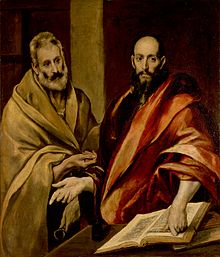
220px-Greco,_El_-_Sts_Peter_and_PaulMuch has been said about the conflicts between Saints Peter and Paul. I have commented on them myself. However, whatever their conflicts, they were martyred in Rome at roughly the same time and that is one of the reasons they are celebrated together in one Feast. Let us see if they have more in common

Both Peter and Paul were penitents. Peter betrayed Jesus by denying that he knew him when pressured by the people in the high priest’s courtyard. Paul approved of the stoning of Stephen and persecuted the Christians. Peter heard the cock crow and he wept. Paul head a voice asking him: “Saul, why are you persecuting me?” Both came to know themselves to be profoundly forgiven sinners. How do we know this? Both preached God’s forgiveness to others.

When. at Pentecost, Peter confronted the people with the truth of what they did in Jerusalem forty days earlier, that they handed an innocent man over to death on the cross, they “were cut to the heart” and asked how they could be saved. Peter’s reply was: “Repent, and be baptized every one of you in the name of Jesus Christ so that your sins may be forgiven; and you will receive the gift of the Holy Spirit.” (Acts 2: 38) Peter was announcing both the truth of what the people had done and the forgiveness of God for what they had done.

In his epistle to the Romans, Paul wrote: “Therefore we have been buried with [Jesus] by baptism into death, so that, just as Christ was raised from the dead by the glory of the Father, so we too might walk in newness of life. (Rom. 6: 4) This is Paul’s more complex way of saying that repentance and baptism bring us forgiveness of our participation in the death of Christ so as to be free to rise with Christ and live new lives in Christ.

In the First Epistle attributed to Peter, the author cites the forgiving example of Christ: “When he was abused, he did not return abuse; when he suffered, he did not threaten; but he entrusted himself to the one who judges justly.” (1 Pet. 2: 23) It is troubling that Peter is speaking specifically to slaves but we should note that the masters are not being upheld as good examples of anything. Later in the Epistle, Peter says to everybody: “Finally, all of you, have unity of spirit, sympathy, love for one another, a tender heart, and a humble mind. Do not repay evil for evil or abuse for abuse; but, on the contrary, repay with a blessing. It is for this that you were called—that you might inherit a blessing.” (1 Pet. 3: 8–9) The forgiving example of Christ should be followed by everybody. (Could one follow this admonition and still be a slave master?)

Likewise Paul makes the identical admonitions when writing to the Romans: “Bless those who persecute you; bless and do not curse them” and “never avenge yourselves, but leave room for the wrath of God; for it is written, ‘Vengeance is mine, I will repay, says the Lord.’ ‘If your enemies are hungry, feed them; if they are thirsty, give them something to drink; for by doing this you will heap burning coals on their heads.’ Do not be overcome by evil, but overcome evil with good.” (Rom 12: 14, 19–21) Lofty words but there is a troublesome sting to them. It should be noted, though, that vengeance is indeed God’s prerogative. The teachings on the part of both Paul and Peter raise the questions as to whether God actually uses that prerogative. The burning coals in the quote from Proverbs are also troubling, but sometimes an undeserved act of kindness has that effect.

What we can celebrate today on the Feast of Saints Peter and Paul is their united front in preaching the forgiveness of the Risen Victim which we must both receive and give to others.

The Holy Spirit as a Divine Person who Inspires and Fosters Love

White_Doves_at_the_Blue_Mosque_(5778806606)The Holy Spirit is the most obscure of the three Persons of the Trinity, not that the other Persons aren’t mysterious as well. One reason is that the Son is said to show the Father, and the Holy Spirit is said to show the Son, but that leaves nobody to show the Holy Spirit. So obscure is the Holy Spirit that it is difficult to think of the Holy Spirit as a Person at all. It is not uncommon to hear the Holy Spirit referred to as “it,” although both masculine and feminine pronouns also fall far short of the Holy Spirit’s personhood.

It is easier to sense some personhood for the Father and the Son because their relationship is defined by filiation, that is, the Father begetting the Son has a personal analogy in human experience. But the Holy Spirit’s relationship to the other Divine Persons is through spiration, that is breathing. We think of breath as a human function rather than a person in his or her own right. The Holy Spirit is often called the “Bond of Love” between the Father and the Son. This is a beautiful phrase but again, it doesn’t give the Holy Spirit a personality. If we say two people are bonded in love, we think of the bond as something between the two people, not a third person.

Since it is a sure thing that the Holy Spirit is a Person, however obscure, and however mysterious, then perhaps we can take these rather impersonal images and analogies and personalize them.

The Holy Spirit as breath, the Person spirated, or breathed, by the Father and the Son is associated with inspiration. The Holy Spirits’s inspiration in its gentler form is symbolized by a dove in scripture, most importantly at Jesus’ baptism, where the image accompanies the heavenly voice acclaiming Jesus as the Son of the heavenly Abba. At Pentecost, the Holy Spirit appears as flames of fire inspiring the disciples to preach in the languages of the pilgrims from foreign countries. In all this, we have, again, impersonal images, except insofar as birds can show some elements of personality. In all this, however, we can see the Holy Spirit revealed as a Divine Person who inspires and energizes. In fact, the Holy Spirit inspires by distributing various gifts to various people, enhancing both the individuality of people and our connectedness as we exchange these inspired gifts to each other. Through this exchange of gifts, we can inspire others with our insights and enthusiasms. We can think of the inspiring teachers and preachers who have energized us to spread that same enthusiasm and inspiration to others. This is what the Holy Spirit does.

The Holy Spirit as the bond of love between the Father and the Son can also be understood in a personal way. That is, the Holy Spirit is a Person who actively encourages love between other people. Humans can act as such a bond of love. Friar Lawrence plays such a role in Romeo and Juliette. In South Pacific, Bloody Mary encourages the love between Col. Talbot and the Polynesian woman in the song “Happy Talk,” while Col. Talbot himself struggles with his racist heritage in “Carefully Taught.” As these go-betweens try to help lovers overcome obstacles (scandals), so the Holy Spirit encourages all of us to overcome all obstacles to loving relationships.

In the Upper Room, Jesus breathes the Holy Spirit into the apostles and then commissions them to spread forgiveness to other people. (Jn. 20: 23) (I don’t think Jesus wants us to retain the sins of others.) Here we have the Holy Spirit as the Person who inspires, encourages, forgives, and reconciles. In all of these acts, the Holy Spirit remains hidden, showing other people to us and us to other people. At the same time, the Holy Spirit shows us the Son in other people and shows the Son in us to others. If we wish to really honor and celebrate the Holy Spirit, we, too, will go and inspire, encourage, forgive, and reconcile others.

The Place of Jesus

crossRedVeil1When Jesus warns of wars and insurrections fought by nation against nation and kingdom against kingdom, he is painting an image of humanity divided by violent conflicts on a grand scale. These conflicts are coupled with catastrophic natural disasters such as earthquakes, plagues, and famines. .(Lk. 21: 9–11) Jesus then goes on to warn his followers of persecutions on an equally large scale involving kings and governors, clearly suggesting a strong connection between strife and persecution. In the late twentieth century, the French thinker René Girard speculated that humanity suffered the same dangerous conflicts at the dawn of civilization and it instinctively resolved the conflicts by persecuting a victim or small group of victims. These victims were blamed for both the violence and the earthquakes and the plagues and famines. Blaming the victims entailed falsifying the reality of what had happened. Persecution and lies are inseparable. It is not difficult to see that Jesus saw clearly the truth in his time that Girard was to articulate in ours.

When warning of persecution, Jesus advises us not to prepare a defense in advance because Jesus will give us words and a wisdom that “none of [our] opponents will be able to withstand or contradict.” (Lk. 21: 15) How is this so? Since persecution requires falsehood, then it follows that truth is found in the perspective of the victim of persecution. That is, the victim is in a highly privileged position to see what others, clouded by the accusations of persecutors, do not see. This is a dubious privilege since the place of the victim is excruciatingly painful and sometimes does not last very long.

But this is the place Jesus occupied and this is the place where any of us who would be followers of Jesus also have to be ready to occupy. Jesus knew that, barring a massive social act of repentance, the volatile situation in his time and place was going to result in the persecution of a victim. Jesus made sure that he, and not somebody else, would be that victim. This is what it means to say that Jesus died for us; not that Jesus died to deflect the alleged wrath of God.

In this place of the victim, reality is crystal clear in a way that it is not in any other place. This is why we really do not know what to say, how to say it, how to act, what our bearing should be until we are actually there. Presumably, Jesus had no script for facing Caiaphas and Pontius Pilate. He knew what to say and what not to say only when he stood in that position. And only if and when we stand in that same position will we know what to say, how to say it, and what not to say.

The position of the victim is not one that involves calling for vengeance, hoping that God will burn the bad guys into stubble, but instead, one only prays for “the sun of righteousness to rise with healing in its wings.” (Mal. 4: 1–2) To wish vengeance is to wish to become a persecutor if the opportunity should arise. Jesus himself did not call for vengeance, and when he was raised from the dead and could have inflicted vengeance, he did nothing of the kind. Jesus assures us that, in this place of the victim where we may be betrayed and even put to death, not a hair of our “heads will perish,” and by our endurance we will “win our souls.” (Lk. 21: 18–19)

Winning our souls can be understood in many ways, but in the place of the victim, winning our souls means seeing God as God truly is by being like God in the same place as God, like the sun with healing in its wings. (Cf. 1 Jn. 3: 2) This winning of souls is precisely what we see in the story of the 21 Coptic Martyrs in 2015, whose story has been told by Martin Mosebach. In interviewing the families of these martyrs, Mosebach encountered grief but also rejoicing in their loved ones’ rising in Christ. In losing sons, brothers, husbands, these people were also in the place of the victim. Mosebach said in his many conversations: “never once did anyone call for retribution or revenge, nor even for the murders to be punished.” This is what it means to be in the place of the risen and forgiving Victim.

A Rogue and God’s Kingship

purpleFlower1Can a charming rogue be an example of how to enter the Kingship of God? Jesus’ Parable of the Dishonest Manager invites us to explore that question.

The Rich Man has heard rumors that his Manager is squandering his property and decides immediately to fire the Manager without giving the Manager a chance to defend himself. In a most helpful article on the parable, David Landry makes the Rich Man’s swift action understandable by explaining the importance of honor in ancient society. In an honor system, the notoriety of a delinquent subordinate reflects badly on the pater familias who is supposed to control everybody under his authority. The public rumors about the Manager threaten the Rich Man with social disgrace and he is running scared.

The inner dialogue of the Dishonest Manager shows no honor as his desperate scheming leads to an inventive solution to his dilemma. Generous with the Rich Man’s money, he quickly acts to reduce the debts owed the Rich Man. These debts strengthen the portrait of the Rich Man as a ruthless person who uses economic power to oppress others, a common practice of absentee landlords in Jesus’ time. He is the sort of rich man who the prophet Amos accused of “buying the poor for silver and the needy for a pair of sandals.” (Amos 6) Although the Dishonest Manager is acting only out of self-interest, he is still helping other people in the process.

The Rich Man’s commendation of the Manager is perhaps the most puzzling turn in the parable. Landry’s discussion of honor is helpful here as well. He suggests that the Manager’s reducing the debts has brought admiration and honor to the Rich Man, something the Rich Man has probably had very little of in the past. The same person who had brought dishonor on the Rich Man has now used his agency to bring the Rich Man more honor than he has ever had.

The act of forgiveness, self-centered as it is, has thrown a monkey wrench into the economic system which up to this time has been one of economic exploitation of the weak. This is what trickster rogues like the Dishonest Manager do. The Rich Man, hard-hearted up to this point, confirms the forgiven debts, which are a fait accompli anyway. What kind of chain reaction might occur out of this action that could transform the economic system into one based on forgiveness and love? What transformation of character might there be on the part of both the Manager and the Rich Man? At the beginning of the parable, the Rich Man believes the accusations against his Dishonest Manager out of fear that his honor is compromised. By the end of the parable, the Rich Man has gained honor for being generous, a challenge to gain even more honor through more generosity, honor that can be enhanced by keeping the Manager.

When we note that this parable in Luke’s Gospel follows directly the Parable of the Prodigal Son, the probability that the Parable of the Dishonest Manager is indeed about forgiveness is heightened. Moreover, there are some significant links between the two parables. Most prominently, each features a man who has squandered the resources of somebody else. Indeed, the same otherwise rare Greek verb diaskorpizo is used both times. The theme of honor plays a contrasting role in these parables. The Rich Man clings to his honor, but he does shift from being a slave to the opinions of those accusing the Manager to accepting honor from those whose debts have been forgiven. The Father of the Prodigal Son, on the other hand, throws honor to the winds throughout, first by allowing the younger son to insult him by asking for his inheritance, then by frantically running out to meet the younger son when he returns. Might the Rich Man eventually take this final step in renouncing his sense of honor out of love for those indebted to him? Is such renunciation of honor what it means to serve God rather than wealth, since honor is a form of wealth? (Lk. 15: 13)

Right after the Rich Man’s commendation of the Manager, Jesus adds: “for the children of this age are more shrewd in dealing with their own generation than are the children of light.” (Lk. 16: 8) Here, Jesus poses a powerful question to his followers: Do we actually forgive others even as much as the Dishonest Manager forgave the debts owed the Rich Man? Is there a chance that the Dishonest Manager and the Rich Man will enter the Kingdom of God before us?

It Was Necessary

yellowTulips1Easter is an occasion of great rejoicing with bells, boisterous singing, and feasting. But do we really know what we are celebrating? The Gospel reading, doesn’t exactly ring out with Christmas joy of angels filling the skies with songs of God’s glory. Instead, we get “two men in dazzling clothes” who tell the women who came to the grave to anoint Jesus’ body that Jesus was not there but had risen. They had come to the wrong place.

A small group of confused women running off to stammer the news to the disciples isn’t exactly a celebration either. The disciples’s thinking the news is an “idle tale” may reflect a masculine condescending attitude towards women, but their reaction also shows how totally disorienting the news was. The Gospel reading ends with Peter running to the tomb to take a look for himself, seeing the empty linen clothes lying about, and then going home, “amazed at what had happened.” (Lk. 24: 12) Still no celebration; just a lot of unanswered questions. Luke continues his Resurrection narrative with two followers of Jesus walking to Emmaus with no indication of why they should be going there, implying that they are going the wrong way. Their conversation with a stranger on the way confirms their sense of confusion. Should we, too, be too disoriented to celebrate?

I think the key to understanding the problem lies in the words of the angelic beings: “Remember how he told you, while he was still in Galilee, that the Son of Man must be handed over to sinners, and be crucified, and on the third day rise again.” (Lk. 24: 6–7) The stranger who met up with the two disciples asked them rhetorically: “Was it not necessary that the Messiah should suffer these things and then enter into his glory?” (Lk. 24: 26) The word “must” is the key here. The Greek word dei is often translated “it is necessary.” In this case, for whom was it “necessary” that Jesus be handed over to sinners to be crucified and then rise on the third day? There is a tendency to think the death was necessary for God, but that suggests that God needed to have God’s own son die a painful death. Many people have a problem with that notion, I among them.

I find the French thinker René Girard helpful here. He interprets the available anthropological evidence as indicating a tendency of archaic societies to solve social tensions by a process that transforms competitive relationships throughout the society into a shared desire to focus on one person and then kill that person who is deemed responsible for the social tensions. The ensuing peace (for a time) is so strong that the victim is then worshiped as a deity. It is this social mechanism that convinces people that it is necessary for “god” that the victim be killed. Throughout this process, the truth of the victim is precisely what nobody knows, except possibly the victim.

This truth of the victim was gradually being revealed in the prophetic tradition of the Jewish people, most prominently in the verses about the “Suffering Servant” in Isaiah, whom the people accounted “stricken, struck down by God, and afflicted.” (Is. 53: 4) But then the people realized that they, not the victim, were the guilty ones. God had vindicated the “stricken one,” not the persecutors. It was these passages in Isaiah that most helped Jesus’ followers begin to make sense of what had happened to Jesus.

But on the day of Jesus’ Resurrection, the disciples had not thought to connect Jesus with the Suffering Servant. Jesus had told them many times that it was “necessary” that he be handed over to be crucified, but they could not understand. How could it be “necessary” that the man who they thought was going to restore Israel should be handed over to death? They assumed it was “necessary” that the guilty ones be handed over, not the innocent. Then, at Passover time, Jesus was deemed to be the guilty one who was causing the tumult by both religious and civil authorities, and so he was handed over. But the disciples had thought Jesus was innocent. Had they gotten their man wrong? Their fleeing when Jesus was arrested suggests they weren’t so sure.

The empty tomb was the first hint that Jesus’ death wasn’t business as usual. A tomb was supposed to have the corpse of the guilty one, but this one didn’t. The announcement of the angelic beings to the women was a stronger hint that Jesus was innocent after all. The women were told that it, although it was “necessary” that Jesus be handed over and killed, it was even more necessary that Jesus be raised from the dead. By raising Jesus from the dead, God showed Jesus’ followers that the “necessity” that Jesus die was a human necessity, a necessity of human factors, and that it was Jesus’ rising from the dead that was the true divine necessity. Only then could the disciples have their minds opened to understand the scriptures when the Risen Lord met with them himself. (Lk. 24: 45)

It is gloriously great news and a wondrous cause for rejoicing that we are freed from the human “necessity” to blame a victim who is put to death for the crimes of a society. That is, unless we feel too disoriented about not having scapegoats. Maybe that is why rejoicing in Jesus’ Resurrection is a much greater challenge than rejoicing in the birth of a child who is going to accomplish something great—what, we don’t know. Rejoicing in the necessity that Jesus be raised from the dead requires us to change our minds and hearts in radical ways to take in this news. Most challenging of all, we have to accept and then embody the forgiveness of the Risen Victim when storms of accusation remain the status quo even at this present day. Are we up to the challenge? Will we come to the party?

For an introduction to the thought of René Girard see Violence and the Kingdom of God and Living Stones in the House of the Forgiving Victim