Liturgical Animals (2)

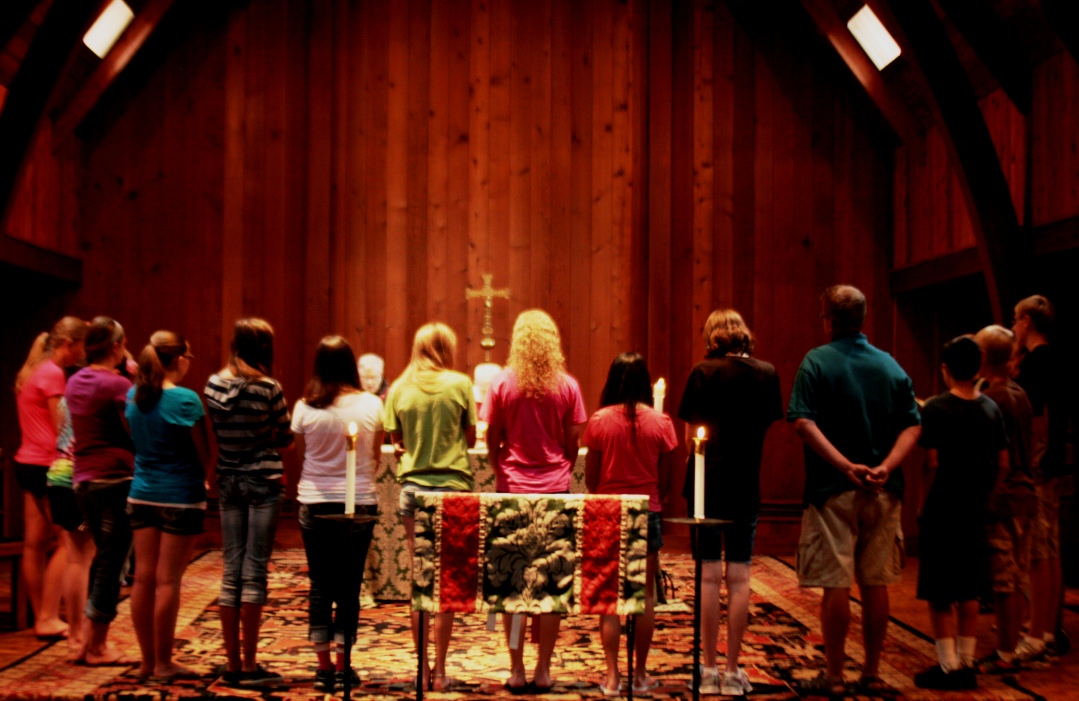
eucharist1In his first letter to the Corinthians, St. Paul brings us to the heart of Christian worship that Jesus inspired at what we call his Last Supper. His followers were doing what he told them to do: Do this in memory of me. While both the myths and rituals obscured the sacrificial stories on which they were based, the Eucharist clearly tells the story on which it is based:  the betrayal of Jesus, his subsequent crucifixion, and his rising from the dead.  This earliest account of the Eucharist, predating all of the Gospels, enshrines the Words of Institution that are repeated in celebrations of the Eucharist two thousand years later. The Eucharist teaches us through its story but it also teaches us at a deeper, more substantial level through actually feeding us with the Word of God so tangibly that we chew on it and swallow it. Celebrating the Eucharist places our desires into Jesus’ Desire for us to gather with him and the other Persons of the Trinity.

The meal is probably the oldest of rituals performed by liturgical animals. Eating is the first activity that immerses us into mimetic desire as we imitate the desires of our caregivers to desire food and, by the time we are old enough to be conscious of what we are eating, to desire certain foods because those around us desire them. However, as much as meals have to do with providing necessary bodily nourishment, they are always more than that. An intrinsic part of learning to eat is learning how to eat in the company of others. It may be culturally arbitrary whether we use eating utensils and plates or large leaves and fingers, but in every culture I have ever heard of, there is always a way of eating that is learned. The shared desire for food extends to a shared desire for the way of eating it. By rooting liturgy in a meal, the Eucharist roots worship in the sensuous act of eating; of tasting food and drink on our tongues.

In this same letter, Paul brings up the manner of table manners in regards to the Eucharist. He berates the richer members of the congregation for their insensitive treatment of those who are more economically challenged. To flaunt their superior food in front of those who cannot afford it without offering them anything was a serious violation of everything the Eucharist stands for. This desire shared by one group in the congregation to demonstrate their superiority over others, to put them in their places, breaks the unity the feast is supposed to create and strengthen. Paul makes it clear that there is much more to worship than saying or singing words together while celebrating a sacrifice. If people are not treated well, worship is diminished if not rendered nonexistent.

John’s version of the feeding in the wilderness brings all of these themes together. The event is explicitly brought into the context of Yahweh’s feeding the Jews in the wilderness after their escape from Egypt. Raymond Brown pointed out that rabbinic teaching interpreted the manna as symbolizing the Torah, thus uniting food and teaching, something the Eucharist also does. While Matthew and Mark recount two feedings in the wilderness, one for the Jews and one for the Gentiles, John has one story of feeding for all people. Jesus’ blessing of the bread and fishes has ritual overtones although the feeding is taking place in the open air, away from temples, synagogues and churches. The social unity that Paul enjoins is embodied in John’s vision where it gains a deep universality. Unfortunately, the people then unite in trying to make Jesus king, which destroys the social vision as surely as the Corinthians did.

The Eucharist teaches us that we don’t outgrow our earliest lessons: table manners. Without them, we don’t grow up.

Beethoven

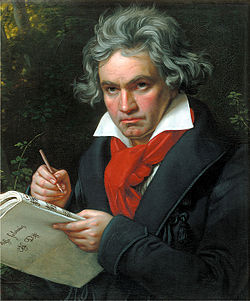
BeethovenLudwig von Beethoven is one of those larger-than-life cultural figures who towers over Western Civilization like a Colossus. Is the man worthy of this mythological status? As a human being, far from it; as a composer of music, very much so. In Beethoven: Anguish and Triumph, Jan Swafford has written a biography and musical survey of Beethoven that is worthy of the subject and surely sets the standards (very high) for any future works on Beethoven. The book is nearly a thousand pages long but I was so absorbed in the narratives that I didn’t mind the length at all.

Swafford places Beethoven firmly in his cultural and historical contexts. His discussion of the Enlightenment as developed in Bonn is particularly interesting as its formative influence on Beethoven was deep. Schiller’s famous Ode to Joy was published during Beethoven’s youth and it haunted the composer throughout his life, giving him a lifelong intention to set it to music which he finally did in the ninth symphony. Then there is Napoleon, another towering figure of the Age who inspired humanistic idealism in Beethoven as well as many others, only to end in disillusionment when he crowned himself emperor of France. Beethoven’s richest period of frenetic composing coincided with the Napoleonic wars and the disruptions they caused, not least in Vienna. After the Congress of Vienna in 1815, Austria sank into a police state where instrumental music was about the only area with some freedom. Although Beethoven was too grounded in the classical tradition to be a Romantic figure, he roughly pushed enough envelopes to be possibly the most inspiring figure of the Romantic Movement wit E.T.A. Hoffman the first to build the Romantic mythology around Beethoven.

The sad narrative of Beethoven’s life is told with novelistic detail and immediacy. Not only Beethoven’s famously cantankerous personality but those of dozens of other important figures in the composer’s life come alive in the telling. The idealism Beethoven believed in and embodied in the nobility of his greatest works did not translate into Beethoven’s daily life. Time after time, the reader winces at Beethoven’s inability to understand any individual person besides himself. His problem isn’t so much a willful egoism so much as a constitutional problem with him, exacerbated by his deafness. I wonder if it might also show the weakness of Enlightenment idealism which stirred love for humanity in general but not for humans in particular. That surely catches Beethoven’s personality in a nutshell. Beethoven could be a devoted and intense friend but he quarreled with nearly all of his friends throughout his life. His problematic relationship with his nephew Karl is particularly painful. When Beethoven’s brother died, Ludwig devoted himself to an ugly custody battle with Karl’s mother. To be blunt and short: Beethoven was not cut out to be a good father figure for an orphaned child. Beethoven’s dealings with music publishers were shabbier than their dealings with him. (If royalties had been invented back then, Beethoven would have been less desperate about money.) The sad saga of Beethoven’s hopes for a companion is marriage is pitiful, though understandable, from the point of view of any woman who ever lived.

The book’s greatest strength, for me anyway, is the discussion of Beethoven’s music. Some rudimentary knowledge of music theory or better would be helpful for any reader, but Swafford’s ability to make Beethoven’s musical works sound like awesome adventure stories might carry along some readers who lack such knowledge. Every work of Beethoven’s of any consequence (and there are many) is discussed with at least a page’s worth of pinpointed criticism, and the most complex works, such as the Eroica and ninth symphonies, are given the epic treatment they deserve. Swafford’s probing analyses reminded me of the frisson of my own first encounters with these great works as a child and adolescent: the amazing start of the Eroica and the numinous opening of the ninth, to name a couple. Swafford also demonstrates how profound Beethoven could be in simplicity as he was in the Pastoral Symphony and the Mass in C Major, a work underrated then as much as it is now. Much attention is given to Mozart’s drawing upon and reacting to his immediate predecessors Mozart and Haydn. Haydn was as much a rival as a mentor to Beethoven. Poor Papa Haydn was traumatized by Beethoven’s early C Minor piano trio and the Eroica shattered his life musical world. As a youth, Beethoven was lucky enough to be introduced to JS Bach’s Well-Tempered Clavier which loomed as a great formative influence throughout his life. Many writers have written fine things about the transcendent late works such as the final piano sonatas & the last string quartets, but Swafford outdoes all of them in leading the reader to the heights of these incredible works.

Beethoven could be problematic not only as a person but even as a composer. For a century, he was a formidable challenge to all other composers. The final movement of his B-flat quartet, known as the Grosse Fugue is as bewildering today as Bartok’s string quartets. Not only was Beethoven a musical pioneer in his own time, he is still well ahead of us today. To tell the truth, I find the subtleties of Mozart and Schubert rich territory for my musical wanderings, but Beethoven’s storming the heavens and then gently floating up into and above them is an important part of my musical life as well.

All this is to say that I recommend Swafford’s book on Beethoven with no reservations. He leaves me hoping that Schubert is next on his list.

Liturgical Animals (1)

monksinChoir1The reality of mimetic desire guarantees that we will engage in liturgical activity. What kind of liturgical activity and for what end leads to many possibilities. However, since we instinctively react to the desires and intentions of others, we also instinctively move and sing with each other and act together. Since we are mimetic animals, we are also liturgical animals. Much liturgy takes place in churches and temples but liturgy can be done anywhere at any time and it is indeed done all over the place. René Girard’s theory of scapegoating violence places the origins of ritual and liturgy in the spontaneous mob violence against a victim that “solves” a massive social crisis. At first thought, one would think there is nothing liturgical about collective violence; it just happens. But actually collective violence is a very predictable phenomenon that consistently works in a certain way once it gets started. We all know that once the persecutory ball gets rolling it is almost impossible to stop until blood has been spilled. The relatively few instances where the persecutory wave is stopped short of bloodshed also follow a predictable pattern. In essence, the mimetic contagion of a mob has to be redirected into another direction, one less destructive. This is what Jesus did when the Jewish elders were gathered around the woman caught in adultery. This is what Christians do to this day when celebrating the Holy Eucharist. Although I think it likely that sacrificial rituals have their origins in collective violence as Girard suggests, I think that ritual in itself is rooted more deeply in human nature. Since we humans are imitative creatures, we would instinctively coordinate our bodily movements with those of others. This sort of mirroring is instinctive to mothers especially in their interactions with their babies. It is this coordination of movement that would unify a family and then a clan and then a tribe. These coordinated movements would naturally turn into communal dancing and singing. Such coordinated action would naturally move into reenactments of primal collective violence once that occurred, but there is nothing in this instinct for coordinated movement that requires that it move in that direction. This is to say that collective violence and its continuations in sacrifice and institutionalized violence are not of the essence of humanity. There is nothing necessary about it; it’s just something that happens most of the time. What is necessary in the sense of being of the essence of humanity is coordinated movement. Our built-in mimetic desire guarantees that it will happen. There are practical reasons for this trait, among them coordinating movements during hunting expeditions, the way soldiers do military drills to facilitate coordination in battle, and the way football teams synchronize their actions, not to speak of the rituals performed by their fans. Singing together over common work such as gathering fruits and preparing meals might not be as necessary for success as the coordinated movement of hunting parties, but perhaps are as necessary at another level. Maybe nobody dies of boredom but we often feel that we can, and maybe we do in the sense that lack of interest in life isn’t conducive to living a long life. It is singing and dancing together and moving together in other ways that would have given our earliest ancestors an interest in living and it is these activities that spark our interest in life today. Many people today may think they are dismissive of liturgy because they think of stuffy church services or masonic rituals. But the ways we greet people, especially when introducing people to strangers or meeting them, are little rituals that we take so much for granted that we don’t think of them as rituals. When I was young, many people who never darkened the door of a church linked arms in the streets and sang the hymn “We Shall Overcome.” All this is to say that humans are liturgical animals. Gathering with others always has some liturgical overtones in the sense of repeating actions we are used to doing together. Drinking parties tend to follow the same patterns for those groups in the habit of gathering for that purpose. Given this human trait to gather through ritual, it is inevitable that any who wish to gather with others in memory of Jesus would gather liturgically. Liturgy is discussed at length in my book Tools for Peace.

Proceed to Liturgical Animals (2)

Christian Community (5)

guestsNarthex1Unfortunately, I can’t discuss Church without saying something about institutions called churches. I also can’t overlook the unfortunate fact that although the word “church” has six letters in it, for some it is a four-letter word.

A common distinction is made between the visible Church and the invisible Church. The former is made up of people who wear clerical collars and vestments and those who sit or stand or kneel in pews and sing hymns or songs of praise. The latter is made up of those who actually have their hearts and minds conformed to Christ regardless of whether or not they place their bodies in buildings with a cross on it. In such a distinction, the invisible Church is the real Church, although people invested in the visible church (sorry about the pun!) hope that at least some of them are in the real, invisible Church as well. Of course, this invisible church isn’t really invisible. It is perfectly visible to God and it is visible to all people who have eyes to see. In my earlier posts on the subject of Church, I have suggested that the essence of Church is to be aligned with the forgiving love of Christ that brings us to the place of the victim in opposition to the principalities and powers that feast on victims. Acting out the role of Church in this way is quite visible, just as visible the people who sing hymns and preach in buildings that we call churches. Again, we hope there is at least some overlap between the two, but we all know that the two hardly coincide.

The Church is, then, visible in acts of worship and in charitable acts such as ministering to the poor. The disconnect between these two visibilities is a cause of dismay and downright confusion. Some people who are devoted to both might find that the people they worship with and the people they work with in ministry are very different. This problem becomes particularly acute when a “church” openly allies itself with Empire. To this day, there is concern that when the Roman Empire theoretically converted to Christianity, Christianity was actually converted to the Empire. The establishment of what was called “Christendom” tended to institutionalize the violent tactics of Empire. The Inquisition was a particularly notorious example of this. In more recent history, the Nazi government of Germany ordered the Evangelical (Lutheran) Church to expel all members of Jewish descent from leadership positions. Complying with this demand was a betrayal of their own members and of Christ. The Confessing Church which seceded in protest was a remnant of the Body of Christ.

The disunity and discord among Christians is a further cause of scandal to many. That there should be many ecclesiastical bodies with long or sometimes short traditions is not a problem to me. People are different and cultures are different. It is sad, however, that most churches, were founded in protest against the ecclesiastical body they left. Many of the long-standing debates have been resolved and many ecclesiastical bodies work together charitably in matters such as world relief. Many of the divisions, however, smack of emulating the disciples who argued about who is the greatest and/or the slogans in 1 Corinthians: “I am of Apollos!” “I am of Cephas!” Many of the theological debates in the early Christian centuries over the Trinity and the Natures of Christ could have been carried on with less rancor if church leaders had not been so afraid that God would eternally torture anyone who didn’t get the formulas just right. Getting the theology right just isn’t enough when we get the Love of God wrong.

The scandal of Church for so many of us tempts us to chuck it all and try to go it alone. If Girard’s theory of mimetic desire is true, that is simply not possible. We are affected by the desires and intentions of others whether we like it or not. If we set ourselves over against everybody else in defiance, that very defiance makes us totally dependent on the people we are defying. After all, if we aren’t defying people, we aren’t doing much in the way of defying. The deeper problem is that when we make ourselves that dependent on other people, we are easily sucked into the power of persecutory mechanisms when they occur. A lone individual can’t hold out against such a thing.

So there is need to connect with others. This is a point I illustrate in some of the stories I’ve written, most particularly in Merendael’s Gift. The protagonist can’t stand up to social pressures of the kids he hangs out with until he allies himself with other children who band together to befriend this strange visitor from another planet. This group becomes an analogy for the Church as the Body of Christ. In real life, we have to be alert to the people who are sincerely and humbly entering the place of the Victim. (I say “humbly” because some people pridefully use “victimhood” to manipulate others.) We can only hope that some of these people actually are in a church in the ecclesiastical sense.

Girard’s theory of mimetic desire and the rivalry and sacrificial violence it can lead to suggests that they greatest division among Christians is along the lines of a theology and practice that is sacrificial on the one hand and one that is grounded in Jesus the Forgiving Victim on the other. Girard’s theory shows us how easily followers of Jesus’ Kingdom could easily slide back into remnants of the primitive sacred. The Body of Christ looks like the Body of Christ when it is embodied by people who stand up to the persecutory mechanism whenever it occurs. Unfortunately, any of us can easily fall into embodying instead the Satan who is the Accuser. That is to say, this schism between sacrificial and forgiving members can split right down the middle our own selves. This is why we need to strengthen ourselves with the practices of Church such as worship and interior prayer and mutual encouragement.

On Gathering with Those who Keep Oil in their Lamps

eucharist1Like many parables, the Parable of the Wise and Foolish Maidens is obvious and yet puzzling in some respects. The notion of forfeiting eternal life for failing to be prepared at a certain level is oppressive, but we can lift this degree of oppression by noting that the Kingdom of God is something we are supposed to be living NOW, in this life. This is what we are to be prepared for. If we are prepared NOW for the kingdom, entering more deeply into the Kingdom when we die will take care of itself.

It is worth noting that just before this parable, Jesus has thrown out the parable of the household where the wicked servant beats his fellow servants and gets drunk with the drunkards. Here we have an image of the violence humanity commits and suffers for not being alert to God’s Kingdom. Ironically, the wicked servant thinks the Master is delayed when the Master is already there in the servants he is beating. In contrast, the Foolish Maidens do not commit violence, but they fail to do anything that would stand up to violence such as that of the wicked servant.

I also think it significant that the parable is about two groups of maidens rather than just two maidens. As one who uses the thought of René Girard as a tool for interpreting scripture, I am inclined to interpret this parable in turns of contrasting human groups, each governed by a collective desire they share within that group. The wise maidens who have extra oil for their lamps are a community whose members encourage one another so as to keep their lamps burning. When they care about the Bridegroom and those the Bridegroom identifies with, their lamps burn yet more. I know how valuable it is to live in a community of men who all encourage me to remain ardent in prayer and kindness to those who come here, which makes it easier for me to encourage them in turn. The Foolish Maidens are quite the opposite. Here is a community, if one even wants to call it that, where the members encourage each other to remain apathetic and so strengthen apathy among themselves. Apathy is just as contagious as ardor, if not more so. When the people around us act (or fail to act) out of apathy, our own lamps are sure to burn lower and lower and eventually go out.

When the Wise Maidens say there is not enough oil to share when the Bridegroom comes, they are wrong in one respect. The strengthening of ardor among themselves could easily catch the foolish Maidens into its burning. The problem is that it is very difficult to extricate oneself from a group whose process has a strong grip on us and it is even much more difficult yet to change a whole group around all at once. Not even with the best will in the world could the Wise Maidens have enough oil burning to do that. The Foolish Maidens are like the drunkards in the previous parable who let the wicked servant beat the other servants and then drink with him. The Wise Maidens have the strength to stand up to the violence and witness to a nonviolent way of living. The Foolish Maidens may not be violent themselves, but they will be swept away by violence when it comes. We really do have to pay attention to the company we keep and how we keep it. The Wise Maidens do need to find ways to reach out to their Foolish sisters without getting caught in their apathy.

Finding themselves flatfooted when they realize the Bridegroom is here, the Foolish Maidens compound their foolishness by running off to the store in the middle of the night. With some stores open 24/7 these days, this act isn’t quite as irrational now as it was then but it is irrational enough. What they are doing is running away from the Maidens who have their lamps lit and away from the Bridegroom. They would have better off to stay with the Wise Maidens and the Bridegroom. It may have been humiliating to have empty unlit lamps but the Bridegroom is the one who lights the lamps of those who hold them out. They also would have been in a position to start catching the ardor of the Wise Maidens. By running off, they get plenty of oil but they have missed the chance to encounter the Bridegroom and those the Bridegroom identifies with. All of this is a perfect image of the kind of crowd panic in reaction to a problem that ensures that it only gets worse.The foolish maidens will almost certainly just let the oil run out all over again.

As with the wicked servant who thought the Master was delayed, the Maidens think the Bridegroom is delayed. The truth is that the Bridegroom is always already HERE. We can turn to the Bridegroom in love at any time and we can respond to the least of those the Bridegroom identifies with at any time they show up. THIS is what we have to be alert to and prepared for. There is lasting damage to being unprepared through apathy for the Bridegroom’s presence. I’m sure all of us can think of opportunities that we squandered and there is now no way to go back and make them good. The Forgiving Victim will still redeem all of us, but the diminishment and needless pain we have allowed always remains. Let these memories that we regret motivate us to stay close to the Bridegroom who lights our lamps in the company of others who will encourage us to keep our lamps lit.

Celebrating the Saints in our Lives

GuestsoutsideAll Saints is a feast for all of us. Does this mean we are all sanctified in the sense of perfected in Christ? No, but it is a feast that celebrates the true glimpses of Christ that others have given us. What does Christ look like in the actions and bearing of those people who have had an effect on us?

The Beatitudes in Matthew give us a sense of direction and a daunting one at that. Hungering and thirsting for righteousness, being merciful and making peace are clear signs of sanctity in the sense of imaging Christ who was and is all of the above. But what about meekness? What is so holy about that? In this context, meekness seems not to be about obsequiousness, which is not holy, but about being out of the loop of the power brokers. Being poor goes with meekness in this respect. Being poor and meek does not guarantee that one will image Christ and it is important not to trash the movers and shakers out of resentment. Jesus did not resent the young rich man’s wealth; he felt sorry for the guy because that wealth prevented him from becoming a follower. By adding the phrase “in spirit” to being poor, Matthew gives us a loophole that Luke’s version doesn’t. A rich and powerful person can be a saint if that person is willing to be a peace maker and merciful and to thirst after righteousness.

Being pure of heart so as to see God is an inner virtue. In his Epistle, John says that “what we will be has not yet been revealed” but when it is revealed, “we will be like [God], because we will see him as he really is.” (1 Jn. 3: 2) One of the fundamental things that purity of heart means is being empty of self so as to give room for God. This is a big part of what being “poor in spirit” is all about. The more we see God, the more visible God will be to others who see us.

Being persecuted and hated and reviled on Jesus’ account is not something that we normally think of as a blessing, but if we thirst for righteousness, we will prefer to be vilified than to be praised for betraying our principles. Making peace, or trying to, is a good way to make enemies. The poor and meek are targets for persecution because they are vulnerable. In Revelation, John the Divine assures us that when we come through such ordeals, we will be given white robes and will be among the pure in heart celebrating before the Lamb who was slain. (Rev. 7: 14)

Many have suffered badly at the hands of people in the Church. Many of those who came through “the ordeal” suffered it not from pagans but from fellow Christians. Such suffering that amounts to scandal can make some of us think there are no saints in the church. Elijah thought he was the only faithful person left in Israel until God told him of seven thousand prophets who had not bent their knee before Baal. Likewise, the uncountable multitude of people from all tribes, languages and nations shows us that there have been and are many saints than we sometimes think.

In my own life, four such come to mind most prominently. During my college years, my parents transferred to an Episcopal Church they thought would be more responsive to our pastoral needs than the one we left. It was. I visited the rector of this church every time I came home for vacation. He listened generously to everything I said although much of what I said was outrageous. His kind listening made it easier for me to see through my silliness than if he had called me out on it. Meanwhile, at college, I had a religion professor who not only taught me how to think theologically, but was a model of gentle listening and gentle prodding to nudge me in better directions of thinking. At the abbey, I was nurtured by a novice master who was one of the most self-effacing people I have ever known, self-effacing to a fault that some people take advantage of. He gently provided the space for me to grow as a monk. During a tough time at the abbey, we had an oblate who was like a grandmother to many of us. She couldn’t solve any of our problems but she could listen and encourage us and strengthen us to seek constructive solutions. None of these people cared about making waves in the world; they were content to be themselves. Let us celebrate this feast by remembering the saints that the “world” may not know about but we do.

Rivalry over Pure Music

angel trumpetMark Evan Bonds’ book Absolute Music: the History of an Idea deals with the most fundamental question in musicology. There are many music lovers for whom the subject is meaningless but some music lovers, including me, like to reflect on these matters. These days, music appreciation courses routinely teach the distinction between absolute music and program music. The latter paints a picture (say, a lake) in tones or tells a story (such as in Dukas’ “The Sorcerer’s Apprentice.”) The former doesn’t refer to anything beyond itself. The basic question, though, is whether or not music is its own isolated world, manipulating tones with no reference to anything else at all, or is related to the world in some way. This latter possibility could suggest that, say Schubert piano sonatas express emotions even if they are hard to define in words.

The title might lead a potential reader to think that Bonds is defending absolute music. That is not the case. Bonds is studying the history of this idea and along the way leaves us with an argument that a commonsense position that music is its own world but connects with phenomena elsewhere in the world. Central to this study is Edward Hanslick whose book Von Musikalischer-Schöne is pivotal to the debates it touched off, although Hansklick was neither the first by a long shot nor the last to make the argument he made (which Bonds examines at length.) (Sorry, the German title is hard to translate; it means something like “the musically beautiful.) Hanslick’s book did have the merit of being lucidly written in a field of thought that produced turgid and obscure tomes. Hanslick’s arch-enemy was Richard Wagner who lampooned Hanslick in the character of Beckmesser in Die Meistersinger.

Bonds’ own writing is very lucid and a great pleasure to read. One does not need to have technical knowledge of music to read this book. The key terms are clearly defined to help the reader understand the debate. There is also much about the characters of the principal debaters of what became the most intense musical debate in Europe for several decades in the 19th century. What the personal element shows is that the heat of debate distorts clear thinking and leads to exaggerated positions that get derailed from common sense and the evidence. More important, the debaters simply failed to understand accurately what their opponents were saying. Bonds traces the debate to the point where some reconciliation (for the time anyway) took place and even shows evidence of softening on the parts of Hanslick and Wagner. And yet neither could get over their personal animosities enough to admit publicly the changes in their positions, let alone reconcile with a hated adversary.

The personal elements in this debate interest me as my study of the thinking of René Girard and his colleagues has given me a keen interest in the phenomenon of what Girard calls “mimetic rivalry.” In light of Girard’s thinking, another personal element stands out for me. Hanslick began writing his book in the wake of the revolutions of 1848-9. This turmoil, climaxed for him by witnessing crowd violence that killed a hapless victim, motivated Hanslick (in Bond’s judgment as well as mine) to find in music a pure refuge from such human turmoil. This shows up in Hanslick’s insistence on the purity (reinlichkeit) of music. This same thing happened in the twentieth century. During and after World War I, there was a strong movement to absolutize music, to isolate it from human affairs. Igor Stravinsky was a ringleader here. That is ironic. His ballet The Rite of Spring (premiered in 1913) can be seen a prophecy of the sacrificial bloodshed about to tear Europe apart. After the war, Stravinsky insisted that it was an abstract symphonic poem. This same kind of thing happened after World War II with another wave of insistent manifestos that tried to tuck music into isolated boxes.

As for me, a Schubert piano sonata is a world with its own beautiful musical argument that spills out into the worlds of real human hearts. Maybe this is a bit fanciful, but there are times when I think Schubert was subtly undermining the Austrian Empire in his dramatic shifts of keys and the uncertainty of which end was sometimes up.

Christian Community (4)

AndrewPalmSunday2I am becoming more and more convinced that we have to pay close attention to the historical fact that Christianity began in the shadow of an empire. Not just any empire but the Roman Empire, the biggest Empire in world history up to that point. This is also true of the Jews. Although they had a brief period of some independence under David and Solomon, the rest of the time, Juda was under the thumb of one empire or another at best and squashed by the boots tramped in battle at worst.

Of the Gospel writers, Luke in particular takes pains to locate the life of Jesus in history. He says that Jesus was born under the reign of the Emperor Augustus when Quirinius was governor of Syria. Some scholars have doubted the historicity of this particular census, but it is the sort of thing Empires do for the sake of social control and it sets the stage for the story. Later, Luke says that the word of God came to John son of Zechariah in the wilderness “in the fifteenth year of the reign of Emperor Tiberius, when Pontius Pilate was governor of Judea, and Herod was ruler of Galilee, and his brother Philip ruler of the region of Ituraea and Trachonitis, and Lysanias ruler of Abilene, during the high priesthood of Annas and Caiaphas.” (Luke 3: 1) Here we have a list of the very people who ordered the crucifixion of Jesus. These were the builders who rejected the cornerstone, the body of a man who is the Body of Christ.

Most people don’t like to think of cold hard politics at Christmas time, but the angels’ song to the shepherds was a political statement. Augustus Caesar claimed to be the peace broker for the Empire. Luke claims that the new-born Christ is the real peace broker. Thirty-three years later, it becomes clear that the Roman peace is kept through tactics such as crucifixion. Jesus’ parable of the Wedding Banquet in Matthew’s version helps us draw the contrast between Church and Empire.

Jesus also draws the distinction between Church and empire in his reply to the question designed to entrap him: Must we pay taxes to the emperor or not? The most important element of this little story is that Jesus asks his questioners to bring a coin because he does not have one. He has withdrawn from the economical system. This reminds us that Empire isn’t necessarily about politics; it is also about economics. Jesus’ lack of a coin suggests that the Parable of the Talents, in Luke’s version that portrays the master as violent, the servant who buried his talent might be the figure of Christ who dropped out of the economic order and was cast out. (I believe we should make the most of the talents given us by God; I’m just not so sure any more that this parable, at least in Luke’s version, teaches us that Jesus does not teach that God demands that his enemies be torn to pieces—a sacrificial act.)

What Empire is about fundamentally is power that must be sustained by sacrifice. This brings us back to the first post in this series where I discussed the contrast between Jesus’ way of gathering people and the Empire’s. Empire isn’t just about size. We all know of little fiefdoms all over the places, including (especially!) religious institutions. Since Empire is all over the place in all sizes, we need Church (not limited here to a single faith tradition) of all sizes in all places.

Being Church is not about dropping out of an imperial society. Jesus was living in the Roman Empire whether he liked it or not (and he probably didn’t) and we live in empires whether we like it or not, which I hope we don’t like. The fundamental thing to do is live and act grounded in the love and forgiveness of Jesus, the Risen Forgiving Victim. Virgil Michel, a Benedictine monk at St. John’s Collegeville during the Depression years was a strong advocate of creating parallel economic structures that would be nurturing for everybody involved. If I remember a lecture I heard about him some years ago rightly, Michel invented, or helped invent the credit union. As a leading member of the Roman Catholic Liturgical Movement, he envisioned liturgy as a springboard to social action.

Most fundamentally, Empire cannot be resisted in the Empire’s terms, which is the use of violence of any kind. This is what Jesus showed us in his silence before Pilate. If Jesus really is the wedding guest thrown out into the outer darkness and the penniless servant thrown out in the same way, then we can all join him in the outer darkness which will then lighten up with some help from the Light of the World.

See also: Stupid Galatians, Stupid Us

Go to Christian Community (5)

Healiang the Gods and the Social Body

purpleFlower1Two major YA series have just been just been completed. One is The Heroes of Olympus by Rick Riordan, the other The Unwind Dystology by Neal Shusterman. With one being a rollicking romp filled with deities and mythological monsters, the other a sober social critique, the two are very different but one thing they have in common is concluding with a strong measure of hard won reconciliation. The final volume in Riordan’s set is The Blood of Olympus and the finale of Shusterman’s is Undivided.

The Heroes of Olympus is the second set of five books dealing with adolescent demigods so it is a relief to have finished a set that is enough to give ADHD to anyone who doesn’t already have it. This second set adds Roman deities and their offspring to the Greek deities and their offspring of the first set. Not surprisingly, the demigods on each side have been feuding for a lot of centuries. The deities themselves suffer some identity crises as they are pulled from Greek to Roman manifestation back to Greek, etc. As a resentful Chronos rose up in the first set, an even more resentful Gaia is rising up in the second, sucking in the power from the long-standing resentments of giants, monsters and neglected deities. Needless to say, the demigods have to get over their feud if there are going to stop Gaia. My review of the third book The Mark of Athena in my blogpost Arachne, Athena and a Thousand Princes” explores these themes.

I discussed Shusterman’s series in my earlier blogpost “Unwinding the Judgment of Solomon.” Shusterman envisions an American society where a civil war was ended with an agreement to outlaw all abortion but allow the unwinding of troubled and troubling adolescents for the harvesting of their body parts to implant on other people. This violent, sacrificial situation accelerates in the last two volumes and this final volume brings everything to the cusp of change where several people have to respond rightly at the right time to lead to a peaceful end and not a bloody one. From start to finish, it’s a riveting and wrenching tale.

In both of these concluding volumes, tons of hate and resentment must be overcome if catastrophe is to be avoided. Of the two, Shusterman’s series is much the deepest and probing. He is among the most perceptive among all YA authors on issues of mimetic desire and rivalry. Riordan is undoubtedly a lot more fun for younger readers and the message should come across. Both series have much to offer. I’m not writing this post to analyze either series further but to draw your attention to them as important resources for young readers to help with these same issues in their lives,

Christian Community (3)

vocationersAtTable1The best-known image of the Church in the New Testament is the analogy of the human body with the Church which is the Body of Christ (1 Cor. 12:12-28). The implication is that as the various parts of a body add up to a unity, the various members of the church, different as we are, also make up a body. This analogy suggests each part must be well-coordinated with all the others. We can see this readily—and impressively—in athletic maneuvers such as acrobatics or in the artistry of a ballet dancer or musician. This image suggests a deep intuition on St. Paul’s part into mimetic desire. Just as each part of the human body must be sensitive and synchronized with each other, so must each member of Christ’s Body resonate with one another. As with the body, this resonance needs to be preconscious, an ongoing awareness of and sensitivity to the other members. The most essential elements of this sensitivity are accepting the other members and not overstepping limits. St. Paul says one part cannot say it doesn’t need another part. His extension of the analogy to a list of various ministries in the church makes it clear that if a foot wants to be a hand, the body won’t walk very well. Neither will the body work well if a foot is amputated. These destructive outcomes happen if the parts of the body fall into mimetic rivalry. The comic character Bottom in Shakespeare’s Midsummer Night’s Dream is a perfect example of overstepping boundaries. At the rehearsal of the play to be performed before the Duke’s court, Bottom first accepts the part assigned to him but then demands every other part as it is doled out to the cast. The absurdity of Bottom’s demands is clear enough if we try to imagine him doing all the parts in the play himself. It is the same absurdity if the neck tried to do all the walking.

Another image of the Church comes in the First Epistle of Peter. The author envisions the community of Christ as a “holy house” made out of “living stones.” (1 Pet. 2: 5) This image reminds us of St. Paul’s admonition that individually and corporately we should each be a Temple of God. (1 Cor. 3:16) It is significant that Peter calls the building a house and not a temple although it is a place where priestly ministry takes place. I see here a hint that Christ’s household is not a place set apart but a place for everyone, sort of like the City of God that doesn’t have a temple because the whole place is one. We have a sense of unity-in-diversity in this image as well. There are many stones and each has to be in its proper place or the house collapses. The stones are not inert but living, vibrant. Again each living stone should resonate with all the other living stones, another powerful image of mimetic desire working constructively.

Another biblical image that I don’t recall seeing used as an image of the Church, but one that could be, is that of the vine and the branches (John 15: 1-9).Here, we are all to be connected with one another through our rootedness in Christ. This image stresses our resonance with the Desire of God but also our connectedness with others through God’s Desire.

These images of the Church complement one another. The Body of Christ has possible pantheistic overtones if taken too far so that the distinction between us and Christ is blurred. But we are, all of us, called to act the part of Christ in the world. The body is dynamic. It can be still for a time to meditate, but usually it is going places and doing stuff. This body and should go out and minister to people in need. The image of the holy house made of living stones is more static. The dynamism is in the living stones while the building stays in one place. This holy house is to be open for the Holy Spirit to fill it and just as open for people to enter and be in it. That is, we are to be living stones creating a loving environment of hospitality for all. The image of the vine and the branches is the most contemplative. While the other two images emphasize the relationships between the members, the image of the vine and the branches emphasizes the grounding of all members in God. It is an important corrective to the pantheistic pitfall of the Body of Christ image.

In themselves, these images are inspiring ideals. The reality is something different. St. Paul himself knew this full well. Just before presenting the Church as the Body of Christ, he had castigated the Corinthians for their disorderly and exclusionary suppers where some gorge themselves in front of their poorer and hungrier brothers and sisters. This same epistle began with Paul’s outrage over the divisions within the church with its party slogans that reinforced the divisions. Likewise, Luke’s claim that “the whole group of those who believed were of one heart and soul, and no one claimed private ownership of any possessions, but everything they owned was held in common” (Acts 4:32) was wishful thinking as the subsequent story of Ananias and Sapphira makes clear. Rather than throwing out these images as unrealistic, we need to keep them before us as models we constantly fail to live up to. Without these images, we would just act like the Corinthians without a second thought. We will have to look again at the reality in relationship to these ideal images.

Then there is the matter of the stones. These living stones aren’t just any stones. The cornerstone had been rejected by the builders. What does this mean for the other living stones we are supposed to be? That is another question for further reflection.

Go to Christian Community (4)