
Silence

fumie

Fumie

Shusaku Endo’s novel Silence has haunted, troubled, and uneasily edified many readers, me among them, since it was written. Scorsese’s film does the same, although the visual effects amplify the haunting, troubling and uneasy edification. The novel follows the book very closely. Very little, perhaps nothing, has been left out of the book by the movie. This review is primarily a response to the movie but it is a review of the book as well.

Certain dimensions of the novel/movie are brought out with the help of the French thinker René Girard. Girard discovered the anthropological trait of what he called “mimetic desire” in the greatest of Western novels, such as Don Quixote and Brothers Karamazov and in the plays of Shakespeare. Mimetic desire is imitating, not the actions of another, but the desires of another. Girard goes on to analyze ways that mimetic desire becomes conflictual and escalates to rivalry, not over a boy friend or a girl friend but ultimately to a struggle for power. Girard called this “mimetic rivalry.” Endo was one of those great novelists who revealed deeply the workings of mimetic rivalry.

SPOILER ALERT: The plot is discussed in much detail, including the ending.

We this mimetic rivalry at work in the opening scene. Rodrigues and Garupe, zealous young Jesuits, wrangle with their superior over whether he will grant permission to go to Japan in spite of the persecution so that they can search for their beloved teacher Ferreira. The superior acts like a battle ax who is used to commanding others but the young Jesuits wear him down. Those in religious orders know how common it is for one to practice religious “obedience” by persuading the superior to grant permission to do what the person under vows wishes to do. This scene reveals both the generous fervor of the young priests and the arrogance of their delusion that they can take on Imperial Japan. Much later, the Japanese inquisitor, Inoue, says of Rodrigues: “The man is arrogant—he will break.” And he does.

There is no mimetic rivalry but only generous love on the part of Rodrigues in his ministry to his small village congregation. In playing the role of the priest, Andrew Garfield lets the love for the people flow and overflow from his face. The people were desperate for tokens and Rodrigues gave them all he had and then had to detach all the beads of his rosary in a prophetic divestment of his prayer discipline.

Once Rodrigues (who had separated from Garupe) is apprehended, the mimetic game becomes very complex and deadly. Rodrigues is very sure of himself and of his faith. He thinks he can meet any challenge. The arrogance of his stout defense of the Faith overflows from Garfield’s face as strongly as did his love for his congregation. He challenges the doddering old man who is questioning him to take him to the chief inquisitor, only to set the old man and his attendants into a soft chuckling fit. When Rodrigues asks what’s so funny since he had not told a joke, the old man tells him he is Inoue, the chief inquisitor. Issei Ogata, who acts the role of Inoue, is quite extraordinary in the way he eyes dance around his dynamic smiles and smirks as he speaks gently but with ruthless cunning.

Inoue presents to Rodrigues a parable of a man who had four wives who quarreled with one another. Finally, he threw out all four of them and lived in peace. Rodrigues said the man was wise. Inoue told him that the wives were Spain, Portugal, England, and Holland. We have here in a nutshell the international situation of mimetic rivalry. The priest, of course, is determined to convince Inoue to accept the one true “wife,” the Church. For a Catholic, this is the truth but Inoue laughs it off as another strand of rivalry threatening Japan.

The pivotal scene is Rodrigues’s meeting with Ferreira, the beloved teacher he had sought. Ferreira had indeed apostatized and he came wearing Buddhist robes. In the book, the silence between the two men is portrayed primarily by Rodrigues being stunned by the clean-shaven face, since Ferreira’s beard had been such an integral part of him. In the movie, Liam Neeson is extraordinary in the way conflicting emotions of guilt, arrogance, shame, and more cross his face. Another mimetic struggle begins as Ferreira has been given the task of convincing the student who had imitated him in Christ to imitate him in apostasy. Rodrigues is angrily self-righteous in his reaction to his teacher, convinced he could never do such a thing. The dialogue is very subtle with multiple meanings to Ferreira’s words. That is, a Christological dimension emerges, but it is undermined by Ferreira’s scorn for the Japanese he had come to convert. He sums it up: “Nothing grows in a swamp.” Ferreira and Inoue had come to agreement that Japan lacks the soil for Christianity to grow.

Ferreira explains how, before his apostasy, he was wrapped and placed upside down in a hole with a small incision cut into side of his head to bleed slowly and slow the flow of blood into the head which could have hastened his death. Rodrigues responds by challenging the inquisitor to do the same to him. He will outdo his superior in endurance.

However, the Japanese had learned some things in their mimetic struggles. It had once been the practice to torture and kill the priests so that they died for their people. Now, they were torturing the Christian people so that they would die for their priest. Rodrigues had already seen three of his followers be crucified in the water and then was forced to see four Christians drowned because Garupe refused commit apostasy. Rodrigues also had to look on as his friend ran into the water to die with his martyred people.

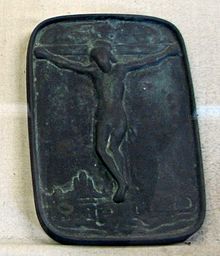
Late at night, Rodrigues heard the moans of the members of his congregation who had been arrested with him as they were held upside down inside the pits. Ferreira was brought in to put more pressure on Rodrigues to apostatize by trampling on the fumie, an image of Christ. As the priest looks down on the image of the crucified Christ, he hears the voice say: “Trample! Trample! It is to be trampled on by you that I am here. ” And so Rodrigues tramples on the fumie and the people are spared an agonizing death. From then on, all the fire drained out of Garfield’s face as the priest became one with the trampled Christ.

Throughout the movie, there is the inner struggle of Kichijiro. Already an apostate hiding in China but longing to return to his own county, he brought the Jesuits to Japan. He committed apostasy again and then ran to Rodrigues to make his confession. Then he betrayed Rodrigues and then came again to confess and receive absolution. He comes again after Rodrigues has apostatized. The priest says nothing, but his face says that is because he no longer feels qualified to absolve him. But when Kichijiro runs off, Rodrigues makes the sign of the cross.

The Japanese persecutors “won” the mimetic match, but Christ, by urging the priest to trample on his image, has embraced the priest, the persecuted Christians, and the persecutors of Imperial Japan.

Over the years, Rodrigues and the other Christians who had also trampled on the fumie are required to repeat the act time and again as a “formality.” So it is that the persecuted Christ returns time and again for the ceremony to repeat his embrace of the country.

There is much noise in the movie Silence. There is the noise of Rodrigues’s fervent declarations of faith before Inoue which dissolves when he tramples the fumie. There is the roar of the surf that is superbly photographed. There is the excruciating noise of the tortures and the even more excruciating inner noise of the psychological tortures. Then there is the silence of the trampled Christ. Although the book is of modest length, the movie is very long. The length is a strong challenge to the viewer and it guarantees that nobody will be entertained by this movie. But the length also creates space for the silence of the trampled Christ.

In the silence of the trampled Christ, there is no mimetic rivalry.

A Musical Note

The Scottish composer James MacMillan, one of the greatest living composers, and a Roman Catholic, wrote his large third symphony as a response to Endo’s novel. There are the sounds of Japanese percussion instruments. There are snarky musical figures that suggest the mockery of the inquisitor. There are grinding discords suggesting the tortures of persecution. The music is as consistently tense as the story the book tells. The silence of the trampled Christ is barely audible.
On Following the God of All Victims

WilliamGuestsChurch1In our readings for today, we celebrate the Week of Christian Unity with the short narrative of Jesus calling his first disciples (Mt. 4: 18–22) and Paul’s rebuke to the Corinthians for their discord and divisiveness (1 Cor. 1: 11–13). The light in the darkness proclaimed by Isaiah (Is. 9: 2) shines brightly on the first scenario but is much obscured in the second.

The situation in Corinth is aptly described by René Girard’s term “mimetic rivalry.” That is, the rivals are mirror images of each other. It is significant that Paul does not mention any issues of disagreement, even though we know from other sources that he had issues with Cephas (Peter.) Girard has taught us that when mimetic rivalry escalates, the issues fall away and we get the chaos of rivalry for the sake of rivalry. Girard goes on to suggest that in ancient societies this chaotic rivalry repeatedly resolved itself through suddenly focusing on one victim who was put to death. Peace, for a time, followed this atrocity. Girard goes on to aver that when this same scenario was committed against Jesus of Nazareth, the truth of this collective violence was unveiled to the extent that it could never again create peace, not even for a time, as it did before. Through Christ, God has presented us with the challenge of either renouncing our participation in chaotic mimetic rivalry or participating in the total destruction of civilization. [For an introduction to René Girard see Violence and the Kingdom of God.]

When we look at the scenario in Corinth denounced in Paul, a scenario we can all recognize in our families, social groups, work places, charity organizations, and even (sometimes especially!) in our parish churches, it appears that Christianity has failed. Actually, the situation is more complicated than that. A big part of the problem is that Christianity has succeeded too well. Or perhaps we should say Christianity has succeeded in a way that threatens to make the situation worse and more dangerous.

The unveiling of collective violence by the Cross has led to an ever-accelerating increase in sympathy for victims. We see this early in Christianity through the charitable work to relieve poverty and disease with hospitals being one of the great Christian inventions. We fret, quite rightly, about serious problems with racism in contemporary America but we do well to remember that racism has been practiced by all people of all times and places and it is only in places where the Gospel has had an influence that anybody has seen racism as a problem and acted on that perception.

While to be a victim was such an unmitigated disgrace in the ancient world that one would do anything to avoid that stigma, preferably by victimizing somebody else, to be a victim has become a badge of honor. This is indeed a badge of honor for people like those who generously risked their well-being and lives during the Civil Rights Movement in the 1960’s, but it looks like shameless exploitation of real victims by those who feel victimized when called to account for injustices and crimes inflicted on others.

This division between real victims and imposters, a division that is often far from clear, is not the problem of division that concerns me during the Week of Christian Unity. The deeper problem is what I am inclined to call a chaos of victims. We have today a plethora of real, legitimate victims, even if the plight of some might seem more urgent than others. Here is the rub. Not only do we have the social chaos of those who continue to victimize others through brute force such as rape or economic exploitation, and the social chaos of many who just don’t care, we have the social chaos of advocates for victims and victims trying to ameliorate their own circumstances. Put in a nutshell: we have a chaos of mimetic rivalry between the favorite victims of some advocates against the favorite victims of other advocates. Here is the heart of the most serious divisions within Christianity in our time. This is not a chaos of those wanting or willing to hurt others; this is a chaos among those who willingly sacrifice themselves for the benefit of others.

In such a situation, it is inevitable that those of us concerned with the vulnerable and the helpless will be more sensitive to some victims more than others. This increased sensitivity to some victims can look like indifference to others and can become downright hostile in situations where equal advocacy between causes is difficult and sometimes impossible.

I am not saying this from outside the fray. I am very much inside it, very much involved in all the mimetic issues I am describing. I know that I respond to the needs of some victims more than others. The complexity of this tension among those of us who wish to help others is enough to lead to despair but we have a light in the darkness in the calling of Jesus to follow Him. Jesus is not a Messiah divided among many victims and their advocates; Jesus is a Messiah for all victims and their advocates. It is surely this call and not any intellectual or moral perspicacity of my part that makes it possible for me to even define this problem as I have. The call to discipleship is a call for repentance on many levels, ranging from our moral own violence and lassitude to the rivalry for the sake of rivalry such as at Corinth, to our rivalry over the causes of real victims. It is this very complexity that requires us to seek a conversion of society and not just our individual selves. Here is where I see the biggest challenge to Christian unity.

Sharing God’s Riches

creche1-copyLike every culture, the Jews had to face fundamental decisions as to how open or closed they would be to others. The default mechanism tends to be flight or fight. In discussing remaining social groups living close to the level of what he calls “traditional” societies, Jared Diamond observed this phenomenon. A stranger wandering into the territory of a different tribe had better come up with a common ancestor or the encounter could prove fatal.
The type of encounters with other nations has an effect on such decisions. In the case of the Jews, most encounters were bad. Slavery in Egypt was followed by both cultural and military threats from the Canaanites who tempted the Jews to forsake the God who had delivered them from Egypt. Encounters with the Assyrians and Babylonians were catastrophic. But then the Persians destroyed the Babylonian Empire and invited the Jews to return to their homeland and revive their cultural and religious traditions. It is surely no accident that the return from Babylonian exile and resettlement back in their homeland coincided with the first expressions of openness to other cultures on the part of the Jews such as we have when Isaiah proclaims: “Nations shall come to your light, and kings to the brightness of your dawn.” (Is. 60:3) With Isaiah, we have the breakthrough insight that the God who brought them out of Egypt and then delivered them from Babylon was the God for all people and not just them. Although Adam Smith took the title of his famous book The Wealth of Nations from Isaiah 60:5: “the wealth of the nations shall come to you,” the prophet encourages a much more profound exchange than that of capital: an exchange of the riches of the Jews’ religious tradition for the riches other nations can bring to that same tradition. Unfortunately, retrenchment followed, climaxed by the expulsion of all foreign wives at about the time of the building of the second temple.

At the time of Jesus’ birth, the relationship between the Jews and the Gentiles, the other nations, was complex and tense. Their religious traditions were mostly tolerated but at times menaced by the Romans. Although some individual Gentiles became God-fearers, practicers of Jewish piety such as the Centurion who built the synagogue at Capernaum, (Lk. 7: 4-5) there were few friendly relations between Jews and Gentiles. And yet in the face of this tension, Matthew sees in the visit of the Magi to the infant Jesus a fulfillment of Isaiah’s prophecy of the exchange of wealth between the two peoples.

It was for St. Paul to return the gifts to the Magi. After his dramatic conversion, he was called to preach the Good News of Jesus, a Jew, to the Gentiles. To the surprise of many Jews who followed Jesus, “the Gentiles have become fellow heirs, members of the same body, and sharers in the promise in Christ Jesus through the gospel.” (Eph. 3: 6) That is, Jesus dissolved the fundamental division between Jew and Gentile when he was crucified by a collaboration between the two peoples who had suddenly come together for that brief moment. But when Jesus was raised from the dead as the forgiving victim, he bridged the gap between nations with one comprehensive act of forgiveness.

Ever since Paul’s commission, the Church has been tempted to retrench herself as the Jews did after building the second temple. This is to fall back into the default hostility to the stranger that Jared Diamond saw as part of “traditional” humanity. What the feast of Epiphany celebrates is the generosity of God who shares God’s riches with all so that all people can share this same richness with all others, not least with strangers who can then soon cease to be strangers.

God-Is-With-Us: A Christmas Eve Meditation

creche1-copyTonight, we celebrate the birth of a child. Usually, there is rejoicing when a child is born. One of my family stories is that my grandmother was so excited about my birth that she burned two pots of beans.

When we celebrate a birth, we celebrate the fact that a baby is. The simple act of coming to be is a cause of wonder and joy. So it is that we celebrate Jesus before he did anything at all except come out of his mother’s womb and maybe cry a bit and suckle some milk. As a friend of mine said once about newborn babies: “They don’t do much at that age.” We also celebrate our hopes for the future and for the future of that child. We know that in the case of Jesus, the future wasn’t all rosy. That Jesus was born in a stable because there was no room for him and his family and that Herod would be out to get him as soon as he found out about him shows that there was cause for anxiety from the very start. Unfortunately, many babies being born right now are born into much the same sort of anxiety that is mingled with hopes for the child. So not every birth leads to unequivocal rejoicing. Such anxiety is exacerbated by our tendency to focus on those who stir up fear in us, goading us on to adding further fuel to the violence growing all around us. We can see in news reports, Twitter, and Facebook that we are locked in violent systems of condemnation that stoke our fears exponentially.

Although we celebrate tonight the very being of Jesus, that Jesus is, when Jesus was apparently not doing much, God was and is already doing a great thing, an unprecedented thing: God had entered humanity. God chose to share, in frail human flesh, the very threats and anxieties that we all share. God has not left us to the human powers over which we have little or no control, powers we doubt we can trust with our well-being. Moreover, God shares the vulnerability other humans suffer from us on account of our fears and our own violence that we cannot see. In this way, God, in Jesus, lives up to the name: Emmanuel, which means “God is with us.”

God’s presence among us means many things. Tonight I will touch on one of them. By entering humanity, God has opened our human nature to God’s nature. We are no longer as trapped in our own human fear and violence as we often think we are. Later in life, Jesus spoke about God coming “like a thief in the night” but at the time of Jesus’ birth, God had already broken into the household of our humanity and started to sneak around, taking away bits of fear and violence and leaving bits of love behind.

This Christmas, let us celebrate the sneaky child who is already crawling around in the dark places of our lives, taking away the things we need to lose and giving us the gifts we need the most.

On Welcoming a Thief in the Night

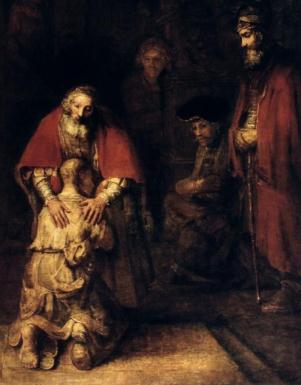
crucifix1A thief is not usually thought of as a good type of person and a thief in the night is worse. And yet Jesus characterizes himself as a thief when he says: “if the owner of the house had known in what part of the night the thief was coming, he would have stayed awake and would not have let his house be broken into.” (Mt. 24: 43) The expression that God will come like “a thief in the night” also comes up in 1 Thessalonians 5:2 and 2 Peter 3:10. Since Jesus commends the dishonest steward who defrauds the master who is firing him and the unjust judge who gives the widow a fair hearing just to stop her from pestering him, it seems that Jesus has a soft spot in his heart for rogues. Maybe he was a bit of a trickster rogue himself.
But surely it isn’t good to be a thief is it? A thief is someone who takes what belongs to somebody else for personal gain at the expense of the thief’s victim. That is not good. However, before we get too self-righteous about other people who are thieves, we should pause to take note that one can steal the reputations of other people through misrepresentation and downright lying. Worse, we can steal the dignity of other people by treating them with disrespect. With these considerations, we begin to see that thieves aren’t just other people.

The context of this verse in Matthew strengthens this uncomfortable realization. Jesus refers to the Flood of Noah’s time, noting that people were going about their business as if nothing was wrong. But Genesis says that the whole society had become a flood of violence that was sweeping everybody away. The implication is that the society of Jesus’ time was likewise being swept away in a flood of violence while most people thought things were just going along normally. And what about our own time? We go about our business while reputations and human dignity are being stolen right and left by both right and left. All of us have become thieves and we will never get out of this social flood until we realize this truth.

So, is Jesus a good thief while the rest of us are bad thieves? Let’s take a look at how Jesus acts like a thief in the night. Does Jesus steal our things for personal gain? Jesus does steal everything we have but he does not steal our things for his personal gain but for our personal gain. More important, Jesus steals everything in us and about us that destroys our relationships with other people and God. That is, Jesus steals our thieving ways that we are so attached to. How else can we feel good about ourselves if we can’t steal the reputations and dignity of other people? But while a human thief leaves nothing for the thief’s victim, Jesus gives us the full richness of God, the richness bestowed on humankind at the dawn of creation.

How can we be ready for a thief like this? St. Paul tells us to “live honorably as in the day” by giving up “quarreling and jealousy.” Then, “put on the Lord Jesus Christ.” (Rom. 13: 13–14) Then, as Isaiah teaches us: beat our “swords into plowshares” and our “spears into pruning hooks.” (Is. 2: 4) Then we won’t have so much thievery and violence for Jesus to take away from us when he sneaks into our lives.

Luke tells us of a thief who became good because he repented and, in so repenting, realized that Jesus had been unjustly swept away by society’s violence. Will we choose to repent and become good thieves?

Jacob & the Prodigal

???????????????????????????????????????????Kenneth Bailey’s book Jacob & the Prodigal overlaps with important sections of my own book Moving and Resting in God’s Desire: A Spirituality of Peace. In using the thought of René Girard and his colleagues to explore ways of renewing Christian spirituality (see Violence and the Kingdom of God for an introduction to Girard), I comment at length on the stories of fratricidal strife in Genesis and Jesus’ Parable of the Prodigal Son in Luke. (The Parable is better titled something like “The Prodigal Father and His Two Sons.”
Wee both see Jesus’ Parable as seeking to resolve the strife between brothers although, like the story in Genesis, the Parable is left open, leaving the possibility of resolution open but not fulfilled in the text. Having grown up in the Near East, Bailey has much knowledge of Semitic culture that many of us in the West do not have. As a result, Bailey offers many important insights into the Parable and the earlier narrative that pass many of us by. For example, Bailey emphasizes the foolishness of the Father in the Parable in running to meet his son at the edge of the village. For a grown man to run for any reason was considered shameful and to run for such a purpose especially so. This is just one example among many of the new insights Bailey has to offer us. Bailey treats the Parable as the climax of a trilogy of parables in Luke 15 which begins with the Parable of the Lost Sheep and continues with the Parable of the Lost Coin before concluding with the Parable of the Prodigal Son. By studying the parables together, Bailey explores the Christology of the Parables where the shepherd, the woman searching for her coin and the father all become images of Jesus Himself as he reveals how overwhelming and unimaginable the Love of God is.

The final portion of the book is a comparison of the Parable with the Saga of Jacob and Esau. Many of the parallels are contrasts which are at least as illumining as the likenesses. In both cases we have two brothers in strife. Isaac, however, in his in ineptness in being tricked is a huge contrast to the father in the Parable. Another contrast is that Jacob does well in the foreign country while the Prodigal Son does not. Another likeness is that neither Jacob nor the Prodigal Son repent of wrongdoing. (Bailey explains at length that the Prodigal Son is only scheming to get set up in a craft to get enough money to live on; he is not repenting of asking his father for half the estate, brutal as that was to his father.) Bailey argues that Esau doesn’t really forgive Jacob as I argue in my take on the story. The number of armed men Esau brings could suggest an aggressive meeting but it could be a defense measure, not knowing how many armed men Jacob might have. Bailey argues that the vowels of the Hebrew word for “kiss: are the same as the vowels for “bite,” leaving open the possibility that Esau bit Jacob. I can’t argue the linguistic case but it seems to me that so aggressive an act would have led to a more violent reaction than we have. In any case, I see Jacob not believing in Esau’s forgiveness and rather than a reconciliation, the story ends in a permanent separation.

In the Parable, the two brothers are separate at the end, thus keeping up the conflict that I see between them dating back to before the younger brother leaves. In the Parable, however, the central separation is between each of the brothers and their father. The younger son does seem to have accepted his father’s welcome, although we don’t know if he persevered in his gratitude. The older son is at odds with his father as well as with his brother. The challenge is whether or not the older son will accept his father’s love for his younger son. In like manner, Bailey demonstrates that this challenge is thrown out to the scribes and Pharisees who criticized Jesus for eating with “sinners.”
Bailey’s book is a valuable source of new insights that deeply refresh our understanding of a Parable that we think we understand so well that we have let it go stale. Most important, Bailey’s study makes the Love of God revealed in Jesus “full of sap, still green.”

Zacchaeus and his City

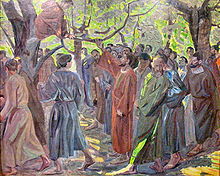
zacchaeusThe French thinker René Girard has argued that since the dawn of humanity, we have tended to solve social tensions through persecuting a victim who absorbs these tensions and suffers for them. Girard has also argued that the Gospels unveil the truth of this scapegoating mechanism in their narratives of Jesus’ death and Resurrection where Jesus opens up new possibilities for humanity to gather through the forgiveness of the Risen Victim. It happens that the Gospels show Jesus unveiling these very same dynamics in his earthly ministry. I analyzed our such stories in my book Moving and Resting in God’s Desire. Here is what I have to say about Zacchaeus:

When Jesus came to Jericho, he was famous, or notorious enough, that something of a hubbub arose as a result of his passing through the town. People gathered and crowded one another to gawk at the man and his followers. Why the stir? The mayor wasn’t exactly giving him the key to the city. Throughout Jesus’ journey to Jerusalem, Jesus was set upon by Pharisees and scribes and questioned in front of the crowd. Such questioning, of course, was made with the intention of publicly discrediting the freelance itinerant preacher who was becoming famous for his clever retorts. The result was bound to be entertaining. The scribes and Pharisees were surely on the prowl in a town that large. Zacchaeus’s act of climbing a tree to get a look at Jesus need not be taken as an indication that he was inclined to have his life changed by this stranger. His eagerness to see and hear the duel is enough to account for his action. And yet the anticipated debate does not occur. Why? Because Jesus saw Zacchaeus up in the tree. The signs that Zacchaeus was a rich man hated by everybody in town were there to be seen by a person with eyes to see.
That Jesus had discerned the social matrix of Jericho rightly was immediately manifest when Jesus called out to the tax collector and invited himself to that man’s house. St. Luke says that “all who saw it began to grumble and said, ‘He has gone to be the guest of one who is a sinner.’” (Lk. 19:7) Here is another example of Luke’s astute anthropological insight. It isn’t just the Pharisees and scribes who grumble about Zacchaeus. Everybody grumbles about him. Like Simon when confronted with the Woman Who Was a Sinner, (Lk. 7:36–50) the people of Jericho were thinking that if this man were a prophet, he would have known who and what kind of man this was who was sitting up in a tree—that he was a sinner. One doesn’t have to be a demonically possessed man or a sinful woman to be a communal scapegoat. A rich man who is a traitor to his people can hold the same position. And deserve it. After all, he was treading down the downtrodden. For scapegoating others, he deserved to be scapegoated. As it happened, Jesus did know what kind of man Zacchaeus was. It is through showing us that anybody can be the scapegoat and anybody can be a persecutor that Luke shows the communal scapegoating phenomenon for what it is. Given the fact that Jesus was on the way to Jerusalem with a pretty clear idea of what was going to happen to him there, it behooved Jesus to give his followers every opportunity to see how collective hostility against one person works, in the hope that they would learn to recognize the process when it happens in the Holy City, and that is what he has done here.

As with the Gerasene demoniac, Jesus performs an exorcism of the communal scapegoat, a quiet one this time, but just as effective. The result is that the homeostasis sustained by the scapegoating process is destabilized. There is some ambiguity as to whether or not Zacchaeus is actually converted by his encounter with Jesus or if he had repented earlier but nobody believed it. Bible scholars disagree as to whether the verbs used by Zacchaeus are in the present tense or the future. That is, Zacchaeus may be saying that he will give half of his possessions to the poor and pay back four times anybody he has defrauded, but he could be saying that he is already doing these things. If Zacchaeus is using the future tense, then he is announcing a change of heart. If Zacchaeus is speaking in the present tense, then he is claiming that he is better, or less terrible, than he has been made out to be. I think our best bet is to look at the implications of either interpretation of the verb tenses.

If Zacchaeus has been converted on the spot by Jesus, and we assume that Jesus did not zap people with a magic wand to override their free will, then we may ask ourselves how this conversion happened. The information in Luke suggests two possibilities. As the communal scapegoat, Zacchaeus had “the intelligence of the victim” and perhaps that intelligence led him to understand what it meant to other people to be the victim of his tax collecting. The other possibility is that an undeserved commendation from Jesus freed Zacchaeus from the necessity of acting in such a way as to justify his designation as communal scapegoat. It is more than likely that both factors played their part here. On the other hand, if Zacchaeus was speaking in the present tense, the implication is that the collective attitude of the townspeople was unjust, which would underline the arbitrary aspect of scapegoating. Generous actions on the part of a rich person who has drawn the collective resentment of the community often do not diminish resentment against him or her. It is also possible, of course, that Zacchaeus is trying to make himself look better than he really is. That is, he is boasting of his good deeds while overlooking the unjust means used for gaining the wealth that he uses for his acts of largesse. If I am right in taking this story as being primarily concerned with communal scapegoating, then the ambiguity enriches the story and there is no need to solve the grammatical problem once and for all.

The challenge of this story, however, is not limited to the possible conversion of one person. It extends to the possible conversion of the whole community. Whether or not Zacchaeus needed to be converted and, if so, whether or not he did change his life, is immaterial for the greater challenge. Either way, by singling out Zacchaeus and inviting himself to that man’s house, Jesus has already robbed Jericho of its scapegoat. The unanimity has been irretrievably broken. That everybody turns to grumbling at Jesus for going to the house of a man who is a sinner suggests that Jesus is well on the way to becoming a unanimous object of hatred. Since Jesus is on the way to Jerusalem, where he would, once again, become the object of hatred, it is no surprise that it should happen in Jericho, while he was on the way to the Holy City. This development does not bode well for Jericho becoming a social climate of healing.

Increasing Faith in Forgiveness

mulberry_tree_by_vincent_van_goghThe disciples’ demand (not a request) that Jesus increase their faith, (Lk. 17: 5) with a hint of desperation that such a demand entails, seems to come out of nowhere when it begins the Gospel reading. So let us look at the preceding paragraph for some context.

That paragraph begins with Jesus’ ominous warning against being occasions of stumbling (scandals) for any of Jesus’ “little ones.” Unlike the parallels in the other synoptic Gospels, however, this warning is quickly followed by an admonition to rebuke those who cause stumbling but then to forgive them if they are penitent, even if it is seven times a day, which is a lot of forgiving.

So, the disciples aren’t having a problem believing in the Nicene Creed. They are having a problem accepting this demand to be forgiving on such an incredible scale. After all, if one repents seven times a day, how serious is the repentance? Forgiving like that often requires the patience of a saint and not even many of the saints I know anything about are as patient as that. The “faith” at issue here, then, seems best understood in the usual meaning in Jesus’ time which would stress fidelity to Jesus’ teachings and trust in his sanity in the face of such impossible demands. In the same fashion, we can understand “faith” as used in Habakkuk 2:4 as referring to remaining steadfast to Yahweh in the face of the human violence of social injustice in Israel and the violence of the Babylonian invaders. That is, in the face of people who cause much stumbling and need forgiveness almost nonstop.

Unlike the parallels in Matthew and Mark, faith the size of a mustard seed is enough to move this mountain, perhaps the Temple Mount and its sacrificial system, from here to there. But mulberry trees have nothing to do with sacrifice. So why a mulberry tree in this version? A mulberry tree can be nice to have around but it an be a nuisance in some circumstances. When I was growing up, we had a mulberry tree on the edge of our property. The berries were a nice treat but they also stained the driveway a deep purple. Mulberry trees also have complex root systems that spread out a large distance just under the surface and they also send sinker roots deep into the soil. This may be one of the reasons my father used a tree removal service rather than faith to move the tree off from the property.

We an see the mulberry tree as an image of the intractability of the occasions for stumbling that we encounter on a daily basis. The image also stands for the tangle of our anger and frustration over being asked to forgive those who keep making us stumble over and over again. The close coupling of Jesus’ admonitions here suggests that all of us cause others to stumble about as much as we have occasion to forgive others for making us stumble. Faith the size of a mustard seed is enough to pull us out this tangle of scandal and stumbling and yet we have trouble having as much faith as that!

A brief parable follows. We are apt to think the master treating his slaves so harshly stands for God, but Jesus is asking: Whom among you would say to his slave to come sit down for dinner after a hard days’s work? The implication is that we are the ones who would like to have the power to order people about like that. But is that faithfulness to Christ? Looks more like a cause of stumbling to me. Jesus then shifts to the perspective of the slave who must not presume to be worthy of any reward, just as slaves were so considered in his time. In a similar parable in Luke 12, Jesus says that the master is the one who will wait on those slaves who eagerly await his return. In daily life, we often feel that we are slaves of those who cause trouble and so demand much attention and energy on our part and yet are the last to express any gratitude for what we do for them. We tend to resent such slavery and take refuge in vengeful anger and maybe some grudging forgiveness that makes us feel superior. But Jesus places himself in the position of the slave to those who stumble and makes others stumble, so that is where we will find Jesus if we have the faith the size of a mustard seed.

God’s Kingdom as Gift

treeBlossoming1There is only one simple qualification for being a disciple of Jesus: give up everything. That’s one whale of a qualification. So hard is this qualification that earnest Christians have thought of many ways to soften Jesus’ words without washing all meaning and challenge out of them. My New Testament professor at Nashotah House, O.C. Edwards, suggested that this qualification means we have to give up everything that comes between us and God. That is, if parents, children, spouses, friends, or fellow members of a community help us draw closer to God, we don’t have to give them up. The same would go for material possessions. Even Benedictine monks have to use things in this world in order to live so we can’t give up having anything at all. The trick is to use things in such a way that the work and recreation we do with them draws us closer to God rather than farther away.

We could phrase this approach by saying that the problem is not possessions but possessiveness. God gives us parents, children, siblings, and friends as gifts. Likewise we should give each ourselves as gifts to other people. The things we use in the world are likewise gifts from God and should be treated accordingly. The problem comes when we prefer to take other people and things rather than receive them. In such cases, the intensity of love we feel for others is actually possessiveness rather than love. We are told to “hate” parents, children, siblings, and friends so as not to be possessive of them. Taking people and things is the result of putting ourselves in competitive relationship with other people. When we compete with others, we have to win and a victory is something we earn, not a gift. This same competitiveness carries over to our attitudes toward possessions. As the French thinker René Girard teaches us, we often want things that other people have or want to have things at the expense of others so that we can claim a victory over them. Of course, competitiveness is a bottomless pit. If we win one round, we always fear losing the next. If we have to have more than other people, or at least as much, we have to keep on accumulating more things no matter the damage our hoarding does to others. In all this, the people we try defeat and our lust to win through possessions become stumbling blocks between ourselves and God. This is what we have to give up.

Paul’s Letter to Philemon illustrates this point very well. Slavery, very common up to the present day (although now other terms such as “trafficking” are often used for it), is perhaps the ultimate in possessing other people. Onesimus was a runaway slave. Paul experienced Onesmimus, not as a possession but as a gift, a person who freely gave of himself to serve Paul while he was a prisoner. Paul is tempted to be possessive and keep Onesimus for himself but he offers Onesemus to Philemon as a gift, clearly hoping that Philemon will give Onesimus back to Paul as a free gift. Paul makes it clear that he is not giving Onesimus back as a slave; instead, he is giving Philemon back as a beloved brother “both in the flesh and in the Lord.” (Philem. 16) If Philemon receives Onesimus as a brother in Christ, he can hardly continue to possess him as a slave.

I’ve always seen Paul’s letter as an artful piece of emotional blackmail, but for all his manipulative rhetoric here, Paul is basically passing on to Philemon Jesus’ invitation to the Kingdom with its one qualification. This sounds simple, but in the heat of daily battles, we find that the possessiveness born of competitiveness is very hard to renounce and it amounts to carrying our cross daily. If we can daily renounce our possessiveness, we will indeed receive everything from God and from others as Gift.

Just a Little Jewish Girl: A Homily for the Feast of St. Mary the Virgin

MaryBack when I was a seminarian at Nashotah House, a student from the South transferred there in the middle of the academic year. Not surprisingly, given Nashotah’s Anglo-Catholic tradition, several students ganged up on him and tried to convert him to an ardent devotion to Our Lady. This student’s response was: “I thought Mary was just a little Jewish girl.”

Not surprisingly, this student never got into rosaries or other Marian devotions. For myself, young and zealous over the Anglo-Catholic way but cautious about going as overboard as some of my classmates did, I was bemused by the remark and it has stuck with me. As I think about it now, I am convinced that this student’s remark, surely meant to be dismissive, was spot on. Mary was a Jewish girl, and if we want a sound Mariology, we are wise not to forget it. In fact, when we look at the Gospels, we see a Jewish girl who said very little, although she pondered much in her heart.

Some of the overblown piety directed at Mary has been enough to make one forget she had ever been a human being, let alone a humble girl from a humble Galilean village. The Gospel canticle known as Magnificat, which was read for today’s Gospel, has this little Jewish girl flinging the mighty from their seats and scattering the proud in the imagination of their hearts. Maybe this little Jewish girl took some Judo lessons and got herself a black belt. Then the paintings of Mary’s Assumption into Heaven and her coronation there make her look something like a goddess. Many devotions to Mary suggest that she is the vehicle of salvation and either her son is just an afterthought, or he just as stern and unapproachable as his heavenly father. This little Jewish girl sure rose up in the world.

However, if God was going to send His Son, born of a woman, at the “fullness of time,” (Gal. 4: 4) a woman would gave to give birth to him. If Jesus was going to be born a Jew, then his mother would have to be a little Jewish girl and not a goddess organizing the heavenly realms. Jesus would not have been fully human otherwise. As a baby and little boy, he needed to be cared for by his mother and adoptive father. Nothing unusual there. What was unusual, to the point of being earthshaking, as the Magnificat proclaims, was that God had entered human nature so that this human mother was not only the mother of a human boy but the Mother of God! So it is that in the Magnificat, it isn’t Mary who is throwing the bad guys around; it is God raising up a little Jewish girl and, with her, the whole human race, little old me and little old you included.

In this festival, we do not celebrate a goddess; we celebrate a little Jewish girl who said “Yes” to God’s Desire, just as every human is called to do. It is saying “Yes” to God’s desire that scatters the imagination of our hearts and raises us up to the level of this little Jewish girl.