
 Probably nothing is more painful than betrayal. My own personal experiences of feeling betrayed are, so far, much smaller than what I know others have suffered, but even the smallest doses of betrayal are unspeakably painful. The pain of betrayal is a pounding discord in the Gospel narratives of Jesus’ Last Supper and Paul’s own short narrative of it. This discord is particularly prominent to the point of being unbearable in John’s Gospel where it overshadows Jesus’ loving act of washing the disciples’s feet. Right after leading into the story with these sublime words: “Having loved his own who were in the world, he loved them to the end,” (Jn. 13: 1) John says: “The devil had already put it into the heart of Judas son of Simon Iscariot to betray him.” (Jn. 13: 2) When Judas leaves the supper, John says “And it was night,” (Jn. 13: 30), meaning “night” in all of its most ominous meanings. Right after Judas’s departure, Jesus gives his disciples his great “new” commandment: “Love one another. Just as I have loved you, you also should love one another.” (Jn. 13: 34)
Does this new commandment cancel the night into which Judas has just walked? Or does the night cancel the light of the commandment? Hatred for Judas has echoed through the centuries with betrayers often called a “Judas.” So commonly is this epithet used that it can be hurled at a person for playing an electric guitar instead of an acoustic one, as Bob Dylan found out. The raging pain of Judas’s betrayal occasions several outbursts in the responses of the Tenebrae services of Holy Week. Most chilling is the “Judas mercator:” “Judas, the worst possible merchant, asked to kiss the Lord.” In the powerful setting by Tomas Victoria, the pain is unbearably searing. Where is the love we are supposed to have for one another? Even in the glory-filled High Priestly prayer of John 17, Jesus says he has guarded the ones entrusted to him “except the one destined to be lost.” (Jn. 17: 12) I feel those words as a shadow in the prayer of glory. The author of 1 John reaffirms this great commandment and insists that God is light with no darkness at all, (1 Jn. 1: 5) but then rages with the hurt received from several “antichrists”who have betrayed the community by going out from them. (1 Jn. 2: 19–20)
There have been attempts to vindicate Judas. One of the more thought-provoking attempts comes in Kazantzakis’s Last Temptation of Christ where Jesus entreats Judas to betray him because it is necessary that he be crucified. Kazantzakis appeals to the reader’s sympathy for the two millennia of opprobrium Judas has suffered for doing what his best friend asked him to do. I fear, though, that the paradoxes of John’s Gospel do not give us this out. We have to face the pain of the betrayal. This pain is all the greater and hits closest to home when we realize that all of Jesus’ disciples betrayed him except “the Beloved Disciple” in John’s account. This suggests that, like Judas, we are all betrayers of Jesus. This doesn’t make Judas right; it makes us as wrong as Judas. Would it have been better if none of us had been born? Our hatred of Judas distracts us from the truth of ourselves. Accusations of betraying Jesus fly between Christians, each convinced that it is other people who have betrayed Jesus while each of us is as faithful as the Beloved Disciple. I have my own list of traitors of Jesus that tempts me to dwell on them more than on myself.
John takes us into the “night” into which Judas walked because this is the night into which Jesus himself walked when he carried the cross to Golgotha and was crucified there because he had been handed over multiple times by the time he reached that destination. Does Jesus’ commandment to love one another as he has loved us extend to everybody who handed Jesus over to the next step towards the cross? Does it apply to each of us when we betray Jesus by disobeying this commandment? Does it apply to Judas? After Jesus’ Ascension, Peter announced that the gap left by Judas had to be filled and Matthias was chosen by lot to make the disciples twelve once more. (Acts 1: 21–26) Does Mathias rub Judas out, or does Mathias redeem Judas in a mysterious way by taking his place so that the Twelve Apostles can be the twelve tribes of a New Israel that embraces everybody? Does the Light shine in the darkness so powerfully that the darkness cannot overcome it, (Jn. 1: 5) not even the darkness into which Judas walked?
 Right after dramatically recalling God’s deliverance of the Jews from the Red Sea, Isaiah proclaims that God is “about to do a new thing; now it springs forth, do you not perceive it?” (Is. 43: 19) By his time, the Red Sea deliverance was an old thing, something the Jews repeatedly recalled, especially at the celebration of Passover. But at the time of that deliverance, it was a new thing that had sprung forth. Delivering escaped slaves through turbulent waters just wasn’t in the play books of deities at the time. God had changed the play book and revealed the hitherto unknown truth that God is a God who delivers victims and outcasts from the rich and the powerful.
 The temptations of Jesus in Matthew and Luke are stylized accounts of three temptations that may not have happened in so neat a fashion in real life, but are clearly meant to be comprehensive of the fundamental temptations that challenge all humans, Jesus included. Jesus’ responses to the three temptations, which would have been particularly strong during his forty days of solitude in the wilderness, are a guide to dealing with the same temptations in our own lives.
 The narratives of the call of Isaiah, Paul, and Simon Peter bring to mind my own experiences of God’s call. In my case, it wasn’t quite like being attacked by a Cherubim in church, getting knocked down on the Road to Damascus or being told to throw out the fishing nets one more time and being overwhelmed by the catch.
 Luke stresses the contrast between John the Baptist and Jesus much more than the three other evangelists. Most strikingly, Luke does not specifically say that John himself baptized Jesus. Luke describes John’s ministry and then says Herod added to all his other crimes by putting John in prison. (Lk. 3: 19–20) Then Luke puts Jesus front and center by saying the he was baptized “when all the people were baptized.” (Lk. 3:21)
 The image of Mary holding her Child is arguably the defining image of the Christmas season. Its tenderness is comforting in a world where violence against the most vulnerable dominates the news. Vulnerability, such as that of a newborn baby tends to arouse either a gentle wish to nurture and protect, or it sets off an urge to take advantage of weakness in hard-hearted fashion as Herod did. We see both of these tendencies happening in the world about us and it is possible that we struggle between them within ourselves. If we let ourselves get caught up in the frantic conflicts occurring today, any weaknesses we see in our opponents become targets for increased aggression.
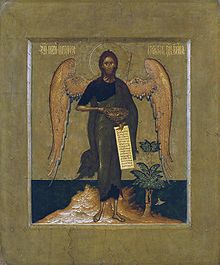 Although John burned with a conviction that God was going to do something new, he had only the models of past prophets to guide him in opening a way to the great new thing. He lived in the desert, wore a camel hair coat and ate wild locusts and honey in imitation of Elijah. Like the prophets of the past, he warned the brood of vipers of the wrath to come if people did not shape up and turn back to God. (Lk. 3: 7) Again like the prophets, he told soldiers not to oppress vulnerable people. Yet again like the prophets, he rebuked his ruler, Herod. And like so many of the prophets, he was put to death.
 Jesus’ words about the lilies of the field (Mt. 6: 25–33) are among the most quoted of his teachings for their poetic beauty but among the most disregarded for their obvious inapplicability to human life as we know it. This teaching seems to be as inapplicable as Jesus’ invitation to the rich man to give away everything he had and follow him. (Mk. 10: 21) If it is impossible to give everything we have for the Kingdom of God, then it is just as impossible to trust God to feed us like the birds of the air and clothe us like the lilies of the field. However, in reference to the rich man, Jesus said that all things are possible with God, so let us, on this day of thanksgiving, reflect further on the birds of the air.
 Do not worry about anything, but in everything by prayer and supplication with thanksgiving let your requests be made known to God (Phil. 4:6) (All Bible quotes are from the NRSV)
 The widow who put “two small copper coins” in the temple treasury, all she had to live on, (Mk. 12: 42) has been held up by many preachers as a touching example of heart-warming generosity. Those of us who have come to notice the social and economic issues in the Gospels have seen some concerns that are rather chilling.
 Imaginary Visions of True Peace