
 The temptations of Jesus in Matthew and Luke are stylized accounts of three temptations that may not have happened in so neat a fashion in real life, but are clearly meant to be comprehensive of the fundamental temptations that challenge all humans, Jesus included. Jesus’ responses to the three temptations, which would have been particularly strong during his forty days of solitude in the wilderness, are a guide to dealing with the same temptations in our own lives.
The first temptation, that Jesus should turn stones into bread, can stand for all sensual temptations. It is surely not a sin to satisfy one’s hunger but it is a sin to be focused on physical sustenance to the neglect of all else, to make god our belly. (Phil. 3: 19) The devil’s proposal puts bread front and center, which sparks the competitive tendencies of humans to seek more material goods for the sake of having more material goods than others. Jesus’ reply puts bread in a wider context, implying what Matthew spells out, that we not only need bread but “every word that comes from the mouth of God.” (Mt. 4:4) Within this broader context, bread is provided in the wilderness by God as it was to the Israelites in their desert journey after escaping from Egypt. When bread is a gift from God, then it should also be a gift between humans as well.
Lust for power is often thought to be the greatest human temptation, as Matthew suggests in his ordering of the temptations, but Luke makes it the second greatest temptation. We might think that the devil’s offering Jesus “all the kingdoms of the world” as being out of our league, but all of us tend to seek power in our own social settings. That is, we try to build up what sociologists call “social capital.” This is what Jesus was warning us about in the Gospel for Ash Wednesday when he told us not to fast or give alms “like the hypocrites” who compete for human admiration. (Matthew 6) In seeking social capital, we try to build our little kingdoms piece by piece. As with the first temptation, Jesus responds with the larger picture grounded in God by alluding to Deuteronomy 6: 13: “Worship the Lord your God, and serve only him.” That is, we should seek our social capital first with God rather than with humans. By worshiping and serving God, we will then serve other people rightly and thus gain social capital in less competitive ways.
The third temptation is the most subtle and the most dangerous. The first two temptations proposed substitutes for focusing primarily on God. The third temptation focuses on God. The devil quotes Psalm 91 to assure Jesus that if he threw himself from the pinnacle of the temple, Jesus’ heavenly Abba would surely save him, as promised in the psalm. But the focus on God is distorted in what amounts to an attempt to manipulate God, which would make God a competitor among human competitors. Catching this distortion, Jesus clarifies the right focus on God by saying that one should not put God to the test. The distortion of the third temptation is subtle because it is based on the profound truth that God cares for each of us and takes care of us. But to assume that we can do anything, no matter how heedless and reckless because God will take care of us is presumption, putting God to the test. If there is anything the prophets have taught us, it is that God allows us to live with the consequences of our choices. Otherwise, what meaning would free will have?
The imposition of ashes on Ash Wednesday is a reminder of our frailty as mortal creatures. The temptations of Christ, the same temptations we experience daily, remind us of our moral and spiritual frailty. If Jesus had to remain mindful of his heavenly Abba and guard against distortions in that relationship, we should do no less. Let us take comfort that, as the author of Hebrews said, precisely by being tempted in every way as we are, Jesus is the pioneer and perfecter of our faith. (Heb. 4: 15, 12: 2)
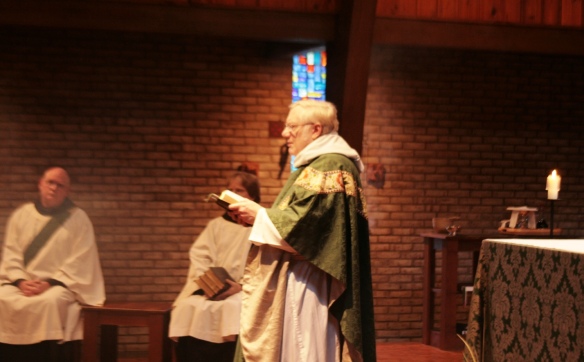 The narratives of the call of Isaiah, Paul, and Simon Peter bring to mind my own experiences of God’s call. In my case, it wasn’t quite like being attacked by a Cherubim in church, getting knocked down on the Road to Damascus or being told to throw out the fishing nets one more time and being overwhelmed by the catch.
 The image of Mary holding her Child is arguably the defining image of the Christmas season. Its tenderness is comforting in a world where violence against the most vulnerable dominates the news. Vulnerability, such as that of a newborn baby tends to arouse either a gentle wish to nurture and protect, or it sets off an urge to take advantage of weakness in hard-hearted fashion as Herod did. We see both of these tendencies happening in the world about us and it is possible that we struggle between them within ourselves. If we let ourselves get caught up in the frantic conflicts occurring today, any weaknesses we see in our opponents become targets for increased aggression.
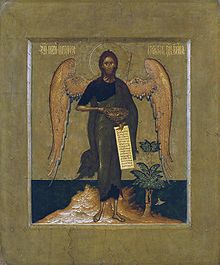 Although John burned with a conviction that God was going to do something new, he had only the models of past prophets to guide him in opening a way to the great new thing. He lived in the desert, wore a camel hair coat and ate wild locusts and honey in imitation of Elijah. Like the prophets of the past, he warned the brood of vipers of the wrath to come if people did not shape up and turn back to God. (Lk. 3: 7) Again like the prophets, he told soldiers not to oppress vulnerable people. Yet again like the prophets, he rebuked his ruler, Herod. And like so many of the prophets, he was put to death.
 Jesus’ words about the lilies of the field (Mt. 6: 25–33) are among the most quoted of his teachings for their poetic beauty but among the most disregarded for their obvious inapplicability to human life as we know it. This teaching seems to be as inapplicable as Jesus’ invitation to the rich man to give away everything he had and follow him. (Mk. 10: 21) If it is impossible to give everything we have for the Kingdom of God, then it is just as impossible to trust God to feed us like the birds of the air and clothe us like the lilies of the field. However, in reference to the rich man, Jesus said that all things are possible with God, so let us, on this day of thanksgiving, reflect further on the birds of the air.
 The widow who put “two small copper coins” in the temple treasury, all she had to live on, (Mk. 12: 42) has been held up by many preachers as a touching example of heart-warming generosity. Those of us who have come to notice the social and economic issues in the Gospels have seen some concerns that are rather chilling.
 Jesus’ insistence that we deny ourselves and take up our crosses and follow him (Mk. 8: 34) jolts us into thinking about what our priorities in life should be. Without being so jolted, we tend to deny other people, take up our favorite pastimes and follow whoever takes our fancy. However, we encounter a serious problem if and when we do take Jesus’ words to heart. We tend to get muddled over what constitutes a “cross” and how we should carry it. Because of this muddle, there is the danger that the cross will be trivialized. Carrying our own crosses is not about being a good sport if we catch the flu.
 I was introduced to the Transfiguration of Our Lord when Raphael’s great painting of the event hit me between the eyes during my student travels in Rome. With the Feast of the Transfiguration coming during my church’s summer slump (and it wouldn’t have celebrated the feast anyway) I knew nothing about it. In many ways, I didn’t have to. The painting opened up a vision of a transfiguration of humanity beyond what I had thought possible. At the time, what faith I had wasn’t centered around any particular religious viewpoint but I was majoring in religion because I thought the subject dealt with the most important things in life. Seeing the painting was more of a religious awakening than I knew. I was, of course, impressed by the sublimity of the upper half of the canvas where Jesus is floating in the air with Moses and Elijah. But I was even more impressed by the inroads the transfigured light made into the lower half which is often interpreted as indicating sinful and benighted humanity. It has taken me years to see further into the significance of this chiaroscuro effect.
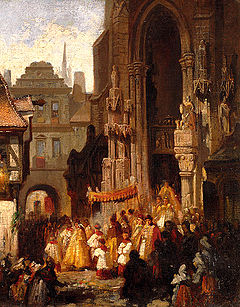 The Feast of Corpus Christi celebrates the presence of Christ’s body in the Eucharistic host. One of the events that inspired the institution of the feast was a vision granted Fr. Peter of Prague in 1263. He had doubted the presence of Christ in the sacrament until he had a vision of blood dripping from the host as he consecrated it. This vision, along with earlier visions of St. Juliana of Mont Cornillon, led Pope Urban IV to order the institution of this feast. Of other Eucharistic visions I’ve heard of, it is better to be silent rather than ruin today’s celebration.
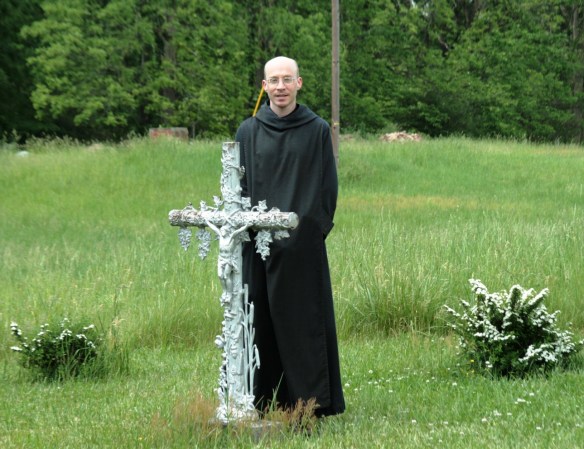 The Trinity is a fundamental doctrine for Christianity but Christianity is a story of salvation before it is a set of doctrines. The Trinity is no exception. If we get the story right, we might get the doctrine right, but if we get the story wrong, then we get the doctrine wrong for sure.
 Imaginary Visions of True Peace