
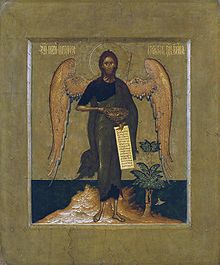
 Although John burned with a conviction that God was going to do something new, he had only the models of past prophets to guide him in opening a way to the great new thing. He lived in the desert, wore a camel hair coat and ate wild locusts and honey in imitation of Elijah. Like the prophets of the past, he warned the brood of vipers of the wrath to come if people did not shape up and turn back to God. (Lk. 3: 7) Again like the prophets, he told soldiers not to oppress vulnerable people. Yet again like the prophets, he rebuked his ruler, Herod. And like so many of the prophets, he was put to death.
In John’s time, baptism was established as a custom for cleansing converts. John gave it a new twist by insisting that his fellow Jews needed to be converted as much as the Gentiles and so were in need of being baptized. This was a prophetic action to dramatize God’s word. Today we call it guerilla theater. The teaching dramatized in this novel way was traditional: the people should return to the Lord who will purify them of their sins.
John defined himself through the words of Isaiah by quoting Isaiah’s prophecy of a new pathway of the Lord. (Is. 40: 3) The pathway through the desert that Isaiah was prophesying was for the return of the exiles from Babylon to Jerusalem, a great new thing God was doing in Isaiah’s time. In quoting these words, John was announcing that God was going to do yet another new thing, something God had never done before.
For John, this new thing was focused on a person who was to come. John believed that Jesus was this person when he came to the river. But John was confused about him, and not for the last time, when Jesus insisted on being baptized although John thought Jesus was the one person who didn’t need it.
When he was in prison by order of King Herod, John had doubts about Jesus and he sent two followers to ask Jesus if he was the one he was expecting. It seems odd that the healing miracles John’s disciples had just reported should cause doubts, but a ministry of healing was beyond the scope of John’s own ministry. Typically, Jesus did not answer the question, but pointed to his healings and said “ blessed is anyone who takes no offense at me.” (Lk. 7: 23) Given the fiery rhetoric of John’s own preaching, the sentiments of the Sermon on the Mount may also have been confusing to John.
John knew that his prophetic ministry was fading. In such a situation, most people fight back and try to regain the upper hand. René Girard suggests in The Scapegoat that John denounced Herod’s marriage not so much on legal grounds but because of the rivalrous action of taking his brother’s wife. This realization would have made John all the more cautious about rivalry on his own part and caused him to take Jesus’ admonition to avoid offense to heart, as offense is the spark that flames rivalry. John managed to renounce rivalrous behavior to the extent of saying that Jesus would increase while John would decrease. But did John know what he was renouncing rivalry for? Did John ever get an inkling that the greatest new thing God was doing in Isaiah’s time was not returning the exiles to Jerusalem but raising up a person who accepted disgrace, torment and possibly death without retaliating in any way? On reflecting on Jesus’ insistence that he be baptized, did John finally realize that Jesus was taking on the sins of the people as did Isaiah’s Suffering Servant, which would make Jesus the “lamb of God?” Most Bible scholars think it unlikely that John arrived at these insights and they think the evangelists wrote them into the narrative to elucidate John’s place in relation to Jesus. Maybe. But John obviously thought long and hard about his own vocation in relation to Jesus and he was outspoken enough to cry out glimpses of insight he still did not understand.
In our time we may think we know what John was pointing to even when John didn’t, but we do well to ponder why, in her infinite wisdom, the Church gives us a liturgical year that begins with Advent where John the Baptist is prominent. Why have a season to look forward to what we know we are looking forward to? Maybe we are more in the dark about what it means for Jesus to be the Lamb of God than we think we are. Maybe we still don’t really know what great new thing God has done and what greater thing God will do. Maybe we have a lot more to look forward to than we know.
 Jesus’ words about the lilies of the field (Mt. 6: 25–33) are among the most quoted of his teachings for their poetic beauty but among the most disregarded for their obvious inapplicability to human life as we know it. This teaching seems to be as inapplicable as Jesus’ invitation to the rich man to give away everything he had and follow him. (Mk. 10: 21) If it is impossible to give everything we have for the Kingdom of God, then it is just as impossible to trust God to feed us like the birds of the air and clothe us like the lilies of the field. However, in reference to the rich man, Jesus said that all things are possible with God, so let us, on this day of thanksgiving, reflect further on the birds of the air.
 The widow who put “two small copper coins” in the temple treasury, all she had to live on, (Mk. 12: 42) has been held up by many preachers as a touching example of heart-warming generosity. Those of us who have come to notice the social and economic issues in the Gospels have seen some concerns that are rather chilling.
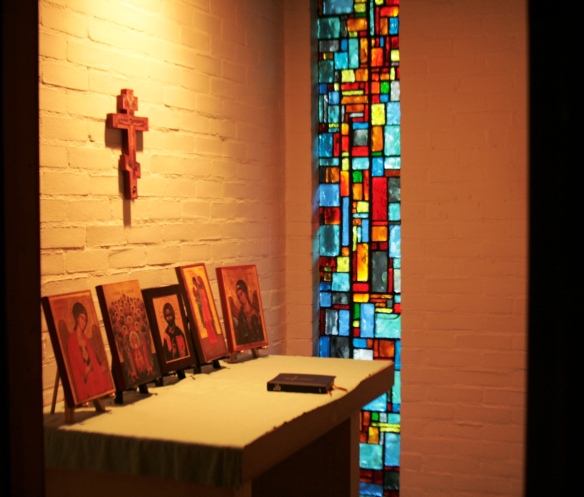 Jesus’ insistence that we deny ourselves and take up our crosses and follow him (Mk. 8: 34) jolts us into thinking about what our priorities in life should be. Without being so jolted, we tend to deny other people, take up our favorite pastimes and follow whoever takes our fancy. However, we encounter a serious problem if and when we do take Jesus’ words to heart. We tend to get muddled over what constitutes a “cross” and how we should carry it. Because of this muddle, there is the danger that the cross will be trivialized. Carrying our own crosses is not about being a good sport if we catch the flu.
 I was introduced to the Transfiguration of Our Lord when Raphael’s great painting of the event hit me between the eyes during my student travels in Rome. With the Feast of the Transfiguration coming during my church’s summer slump (and it wouldn’t have celebrated the feast anyway) I knew nothing about it. In many ways, I didn’t have to. The painting opened up a vision of a transfiguration of humanity beyond what I had thought possible. At the time, what faith I had wasn’t centered around any particular religious viewpoint but I was majoring in religion because I thought the subject dealt with the most important things in life. Seeing the painting was more of a religious awakening than I knew. I was, of course, impressed by the sublimity of the upper half of the canvas where Jesus is floating in the air with Moses and Elijah. But I was even more impressed by the inroads the transfigured light made into the lower half which is often interpreted as indicating sinful and benighted humanity. It has taken me years to see further into the significance of this chiaroscuro effect.
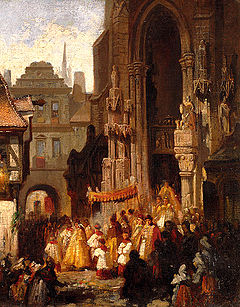 The Feast of Corpus Christi celebrates the presence of Christ’s body in the Eucharistic host. One of the events that inspired the institution of the feast was a vision granted Fr. Peter of Prague in 1263. He had doubted the presence of Christ in the sacrament until he had a vision of blood dripping from the host as he consecrated it. This vision, along with earlier visions of St. Juliana of Mont Cornillon, led Pope Urban IV to order the institution of this feast. Of other Eucharistic visions I’ve heard of, it is better to be silent rather than ruin today’s celebration.
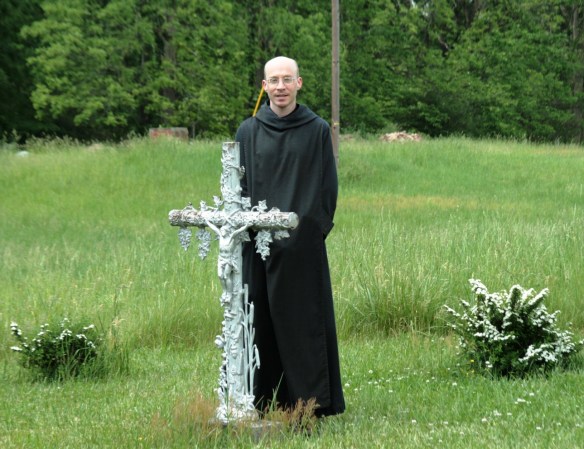 The Trinity is a fundamental doctrine for Christianity but Christianity is a story of salvation before it is a set of doctrines. The Trinity is no exception. If we get the story right, we might get the doctrine right, but if we get the story wrong, then we get the doctrine wrong for sure.
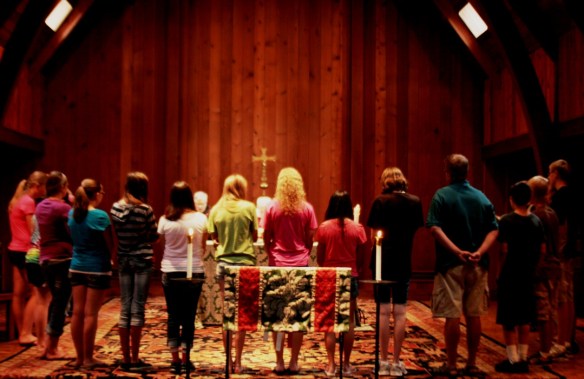 The image of the vine and the branches in John 15 gives us a powerful image of closeness both between ourselves and God and also with each other through our grounding in God.
 St. Paul proclaims the Resurrection of Jesus as a radical game changer. It is a passage from death to ourselves to a new life in Christ. This proclamation is often understood as an individual conversion. It is that but it is much more. During his life, Jesus proclaimed the kingship of God. A kingship, of course is social, not individual, much as we like to fancy ourselves kings and queens of our little castles. The kingship of God looked like a lost cause when Jesus died, but after being raised from the dead, Jesus leads us into the kingship that we rejected when we crucified him. It is important to note that Paul was not writing to an individual but to a community, indeed, the community that at the time represented all humanity as Paul knew it. St. Paul proclaims the Resurrection of Jesus as a radical game changer. It is a passage from death to ourselves to a new life in Christ. This proclamation is often understood as an individual conversion. It is that but it is much more. During his life, Jesus proclaimed the kingship of God. A kingship, of course is social, not individual, much as we like to fancy ourselves kings and queens of our little castles. The kingship of God looked like a lost cause when Jesus died, but after being raised from the dead, Jesus leads us into the kingship that we rejected when we crucified him. It is important to note that Paul was not writing to an individual but to a community, indeed, the community that at the time represented all humanity as Paul knew it.
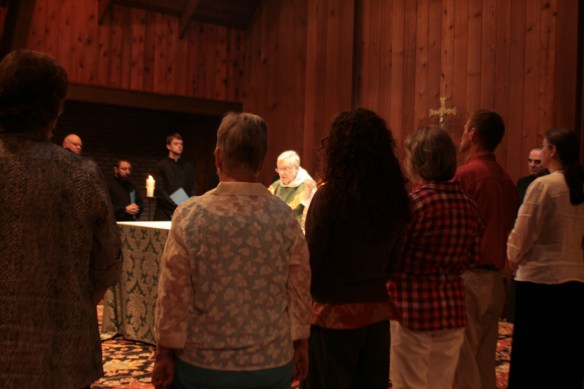 The Passover is the formative event for Jews, the event that constitutes them as a culture. The Last Supper, the Eucharist, is as formative for Christians. Although there is debate as to whether the Last Supper was a Passover meal, the association with that feast is clear enough for Jesus’ supper to have incorporated and redefined Passover. The big question is: What is the culture that these events are intended to form?
