

Luke’s first Resurrection narrative is the quietest of all four Gospels. Matthew is easily the loudest with an earthquake announcing the event. That’s our idea of Easter! Mark is puzzling and a bit of a cliffhanger with the women running away from the tomb out of fright. That’s still a pretty intense reaction. John is almost as quiet with the women finding the tomb empty before Jesus appears to Mary, but Luke is quieter still. The women are puzzled by the empty tomb and the announcement of the two men in dazzling clothes. They do tell the disciples but the disciples don’t believe them, not just because they are women but because the news is too unbelievable. The narrative ends with Peter looking into the empty tomb, amazed, but scratching his head.
There is an air of suspended reality about all this. Much of it has to do with the shock of grief over the death of a loved one. In the shock of grief, nothing seems real, least of all the absence of the loved one. It’s like the person is there and not there. This isn’t what we think Easter is all about but I would argue that this is the most realistic entry into this stupendous event. We are used to thinking of earth-shaking events as–well–events that shake up the world. But these sorts of events don’t really change the world as they are the same old acts of competition and violence and force that have been with us since Cain killed Abel. If the Resurrection were such an earth-shaking event, it would actually have kept the world going in the same old rut of retaliatory violence. That the Resurrection is so low-key, especially in Luke’s version, shows us that the Resurrection does indeed embody a radical act of non-violence, giving us all the space we need, century after century, the discern why it was “necessary” that Jesus be handed over to sinners, crucified and then rise from the dead. The necessity for the death was, of course, a human necessity as Caiaphas affirmed. (Jn. 11: 15) The Resurrection, though, is God’s necessity. It was necessary that God raise Jesus to give us an undying life-giving presence for all time. But this presence needed to be totally without violence, i..e. without force of any kind, just as Jesus’ death had to result from renouncing all violence in the face of evil. Not even the earthquake in Matthew forced Jesus’ resurrected life on anybody.
St. Paul writes about being baptized into Christ’s death before rising with him. (Rom. 6: 3) The initial phase of disorientation described by Luke is very much a feeling of death as the world the disciples had been living in had also been rendered unreal, even if the imperial order continued unabated as it always had done. There is a lot more to dying to the old self than giving up our own personal sins. More than that, we need to die to the culture of violence we are immersed in so as to enter the life-giving nonviolence of the resurrected life. Since there is nothing earthshaking about it, nothing to make headlines, it may not seem like much, but to the contrary, embracing the forgiving life is indeed everything.
We may think that nothing has changed when we read about the virulent racism in our own country and around the world. Even worse is the horrific act of violence in Ukraine, which makes headlines, but is really only a repeat of what Rome was doing in Jesus’ time. But something has changed over the centuries. We now have oppressed people throughout the world arising in non-violent protest, including Martin Luther King Jr and William Barber II. We have a world-wide protest against the invasion of Ukraine and many countries doing what they can to help their stricken neighbor. These are all signs of the Resurrection in the midst of the horror and death that Jesus suffered on the Cross. The Resurrection, though, isn’t just about events on a large scale. It is also about small events of love and concern for the well-being of others day after day with the people right next to us—our neighbors.



 The eighth chapter of Romans is among the most inspirational passages in all scripture. Paul assures us that “all things work together for good for those who love God, who are called according to his purpose” and that we will be “conformed to the image of his Son, in order that he might be the firstborn within a large family.” (Rom. 8: 28–29) Lest we think that only some people are predestined for God’s family, Paul asks: “If God is for us, who is against us?” (Rom. 8: 31) If Jesus is interceding for us, what more powerful persecutor is there to speak against us? Do we really want any personal being to veto the advocacy of Jesus? If we are truly stirred by these words, then we must stamp them deep into our hearts and allow them to govern how we view God and how we view other parts of scripture. For today, I suggest using these words to help us understand the parables in Matthew 13.
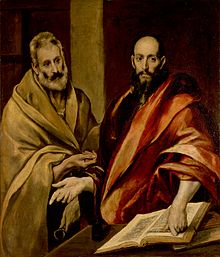 Much has been said about the conflicts between Saints Peter and Paul. I have
  The Holy Spirit is the most obscure of the three Persons of the Trinity, not that the other Persons aren’t mysterious as well. One reason is that the Son is said to show the Father, and the Holy Spirit is said to show the Son, but that leaves nobody to show the Holy Spirit. So obscure is the Holy Spirit that it is difficult to think of the Holy Spirit as a Person at all. It is not uncommon to hear the Holy Spirit referred to as “it,” although both masculine and feminine pronouns also fall far short of the Holy Spirit’s personhood.
 The Good Shepherd is a reassuring image. The shepherd is in charge and the sheep follow the shepherd’s guidance. When thieves and robbers and wolves come to threaten the sheep, the shepherd deals with them in no uncertain terms. Jesus’ claim to be the gate, the way in and out of the fold, gives us another reassuring image: some of us are in and certain other people are out, just the way it should be.
