
 The Holy Spirit is the most obscure of the three Persons of the Trinity, not that the other Persons aren’t mysterious as well. One reason is that the Son is said to show the Father, and the Holy Spirit is said to show the Son, but that leaves nobody to show the Holy Spirit. So obscure is the Holy Spirit that it is difficult to think of the Holy Spirit as a Person at all. It is not uncommon to hear the Holy Spirit referred to as “it,” although both masculine and feminine pronouns also fall far short of the Holy Spirit’s personhood.
It is easier to sense some personhood for the Father and the Son because their relationship is defined by filiation, that is, the Father begetting the Son has a personal analogy in human experience. But the Holy Spirit’s relationship to the other Divine Persons is through spiration, that is breathing. We think of breath as a human function rather than a person in his or her own right. The Holy Spirit is often called the “Bond of Love” between the Father and the Son. This is a beautiful phrase but again, it doesn’t give the Holy Spirit a personality. If we say two people are bonded in love, we think of the bond as something between the two people, not a third person.
Since it is a sure thing that the Holy Spirit is a Person, however obscure, and however mysterious, then perhaps we can take these rather impersonal images and analogies and personalize them.
The Holy Spirit as breath, the Person spirated, or breathed, by the Father and the Son is associated with inspiration. The Holy Spirits’s inspiration in its gentler form is symbolized by a dove in scripture, most importantly at Jesus’ baptism, where the image accompanies the heavenly voice acclaiming Jesus as the Son of the heavenly Abba. At Pentecost, the Holy Spirit appears as flames of fire inspiring the disciples to preach in the languages of the pilgrims from foreign countries. In all this, we have, again, impersonal images, except insofar as birds can show some elements of personality. In all this, however, we can see the Holy Spirit revealed as a Divine Person who inspires and energizes. In fact, the Holy Spirit inspires by distributing various gifts to various people, enhancing both the individuality of people and our connectedness as we exchange these inspired gifts to each other. Through this exchange of gifts, we can inspire others with our insights and enthusiasms. We can think of the inspiring teachers and preachers who have energized us to spread that same enthusiasm and inspiration to others. This is what the Holy Spirit does.
The Holy Spirit as the bond of love between the Father and the Son can also be understood in a personal way. That is, the Holy Spirit is a Person who actively encourages love between other people. Humans can act as such a bond of love. Friar Lawrence plays such a role in Romeo and Juliette. In South Pacific, Bloody Mary encourages the love between Col. Talbot and the Polynesian woman in the song “Happy Talk,” while Col. Talbot himself struggles with his racist heritage in “Carefully Taught.” As these go-betweens try to help lovers overcome obstacles (scandals), so the Holy Spirit encourages all of us to overcome all obstacles to loving relationships.
In the Upper Room, Jesus breathes the Holy Spirit into the apostles and then commissions them to spread forgiveness to other people. (Jn. 20: 23) (I don’t think Jesus wants us to retain the sins of others.) Here we have the Holy Spirit as the Person who inspires, encourages, forgives, and reconciles. In all of these acts, the Holy Spirit remains hidden, showing other people to us and us to other people. At the same time, the Holy Spirit shows us the Son in other people and shows the Son in us to others. If we wish to really honor and celebrate the Holy Spirit, we, too, will go and inspire, encourage, forgive, and reconcile others.
 The Good Shepherd is a reassuring image. The shepherd is in charge and the sheep follow the shepherd’s guidance. When thieves and robbers and wolves come to threaten the sheep, the shepherd deals with them in no uncertain terms. Jesus’ claim to be the gate, the way in and out of the fold, gives us another reassuring image: some of us are in and certain other people are out, just the way it should be.
 At the end of Epiphany, we celebrate the Transfiguration of Our Lord to prepare for Lent. The vision of the glorified Christ is supposed to cheer us up for the grim days of penance and the grimmer days of following Jesus through his Passion. The Transfiguration also prepares us for Easter as it gives us a foretaste of the glorified body of the risen Lord.
 When we dip our fingers in a holy water stoup as a reminder of our baptism, how much do we really remember? Do we stop to think that the water is as explosive as the bread we receive at the Eucharist?
 The story of the Magi’s visit to the newborn Christ Child in Matthew is one of the archetypes of the Christmas season. Most popularly, the Magi are the archetypes of giving because of the gifts they brought to the Christ Child and they are often credited with being responsible for the exchanges of gifts customary during the Christmas season, even among people who otherwise have nothing to do with Christianity.
 God is a mystery. That almost goes without saying since anything we can comprehend can’t be God. Humanity is also a mystery. One of the few things we truly know about ourselves is that we don’t know ourselves or our natures very well. When we celebrate the birth of Jesus, the time God entered humanity, we have the mystery of mysteries to the zillionth power.
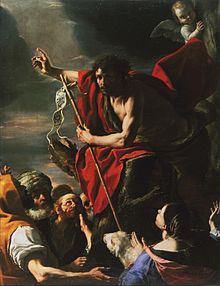 John the Baptist is so closely associated with the beginning of Jesus’ ministry that it’s easy to see them as two of a kind. Both preached repentance. Both died the death of a martyr.
 When Jesus warns of wars and insurrections fought by nation against nation and kingdom against kingdom, he is painting an image of humanity divided by violent conflicts on a grand scale. These conflicts are coupled with catastrophic natural disasters such as earthquakes, plagues, and famines. .(Lk. 21: 9–11) Jesus then goes on to warn his followers of persecutions on an equally large scale involving kings and governors, clearly suggesting a strong connection between strife and persecution. In the late twentieth century, the French thinker René Girard speculated that humanity suffered the same dangerous conflicts at the dawn of civilization and it instinctively resolved the conflicts by persecuting a victim or small group of victims. These victims were blamed for both the violence and the earthquakes and the plagues and famines. Blaming the victims entailed falsifying the reality of what had happened. Persecution and lies are inseparable. It is not difficult to see that Jesus saw clearly the truth in his time that Girard was to articulate in ours.
 The introduction to the Parable of the Unjust Judge tells us that we should keep on praying and never give up. At the end of the parable, Jesus tells us that we should keep on praying even when our prayers go unanswered for so long that we think we are praying to one who does not care and perhaps is not even just.
 Can a charming rogue be an example of how to enter the Kingship of God? Jesus’ Parable of the Dishonest Manager invites us to explore that question.
 Imaginary Visions of True Peace