Where Are You Planted?

The last time I preached, Jesus announced the Jubilee of God. I suggested that we will likely find the rest of the Gospel filling out what such a Jubilee entails. If that is so, the blessings and woes at the beginning of the Sermon on the Plain (Lk. 6: 20–26) seem to be an odd way to have a jubilee. Usually we think that being rich and being well fed at meals filled with laughter and receiving lots of compliments is precisely how to have a jubilee. On the other hand, being poor and hungry while weeping and being reviled are all downers, but Jesus seems to suggest that these downers are what the jubilee is all about. As for Jesus himself, after he announced the Jubilee, he was spoken well of for about a minute and then it all tanked and he was driven out of the synagogue. So Jesus was already practicing his jubilee in terms of the Sermon on the Plain from the start of his ministry.

Obviously we need all the help we can get for understanding these troubling and puzzling words, so let’s see what we can glean from the first two readings. Jeremiah also talks about blessings and curses. Does he mean that God curses people God doesn’t like? The people that Jeremiah says are cursed “trust in mere mortals and make mere flesh their strength.” (Jer. 17: 5) Sounds like these people are cursing themselves by rejecting God. The contrast of a tree planted by the water and a tree planted in salt land suggest that blessings and curses are simply natural outcomes of being grounded in God or not being so grounded. Jesus, then, picking up on Jeremiah, would be suggesting that the poor and hungry are grounded in God and the rich and sated aren’t. If that is true, then maybe being rich is overrated and is not such a great cause for jubilee. It is worth noting that the Rich Young Man went away sad because he had many possessions.

The words of St. Paul from the end of his First Epistle to the Corinthians (1 Cor. 15: 12–20) with his anxious defense of the Resurrection suggest the possibility that the reversal takes place in the afterlife. Jesus does hint at that for the reviled and defamed. Maybe a better afterlife can also be some consolation for the poor and starving, but that does not otherwise help us cope with being poor and starving and slandered right now. And Jesus is saying that the poor are blessed now, not just later. The anxiety on Paul’s part is the denial of the resurrection on the part of some supposed followers. What’s the problem? If applying Jeremiah’s words to the Sermon on the Plain leads us to depend on God, we must depend on a living God, not a dead one. Only if Jesus is truly raised from the dead as the apostolic witness avers can Jesus be depended on right now.

So, the big take from Jeremiah and Paul is that we are blessed if we are grounded in God and we are unfortunate if we are not. That much is certainly true and has the advantage of being a pretty big loophole where there didn’t seem to be one: we don’t have to worry about having some economic resources and being well-fed as long as we are grounded in God. But maybe this loophole threatens to be a trap. Surely Jesus is warning us that the more we have, the less likely we are to depend on God.

At this point. I get the feeling I’m fretting that if I have one penny too many, I lose my blessing and become unfortunate. Same if I take one bite of food too many, laugh too much or get one compliment past my quota. There is no end to this spiral unless I stop and turn around. After all, these thoughts are all centered on self. There is no jubilee in such fretting and there is no depending on God either. But what if we think more about other people having something to eat and something to laugh about? What if we stop reviling other people and build them up by letting them know we appreciate them? Doesn’t this start to look a little more like the Jubilee announced by Jesus? If we take this approach, we start to see how we hinder these things and how our social system hinders them. This gives us cause to weep, but if weeping leads to making these things better, then we have turned tears into laughter. But the deeper mystery remains. Sometimes we don’t see the silver lining of being poor and starving, crying and being reviled and these things often happen as a result of doing the things listed above. Jesus is encouraging us by promising that the silver lining we cannot see is really there in the love we pour out for others. He should know, having gone through Gethsemane and the Cross. This is why we are blessed even in such times if we are grounded in the crucified and Risen Christ.

As Jesus Grew

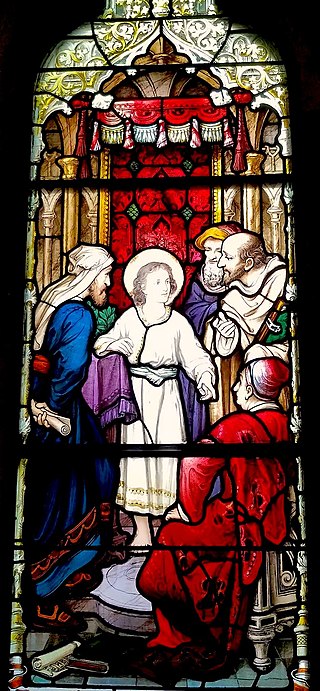
Church window at the Church of the Good Shepherd, Rosemont, PA

The story of Jesus in the Temple at the age of twelve (Lk. 2: 41–41) is unique in the New Testament in that, being the only story about Jesus as an adolescent, it is also the only text that gives us insight into Jesus as a developing person. The infancy narratives show Jesus as a vulnerable baby and stories of Jesus as an adult, thirty years of age, show a pretty steady portrait of Jesus although a few stories hint at some change in Jesus’ perspective, such as the story of the Canaanite woman. (Lk. 18: 1–9). The big turning point in Jesus’ life was the baptism when the heaven’s opened. This was clearly a powerful experience that oriented him for the rest of his life and solidified his identity. It is well-known that early adolescence is a time of transition and a growing sense of identity, and Luke shows us the beginnings of the identity that was firmed up by his baptism.

The biggest transition for an adolescent is to move from parental care and authority to a growing independence in calling the shots for one’s own life. This is a transition that both parents and children have to navigate. That Jesus’ parents assumed that their son had rejoined the caravan for the return trip from Jerusalem (a poor assumption) suggests that they were indeed letting go and giving their son some responsibility for himself. If Jesus had been younger, they would have made sure the boy was with them before the caravan left. As for Jesus, it is obvious that he made an independent decision on his own initiative. This independent choice led to a new dependence beyond his family as Jesus felt drawn to the temple and took advantage of the opportunity to learn and sharpen his own growing insights in conversation with the elders. Although Jesus would, as an adult, have an adversarial relationship with many of the same people, at this time in his life, Jesus asked questions, listened carefully, and weighed the answers for what they could teach him. As often happens with adolescents, Jesus seemed to assume that his parents would know where he would be, another poor assumption..

That Jesus was drawn to the temple and to conversation with the elders indicates that he had a growing sense of a vocation deeply involved with the religious tradition of his people and the time to begin preparing for it had come. When his parents found him, he showed himself to be firm in this growing sense of vocation when he said: “Did you not know that I must be in my Father’s house?” (Lk. 2: 49) Like many adolescents, Jesus failed to make himself understood to his parents. Not wishing to be a rebellious adolescent, Jesus returned to Nazareth and “was obedient to them.” (Lk. 2: 51)

The insights into adolescent psychology are pretty good for a writer who had no opportunity to take a course in developmental psychology, but that is not the point of the story. What is important, and something we should ponder, is that Jesus, as truly and fully human as well as divine, developed as a human being as every human being develops. As with everything else human, Jesus leads us through his own human experience in our own navigating of transitions in life.

On Not Offending the Vulnerable—Or Anybody Else

Jesus’ suggestions that we cut off a hand or a foot or tear out an eye are so shocking that we are pulled away from the previous verse where Jesus mildly says that “whoever is not against us is for us” and that anyone who gives a cup of water will be rewarded. (Mk. 9: 41) It is worth noting that a great many sayings and parables of Jesus take us out of our comfort zones. This particular hard saying takes the cake, a rock hard bad tasting cake at that. The standard way for a preacher to wriggle out of these hard sayings is to say that they are “hebraisms,” that is to say, hyperboles to get our attention. Maybe so, but let’s allow these verses to get our attention and see where they take us.

We get some help from the broader context of these sayings. Earlier in Mark 9, read as last week’s Gospel, Jesus tells his disciples that he will be “betrayed into human hands” and killed. The disciples respond to this warning by fighting about who is the greatest. Jesus responds to this infighting by putting a child among the disciples and saying that whoever welcomes this child welcomes him and the one who sent him. (Mk. 9: 37)

In this context, we can see that the disciples’ complaint about the person who is not “one of us” casting out demons is a renewal of the competitiveness on the part of the disciples. Casting out demons is something Jesus has told the disciples to do and now this other person is doing it. What’s the problem? Maybe the problem is that the disciples had just failed to exorcize a demon as Jesus was coming down from the mountain and they are jealous. Jesus gently rebukes them for their competitiveness by saying that anyone who is not against him is for him. The disciples aren’t the only show in town. Then Jesus echoes his commendation of the child by saying that whoever offers anyone a cup of water will be rewarded. That is, thinking about the needs of others, especially the most vulnerable, and doing something about it, leaves no room for competition.

Then come the hard sayings. Jesus warns the disciples (and us) about putting stumbling blocks before these little ones: the child in the midst of the disciples, the one who should be given a cup of water. It is precisely the competitive behavior that scandalizes the little ones, leading them to copy the behavior modeled by those larger and more powerful than they. Children playing cowboys and Indians, as in my day, or with GI Joe or Ninja toys more recently, may be cute, but aren’t they mimicking their elders too closely for comfort? When children see their elders fighting over who is the greatest, is it any wonder they do the same? The notion that it is better to be hurled into the sea with a millstone around the neck than to scandalize the little ones should make one think. It is worth noting that throwing people off of cliffs was a popular means of sacrificing. Being willing to cut off a hand or leg or gouge out an eye rather than scandalize a little one is drastic, but it makes it urgent that we sacrifice our competitiveness rather than scandalize the vulnerable. Indeed, lacking a limb or an eye (remember Odin?) causes one to be a “random” victim of sacrifice. Moreover, dismemberment is also a common method of sacrifice. (Remember Prajapati?) Of course, it would be simpler and less drastic to offer a cup of water, but if competitiveness through what René Girard called “mimetic rivalry” is a powerful addiction, as Girard suggested, our hands and feet are too caught up in rivalry to make even so simple a gesture.

This brings us to hell where the worm never dies and the fire never quenched. (Mk. 9: 48) It would indeed be better to have one hand rather than two that burn in hell for all eternity. But that isn’t what Jesus is talking about here. The word he uses is “Gehenna,” which means something different. Some scholars think it was a large garbage dump outside Jerusalem whose flames never stopped smouldering. More to the point, Gehenna was the valley where Jeremiah claimed that children were sacrificed to the pagan deities. It does seem fitting that such a cursed place would be turned into a refuse heap. Gehenna, then, is where our rivalrous battles end: a place where the vulnerable are sacrificed to fuel our battles. Maybe Jesus’ words about cutting off limbs is hyperbole, a set of “hebraisms,” but they are warning us of the consequences of our rivalrous ways. One of the clearest symptoms of mimetic rivalry is the sharp divide between us and them, a divide the contending disciples tried to make between themselves and the other person who exorcized people.

Jesus concludes his teaching by referring to salt. Salt was added to sacrifices by both Jews and Romans, but as in the use of the image in Matthew and Luke, salt refers to an inner quality, perhaps a willingness to sacrifice self rather than others. This willingness to sacrifice self is of great value and losing it would be much worse than losing an arm or a leg. Jesus tells us that the greatest value of the inner salt is to “be at peace with one another.” (Mk. 9: 49) Being at peace allows for offering a cup of water to one who has need of it, and such giving creates more peace. Indeed, Jesus himself gave up much more than a hand or a foot; he gave up his life to deliver us from the Gehenna of our own making.

Sowing Parables in our Hearts

mustardTreeThe eighth chapter of Romans is among the most inspirational passages in all scripture. Paul assures us that “all things work together for good for those who love God, who are called according to his purpose” and that we will be “conformed to the image of his Son, in order that he might be the firstborn within a large family.” (Rom. 8: 28–29) Lest we think that only some people are predestined for God’s family, Paul asks: “If God is for us, who is against us?” (Rom. 8: 31) If Jesus is interceding for us, what more powerful persecutor is there to speak against us? Do we really want any personal being to veto the advocacy of Jesus? If we are truly stirred by these words, then we must stamp them deep into our hearts and allow them to govern how we view God and how we view other parts of scripture. For today, I suggest using these words to help us understand the parables in Matthew 13.
There is a tendency to interpret these parables separately, treating each as a little gem of wisdom in itself. Each parable is indeed a gem but I think we do well to see how these parables interact with each other. Perhaps we’ll get one great big gem with many facets.

Most of the parables present images of sowing seeds and cultivating plants, a similarity that begs for comparisons. The Parable of the Sower, the Parable of Weeds among the Wheat and the Parable of the Fishnet all deal with sorting the good from the bad. One comes at the beginning of the sequence, one in the middle, one at the end, providing a frame for the set. Sorting good from bad seems to be a good thing to do, but there are some cautions in these parables. The slaves of the household want to pull out the weeds sown among the wheat but the householder says that we can’t differentiate well enough to do this sorting without pulling out a lot of good stuff. And what about the seed that falls on bad soil or among the thorns? Are they bad seeds because they got tossed on the wrong places? Are these seeds just cast away? And do the fishers sorting fish caught in the net really want any fish to be so bad that they have to throw them away? Does God, who did not withhold his only son, want the angels to throw anybody away? (Rom. 8: 32)

The Parable of the Mustard Seed and the Mustard Plant gives us pause. When we take the parable in isolation, we assume the mustard plant is a great good thing, a sign of God’s kingdom. But many farmers consider it a weed and try to get rid of it, although the farmers hired by Grey Poupon Dijon seem to want it. Maybe it is precisely because the mustard plant, “the greatest of shrubs,” is a weed, or in any case not an impressive plant, that it is a sign of the Kingdom of God. Jesus was treated like an unwanted weed that was pulled up by the roots and thrown away. And yet this weed popped back up and grew until birds could nest in its branches. This weedy shrub continues to shelter many others who are elsewhere treated like weeds.

How did we get into the habit of treating some (many) people like weeds? René Girard suggests that it happened at the dawn of humanity when social tensions were most successfully resolved (in the short run anyway) through everybody ganging up on a victim or a group of victims. That is, somebody was weeded out. When Jesus let the people of his day weed him out, he revealed the truth of what we have been doing all these millennia. So who planted the mustard seed? Looks like the work of God.

In the other two parables, Jesus says the kingdom of God is like a treasure hidden in a field and a pearl, both so valuable as to be worth selling everything to buy them. The large family that Paul says God is gathering everybody into would surely be the treasure in the field and the pearl of great price, worth everything we have. But are these treasures worth giving up our desire to weed out the people we don’t like, or hoping God will do it for us? That is the route to weeping and gnashing of teeth. Or will we embrace the priceless pearl that puts us in embrace with everybody else? That would give our culture a makeover, maybe like the small measure of yeast that transforms the bread. Paul concludes his inspirational chapter: “neither death, nor life, nor angels, nor rulers, nor things present, nor things to come, nor powers, nor height, nor depth, nor anything else in all creation, will be able to separate us from the love of God in Christ Jesus our Lord.” If that is so, than no number of weeds in our lives can separate us from God.

For an introduction to René Girard see Violence and the Kingdom of God and Living stones in the House of the Forgiving Victim

The Common Ministry of Peter and Paul

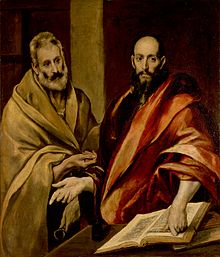
220px-Greco,_El_-_Sts_Peter_and_PaulMuch has been said about the conflicts between Saints Peter and Paul. I have commented on them myself. However, whatever their conflicts, they were martyred in Rome at roughly the same time and that is one of the reasons they are celebrated together in one Feast. Let us see if they have more in common

Both Peter and Paul were penitents. Peter betrayed Jesus by denying that he knew him when pressured by the people in the high priest’s courtyard. Paul approved of the stoning of Stephen and persecuted the Christians. Peter heard the cock crow and he wept. Paul head a voice asking him: “Saul, why are you persecuting me?” Both came to know themselves to be profoundly forgiven sinners. How do we know this? Both preached God’s forgiveness to others.

When. at Pentecost, Peter confronted the people with the truth of what they did in Jerusalem forty days earlier, that they handed an innocent man over to death on the cross, they “were cut to the heart” and asked how they could be saved. Peter’s reply was: “Repent, and be baptized every one of you in the name of Jesus Christ so that your sins may be forgiven; and you will receive the gift of the Holy Spirit.” (Acts 2: 38) Peter was announcing both the truth of what the people had done and the forgiveness of God for what they had done.

In his epistle to the Romans, Paul wrote: “Therefore we have been buried with [Jesus] by baptism into death, so that, just as Christ was raised from the dead by the glory of the Father, so we too might walk in newness of life. (Rom. 6: 4) This is Paul’s more complex way of saying that repentance and baptism bring us forgiveness of our participation in the death of Christ so as to be free to rise with Christ and live new lives in Christ.

In the First Epistle attributed to Peter, the author cites the forgiving example of Christ: “When he was abused, he did not return abuse; when he suffered, he did not threaten; but he entrusted himself to the one who judges justly.” (1 Pet. 2: 23) It is troubling that Peter is speaking specifically to slaves but we should note that the masters are not being upheld as good examples of anything. Later in the Epistle, Peter says to everybody: “Finally, all of you, have unity of spirit, sympathy, love for one another, a tender heart, and a humble mind. Do not repay evil for evil or abuse for abuse; but, on the contrary, repay with a blessing. It is for this that you were called—that you might inherit a blessing.” (1 Pet. 3: 8–9) The forgiving example of Christ should be followed by everybody. (Could one follow this admonition and still be a slave master?)

Likewise Paul makes the identical admonitions when writing to the Romans: “Bless those who persecute you; bless and do not curse them” and “never avenge yourselves, but leave room for the wrath of God; for it is written, ‘Vengeance is mine, I will repay, says the Lord.’ ‘If your enemies are hungry, feed them; if they are thirsty, give them something to drink; for by doing this you will heap burning coals on their heads.’ Do not be overcome by evil, but overcome evil with good.” (Rom 12: 14, 19–21) Lofty words but there is a troublesome sting to them. It should be noted, though, that vengeance is indeed God’s prerogative. The teachings on the part of both Paul and Peter raise the questions as to whether God actually uses that prerogative. The burning coals in the quote from Proverbs are also troubling, but sometimes an undeserved act of kindness has that effect.

What we can celebrate today on the Feast of Saints Peter and Paul is their united front in preaching the forgiveness of the Risen Victim which we must both receive and give to others.

The Holy Spirit as a Divine Person who Inspires and Fosters Love

White_Doves_at_the_Blue_Mosque_(5778806606)The Holy Spirit is the most obscure of the three Persons of the Trinity, not that the other Persons aren’t mysterious as well. One reason is that the Son is said to show the Father, and the Holy Spirit is said to show the Son, but that leaves nobody to show the Holy Spirit. So obscure is the Holy Spirit that it is difficult to think of the Holy Spirit as a Person at all. It is not uncommon to hear the Holy Spirit referred to as “it,” although both masculine and feminine pronouns also fall far short of the Holy Spirit’s personhood.

It is easier to sense some personhood for the Father and the Son because their relationship is defined by filiation, that is, the Father begetting the Son has a personal analogy in human experience. But the Holy Spirit’s relationship to the other Divine Persons is through spiration, that is breathing. We think of breath as a human function rather than a person in his or her own right. The Holy Spirit is often called the “Bond of Love” between the Father and the Son. This is a beautiful phrase but again, it doesn’t give the Holy Spirit a personality. If we say two people are bonded in love, we think of the bond as something between the two people, not a third person.

Since it is a sure thing that the Holy Spirit is a Person, however obscure, and however mysterious, then perhaps we can take these rather impersonal images and analogies and personalize them.

The Holy Spirit as breath, the Person spirated, or breathed, by the Father and the Son is associated with inspiration. The Holy Spirits’s inspiration in its gentler form is symbolized by a dove in scripture, most importantly at Jesus’ baptism, where the image accompanies the heavenly voice acclaiming Jesus as the Son of the heavenly Abba. At Pentecost, the Holy Spirit appears as flames of fire inspiring the disciples to preach in the languages of the pilgrims from foreign countries. In all this, we have, again, impersonal images, except insofar as birds can show some elements of personality. In all this, however, we can see the Holy Spirit revealed as a Divine Person who inspires and energizes. In fact, the Holy Spirit inspires by distributing various gifts to various people, enhancing both the individuality of people and our connectedness as we exchange these inspired gifts to each other. Through this exchange of gifts, we can inspire others with our insights and enthusiasms. We can think of the inspiring teachers and preachers who have energized us to spread that same enthusiasm and inspiration to others. This is what the Holy Spirit does.

The Holy Spirit as the bond of love between the Father and the Son can also be understood in a personal way. That is, the Holy Spirit is a Person who actively encourages love between other people. Humans can act as such a bond of love. Friar Lawrence plays such a role in Romeo and Juliette. In South Pacific, Bloody Mary encourages the love between Col. Talbot and the Polynesian woman in the song “Happy Talk,” while Col. Talbot himself struggles with his racist heritage in “Carefully Taught.” As these go-betweens try to help lovers overcome obstacles (scandals), so the Holy Spirit encourages all of us to overcome all obstacles to loving relationships.

In the Upper Room, Jesus breathes the Holy Spirit into the apostles and then commissions them to spread forgiveness to other people. (Jn. 20: 23) (I don’t think Jesus wants us to retain the sins of others.) Here we have the Holy Spirit as the Person who inspires, encourages, forgives, and reconciles. In all of these acts, the Holy Spirit remains hidden, showing other people to us and us to other people. At the same time, the Holy Spirit shows us the Son in other people and shows the Son in us to others. If we wish to really honor and celebrate the Holy Spirit, we, too, will go and inspire, encourage, forgive, and reconcile others.

The Still Small Voice of the Good Shepherd

lambsThe Good Shepherd is a reassuring image. The shepherd is in charge and the sheep follow the shepherd’s guidance. When thieves and robbers and wolves come to threaten the sheep, the shepherd deals with them in no uncertain terms. Jesus’ claim to be the gate, the way in and out of the fold, gives us another reassuring image: some of us are in and certain other people are out, just the way it should be.

But in my reflections on John 10 from a year ago, I noted that the Good Shepherd is the Lamb of God who lays down his life for the sheep. With this realization, the hierarchical picture breaks down. The Good Shepherd is not above the sheep but is one of the sheep. Whereas even the most compassionate and conscientious shepherds end up eating or sacrificing the sheep, Jesus shares the fate of the sheep by becoming the Paschal Lamb in place of the sheep.

The Lamb of God is also an odd gate. Rather than keeping the lambs inside, he leads the lambs in and out with so much movement that the idea of there being a gated sheepfold ceases to make sense. Rather than keeping the bandits and robbers away, Jesus lays down his life for the flock when the bandits attack. If Jesus is the gate, than his willingness to lay down his life is the way in to this abundant pasture for all who would join his flock.

In an essay on the Eucharistic Christ, James Alison explores these paradoxes with great insight. After taking us through stages where we fixate on the bad shepherds and feel righteous about identifying and hating them, Alison takes us to a stage where the fixations fall away:

There is no definitive inside and outside for the Good Shepherd, there are places of shelter and of feeding, different places to which the door gives access, and which presuppose movement, non-fixity, and confidence in being neither in nor out. It is assumed that the best feeding place might not be one that seems to be “in,” yet the good shepherd is able to make that place available to his sheep.

The mixup that Alison envisages reaches the point where we are all sheep and all wolves, not in a negative sense where each of us supposedly good people find the wolf within, but rather a recreation of abundant life where nobody needs to be a sheep who is devoured or sacrificed or a wolf who does the devouring and sacrificing. This is where our baptism into the death of Jesus leads us further into the abundant life of Jesus.

It is in the space of this abundant life that we hear the true voice of the Good Shepherd as the Lamb of God, which Alison suggests is the still small voice that Elijah heard in the wilderness. When we hear this still small voice, the strident voices of bandits are drowned out and our own voices can take on the same stillness that others need to hear.

The Beloved Son on the Mountain

Transfigurazione_(Raffaello)_September_2015-1aAt the end of Epiphany, we celebrate the Transfiguration of Our Lord to prepare for Lent. The vision of the glorified Christ is supposed to cheer us up for the grim days of penance and the grimmer days of following Jesus through his Passion. The Transfiguration also prepares us for Easter as it gives us a foretaste of the glorified body of the risen Lord.

The climax of the Transfiguration is the bright cloud overshadowing the disciples and the heavenly voice saying: “This is my Son, the Beloved; with him I am well pleased; listen to him!” (Mt. 17: 5) These same words were said to Jesus at the time of his baptism. These words of encouragement from Psalm 2 strengthened Jesus for his immediate trial in the desert when he was tempted. This time, they strengthen Jesus before his final trial at the time of his Passion. The royal psalm also has much of the same foreshadowing as the “kings of the earth set themselves, and the rulers take counsel together, against the Lord and his anointed.” (Ps. 2: 2) This is exactly what happened to Jesus.

When the disciples heard the voice from the bright cloud, they “were overcome with fear.” What were they afraid of? Was it just the power of a voice from Heaven? That could account for the fear. But maybe there is more to it. The disciples had been following Jesus for some time but they often failed to understand him, not least when Jesus predicted his imminent suffering and death. Were these predictions giving the disciples second thoughts about Jesus? If so, the heavenly affirmation of Jesus would have been frightening if it was Jesus’ willingness to suffer that made Jesus the beloved Son with whom God was well pleased. Worse, this could mean that being willing to follow Jesus through the same suffering and death was the way for them to be sons with whom God was well pleased. The glory revealed on the mountain was a powerful encouragement, but the kind of encouragement that must have left the disciples shaken, as it should leave us shaken.

Lenten penances are small potatoes compared to the willingness to suffer if the kings and rulers and all other people should rage together and rise against the Lord and those who follow the Lord’s anointed. May the glory of the Lord’s Resurrection strengthen us with the deep life that casts out fear so that we can bring peace into the world of strife and rage.

On Entering Jesus’ Baptism

HolyWater1When we dip our fingers in a holy water stoup as a reminder of our baptism, how much do we really remember? Do we stop to think that the water is as explosive as the bread we receive at the Eucharist?

John baptizing people with water at the River Jordan seems idyllic if we overlook John’s warnings to flee the wrath to come and the axe poised to chop down the tree of our lives; all this to prepare the way for the one who comes to baptize with fire to burn away the chaff. The baptism of Jesus seems much gentler in that Jesus did not need to be cleansed of sins and vices like the rest of us and so didn’t need to be saved from a wrathful response from God. But this peaceful event becomes dramatic when a voice from Heaven declares Jesus to be God’s son with whom God is well pleased. Whatever Jesus is going to baptize people with, it won’t be fire burning up the chaff.

At the end of his life, the baptism with which Jesus is baptized turns out to be his suffering and death on a cross. This makes it clear that we did not need to be baptized to ward off the wrath of God, but to ward off human wrath. What we needed was to be delivered from the wrath in our own hearts that led us to join the persecutors of Jesus. This is what Paul was getting at in his epistles, when he wrote of baptism as a passage through the death of Jesus into Jesus’ resurrection. The passage of baptism, then, is a passage into death to our own wrath, then unto the flood of the wrath of other humans which was inflicted on Jesus, and ending in a new resurrected life without wrath.

The acclamation of Jesus’ heavenly Abba becomes all the more significant in retrospect as it gave Jesus the loving encouragement to go through his own baptism. When we follow Jesus in our baptism, we also begin with the encouragement of the voice from Heaven that we are beloved of God. Far from being driven to flee God’s wrath, we are invited by love to enter the cleansing water so as to participate in God’s affirming love, a love that will sustain us when we struggle with our own wrath and suffer the wrath of others.

That’s a lot to think about when we dip our fingers into a holy water stoup.

Gifts to the Universal King

crecheThe story of the Magi’s visit to the newborn Christ Child in Matthew is one of the archetypes of the Christmas season. Most popularly, the Magi are the archetypes of giving because of the gifts they brought to the Christ Child and they are often credited with being responsible for the exchanges of gifts customary during the Christmas season, even among people who otherwise have nothing to do with Christianity.

Theologically, the incident manifests the universality of the Christ Child. From the first, the child has received homage from representatives of other parts of the world beyond the Jewish culture into which he was born. The Magi were astrologers, but they had nothing to do with fortune cookie-type columns for daily newspapers; they studied the stars to probe the world’s mysteries. Since the sky was observable by all people, the study of the stars is an apt image for the universality of Christ. The star that the Magi followed is likely a reference to the prophecy of Balaam: “a star shall come out of Jacob, and a scepter shall rise out of Israel.: (Num. 24: 17) Here a mercenary pagan makes a favorable prophecy for Israel when he could have been richly awarded for doing the opposite. The gifts of gold and frankincense are often interpreted as fulfilling the prophecy of Isaiah: “All those from Sheba shall come. They shall bring gold and frankincense, and shall proclaim the praise of the Lord.” (Is 60: 6) The myrrh, not mentioned in Isaiah, would foreshadow Jesus’ passion and death.

The priestly authors of Numbers and the prophet called by many scholars “Third Isaiah” (Isaiah 56-66) are among the writers of the Hebrew Bible who pushed for an inclusive Israel that would welcome all people from all nations against those who would shut the gates and keep them shut. In her book on Numbers, Mary Douglas offers the interesting argument that the story of Balaam’s prophecy is a lampooning of the exclusionary policies of Ezra who ordered his fellow Israelites to put away all foreign wives and their children after the return from the Babylonian Exile. (Ezra 9–10) The allusion to the prophecies of Balaam and Isaiah would put Matthew firmly in the inclusionary camp. The affirmation of an inclusive Israel where Jews and Gentiles come together, is also affirmed by Paul as one of his most fundamental teachings. In Ephesians, he writes of God’s plan “for the fullness of time, to gather up all things in him, things in heaven and things on earth.” (Eph. 1: 10)

This preaching of universality is among the more attractive strands in biblical thought. However, as with most good and glorious things, there is a shadow that we must deal with. It is very easy for an inclusionary view to become imperialistic and intolerant to the point that everybody must conform to the one particular inclusionary embrace that I happen to accept. Everybody must be a Christian, actually, my kind of Christian. As a committed Christian, I believe my faith is true and universal and I would like for all people to share its blessings, but I accept that people of other faiths feel the same about theirs.

The generosity of giving seems to be the best way out of this impasse. In the Isaianic prophecy fulfilled by the Magi, people bring their gifts to God from all over the earth. These gifts represent many cultures, many faiths. Each of these traditions have gifts that we all can benefit from and receive with gratitude. If we offer our talents, our insights, our beliefs, and the revelations we have received as genuinely free gifts, then we do not want to smother what others have to offer us in return.

An interesting question remains. If Jesus was given these valuable gifts at the time of his birth, how come he was a homeless itinerant teacher with no place to lay his head? If indeed he had some gold and other precious gifts when he was young, we have to assume that he did what he asked the rich young man to do: he gave all of it away to the poor. Jesus still keeps on giving us all of himself. What about us?