
 Tonight, we celebrate the birth of a child. Usually, there is rejoicing when a child is born. One of my family stories is that my grandmother was so excited about my birth that she burned two pots of beans.
When we celebrate a birth, we celebrate the fact that a baby is. The simple act of coming to be is a cause of wonder and joy. So it is that we celebrate Jesus before he did anything at all except come out of his mother’s womb and maybe cry a bit and suckle some milk. As a friend of mine said once about newborn babies: “They don’t do much at that age.” We also celebrate our hopes for the future and for the future of that child. We know that in the case of Jesus, the future wasn’t all rosy. That Jesus was born in a stable because there was no room for him and his family and that Herod would be out to get him as soon as he found out about him shows that there was cause for anxiety from the very start. Unfortunately, many babies being born right now are born into much the same sort of anxiety that is mingled with hopes for the child. So not every birth leads to unequivocal rejoicing. Such anxiety is exacerbated by our tendency to focus on those who stir up fear in us, goading us on to adding further fuel to the violence growing all around us. We can see in news reports, Twitter, and Facebook that we are locked in violent systems of condemnation that stoke our fears exponentially.
Although we celebrate tonight the very being of Jesus, that Jesus is, when Jesus was apparently not doing much, God was and is already doing a great thing, an unprecedented thing: God had entered humanity. God chose to share, in frail human flesh, the very threats and anxieties that we all share. God has not left us to the human powers over which we have little or no control, powers we doubt we can trust with our well-being. Moreover, God shares the vulnerability other humans suffer from us on account of our fears and our own violence that we cannot see. In this way, God, in Jesus, lives up to the name: Emmanuel, which means “God is with us.”
God’s presence among us means many things. Tonight I will touch on one of them. By entering humanity, God has opened our human nature to God’s nature. We are no longer as trapped in our own human fear and violence as we often think we are. Later in life, Jesus spoke about God coming “like a thief in the night” but at the time of Jesus’ birth, God had already broken into the household of our humanity and started to sneak around, taking away bits of fear and violence and leaving bits of love behind.
This Christmas, let us celebrate the sneaky child who is already crawling around in the dark places of our lives, taking away the things we need to lose and giving us the gifts we need the most.
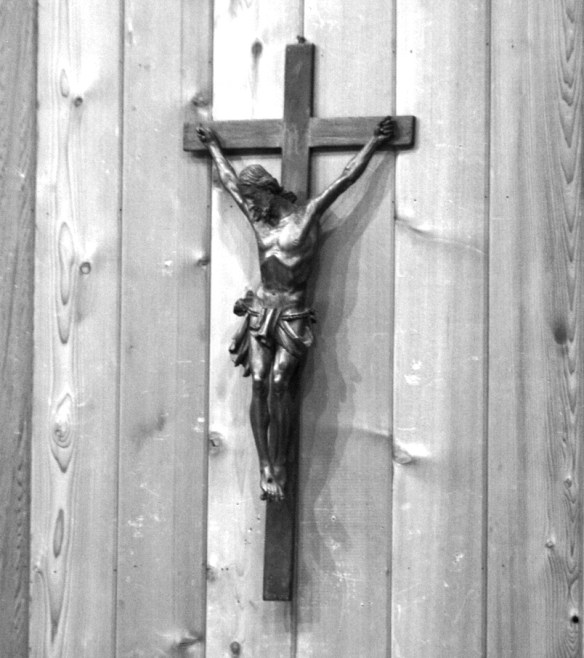 A thief is not usually thought of as a good type of person and a thief in the night is worse. And yet Jesus characterizes himself as a thief when he says: “if the owner of the house had known in what part of the night the thief was coming, he would have stayed awake and would not have let his house be broken into.” (Mt. 24: 43) The expression that God will come like “a thief in the night” also comes up in 1 Thessalonians 5:2 and 2 Peter 3:10. Since Jesus commends the dishonest steward who defrauds the master who is firing him and the unjust judge who gives the widow a fair hearing just to stop her from pestering him, it seems that Jesus has a soft spot in his heart for rogues. Maybe he was a bit of a trickster rogue himself.
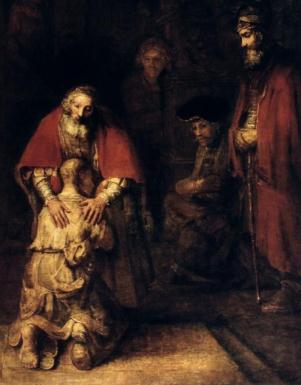 Kenneth Bailey’s book Jacob & the Prodigal overlaps with important sections of my own book
  The French thinker René Girard has argued that since the dawn of humanity, we have tended to solve social tensions through persecuting a victim who absorbs these tensions and suffers for them. Girard has also argued that the Gospels unveil the truth of this scapegoating mechanism in their narratives of Jesus’ death and Resurrection where Jesus opens up new possibilities for humanity to gather through the forgiveness of the Risen Victim. It happens that the Gospels show Jesus unveiling these very same dynamics in his earthly ministry. I analyzed our such stories in my book
  The disciples’ demand (not a request) that Jesus increase their faith, (Lk. 17: 5) with a hint of desperation that such a demand entails, seems to come out of nowhere when it begins the Gospel reading. So let us look at the preceding paragraph for some context.
 There is only one simple qualification for being a disciple of Jesus: give up everything. That’s one whale of a qualification. So hard is this qualification that earnest Christians have thought of many ways to soften Jesus’ words without washing all meaning and challenge out of them. My New Testament professor at Nashotah House, O.C. Edwards, suggested that this qualification means we have to give up everything that comes between us and God. That is, if parents, children, spouses, friends, or fellow members of a community help us draw closer to God, we don’t have to give them up. The same would go for material possessions. Even Benedictine monks have to use things in this world in order to live so we can’t give up having anything at all. The trick is to use things in such a way that the work and recreation we do with them draws us closer to God rather than farther away.
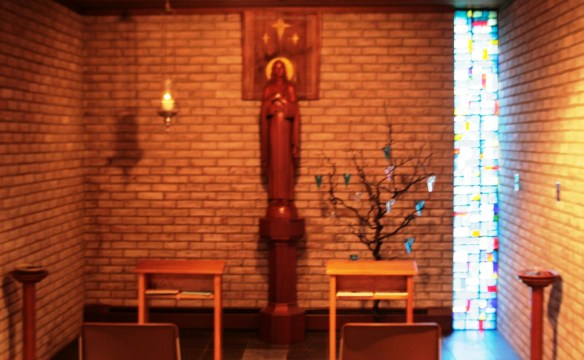 Back when I was a seminarian at Nashotah House, a student from the South transferred there in the middle of the academic year. Not surprisingly, given Nashotah’s Anglo-Catholic tradition, several students ganged up on him and tried to convert him to an ardent devotion to Our Lady. This student’s response was: “I thought Mary was just a little Jewish girl.”
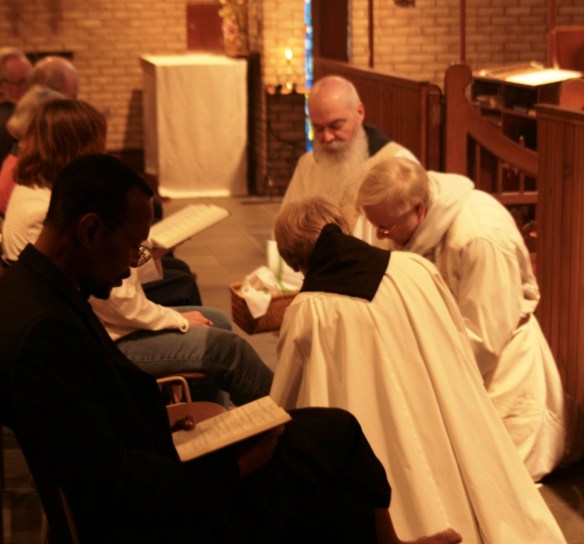 The first verses of today’s Gospel (Lk. 12: 32–34) pick up from where we left off last week. That reading ended with Jesus’ little parable about the rich fool who tore down his barns to build bigger barns (Lk. 12: 12–21) only to find that his life was being demanded of him. This reading begins with Jesus’ soothing admonition to “sell our possessions and give alms” and “make purses for yourselves that do not wear out, an unfailing treasure in heaven, where no thief comes near and no moth destroys.” (Lk. 12: 32-33) This is quite a contrast to two brothers fighting over an inheritance or a rich person gloating over fabulous amounts of wealth. Lest we think Jesus is asking us to make ourselves miserable, Jesus assures us that it is our heavenly Abba’s pleasure to give us a treasure that is the kingdom. If this treasure, the kingdom, is the Abba’s pleasure, then it is our pleasure as well.
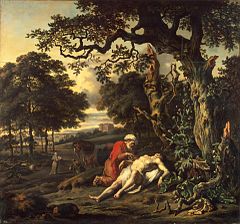 Many of us instinctively think that knowing is something we have in our heads, something we can recite, like a catechism. This is the sort of knowing that the lawyer demonstrates when he recites, correctly, the two great commandments when Jesus encourages him to answer his own question as to what he must do to inherit eternal life. (Lk. 10: 27) But then the lawyer shows a certain ignorance, a missing piece. He doesn’t know who or what his neighbor is. Jesus answers this question by telling a story that pinpoints exactly the missing piece in the lawyer’s cognition.
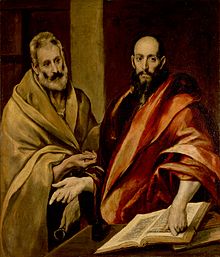 It is interesting and a bit ironic that we celebrate Saints Peter and Paul on the same day. Although there are famous icons of the two embracing one another in Christian love, the two seem not to have had an easy time getting along in real life. Although the two appeared to have been somewhat reconciled at the Council of Jerusalem in Acts 15, in his letter to the Galatians, Paul says that he opposed Peter “to his face” for backing down from what he thought they had agreed on. (Gal. 2: 11) The final chapters of John’s Gospel suggest tensions between the “Beloved Disciple” and Peter, and/or some tension between the two communities derived from them. The Beloved Disciple rests on Jesus’ breast at the Last Supper while Peter stubbornly tries to prevent Jesus from washing his feet. In her book Courting Betrayal,” Helen Orchard argues that Peter was resisting the slavish action of Jesus in washing his feet because he did not want to stoop so low himself. The episode of the Empty Tomb in John shows a rather awkward dance between the two where the Beloved Disciple gets there first but waits at the entrance and allows Peter to go in first. In this little tangle of a narration, both seem to have been first but not in the same way; which suggests some attempt to overcome the tension. In the final chapter of John, after the threefold question to Peter: “Do you love me?,” Peter points to the Beloved Disciple and asks” What about him?” Jesus answer basically tells us it is none of his business.
 Imaginary Visions of True Peace