
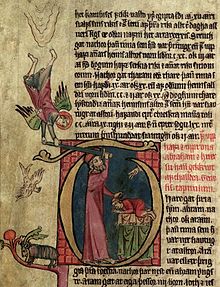
 When the story of the near-sacrifice of Isaac was first told to me in Sunday school, the teacher prefaced the story by saying that in biblical times there were people who made sacrifices to “god” and some people even sacrificed their own children, but God decided to teach Abraham that he should not do that. The story was troubling but it was comforting to know that God did not want such an awful thing. Between that and being told around the same time the story about Jesus inviting the children to come to him did much to instill in me a trust in God as deeply loving from an early age. Since then, I’ve come across many learned scholars who think such an interpretation of the Isaac story is simplistic. Who’s right?
Christian exegetes in the early Christian centuries softened the story to some extent through a Christological interpretation where Isaac is an antitype of Christ, the Son who was willing to lay down his life. Such an understanding continued in folk tradition where the English Miracle plays dramatized the story of a pleading child wondering if he really was that naughty and then becoming reconciled to his fate.
Such an approach is still troubling but it makes some effort to draw back from the notion of an violent and arbitrary “god” who really would make such a command to Abraham. Unfortunately, later medieval and Reformation theologians shifted the emphasis back to Abraham and his anguished “obedience.” Such an emphasis falls deeply into the tragic pitfall of a sacrificial atonement. While even St. Anselm, who set in motion this theological tendency, still emphasized the Son’s love of humanity in laying down his life, Luther and Calvin emphasized the Father’s sacrifice of his Son with severe violence with the Father taking his anger over human sin out on his Son. Martin Luther, for example was very stern in saying that in no way was it legitimate for Abraham (or us) to question what God orders, no matter how unethical the command. In Fear and Trembling, Søren Kierkegaard’s pseudonymous author calls this kind of obedience “the teleological suspension of the ethical.” Many think Kierkegaard supported that position but in fact, this suspension of the ethical is not faith. Abraham is a “knight of faith” because he does not kill his son but receives him back from God. This treatise then is actually Kierkegaard’s first salvo in dismantling a sacrificial understanding of atonement such as Luther’s. The highly convoluted arguments of this book end up in roughly the same place as my Sunday School teacher.
The French thinker René Girard is very helpful in helping us deal with this troubling story. He theorizes that since the dawn of humanity, societies have dealt with systemic conflict through uniting against a victim who is blamed for the crisis. This initial act of mob violence, repeated time and again was institutionalized into rites of sacrifice. Children were frequently among the victims. The Maya, for example, thought that the children’s tears would bring much-needed rain. This social factor is a startling contrast to the narrative of Abraham where he and Isaac are alone save for a pair of servants. Girard would have us see Abraham’s dilemma in terms of his surrounding culture where everybody else was sacrificing their children so that it seemed the religious thing to do. For Girard, God breaks through the collective so that Abraham, as an individual hears God’s true desire, not as an individual genius, but as a human related both to God and to Isaac and the many offspring in faith that he would beget through Isaac. So Girard also agrees with my Sunday school teacher.
When Paul says: “Therefore, do not let sin exercise dominion in your mortal bodies, to make you obey their passions” (Rom 6: 12) we tend to understand these words as lone individuals each struggling against our sinful hangups. But for Paul, the dominion of sin is the human culture that perpetuates itself through collective murder and sacrifice. This is the Gospel story Paul preached: not a story about individuals who sin, but a society that swarms with violent passion in troubled times. Such as our own time. This is why the end of sin is death. Literally.
Before the movers and shakers and the crowd coalesced to put Jesus to death, Jesus told us that; “whoever gives even a cup of cold water to one of these little ones in the name of a disciple—truly I tell you, none of these will lose their reward.” (Mt. 10: 42) Simple. It doesn’t take a professor with several degrees to understand it. And yet, the “little ones,” not just children but vulnerable people in many inner cities, do not get a cup of water that is not dangerously contaminated. Flint, Michigan is everywhere. This is the power of sin’s dominion that holds society in thrall. Jesus is telling us, as God told Abraham, that we should not sacrifice our “little ones,” but we should nurture them. Like Abraham, we have to move out of the crowd that continues to sacrifice children and then regather with those who will bring drinkable water to those who need it. My Sunday school teacher got it right.
See also: Abraham out on Highway 61
For an extensive discussion on the story, including the quote from Martin Luther, see:
Girardian Reflections on the Lectionary, Proper 8, Year A
For an introduction to René Girard, see: Violence and the Kingdom of God
and Living Stones in the House of the Forgiving Victim
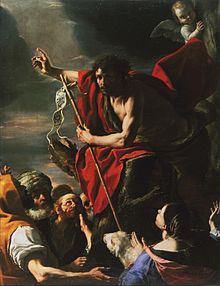 John the Baptist is so closely associated with the beginning of Jesus’ ministry that it’s easy to see them as two of a kind. Both preached repentance. Both died the death of a martyr.
 When Jesus warns of wars and insurrections fought by nation against nation and kingdom against kingdom, he is painting an image of humanity divided by violent conflicts on a grand scale. These conflicts are coupled with catastrophic natural disasters such as earthquakes, plagues, and famines. .(Lk. 21: 9–11) Jesus then goes on to warn his followers of persecutions on an equally large scale involving kings and governors, clearly suggesting a strong connection between strife and persecution. In the late twentieth century, the French thinker René Girard speculated that humanity suffered the same dangerous conflicts at the dawn of civilization and it instinctively resolved the conflicts by persecuting a victim or small group of victims. These victims were blamed for both the violence and the earthquakes and the plagues and famines. Blaming the victims entailed falsifying the reality of what had happened. Persecution and lies are inseparable. It is not difficult to see that Jesus saw clearly the truth in his time that Girard was to articulate in ours.
 Easter is an occasion of great rejoicing with bells, boisterous singing, and feasting. But do we really know what we are celebrating? The Gospel reading, doesn’t exactly ring out with Christmas joy of angels filling the skies with songs of God’s glory. Instead, we get “two men in dazzling clothes” who tell the women who came to the grave to anoint Jesus’ body that Jesus was not there but had risen. They had come to the wrong place.
 The narratives of the call of Isaiah, Paul, and Simon Peter bring to mind my own experiences of God’s call. In my case, it wasn’t quite like being attacked by a Cherubim in church, getting knocked down on the Road to Damascus or being told to throw out the fishing nets one more time and being overwhelmed by the catch.
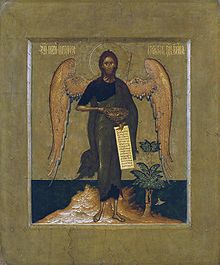 Although John burned with a conviction that God was going to do something new, he had only the models of past prophets to guide him in opening a way to the great new thing. He lived in the desert, wore a camel hair coat and ate wild locusts and honey in imitation of Elijah. Like the prophets of the past, he warned the brood of vipers of the wrath to come if people did not shape up and turn back to God. (Lk. 3: 7) Again like the prophets, he told soldiers not to oppress vulnerable people. Yet again like the prophets, he rebuked his ruler, Herod. And like so many of the prophets, he was put to death.
 Do not worry about anything, but in everything by prayer and supplication with thanksgiving let your requests be made known to God (Phil. 4:6) (All Bible quotes are from the NRSV)
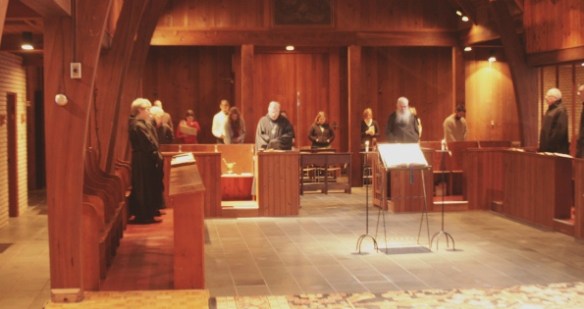 The rich man who asked Jesus what he needed to do to inherit eternal life and then walked away grieving when Jesus told him to sell all that he owned (Mk. 10: 21) is a warning to all of us, rich or poor. Jesus’ added warning that it “is easier for a camel to go through the eye of a needle than for someone who is rich to enter the kingdom of God” only makes the warning all the more dire. Paul strengthens the warning further when he tells Timothy that “the love of money is a root of all kinds of evil,” (1 Tim. 6: 10) Bucking these warnings is our formation from earliest childhood that money is both good and necessary and more of it is always better than less.
 Eating is among the most fundamental activities of civilization, perhaps the most fundamental. It is the practice that brings people together to share in nourishment and social nurturing. And yet, throughout the animal kingdom, sustenance requires feeding on other living beings. Sometimes it is other animals, sometime plants. That is, a group bonding through eating inevitably bonds at the expense of other living beings.
 Imaginary Visions of True Peace