
 The denunciations by prophets like Micah of the rulers “who abhor justice and pervert all equity” (Mic. 3:9) and Jesus’ denunciations of Pharisees in Matthew 23 tend to curl our mouths in a snide smile as we think about how much better we are than they. But while Jesus is still warming up for his fiery words to come, he slows down and says: “Call no one your father on earth, for you have one Father—the one in heaven. Nor are you to be called instructors, for you have one instructor, the Messiah.” (Mt. 23: 9–10) When Jesus goes on with words of woe for the scribes and Pharisees, we are apt to conveniently shove these words aside, but, I think we should linger over them a bit before enjoying the scolding of “other” people.
That the false prophets and wayward rulers, the Pharisees and the scribes are not worthy of being called “Father” or “Teacher” or Leader” is understandable. The broader implication of not calling other people “father” is that we are all brothers and sisters. That is, Jesus is leveling the field among humans so that all of our relationships are fraternal, including relationships with people we usually think are “higher” or “lower” than we are, such as the relationship between parents and children and leaders and their followers. That is, we are all equal but we have a tendency to try to be more equal than others. And that is where we have problems.
Jesus scoffs at those who want the best places in the synagogues and banquets and who want to be greeted with fawning respect in the marketplace. We scoff at them too since mocking the foibles of our leaders and putting them down is everybody’s favorite blood sport. Which is to say that it is not just false prophets and ruthless leaders and scribes and Pharisees who do these things. We all do them. We all try to be a little more equal than other people in little and big ways. It is this desire to be more equal than others that causes us to lay heavy burdens on the shoulders of others and not “lift a finger to move them.” After all, putting a weight on another makes the person stoop, lowering that person. So why do anything to help the lowered person rise up?
The lectionary spares us the rest of Jesus’ harsh words as he dissects the ways we interpret law and morality to our own advantage and the disadvantage of others. Jesus reaches his climax with the charge that we persecute the prophets and so that “all the righteous blood shed on earth, from the blood of righteous Abel to the blood of Zechariah son of Barachiah” will be on our heads. (Mt. 23: 35) Jesus is warning us that the pushing and shoving to get the best seats at the banquet lead to the violence perpetrated against the prophets sent by God.
Forgotten in all this rivalry is Jesus’ teaching: “The greatest among you will be your servant.” (Mt. 23: 11) This is quite the opposite of laying burdens on other people to make them bow down to us in public places. Jesus is also accepting the fact that some humans naturally take more responsibility for others and do act as leaders. Paul, for example, was called to preach the Good News of Jesus and naturally went on to help people organize their churches. But when preaching in Thessalonika, Paul took the burdens on himself and worked hard so as not to be a burden on others. And he dealt with the Thessalonians like “a father with his children” in trying to lead them in a way worthy of God’s kingdom and glory. (1 Thess. W: 11–12) That is, a leader has to make everyone else more important than oneself.
This is what Jesus did, even to dying on the cross. And this is why Jesus is our teacher and guide to his heavenly Abba.
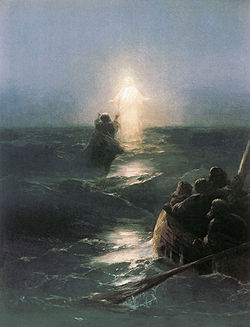 It is highly significant that Elijah did not find God in the wind, the earthquake, or the fire, but only in a “sound of sheer silence.” (1 Kg 19:12) It happens that Elijah had just run away from fire and storm when he heard this sound of silence. Since Elijah had just “won” the battle with the priests of Baal, one might have thought that God had spoken through wind and fire that time, but the result of “winning” that contest was needing to run for his life because Jezebel was out to get him. So it seems God had not spoken in the wind and fire on Mount Carmel after all. If we stop the story with the “sound of sheer silence,” we are edified, but when we read on to the words Elijah heard, we are seriously troubled. At least I am. Elijah is told to anoint Elisha to be his successor prophet. So far so good. But Elijah is also told to anoint Jehu son of Nimshi to be king of Israel. The narrative of Jehu’s cold-blooded coup d’état is chilling to say the least. (2 Kg. 9) More chilling are the words Elijah heard: “Whoever escapes from the sword of Hazael, Jehu shall kill; and whoever escapes from the sword of Jehu, Elisha shall kill.” (1 Kg. 19: 17) After the violent rivalry between Elijah and the priests of Baal, we get the crossfire of the violent rivalry between Hazael and the House of Ahab: more storm and fire. I have a hard time hearing this storm in the “sound of sheer silence.”
 Jesus’ invitation to come to him with our burdens so that he can give us rest and take his easy yoke upon ourselves sounds like an irresistible blessing. But the troubling words skipped by the lectionary suggest that Jesus’ offer is highly resistible. Here, he bemoans the rejection of Chorazin, Bethsaida and Capernaum. Given the horrifying hardness of heart shown in the story of Sodom and Gomorrah’s destruction, it boggles the mind that Jesus thought those people might have responded better than the people of Capernaum who witnessed Jesus’ first miracles of healing.
 Jesus’ famous words in John: “I am the way and the truth and the life” (Jn. 14: 6) have inspired many Christians, including me, but they tend to cause some consternation in an age where many seek to be inclusive and affirming of diversity. Now that René Girard has greatly increased our awareness of mimetic rivalry, the worry grows that we might understand a verse such as this as meaning “my god is better than your god.” Such a reading projects our own rivalry onto Jesus so as to make Jesus a rival against other “gods.” Which is to turn Jesus into an idol of our own making.
 Easter is a great celebration, but it is a strange celebration. It isn’t like celebrating an election won or winning the World Series. It most certainly isn’t like celebrating victory in war. But if we have trumpets and kettle drums to augment the shouts of Alleluia!” we might forget the strangeness sometimes and get carried away by a sense of triumphant victory.
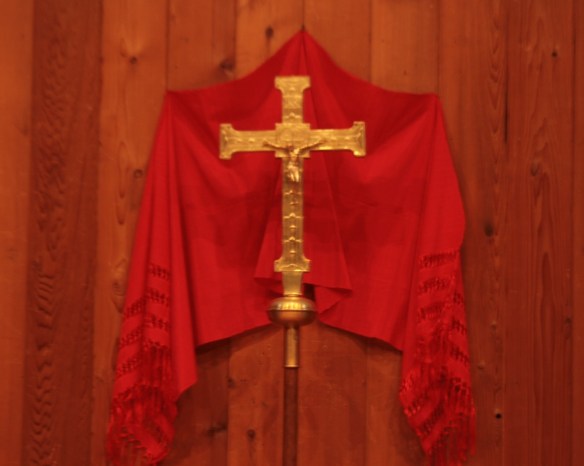 We rightly meditate on the sufferings of Jesus during Holy Week. But in Matthew 25, Jesus made it clear that the sufferings of others were also his sufferings. So it is also suitable to meditate on the sufferings Jesus bears with others.
 Like every culture, the Jews had to face fundamental decisions as to how open or closed they would be to others. The default mechanism tends to be flight or fight. In discussing remaining social groups living close to the level of what he calls “traditional” societies, Jared Diamond observed this phenomenon. A stranger wandering into the territory of a different tribe had better come up with a common ancestor or the encounter could prove fatal.
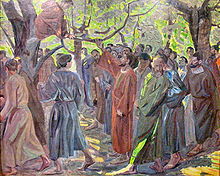 The French thinker René Girard has argued that since the dawn of humanity, we have tended to solve social tensions through persecuting a victim who absorbs these tensions and suffers for them. Girard has also argued that the Gospels unveil the truth of this scapegoating mechanism in their narratives of Jesus’ death and Resurrection where Jesus opens up new possibilities for humanity to gather through the forgiveness of the Risen Victim. It happens that the Gospels show Jesus unveiling these very same dynamics in his earthly ministry. I analyzed our such stories in my book
  Imaginary Visions of True Peace