
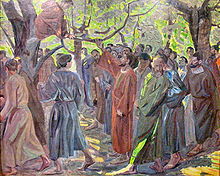
 The French thinker René Girard has argued that since the dawn of humanity, we have tended to solve social tensions through persecuting a victim who absorbs these tensions and suffers for them. Girard has also argued that the Gospels unveil the truth of this scapegoating mechanism in their narratives of Jesus’ death and Resurrection where Jesus opens up new possibilities for humanity to gather through the forgiveness of the Risen Victim. It happens that the Gospels show Jesus unveiling these very same dynamics in his earthly ministry. I analyzed our such stories in my book Moving and Resting in God’s Desire. Here is what I have to say about Zacchaeus:
When Jesus came to Jericho, he was famous, or notorious enough, that something of a hubbub arose as a result of his passing through the town. People gathered and crowded one another to gawk at the man and his followers. Why the stir? The mayor wasn’t exactly giving him the key to the city. Throughout Jesus’ journey to Jerusalem, Jesus was set upon by Pharisees and scribes and questioned in front of the crowd. Such questioning, of course, was made with the intention of publicly discrediting the freelance itinerant preacher who was becoming famous for his clever retorts. The result was bound to be entertaining. The scribes and Pharisees were surely on the prowl in a town that large. Zacchaeus’s act of climbing a tree to get a look at Jesus need not be taken as an indication that he was inclined to have his life changed by this stranger. His eagerness to see and hear the duel is enough to account for his action. And yet the anticipated debate does not occur. Why? Because Jesus saw Zacchaeus up in the tree. The signs that Zacchaeus was a rich man hated by everybody in town were there to be seen by a person with eyes to see.
That Jesus had discerned the social matrix of Jericho rightly was immediately manifest when Jesus called out to the tax collector and invited himself to that man’s house. St. Luke says that “all who saw it began to grumble and said, ‘He has gone to be the guest of one who is a sinner.’” (Lk. 19:7) Here is another example of Luke’s astute anthropological insight. It isn’t just the Pharisees and scribes who grumble about Zacchaeus. Everybody grumbles about him. Like Simon when confronted with the Woman Who Was a Sinner, (Lk. 7:36–50) the people of Jericho were thinking that if this man were a prophet, he would have known who and what kind of man this was who was sitting up in a tree—that he was a sinner. One doesn’t have to be a demonically possessed man or a sinful woman to be a communal scapegoat. A rich man who is a traitor to his people can hold the same position. And deserve it. After all, he was treading down the downtrodden. For scapegoating others, he deserved to be scapegoated. As it happened, Jesus did know what kind of man Zacchaeus was. It is through showing us that anybody can be the scapegoat and anybody can be a persecutor that Luke shows the communal scapegoating phenomenon for what it is. Given the fact that Jesus was on the way to Jerusalem with a pretty clear idea of what was going to happen to him there, it behooved Jesus to give his followers every opportunity to see how collective hostility against one person works, in the hope that they would learn to recognize the process when it happens in the Holy City, and that is what he has done here.
As with the Gerasene demoniac, Jesus performs an exorcism of the communal scapegoat, a quiet one this time, but just as effective. The result is that the homeostasis sustained by the scapegoating process is destabilized. There is some ambiguity as to whether or not Zacchaeus is actually converted by his encounter with Jesus or if he had repented earlier but nobody believed it. Bible scholars disagree as to whether the verbs used by Zacchaeus are in the present tense or the future. That is, Zacchaeus may be saying that he will give half of his possessions to the poor and pay back four times anybody he has defrauded, but he could be saying that he is already doing these things. If Zacchaeus is using the future tense, then he is announcing a change of heart. If Zacchaeus is speaking in the present tense, then he is claiming that he is better, or less terrible, than he has been made out to be. I think our best bet is to look at the implications of either interpretation of the verb tenses.
If Zacchaeus has been converted on the spot by Jesus, and we assume that Jesus did not zap people with a magic wand to override their free will, then we may ask ourselves how this conversion happened. The information in Luke suggests two possibilities. As the communal scapegoat, Zacchaeus had “the intelligence of the victim” and perhaps that intelligence led him to understand what it meant to other people to be the victim of his tax collecting. The other possibility is that an undeserved commendation from Jesus freed Zacchaeus from the necessity of acting in such a way as to justify his designation as communal scapegoat. It is more than likely that both factors played their part here. On the other hand, if Zacchaeus was speaking in the present tense, the implication is that the collective attitude of the townspeople was unjust, which would underline the arbitrary aspect of scapegoating. Generous actions on the part of a rich person who has drawn the collective resentment of the community often do not diminish resentment against him or her. It is also possible, of course, that Zacchaeus is trying to make himself look better than he really is. That is, he is boasting of his good deeds while overlooking the unjust means used for gaining the wealth that he uses for his acts of largesse. If I am right in taking this story as being primarily concerned with communal scapegoating, then the ambiguity enriches the story and there is no need to solve the grammatical problem once and for all.
The challenge of this story, however, is not limited to the possible conversion of one person. It extends to the possible conversion of the whole community. Whether or not Zacchaeus needed to be converted and, if so, whether or not he did change his life, is immaterial for the greater challenge. Either way, by singling out Zacchaeus and inviting himself to that man’s house, Jesus has already robbed Jericho of its scapegoat. The unanimity has been irretrievably broken. That everybody turns to grumbling at Jesus for going to the house of a man who is a sinner suggests that Jesus is well on the way to becoming a unanimous object of hatred. Since Jesus is on the way to Jerusalem, where he would, once again, become the object of hatred, it is no surprise that it should happen in Jericho, while he was on the way to the Holy City. This development does not bode well for Jericho becoming a social climate of healing.
 The first verses of today’s Gospel (Lk. 12: 32–34) pick up from where we left off last week. That reading ended with Jesus’ little parable about the rich fool who tore down his barns to build bigger barns (Lk. 12: 12–21) only to find that his life was being demanded of him. This reading begins with Jesus’ soothing admonition to “sell our possessions and give alms” and “make purses for yourselves that do not wear out, an unfailing treasure in heaven, where no thief comes near and no moth destroys.” (Lk. 12: 32-33) This is quite a contrast to two brothers fighting over an inheritance or a rich person gloating over fabulous amounts of wealth. Lest we think Jesus is asking us to make ourselves miserable, Jesus assures us that it is our heavenly Abba’s pleasure to give us a treasure that is the kingdom. If this treasure, the kingdom, is the Abba’s pleasure, then it is our pleasure as well.
 There is much theology that treats the Trinity as a mathematical game, trying to work out how three can be one and one can be three. But math, important as it is for many things, is not the way of salvation.
 Luke’s version of Jesus’ Resurrection is much the gentlest among the synoptic Gospels. No earthquakes and no women running off so afraid that they can tell nobody what they had seen at the empty tomb. The women were, indeed, terrified of the two men in “dazzling clothes” who appeared to them. But by the time, but before long they have remembered, with prompting from the men in white, Jesus’ words to them.
 Jesus’ prayer in the garden of Gethsemane may well have been the loneliest moment of all for Jesus. His disciples were not able to stay awake with him. Much worse, his disciples still seem not to have understood anything of what Jesus had tried to teach them. At what he knew would be his last meal with his disciples, a meal when he had poured himself into the bread and wine to give his life to his disciples and all others who would follow him, his disciples fought yet again about who was the greatest. (Lk. 22:24–26) As he had done many times before, he told his disciples that the one who would be first would be the one who served, but he must have realized his words had had the same effect as before.
 Paul’s famous Hymn of Love zeroes in on what love, as agape, is all about: “Love is patient; love is kind; love is not envious or boastful or arrogant or rude. It does not insist on its own way; it is not irritable or resentful; it does not rejoice in wrongdoing, but rejoices in the truth.” (1 Cor. 13:4–6) In these qualities, we can see love as a deep renunciation of mimetic rivalry. Insisting on our own way, being resentful, rejoicing in the shortcomings of others, are all ways of putting ourselves on top of other people. Surely this short list is meant to stand for any attempt to put ourselves above other people. As long as we try to “win,” we lose at love. When we are willing to “lose,” we win at love.
 “After eight days had passed, it was time to circumcise the child; and he was called Jesus, the name given by the angel before he was conceived in the womb.” (Luke 2:21)
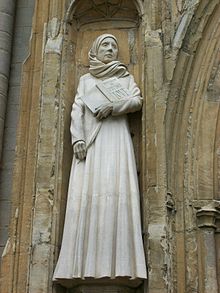 Many of the words in today’s Gospel are fearsome but many events in the past couple of weeks have also been fearsome so they fit right in. We are rightly anxious about Terrorism although I personally find the hateful and fearmongering rhetoric of some politicians around the world, not least in the US much scarier.
 Imaginary Visions of True Peace