
 Do not worry about anything, but in everything by prayer and supplication with thanksgiving let your requests be made known to God (Phil. 4:6) (All Bible quotes are from the NRSV)
When James says in his Epistle: “Every generous act of giving, with every perfect gift, is from above, coming down from the Father of lights, with whom there is no variation or shadow due to change.” (James 1:17) he is suggesting that giving is of the very essence of God, and that every act of giving participates in God’s own generosity. When Jesus sites the lilies of the field as a counsel not to worry about our material needs, Jesus is assuring us that the heavenly Father knows we have these needs and that He will fulfill them.
However, the prayer and supplication we are encouraged to make should be made with thanksgiving. It is not just a matter of being grateful for what we have already received; we should be thankful in the act of asking. Usually, we prefer to wait until a request has been granted before thanking the donor. Here, however, we are expected to thank the donor in advance. This can be taken as an expression of confidence that the request will be granted in precisely the way we asked for it. However, thanksgiving in advance could just as well be gratitude for whatever is given us in whatever way it is given. In short, gratitude is an ongoing attitude that motivates us to make requests of God, but it is also an attitude that permeates these requests.
When Jesus tells us not to worry about what we are to wear or what we will eat, Jesus says that “it is the Gentiles who strive for all these things; and indeed your heavenly Father knows that you need all these things.” (Mt. 6:32) The key word here is “strive.” It is one thing to need certain things in life and quite another to strive for them. Striving after goods is the quickest way to lose any sense of thanksgiving.
The warning Moses gives the people when they are about to enter the Promised Land is cautions us against one of the ways we strive after goods: “When you have eaten your fill and have built fine houses and live in them, and when your herds and flocks have multiplied, and your silver and gold is multiplied, and all that you have is multiplied, then do not exalt yourself, forgetting the Lord your God, who brought you out of the land of Egypt, out of the house of slavery.” (Deut. 8:12-14) The way we might exult ourselves is to think that: “My power and the might of my own hand have gotten me this wealth.” (Deut. 8:17) This blatantly false supposition shows the Israelites striving for the Promised Land when they are meant to receive it. When we think that we have earned what we have received, then we feel no gratitude for it. When we think we had something coming to us, there is nobody to thank for it but ourselves. We don’t write a thank you note to our boss for paying our salary. Likewise, if we feel that God owes us what God gives us as the just payment for the prayers we have given or for other acts of service we have performed for the sake of God’s Kingdom, then we don’t thank God for it. On the contrary, if “the wheat and barley, of vines and fig trees and pomegranates, olive trees and honey” fall short of our standards, we complain to God about it. It is important, then, to realize that a covenant between God and humanity it is not a contract where God gives us a pre-established “salary” for what we do for God. Rather, a covenant sets in motion a circle of giving. We give free gifts to God and God gives free gifts to us.
At St. Gregory’s, we don’t earn money from the monastery by washing the dishes or setting up tables. We do the work as a free gift to the monastery. However, the members of the community are fed because they are members of the community. Nobody calculates whether or not a monk has enough “work credits” to qualify for coming to supper. Likewise, we do not charge for praying for people in their needs, just as we do not charge for the Abbey Letter and we do not charge our guests for staying with us. They are guests, not customers. We depend on the free gifts given us by people who are willing to support what we do because they think it is worth doing. The point is, these gifts are is not contracted payments for any services we may have given or prayers we have offered.
Jesus’ counsel that we not worry about tomorrow, for tomorrow will bring worries of its own,” (Mt. 6: 34) is also vital to an attitude of thanksgiving. When we are thankful, we are focusing on what we already have rather than on what we do not have. More important, when we are thankful, we are content with what we have. On the other hand, when we strive for what we do not have, we are focused on what we lack and so we do not even think about what we have already, let alone give thanks for it. This attitude is also important in our human relationships as well. When we are thankful for what the people in our lives do for us and for what they mean to us, we are content with them as they are, even if we know that there is room for them to grow in virtue and goodness. Striving to change other people becomes a contest against that very person. If we succeed in reforming another, it is seen as a victory over that person. Being content with the other person as that person is in the present can become complacency, but it is also a condition with great potential for encouraging a person to change.
Contentment with what we have does not deny the intrinsic value of those goods we desire but do not have already. It only means that we can be patient about what we do not have because we appreciate the intrinsic value of what we have already. This is the key to “making supplications” with thanksgiving. This does not mean that we pray with thankful hearts because we assume we are going to get what we want when we want it. Rather, this is a matter of praying out of contentment in the present that only worries that “today’s trouble is enough for today.”
Jesus gives us the true focus for gratitude when he goes on to admonish us to “strive first for the kingdom of God and his righteousness, and all these things will be given to you as well.” (Mt. 6:33) Note that the word “strive” is used again here to show us that striving in itself is not necessarily a bad thing. What matters is the objective of our striving. If we strive for God’s kingdom, then we do not strive for “all these things” like the “Gentiles.” Striving for God’s kingdom, of course, entails striving to provide the needs and wants of other people, i.e. being “doers of the word” rather than hearers only. When we strive for God’s kingdom, it becomes immediately apparent that our efforts cannot earn the good we are striving for. Our efforts fall far short and we can only receive God’s kingdom as a gift. When we know that we cannot earn the kingdom, then we don’t require other people to earn it either. We become free of worry over whether or not the widows and orphans are worthy of the aid we give them and, likewise, we become free from the need to grumble like the workers in the vineyard who didn’t like it when the master was generous with his money to other people. This freedom from worry encourages us to become more open-handed and open-hearted towards other people in their needs. The more we open our hands and hearts to others, the more we receive to be thankful for.
 Jesus’ insistence that we deny ourselves and take up our crosses and follow him (Mk. 8: 34) jolts us into thinking about what our priorities in life should be. Without being so jolted, we tend to deny other people, take up our favorite pastimes and follow whoever takes our fancy. However, we encounter a serious problem if and when we do take Jesus’ words to heart. We tend to get muddled over what constitutes a “cross” and how we should carry it. Because of this muddle, there is the danger that the cross will be trivialized. Carrying our own crosses is not about being a good sport if we catch the flu.
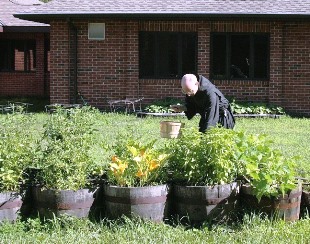 Eating is among the most fundamental activities of civilization, perhaps the most fundamental. It is the practice that brings people together to share in nourishment and social nurturing. And yet, throughout the animal kingdom, sustenance requires feeding on other living beings. Sometimes it is other animals, sometime plants. That is, a group bonding through eating inevitably bonds at the expense of other living beings.
 The Trinity is a fundamental doctrine for Christianity but Christianity is a story of salvation before it is a set of doctrines. The Trinity is no exception. If we get the story right, we might get the doctrine right, but if we get the story wrong, then we get the doctrine wrong for sure.
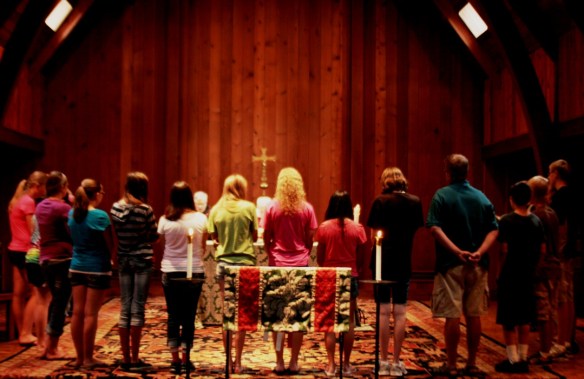 The image of the vine and the branches in John 15 gives us a powerful image of closeness both between ourselves and God and also with each other through our grounding in God.
 St. Paul proclaims the Resurrection of Jesus as a radical game changer. It is a passage from death to ourselves to a new life in Christ. This proclamation is often understood as an individual conversion. It is that but it is much more. During his life, Jesus proclaimed the kingship of God. A kingship, of course is social, not individual, much as we like to fancy ourselves kings and queens of our little castles. The kingship of God looked like a lost cause when Jesus died, but after being raised from the dead, Jesus leads us into the kingship that we rejected when we crucified him. It is important to note that Paul was not writing to an individual but to a community, indeed, the community that at the time represented all humanity as Paul knew it. St. Paul proclaims the Resurrection of Jesus as a radical game changer. It is a passage from death to ourselves to a new life in Christ. This proclamation is often understood as an individual conversion. It is that but it is much more. During his life, Jesus proclaimed the kingship of God. A kingship, of course is social, not individual, much as we like to fancy ourselves kings and queens of our little castles. The kingship of God looked like a lost cause when Jesus died, but after being raised from the dead, Jesus leads us into the kingship that we rejected when we crucified him. It is important to note that Paul was not writing to an individual but to a community, indeed, the community that at the time represented all humanity as Paul knew it.
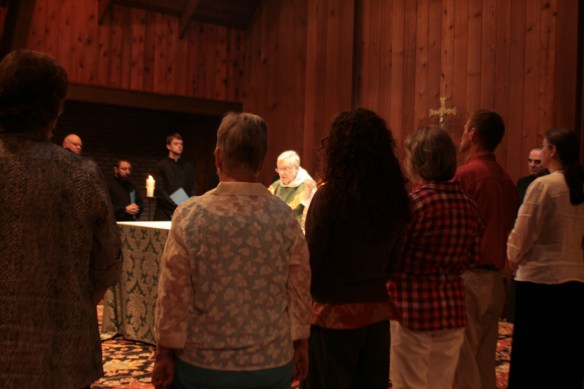 The Passover is the formative event for Jews, the event that constitutes them as a culture. The Last Supper, the Eucharist, is as formative for Christians. Although there is debate as to whether the Last Supper was a Passover meal, the association with that feast is clear enough for Jesus’ supper to have incorporated and redefined Passover. The big question is: What is the culture that these events are intended to form?
 Mark tells us that immediately after his baptism, the Spirit drove Jesus out into the wilderness where he was tempted, or tested, by Satan.
 The custom of imposing ashes on our foreheads as a sign of our mortality on Ash Wednesday, the beginning of the penitential season of Lent, has the potential to encourage us to think that mortality is something we should repent of. The opposite is the case. We are not asked to repent of our mortality, we are asked to remember our mortality. Remembering our mortality is an important way to repent and to amend our lives. Since God made us mortal, mortality is not the problem. The problem, a huge problem, is the tendency to deny our mortality, to think that death should not apply to us. Clinical studies inspired by Ernest Becker show that denial of mortality leads to violent and insensitive behavior while some measure of acceptance leads to a much more humane way of relating to others, of connecting to others. I can’t help but reflect that in a great many fantasy novels, the villain tries to gain immortality which can only be achieved by stealing the life substance of others; an extreme example of how denial of mortality inevitably leads to victimization of other people. Such villains are always so deeply isolated as to be living deaths, no matter how many years they survive in this world. But if we accept our mortality, we put our trust in the crucified and Risen Lord, the true giver of life. When we accept our mortality, the time we have to repent becomes precious and we are ready to spend this precious gift wisely in the way we live so that others, too, may live.
 When Jesus opened his teaching ministry, Mark says that the people were “astounded” because he taught them“as one having authority, and not as the scribes.” (Mk. 1: 22) Oddly, Mark doesn’t include anything of what Jesus said. The Greek work exousia is much stronger than the English word that translates it. “Powerful authority” would bring us closer to the meaning. That Jesus’ teaching was not like that of the scribes doesn’t give us much more to go on as to the content, but it indicates that this authoritative teaching was distinct from those who were normally considered the teaching authorities.
