

When Jesus washed the feet of his disciples, he stressed the importance of what he was doing. Likewise, when he passed the bread and the wine, he stressed the importance of what he was doing. Both acts were to be remembered and done in memory of Jesus. And both are to this day, although the footwashing is not anywhere near as common as the eating and drinking of the bread and wine.
What is it about the footwashing that has put it into a very low second place? Logistics may have something to do with it but a look at its meaning, the sign that Jesus is giving us, probably has a lot more to do with our not even talking about it all that much. In the Greco-Roman world, it was slaves who washed the feet of their masters and their masters’ guests. That Jesus would do the work of a slave must have been shocking at the time and still is, if we consider the implication that imitating Jesus’ act is not confined to literally washing the feet of others but entails acting as a slave to others. Fundamentally, being a slave means to be in the hands of another person. If we are supposed to put ourselves into the hands of others like this, what does this say about trying to enslave another human being? Jesus himself was about to put himself into the hands of others with the result that he would be crucified. If the disciples still remembered the anointing of the feet of Jesus by Mary of Bethany six days ago, that too would have added to their discomfort. This discomfort extends to the parallel versions of this story
The woman ( or women) in the Gospel stories poured out her very substance (the expense of the perfume or oil) in devotion to Jesus. Likewise, Jesus poured out his very self to his disciples in washing their feet just as he was about to pour out his life for all people to put an end to the violence that includes the enslaving of other people. In those Gospel stories, the women were commended as examples of discipleship. If Jesus thought these women were such good examples, it makes sense that Jesus was humble enough to learn from them and do for his disciples what the women had done for him. There is no indication in any variant of the story that the disciples were reconciled to what the women had done. Did Peter take umbrage at Jesus for washing his feet because he associated it with the women as much as he associated it with slavery?
With the bread and wine, Jesus again poured himself into the two elements just as he poured out his life on the cross. So it is that the footwashing and the Eucharist both mean the same thing. We have put up with the Eucharist more than the footwashing because we have been able to sidestep this meaning by arguing about the metaphysics of Jesus’ presence. But the real presence of Jesus is his pouring himself into the hands of others and through them, the hands of his heavenly Abba. Paul knew this very well but we also conveniently forget that the context of his recalling the Last Supper is to upbraid the Corinthians for violating its meaning through denigrating the weaker and poorer members of the assembly.
Jesus rebuked Peter for refusing to have his feet washed, warning him that he would have no share in him. (Jn. 13: 8) This warning converts Peter so powerfully that he goes overboard and asks to be washed all over. He has allowed Jesus to be a slave to him so that he could be a slave to Jesus and all people. This conversion did not prevent him from denying Jesus three times but it allowed him to hear the cock crow and then to affirm his love to the Resurrected Jesus three times. This is what both the footwashing and the Eucharist are all about.

 The eighth chapter of Romans is among the most inspirational passages in all scripture. Paul assures us that “all things work together for good for those who love God, who are called according to his purpose” and that we will be “conformed to the image of his Son, in order that he might be the firstborn within a large family.” (Rom. 8: 28–29) Lest we think that only some people are predestined for God’s family, Paul asks: “If God is for us, who is against us?” (Rom. 8: 31) If Jesus is interceding for us, what more powerful persecutor is there to speak against us? Do we really want any personal being to veto the advocacy of Jesus? If we are truly stirred by these words, then we must stamp them deep into our hearts and allow them to govern how we view God and how we view other parts of scripture. For today, I suggest using these words to help us understand the parables in Matthew 13.
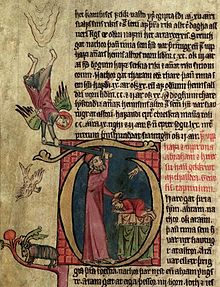 When the story of the near-sacrifice of Isaac was first told to me in Sunday school, the teacher prefaced the story by saying that in biblical times there were people who made sacrifices to “god” and some people even sacrificed their own children, but God decided to teach Abraham that he should not do that. The story was troubling but it was comforting to know that God did not want such an awful thing. Between that and being told around the same time the story about Jesus inviting the children to come to him did much to instill in me a trust in God as deeply loving from an early age. Since then, I’ve come across many learned scholars who think such an interpretation of the Isaac story is simplistic. Who’s right?
 The Holy Spirit is the most obscure of the three Persons of the Trinity, not that the other Persons aren’t mysterious as well. One reason is that the Son is said to show the Father, and the Holy Spirit is said to show the Son, but that leaves nobody to show the Holy Spirit. So obscure is the Holy Spirit that it is difficult to think of the Holy Spirit as a Person at all. It is not uncommon to hear the Holy Spirit referred to as “it,” although both masculine and feminine pronouns also fall far short of the Holy Spirit’s personhood.
 The Good Shepherd is a reassuring image. The shepherd is in charge and the sheep follow the shepherd’s guidance. When thieves and robbers and wolves come to threaten the sheep, the shepherd deals with them in no uncertain terms. Jesus’ claim to be the gate, the way in and out of the fold, gives us another reassuring image: some of us are in and certain other people are out, just the way it should be.
 When we dip our fingers in a holy water stoup as a reminder of our baptism, how much do we really remember? Do we stop to think that the water is as explosive as the bread we receive at the Eucharist?
 John the Baptist is so closely associated with the beginning of Jesus’ ministry that it’s easy to see them as two of a kind. Both preached repentance. Both died the death of a martyr.
 When Jesus warns of wars and insurrections fought by nation against nation and kingdom against kingdom, he is painting an image of humanity divided by violent conflicts on a grand scale. These conflicts are coupled with catastrophic natural disasters such as earthquakes, plagues, and famines. .(Lk. 21: 9–11) Jesus then goes on to warn his followers of persecutions on an equally large scale involving kings and governors, clearly suggesting a strong connection between strife and persecution. In the late twentieth century, the French thinker René Girard speculated that humanity suffered the same dangerous conflicts at the dawn of civilization and it instinctively resolved the conflicts by persecuting a victim or small group of victims. These victims were blamed for both the violence and the earthquakes and the plagues and famines. Blaming the victims entailed falsifying the reality of what had happened. Persecution and lies are inseparable. It is not difficult to see that Jesus saw clearly the truth in his time that Girard was to articulate in ours.
 The introduction to the Parable of the Unjust Judge tells us that we should keep on praying and never give up. At the end of the parable, Jesus tells us that we should keep on praying even when our prayers go unanswered for so long that we think we are praying to one who does not care and perhaps is not even just.
