
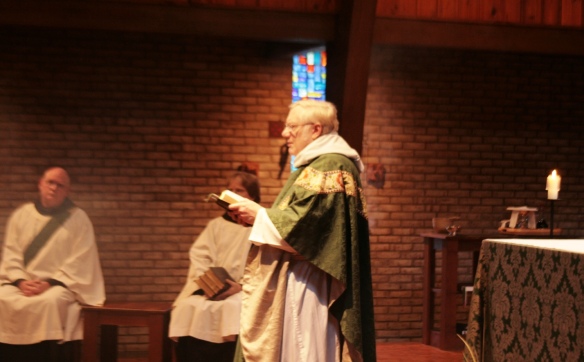
 The narratives of the call of Isaiah, Paul, and Simon Peter bring to mind my own experiences of God’s call. In my case, it wasn’t quite like being attacked by a Cherubim in church, getting knocked down on the Road to Damascus or being told to throw out the fishing nets one more time and being overwhelmed by the catch.
I did quite a lot of fishing as a child for the simple reason that my father loved it and my family spent most summer vacations at a fishing lodge. I lost interest in fishing by the time I was a teenager but the contemplative aspect of fishing stayed with me as I became a monk. While praying the Divine Office and praying silently in the Abbey Church, I constantly sense God calling me out of my self-preoccupations and self-indulgence to the wider concerns of God.
I had the call of Isaiah memorized when I was a choirboy because I sang an overwrought anthem to that text, ending with the prophet’s quiet volunteering to be sent by God. Even then, I had intimations that I might be called to the ministry although I was put off by how much kneeling I would have to do. Even so, one Sunday when our whole family was too sick to go to church, I led the four of us in the Office of Morning Prayer. As for kneeling, liturgical renewal dealt with that.
During my late high school and college years, I was a self-styled religious rebel who didn’t like the way God ran the universe. Like Paul, I was quite vocal about saying what I thought to anyone who would listen and to others who would rather not. By hindsight, I realize that I was being called all that time until I listened sufficiently to get on the track that led me to St. Gregory’s Abbey. By then I had come to realize that God doesn’t try to run the universe but God has pointed out ways we can run it better than we’re doing it if only we would listen.
It is tempting to think that one is special if one senses a call from God, as if God would surely call a superior person such as myself. But Isaiah, Paul, and Simon Peter all felt differently when approached by God. In each case, the call convicted them and pulled them out of the way they were living to a radical change of attitude and activity. In my case, I had to realize that a seminary I went to after graduating from college was the wrong choice for me, one fueled by my rebellious attitude. Only then could I hear the call to a seminary much better suited for me.
In God’s mission charge to Isaiah, God tells him to tell the people: “Keep listening, but do not comprehend; keep looking, but do not understand.” (Is. 6: 9) Jesus uses these same words to characterize the response he got from his own preaching. Some way to be “ catching people.” (Lk. 5: 10) There are many ways one can understand what it means to be a person of unclean lips living “among a people of unclean lips.” (Is. 6: 5) René Girard writes of the human tendency to share desires so intensely that they become rivalrous. When that happens, we may have ears but we will not hear what other people are saying and we will not hear what God is saying to us. In my case, I had cast myself so deeply into rivalry with God that I drowned out the direction of my call for many years. Since the most vulnerable people in a society bear the brunt of the rivalry of the powerful, deafness to the cries of the poor go unheard with only prophets like Isaiah to defend them.
Paul received his call from the resurrected Christ who asked Paul why he was persecuting him in the act of persecuting his people. John’s Gospel has a variant of the story of the overwhelming catch of fish placed after the Resurrection which raises the intriguing question of whether or not Luke placed a resurrection narrative in an early chapter of his narrative. In any case, after deserting Jesus, the disciples did need to be called a second time by the resurrected Christ. Jesus was raised from the dead because first he was killed in an act of collective violence, the sort of persecution Girard argues is the result of a society allowing itself to be swamped in rivalry where we have ears but fail to hear.
Since God’s call to each of us entails preaching the Word and, much more important, witnessing to it in our ways of living, we are fundamentally spreading our repentance to others to open their ears as well. The hazard is that a sense of rivalry can enter through the back door if we treat our ministry of witnessing as a contest in which we try to “defeat” the other and win a “victory.” What we need to do is listen to ourselves in God, and listen to others as God listens to them, and use our listening skills, based on repentance, to help other people learn to listen.
For an introduction to the thought of René Girard, see Violence and the Kingdom of God and Living Stones in the House of the Forgiving Victim.
 Luke stresses the contrast between John the Baptist and Jesus much more than the three other evangelists. Most strikingly, Luke does not specifically say that John himself baptized Jesus. Luke describes John’s ministry and then says Herod added to all his other crimes by putting John in prison. (Lk. 3: 19–20) Then Luke puts Jesus front and center by saying the he was baptized “when all the people were baptized.” (Lk. 3:21)
 The image of Mary holding her Child is arguably the defining image of the Christmas season. Its tenderness is comforting in a world where violence against the most vulnerable dominates the news. Vulnerability, such as that of a newborn baby tends to arouse either a gentle wish to nurture and protect, or it sets off an urge to take advantage of weakness in hard-hearted fashion as Herod did. We see both of these tendencies happening in the world about us and it is possible that we struggle between them within ourselves. If we let ourselves get caught up in the frantic conflicts occurring today, any weaknesses we see in our opponents become targets for increased aggression.
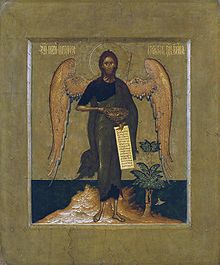 Although John burned with a conviction that God was going to do something new, he had only the models of past prophets to guide him in opening a way to the great new thing. He lived in the desert, wore a camel hair coat and ate wild locusts and honey in imitation of Elijah. Like the prophets of the past, he warned the brood of vipers of the wrath to come if people did not shape up and turn back to God. (Lk. 3: 7) Again like the prophets, he told soldiers not to oppress vulnerable people. Yet again like the prophets, he rebuked his ruler, Herod. And like so many of the prophets, he was put to death.
 Jesus’ insistence that we deny ourselves and take up our crosses and follow him (Mk. 8: 34) jolts us into thinking about what our priorities in life should be. Without being so jolted, we tend to deny other people, take up our favorite pastimes and follow whoever takes our fancy. However, we encounter a serious problem if and when we do take Jesus’ words to heart. We tend to get muddled over what constitutes a “cross” and how we should carry it. Because of this muddle, there is the danger that the cross will be trivialized. Carrying our own crosses is not about being a good sport if we catch the flu.
 Eating is among the most fundamental activities of civilization, perhaps the most fundamental. It is the practice that brings people together to share in nourishment and social nurturing. And yet, throughout the animal kingdom, sustenance requires feeding on other living beings. Sometimes it is other animals, sometime plants. That is, a group bonding through eating inevitably bonds at the expense of other living beings.
 I was introduced to the Transfiguration of Our Lord when Raphael’s great painting of the event hit me between the eyes during my student travels in Rome. With the Feast of the Transfiguration coming during my church’s summer slump (and it wouldn’t have celebrated the feast anyway) I knew nothing about it. In many ways, I didn’t have to. The painting opened up a vision of a transfiguration of humanity beyond what I had thought possible. At the time, what faith I had wasn’t centered around any particular religious viewpoint but I was majoring in religion because I thought the subject dealt with the most important things in life. Seeing the painting was more of a religious awakening than I knew. I was, of course, impressed by the sublimity of the upper half of the canvas where Jesus is floating in the air with Moses and Elijah. But I was even more impressed by the inroads the transfigured light made into the lower half which is often interpreted as indicating sinful and benighted humanity. It has taken me years to see further into the significance of this chiaroscuro effect.
 For Proper 11 in Year B, the year of Mark, the Gospel has only two snippets. The first has Jesus taking his disciples to a deserted place only to be followed by crowds of people. Jesus has compassion on them “because they were like sheep without a shepherd.” (Mk. 6: 34) This reference to shepherding echoes the reading from Jeremiah where the prophet rails against the shepherds who destroy and scatter God’s sheep. (Jer. 23: 1) The other snippet comes at the end of chapter 6 where Jesus heals many people who are being brought to him.
 St. Paul proclaims the Resurrection of Jesus as a radical game changer. It is a passage from death to ourselves to a new life in Christ. This proclamation is often understood as an individual conversion. It is that but it is much more. During his life, Jesus proclaimed the kingship of God. A kingship, of course is social, not individual, much as we like to fancy ourselves kings and queens of our little castles. The kingship of God looked like a lost cause when Jesus died, but after being raised from the dead, Jesus leads us into the kingship that we rejected when we crucified him. It is important to note that Paul was not writing to an individual but to a community, indeed, the community that at the time represented all humanity as Paul knew it. St. Paul proclaims the Resurrection of Jesus as a radical game changer. It is a passage from death to ourselves to a new life in Christ. This proclamation is often understood as an individual conversion. It is that but it is much more. During his life, Jesus proclaimed the kingship of God. A kingship, of course is social, not individual, much as we like to fancy ourselves kings and queens of our little castles. The kingship of God looked like a lost cause when Jesus died, but after being raised from the dead, Jesus leads us into the kingship that we rejected when we crucified him. It is important to note that Paul was not writing to an individual but to a community, indeed, the community that at the time represented all humanity as Paul knew it.
 Imaginary Visions of True Peace