
 The Good Shepherd is a reassuring image. The shepherd is in charge and the sheep follow the shepherd’s guidance. When thieves and robbers and wolves come to threaten the sheep, the shepherd deals with them in no uncertain terms. Jesus’ claim to be the gate, the way in and out of the fold, gives us another reassuring image: some of us are in and certain other people are out, just the way it should be.
But in my reflections on John 10 from a year ago, I noted that the Good Shepherd is the Lamb of God who lays down his life for the sheep. With this realization, the hierarchical picture breaks down. The Good Shepherd is not above the sheep but is one of the sheep. Whereas even the most compassionate and conscientious shepherds end up eating or sacrificing the sheep, Jesus shares the fate of the sheep by becoming the Paschal Lamb in place of the sheep.
The Lamb of God is also an odd gate. Rather than keeping the lambs inside, he leads the lambs in and out with so much movement that the idea of there being a gated sheepfold ceases to make sense. Rather than keeping the bandits and robbers away, Jesus lays down his life for the flock when the bandits attack. If Jesus is the gate, than his willingness to lay down his life is the way in to this abundant pasture for all who would join his flock.
In an essay on the Eucharistic Christ, James Alison explores these paradoxes with great insight. After taking us through stages where we fixate on the bad shepherds and feel righteous about identifying and hating them, Alison takes us to a stage where the fixations fall away:
There is no definitive inside and outside for the Good Shepherd, there are places of shelter and of feeding, different places to which the door gives access, and which presuppose movement, non-fixity, and confidence in being neither in nor out. It is assumed that the best feeding place might not be one that seems to be “in,” yet the good shepherd is able to make that place available to his sheep.
The mixup that Alison envisages reaches the point where we are all sheep and all wolves, not in a negative sense where each of us supposedly good people find the wolf within, but rather a recreation of abundant life where nobody needs to be a sheep who is devoured or sacrificed or a wolf who does the devouring and sacrificing. This is where our baptism into the death of Jesus leads us further into the abundant life of Jesus.
It is in the space of this abundant life that we hear the true voice of the Good Shepherd as the Lamb of God, which Alison suggests is the still small voice that Elijah heard in the wilderness. When we hear this still small voice, the strident voices of bandits are drowned out and our own voices can take on the same stillness that others need to hear.
 When we dip our fingers in a holy water stoup as a reminder of our baptism, how much do we really remember? Do we stop to think that the water is as explosive as the bread we receive at the Eucharist?
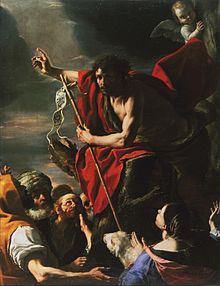 John the Baptist is so closely associated with the beginning of Jesus’ ministry that it’s easy to see them as two of a kind. Both preached repentance. Both died the death of a martyr.
 When Jesus warns of wars and insurrections fought by nation against nation and kingdom against kingdom, he is painting an image of humanity divided by violent conflicts on a grand scale. These conflicts are coupled with catastrophic natural disasters such as earthquakes, plagues, and famines. .(Lk. 21: 9–11) Jesus then goes on to warn his followers of persecutions on an equally large scale involving kings and governors, clearly suggesting a strong connection between strife and persecution. In the late twentieth century, the French thinker René Girard speculated that humanity suffered the same dangerous conflicts at the dawn of civilization and it instinctively resolved the conflicts by persecuting a victim or small group of victims. These victims were blamed for both the violence and the earthquakes and the plagues and famines. Blaming the victims entailed falsifying the reality of what had happened. Persecution and lies are inseparable. It is not difficult to see that Jesus saw clearly the truth in his time that Girard was to articulate in ours.
 The introduction to the Parable of the Unjust Judge tells us that we should keep on praying and never give up. At the end of the parable, Jesus tells us that we should keep on praying even when our prayers go unanswered for so long that we think we are praying to one who does not care and perhaps is not even just.
 When Jesus’ disciples asked their master how they should pray, he taught them a prayer that has us learn by doing. We are taken aback by Luke’s shorter version of this prayer (Lk. 11: 2–4) since the liturgical use of Matthew’s version with an added doxology causes us to think it is the only form it has. We will find, however, that this shorter version has the main elements of the longer one.
 When called by the prophet Elijah, (1 Kings 19: 19–21) Elisha asks to kiss his mother and father first. When he is rebuked for this demurral, he slaughters his oxen, breaks the yokes and burns them, and then follows Elijah. That is, he burns his bridges in making a clean break. Elisha makes this break, however, to join a brotherhood of prophets who have set up an alternate community to the violent and idolatrous kingdom of Ahab and Jezebel. Unfortunately, this community is also compromised by violence as Elijah calls fire down on his enemies (2 Kings 1: 10–12) and one of the prophets anoints Jehu to pull of a violent coup d’état. (2 Kings 9)
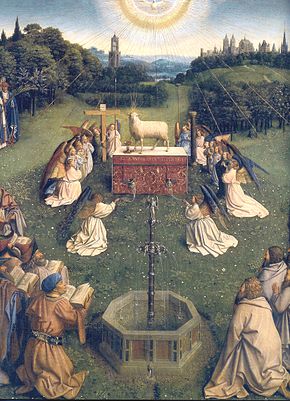 We usually understand a shepherd to be one who leads a flock of sheep and protects it from harm. But in Revelation, the author proclaims “the Lamb at the center of the throne” to be the shepherd of the multitude of worshipers from all nations. The worshipers are praising this Lamb whom they follow and the Lamb “will guide them to springs of the water of life.” (Rev. 7: 17) Their white robes have been made white in the blood of this Lamb because the Lamb has lead his followers through the ordeal. This is an odd sort of shepherd since normally it is the job of the shepherd to protect the flock from danger, not lead the flock into it.
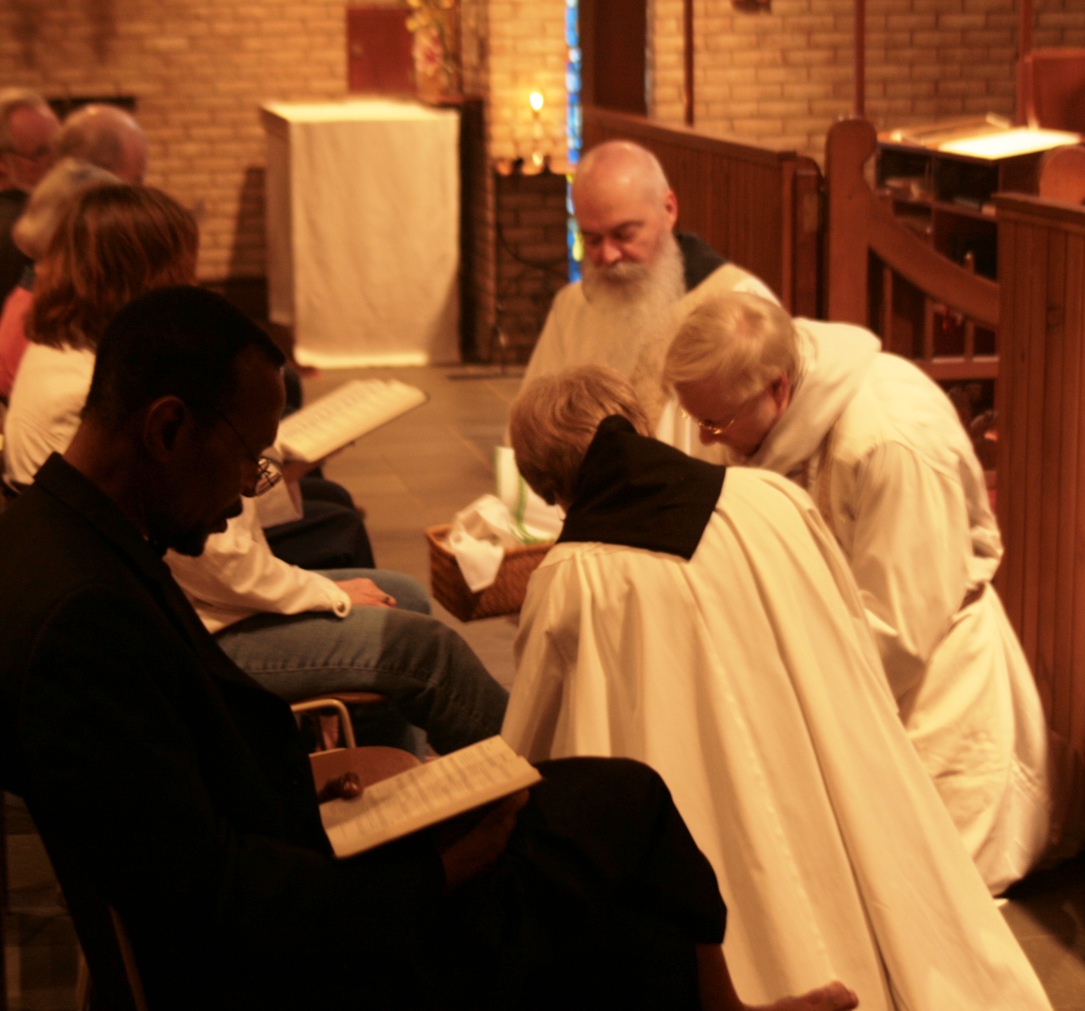 Probably nothing is more painful than betrayal. My own personal experiences of feeling betrayed are, so far, much smaller than what I know others have suffered, but even the smallest doses of betrayal are unspeakably painful. The pain of betrayal is a pounding discord in the Gospel narratives of Jesus’ Last Supper and Paul’s own short narrative of it. This discord is particularly prominent to the point of being unbearable in John’s Gospel where it overshadows Jesus’ loving act of washing the disciples’s feet. Right after leading into the story with these sublime words: “Having loved his own who were in the world, he loved them to the end,” (Jn. 13: 1) John says: “The devil had already put it into the heart of Judas son of Simon Iscariot to betray him.” (Jn. 13: 2) When Judas leaves the supper, John says “And it was night,” (Jn. 13: 30), meaning “night” in all of its most ominous meanings. Right after Judas’s departure, Jesus gives his disciples his great “new” commandment: “Love one another. Just as I have loved you, you also should love one another.” (Jn. 13: 34)
 Right after dramatically recalling God’s deliverance of the Jews from the Red Sea, Isaiah proclaims that God is “about to do a new thing; now it springs forth, do you not perceive it?” (Is. 43: 19) By his time, the Red Sea deliverance was an old thing, something the Jews repeatedly recalled, especially at the celebration of Passover. But at the time of that deliverance, it was a new thing that had sprung forth. Delivering escaped slaves through turbulent waters just wasn’t in the play books of deities at the time. God had changed the play book and revealed the hitherto unknown truth that God is a God who delivers victims and outcasts from the rich and the powerful.
 Imaginary Visions of True Peace