
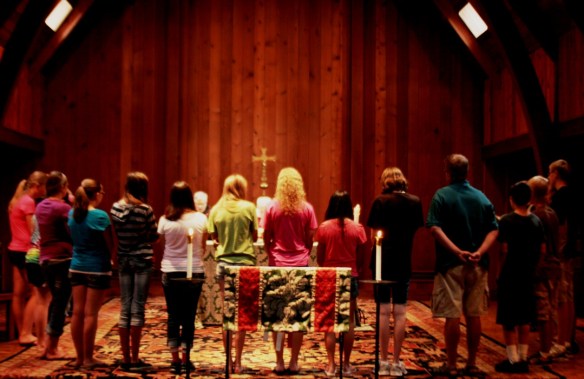
 The image of the vine and the branches in John 15 gives us a powerful image of closeness both between ourselves and God and also with each other through our grounding in God.
Each of us is a branch connected to the vine which is Jesus. Jesus is telling us that the desires of each and every one of us must be rooted in His Desire, which is the same Desire as that of his heavenly Father. Between Jesus and his Father, there is no rivalry and Jesus does not enter into rivalry with us. From our side it tends to be a different story. We experience rivalry so constantly that it is very hard to imagine a relationship without rivalry. Just note how political and social debates are saturated with it.
Jesus’ words start to sound threatening when he talks about branches withering, being thrown away, and then burnt. However, it isn’t Jesus who cuts off the branches; it’s branches that cut themselves off. Life rooted in Christ has to be rooted in Christ. This is, or should be, a tautology, but we have a folk saying about cutting off the limb we’re sitting on. People who center their lives on one or more rivals instead of Christ are doing just that. Once cut off from the vine, we are consumed with rage with our rivals, a strife that burns us up.
We often think of union with God as individualistic but that is not so. On the contrary, union with the vine unites us with all of the other branches. This means we share our union with the vine with everybody else’s union with the vine. It is by being united to others through Christ that we have the ability, through grace, to act towards others in God’s Desire rather than through our rivalistic tendencies. Since there is no rivalry in Jesus, there is no way that Jesus would encourage rivalry with others who are connected to him. In his first epistle, John says that we should love one another because “love is from God” and God is love. (1 Jn. 4: : 7–8) Again, God’s love for us is deeply connected with our love for one another. God abides in us insofar as we love one another. If we cut ourselves off from God, we cut ourselves off from other people and if we cut ourselves off from other people, we cut ourselves off from God.
The image of the vine and the branches is, above all, Eucharistic. The Eucharist is a public event. The wine in the Eucharistic celebration is the blood of Jesus that he gave to heal all of us of our violent ways. The blood of Jesus on the altar shared with each of us makes present to us the death of Jesus at the hands of persecutory humans as it also makes present the risen life of Jesus. In exchange for the way we betray Jesus with our violence, we receive the gift of life through deep union with Jesus, a union like that of the branches to the vine. We associate blood with violence, such as with the term “bloodshed,” but blood is the life within us and it is life that the Risen Jesus gives us through his Blood. This is the wine, the blood, that flows from the vine to the branches to connect us to Christ and to each other.
 St. Paul proclaims the Resurrection of Jesus as a radical game changer. It is a passage from death to ourselves to a new life in Christ. This proclamation is often understood as an individual conversion. It is that but it is much more. During his life, Jesus proclaimed the kingship of God. A kingship, of course is social, not individual, much as we like to fancy ourselves kings and queens of our little castles. The kingship of God looked like a lost cause when Jesus died, but after being raised from the dead, Jesus leads us into the kingship that we rejected when we crucified him. It is important to note that Paul was not writing to an individual but to a community, indeed, the community that at the time represented all humanity as Paul knew it. St. Paul proclaims the Resurrection of Jesus as a radical game changer. It is a passage from death to ourselves to a new life in Christ. This proclamation is often understood as an individual conversion. It is that but it is much more. During his life, Jesus proclaimed the kingship of God. A kingship, of course is social, not individual, much as we like to fancy ourselves kings and queens of our little castles. The kingship of God looked like a lost cause when Jesus died, but after being raised from the dead, Jesus leads us into the kingship that we rejected when we crucified him. It is important to note that Paul was not writing to an individual but to a community, indeed, the community that at the time represented all humanity as Paul knew it.
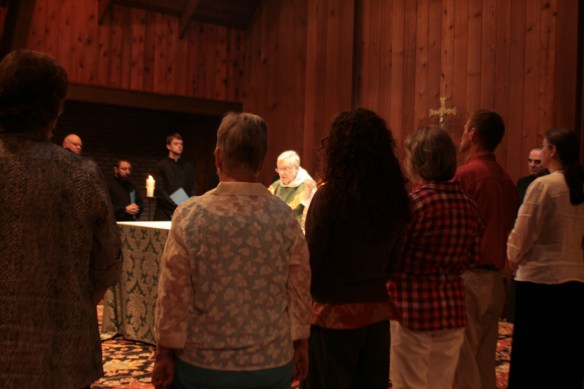 The Passover is the formative event for Jews, the event that constitutes them as a culture. The Last Supper, the Eucharist, is as formative for Christians. Although there is debate as to whether the Last Supper was a Passover meal, the association with that feast is clear enough for Jesus’ supper to have incorporated and redefined Passover. The big question is: What is the culture that these events are intended to form?
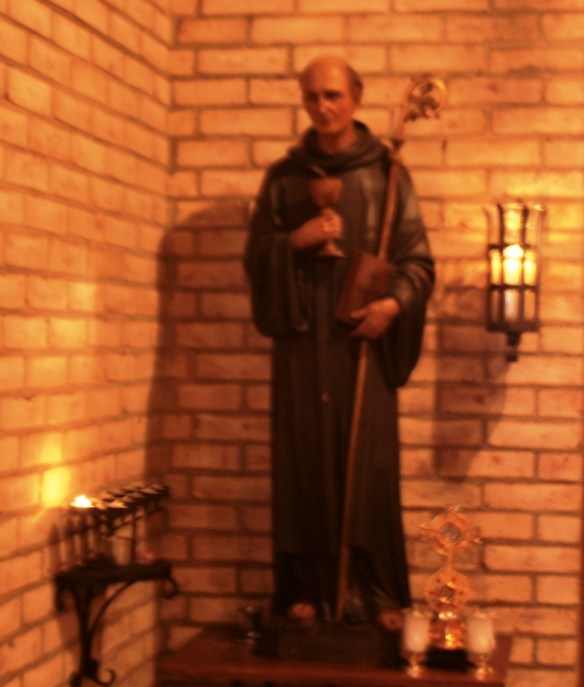 Abraham’s call to leave his country and kindred has been a monastic trope ever since there was a monastic presence in Christianity. Entering the monastic life does entail leaving behind the life one had been leading up to that time. It is also a venture into the unknown. Reading books on monasticism or even visiting monasteries do not fully prepare one for life after actually entering. The author of Hebrews said that Abraham did not know where he was going and lived “as in a foreign land.” (Heb. 11: 9) The author of Hebrews was not writing for monastics but for a Christian community under pressure. For this author, all Christians have “no lasting city. (Heb. 13: 14) Abraham did not simply turn his back on his family and his culture. God told him that he would “be a blessing” and through whom all families would be blest. (Gen. 12: 3) This would include being a blessing for the family he had left behind. Monks, for that matter remain involved with their families of origin and offer help when it is needed. Benedict himself had left the Roman culture of his time in which we was well-placed socially to enter a new life in which he became a pioneer for many sons and daughters in the millennium and a half since his life.
 Mark tells us that immediately after his baptism, the Spirit drove Jesus out into the wilderness where he was tempted, or tested, by Satan.
 The custom of imposing ashes on our foreheads as a sign of our mortality on Ash Wednesday, the beginning of the penitential season of Lent, has the potential to encourage us to think that mortality is something we should repent of. The opposite is the case. We are not asked to repent of our mortality, we are asked to remember our mortality. Remembering our mortality is an important way to repent and to amend our lives. Since God made us mortal, mortality is not the problem. The problem, a huge problem, is the tendency to deny our mortality, to think that death should not apply to us. Clinical studies inspired by Ernest Becker show that denial of mortality leads to violent and insensitive behavior while some measure of acceptance leads to a much more humane way of relating to others, of connecting to others. I can’t help but reflect that in a great many fantasy novels, the villain tries to gain immortality which can only be achieved by stealing the life substance of others; an extreme example of how denial of mortality inevitably leads to victimization of other people. Such villains are always so deeply isolated as to be living deaths, no matter how many years they survive in this world. But if we accept our mortality, we put our trust in the crucified and Risen Lord, the true giver of life. When we accept our mortality, the time we have to repent becomes precious and we are ready to spend this precious gift wisely in the way we live so that others, too, may live.
 When Jesus opened his teaching ministry, Mark says that the people were “astounded” because he taught them“as one having authority, and not as the scribes.” (Mk. 1: 22) Oddly, Mark doesn’t include anything of what Jesus said. The Greek work exousia is much stronger than the English word that translates it. “Powerful authority” would bring us closer to the meaning. That Jesus’ teaching was not like that of the scribes doesn’t give us much more to go on as to the content, but it indicates that this authoritative teaching was distinct from those who were normally considered the teaching authorities.
 When the angel Gabriel announced to Mary that the child she was about to conceive in her womb would be the heir of the House of David, making him a second David, one might have thought that the child would be named David after his forebear. But the angel said the child should be named “Jesus” and he was given that name when he was circumcised on the eighth day.
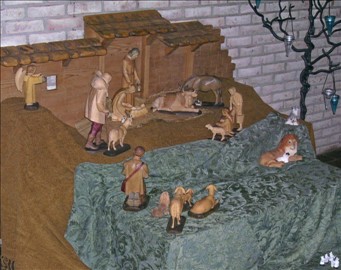 The celebration of the birth of Jesus is a time to put all political differences aside in glad agreement that this child is born. I wish! I have pointed out many times over the years when preaching on Luke’s nativity story that it puts political issues front and center, forcing us to confront our political realities if we are to confront the Gospel.
 Imaginary Visions of True Peace