 René Girard’s Mimetic Theory has given us many important insights into the roots of human violence, both in the human heart and at the root of civilization. By revealing the entanglements of our desires with the desires of others and the way this entanglement easily and quickly leads to rivalry, even in people of good will, Mimetic Theory places strong demands upon us. Being a scholar and thinker, Girard wasn’t the sort of person to work out practical disciplines that might help us live by his theories, although his overall character as known to me suggests that he lived by his ideals very well. I have heard of one telling moment when he was asked how to live by his theory. René answered that it requires sanctity. There are many saints over the centuries who have taught spiritual practices that help us live with the challenges that Mimetic Theory brings to light.
Girard analyzed the interaction of human desires on a horizontal level where the workings of mimetic desire in a social matrix can be quite claustrophic. Here we can get hemmed in by the pressure of strong desires that either conflict or draw everyone in one direction that usually ends in persecution. It is this scapegoat mechanism committed at this horizontal level that is the basis of civilization. Given the mendacity that civilization so established requires, civilization has been built on lies since the beginning. This suggests that relief can only come from outside the system, from a desire vertical to the horizontal matrix. The question is, how do we tap into a vertical reality that rises above human mimetic rivalry and offers us an alternative to it?
Of the many disciplines that have been developed in the world’s wisdom traditions that help us tune in to reality outside the human mimetic system, I wish to focus on meditation, known as contemplative prayer or centering prayer in the Christian tradition. One of the earliest and most developed contemplative traditions arose within Hinduism by the sages whose teaching were recorded in the Upanishads. It is surely no coincidence that this withdrawal into meditation was accompanied by questioning and sometimes rejecting Vedic sacrificial rituals. Out of Hinduism, Buddhism arose, a tradition in which meditative practices remain fundamental. Buddhists treatises on meditation often show deep insight into the working of mimetic desire and the need to escape its violent aspects.
There seems to be a contemplative element to much ancient Greek philosophy but I haven’t found much in the way of contemplative practices there except perhaps the Pythagorean community, for which information is scanty. Judaism also produced little in this regard but the many references to meditating on God’s Torah, especially in Psalm 119, suggest that the study of Torah may have included a meditative aspect.
By the fourth Christian century, monasticism had become a highly organized institution. The earliest monastic literature of pioneers such as Anthony of Egypt and Pachomius refer to free-lance ascetics who initiated them into contemplative practices., suggesting that practitioners of contemplation go back to Christianity’s earliest years. The many challenges in Jesus’ teachings involving self-knowledge and self-discipline, especially the Sermon on the Mount, were enough to drive many people into the desert just as Jesus himself was driven out into the desert to prepare for his public ministry. The Beatitude “Blessed are the pure of heart for they shall see God” was among the most meditated on verses in all scripture in this early monastic movement. There are many ways this beatitude can be understood, but surely one of them is that the less a person is affected by rivalrous mimetic desire and the more attuned to the non-rivalrous model of Jesus’s Desire, the more pure of heart one is.
Contemplative prayer did not develop in Christianity as an antidote to mimetic rivalry. The purpose of contemplative prayer is to reach union with God through Christ under the inspiration of the Holy Spirit. Even so, the more we learn of mimetic desire, the more we realize that union with God through Christ in the Holy Spirit is a powerful means of withdrawing from mimetic rivalry and developing habits of the heart that foster nurturing other people.
Among the differences in contemplative disciplines in various traditions, there are many similarities. The greatest of these is that the nuts and bolts of contemplative prayer, if you will excuse such a mechanical image, seem to be roughly the same across the board. In these traditions, including that of psychologists who recommend meditation for the sake of mental health, the primary technique is a gentle focusing of the mind that collects a person and leads to a withdrawal from the inner noise that plagues us most of the time and often fuels mimetic rivalry. Zen Buddhist masters aptly call it the monkey mind. The approach to focusing should always be gentle. When the monkeys in the mind get active, they are irritating and it is tempting to get angry at them and try to swat them away. In this way we easily get caught up in mimetic rivalry with the monkey mind, which is the opposite of meditating. More problematic, when we try to quiet the mind in order to meditate, we often find our minds filled with rivalrous thoughts where every little grudge or slight blows up and takes center stage. It is enough to make us think that trying to meditate makes us more rivalrous than we were before. That is not the case. What is happening is that rivalrous desires and actions that were below our radar have become more visible in the quiet space we are clearing within us. The noise of mimetic rivalry does not like silence so it makes a huge racket to try and draw us back into the fray until we take it for granted once again. As with monkey mind distractions, it is self-defeating to engage in battle with rivalrous thoughts. We must do the opposite: let the racket continue on its own steam without any fuel from ourselves. Of course, it won’t do to try not thinking about whatever distracts us. We must return to whatever focus we are using for our meditation.
It is when we look at how we focus or what we focus on and the world view we bring to contemplative practice, that we see the differences between traditions. A Christian’s primary focus is Jesus Christ crucified and risen as the normative example to follow. Even if a Christian does contemplative practice without images, the Christian is moving inside the example of Christ. The Spiritual Exercises of Ignatius of Loyola use structured meditations that often involve putting one in a Gospel scene, reliving it interiorly, and making a resolution to apply the fruit of the meditation. Much Buddhist meditative practice is without images but within Tibetan Buddhism, many elaborate mandolas have been devised to focus meditation. Whatever examples we have in our traditions, we open our hearts to invite them to enter deeply within us so that their desires can resonate within us.
The type of focus that mainly, or totally eschews images turns up in just about every contemplative tradition but there is usually a means of focusing that is not tied to images. Many Zen practitioners use a koan, Hindus a mantra, Islamic Sufis practice dhikr. Repetitive prayers turn up in the desert monastic tradition in Christianity, with many of these monastics saying a Psalm verse over and over again. The opening verse of Psalm 70: “O God make haste to help me” was a favorite, noted in the writings of John Cassian. The Eastern Orthodox tradition fostered the Jesus prayer which involves repeating the name of Jesus. The anonymous 14th century English classic The Cloud of Unknowing suggests focusing on a prayer word such as “God” or “Love.” Contemporary teachings on centering prayer are deeply indebted to this treatise. Whether a focusing technique begins with images or without, over time, contemplative practice moves beyond images, beyond thought, and sometimes beyond the focusing technique into a state that is paradoxically called both emptiness and fullness. If and when such a state happens, there is nothing to do but just be.
I have used the word tradition many times. That is because the practices I have been talking about have developed in traditions where teachings were handed down from generation to generation. In these traditions, contemplative practices are deeply grounded in scriptures, teachings, and liturgical practice. Contemplative practice is best performed within a tradition accompanied with respect for other traditions. This has become a problem for many people in modern and post-modern times where a sense of tradition is eroding. Sometimes this erosion can be blamed on people desiring to be autonomous, a trait that Mimetic Theory warns us makes us all the more susceptible to mimetic movements in society. Many times, however, it is a result of scandals within the various traditions where trust has been compromised. In any case, awareness of the traditions in which contemplative practices are embedded is important and can be enriching. The more one can participate in an deep tradition, even if marginally, the better.
Contemplation is an exercise in letting go and letting God, to use a phrase made famous by Alcoholics Anonymous. It is worth noting that contemplative meditation is one of the twelves steps of recovery for addiction. In renouncing the monkey mind, we are also practicing the renunciation of mimetic rivalry. This is a practice that can have real effects in our lives as it gives us practice in renouncing mimetic rivalry in our day-to-day encounters. Mimetic Theory teaches that we are connected to everybody through the interaction of our desires. In rivalrous encounters, we are stuck together in rivalry. Contemplation opens us up to all other people through God’s Desire that is outside of the system. This divine Desire invites us to union with all sentient beings through the Desire that set all of Creation into motion at the beginning before the beginning of civilization.
[For a much more detailed discussion of contemplative prayer see Moving and Resting in God’s Desire]

 The widow who put “two small copper coins” in the temple treasury, all she had to live on, (Mk. 12: 42) has been held up by many preachers as a touching example of heart-warming generosity. Those of us who have come to notice the social and economic issues in the Gospels have seen some concerns that are rather chilling.
 The rich man who asked Jesus what he needed to do to inherit eternal life and then walked away grieving when Jesus told him to sell all that he owned (Mk. 10: 21) is a warning to all of us, rich or poor. Jesus’ added warning that it “is easier for a camel to go through the eye of a needle than for someone who is rich to enter the kingdom of God” only makes the warning all the more dire. Paul strengthens the warning further when he tells Timothy that “the love of money is a root of all kinds of evil,” (1 Tim. 6: 10) Bucking these warnings is our formation from earliest childhood that money is both good and necessary and more of it is always better than less.
 Jesus’ insistence that we deny ourselves and take up our crosses and follow him (Mk. 8: 34) jolts us into thinking about what our priorities in life should be. Without being so jolted, we tend to deny other people, take up our favorite pastimes and follow whoever takes our fancy. However, we encounter a serious problem if and when we do take Jesus’ words to heart. We tend to get muddled over what constitutes a “cross” and how we should carry it. Because of this muddle, there is the danger that the cross will be trivialized. Carrying our own crosses is not about being a good sport if we catch the flu.
 Eating is among the most fundamental activities of civilization, perhaps the most fundamental. It is the practice that brings people together to share in nourishment and social nurturing. And yet, throughout the animal kingdom, sustenance requires feeding on other living beings. Sometimes it is other animals, sometime plants. That is, a group bonding through eating inevitably bonds at the expense of other living beings.
 I was introduced to the Transfiguration of Our Lord when Raphael’s great painting of the event hit me between the eyes during my student travels in Rome. With the Feast of the Transfiguration coming during my church’s summer slump (and it wouldn’t have celebrated the feast anyway) I knew nothing about it. In many ways, I didn’t have to. The painting opened up a vision of a transfiguration of humanity beyond what I had thought possible. At the time, what faith I had wasn’t centered around any particular religious viewpoint but I was majoring in religion because I thought the subject dealt with the most important things in life. Seeing the painting was more of a religious awakening than I knew. I was, of course, impressed by the sublimity of the upper half of the canvas where Jesus is floating in the air with Moses and Elijah. But I was even more impressed by the inroads the transfigured light made into the lower half which is often interpreted as indicating sinful and benighted humanity. It has taken me years to see further into the significance of this chiaroscuro effect.
 For Proper 11 in Year B, the year of Mark, the Gospel has only two snippets. The first has Jesus taking his disciples to a deserted place only to be followed by crowds of people. Jesus has compassion on them “because they were like sheep without a shepherd.” (Mk. 6: 34) This reference to shepherding echoes the reading from Jeremiah where the prophet rails against the shepherds who destroy and scatter God’s sheep. (Jer. 23: 1) The other snippet comes at the end of chapter 6 where Jesus heals many people who are being brought to him.
 In the readings from Job and Mark huge storms break out. Storms are chaotic, but they follow the laws of nature, curiously now called “chaos science.” Just before the stormy voyage on the Sea of Galilee, Jesus had pointed out that plants grow from seeds by the laws of nature and that the Kingdom of God is like this natural growth. But what does the storm at sea have to do with the Kingdom of God? Since it is also by the laws of nature that storms destroy crops, are there storms that can blow away the Kingdom of God? The frightened disciples in the boat seem to have thought so and they feared that Jesus didn’t even care about it. Out of the whirlwind God says a lot about throwing oceans around but doesn’t say anything about caring for Job’s excruciating sufferings. Being a puny being in a vast universe doesn’t cheer up a suffering person.
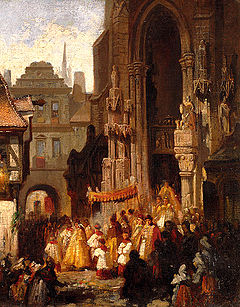 The Feast of Corpus Christi celebrates the presence of Christ’s body in the Eucharistic host. One of the events that inspired the institution of the feast was a vision granted Fr. Peter of Prague in 1263. He had doubted the presence of Christ in the sacrament until he had a vision of blood dripping from the host as he consecrated it. This vision, along with earlier visions of St. Juliana of Mont Cornillon, led Pope Urban IV to order the institution of this feast. Of other Eucharistic visions I’ve heard of, it is better to be silent rather than ruin today’s celebration.
 The Trinity is a fundamental doctrine for Christianity but Christianity is a story of salvation before it is a set of doctrines. The Trinity is no exception. If we get the story right, we might get the doctrine right, but if we get the story wrong, then we get the doctrine wrong for sure.
 Imaginary Visions of True Peace