

Jesus’ words about cutting off hands and feet and plucking out eyes in order to avoid unquenchable fire are pretty grim and can leave us feeling traumatized. (Mk. 9: 43–48) It is enough to make a preacher look for ways to make everybody feel better. For starters, I think I can safely say that this business of cutting off hands and feet and plucking out eyes is hyperbole and Jesus doesn’t expect or want us to do any such things. Even so, even if we take these words metaphorically, they are clearly metaphorical about giving up something that feels like a part of us, so we aren’t in for a free ride by any means.
Why the talk about stumbling blocks that lead to sin and the drastic solution of dismemberment? The French thinker René Girard is helpful for understanding what a stumbling-block is all about. The Greek word is skandalon. It refers to offense, scandalizing other people by our conduct or our words. In the preceding verses read as last Sunday’s Gospel, the disciples had argued about who was the greatest. Jesus then put a child among them and told them to become like this little child. (Mk. 9: 33–37) At the beginning of today’s reading, the disciples are complaining about somebody casting out demons in Jesus’ name, another example of arguing about who is the greatest, as they see this exorcist as a competitor while Jesus sees him as somebody else doing what needs to be done. (Mk. 9: 38–40) Girard suggested that when people become rivals, they become stumbling blocks to one another. They become entangled with one another, tripping and falling over each other. Children, such as the child Jesus placed among the contentious disciples, are very vulnerable to such a competitive environment in many ways. If they feel they have to compete to get attention in order to have their needs met, they copy the behavior that is modeled to them. More tragically, children are often “collateral damage” in the conflicts waged by their elders, whether it is in the family or large-scale warfare. A society permeated by people arguing and fighting about who is the greatest is hellish. It is a fire that never goes out. So we don’t have to think in terms of an afterlife, but it is worth mentioning that there can be no such rivalry in heaven so we do have to give it up if we are going to find heaven heavenly. Besides, the word translated as “hell” is Gehenna. Far from referring to the afterlife, Gehenna refers to a valley outside Jerusalem that Jeremiah and other prophets said was used for child sacrifice. (Jer. 19: 2–5) This image is most apt for the vulnerability of the “little ones” or “the least of these.” This term does not necessarily refer to children, although because Jesus had recently placed a child among the disciples, it is easy to think that. There is no question, however, that Jesus is referring to all vulnerable people, which certainly includes children.
These considerations would suggest that we need to cut off our rivalrous desires and throw them away so as to avoid the hell of rivalrous contention. The trouble is, we can’t really cut off our desires and throw them away. We are still human if we have one hand or one foot or one eye, but we aren’t human if we don’t have desires. And it isn’t that we have some bad desires we can throw away and some good desires that are keepers. We have desire. Period. So it isn’t a case of cutting off desire but directing it and, when necessary, redirecting it. Such redirection can feel like an amputation for those of us who are addicted to fighting over whether we are the greatest. We have a simple but powerful example of redirecting desire away from rivalry towards charity in the words sandwiched by the apostles’ complaint about the “unauthorized” exorcist and the exhortations to cut off hands and feet if they cause us to stumble. Here Jesus urges us to give a cup of cold water to anyone who bears the name of Christ. (Mk. 9: 41) Such redirection leaves us vulnerable to those who continue to play the hellish game, but Jesus has told us that the kingdom is about being among the least of all people, the most vulnerable. The more we are in touch with our own vulnerability, the more sympathy we have for the vulnerability of others, including the vulnerability of those who try to hide their vulnerability through rivalry. We need these cups of cold water to put out the fires.
 Easter is an occasion of great rejoicing with bells, boisterous singing, and feasting. But do we really know what we are celebrating? The Gospel reading, doesn’t exactly ring out with Christmas joy of angels filling the skies with songs of God’s glory. Instead, we get “two men in dazzling clothes” who tell the women who came to the grave to anoint Jesus’ body that Jesus was not there but had risen. They had come to the wrong place.
 When Jesus opened his teaching ministry, Mark says that the people were “astounded” because he taught them“as one having authority, and not as the scribes.” (Mk. 1: 22) Oddly, Mark doesn’t include anything of what Jesus said. The Greek work exousia is much stronger than the English word that translates it. “Powerful authority” would bring us closer to the meaning. That Jesus’ teaching was not like that of the scribes doesn’t give us much more to go on as to the content, but it indicates that this authoritative teaching was distinct from those who were normally considered the teaching authorities.
 When I last posted a
 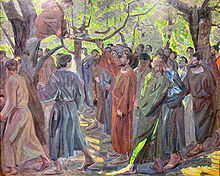 The French thinker René Girard has argued that since the dawn of humanity, we have tended to solve social tensions through persecuting a victim who absorbs these tensions and suffers for them. Girard has also argued that the Gospels unveil the truth of this scapegoating mechanism in their narratives of Jesus’ death and Resurrection where Jesus opens up new possibilities for humanity to gather through the forgiveness of the Risen Victim. It happens that the Gospels show Jesus unveiling these very same dynamics in his earthly ministry. I analyzed our such stories in my book
 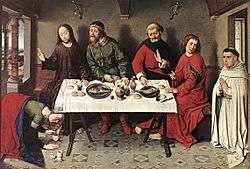 We have a tendency to think of salvation as a personal matter. To some extent it is, but the way salvation is presented in scripture, it is never personal in an individualistic sense. In the case of the famous story of “The Sinful Woman,” we easily focus on the woman whose dramatic action is enough to grab our attention. However, her act is a public drama. Moreover, in very few words, Luke paints the social context of the woman’s behavior. She is a “sinful woman.” We are not told the nature of her sinfulness, so that is not relevant to what we should learn from the story. Simon, Jesus’ host at the dinner, assumes that Jesus should have known that the woman was a sinner and he should not have allowed her to anoint and dry his feet with her hair, actions that further proved the woman’s sinfulness in Simon’s mind. Simon may have been expecting Jesus to have supernatural discernment, but he may have simply expected Jesus to know who had a bad reputation and who didn’t. In any case, it is a social judgment that has labeled this woman as sinful. That is, this woman shows all the signs of being the community scapegoat who helps everybody else feel good about themselves.

 Imaginary Visions of True Peace