

The Parable traditionally known as The Prodigal Son (Lk. 15: 11–32) is obviously a story of estrangement and reconciliation and forgiveness. So clear is this message, there should be no diluting or compromising it with violence, discord, or unforgiveness. However, the United States, a country filled with active churches, has the highest rate of incarceration in the world by a large margin. On top of that, we are seeing a spirit of vengeance in politics that seems to keep on growing. Does this parable’s meaning just disappear at the church door on the way out to the “real” world? A lawyer, Preston Shipp, author of Confessions of a Former-Prosecutor is an example of this disconnect. While raised in the church, he dreamed of being a prosecuting attorney from a fairly young age to protect society from the bad guys who victimized the good people. For many years, he fulfilled this dream by working at the state attorney’s office in Nashville. All this time, Jesus’ parable was in a totally alien universe, to judge by his own account. So, somehow, the simple and clear message of the parable is extraordinarily difficult to hear and believe in and act out in life. Why is this? Does the Parable itself give us insights into these difficulties? Let us take a look for ourselves with the help of Preston Shipp.
The elder brother’s relationship with his younger brother is not brotherly, although I suppose a cynic might say that’s what brotherhood is. Given the outrageous way the younger brother left home (demanding, not requesting his half of the inheritance) there are understandable reasons for this attitude. In any case, the elder brother’s calling his younger brother “that son of yours” in speaking with his father, suggests a highly depersonalized relationship with his brother. Preston Shipp writes about how he realized that the justice system is designed to prevent a prosecutor from having any personal awareness of the person he was prosecuting, let alone a relationship. This changed when a professor he had in college asked him to teach some law classes for college credit in a woman’s prison. This experience of bonding with incarcerated persons lead him to leave the prosecutor’s office. He now works for the Campaign for the Fair Sentencing of Youth. Clearly, the way we manage relationships has a lot to do with how forgiving, or not, we might be. The second time Preston taught a course, he was highly impressed by a woman named Cyntoia Brown. She was underage when convicted of murder, but was sentenced as an adult. As he learned of her exposure to sex trafficking from an early age and other factors, he saw a person in a way that a prosecuting attorney is not encouraged to see a defendant. Imagine his shock when he received a copy of a court document he had filed while still working as a prosecutor, showing that he himself had rejected her appeal of a 51-year sentence and had never recollected it after meeting her in class.
Although the elder son is dutiful in the sense of staying home and working on his father’s farm, the way he berates his father for receiving his younger brother suggests he has little love for the work or for his father. Serious dissatisfaction with one’s work and family situation can harden the heart and make one less inclined to forgive. However, when the father tells the elder brother that everything he has, his elder son also has, we gain the suspicion that perhaps the elder brother was surrounded with blessings, like fattened calves, that he did not see or appreciate. Such lack of appreciation also dampens a sense of forgiveness of other people. The elder brother may have stayed with his father geographically, but his mind and heart seem to have been miles away.
The trauma of abuse or violent crime can make it difficult for the victim to forgive. Preston Shipp encountered many such crimes and knows what they cost the victims, although he also realized that the justice system did nothing to assist such victims except to feed any vengeance they might have. There is nothing in the parable to suggest that the elder brother had suffered any such trauma. The father, on the other hand, was surely traumatized by his younger son’s departure, and yet he welcomed him back with open arms. Cyntoia Brown was traumatized when she saw that her appeal had been denied and that Preston Shipp had been the one who reviewed it and rejected it. Preston expected to be skewered by her when he came to the next class, but he found her deeply forgiving, in spite of her hurt. This particular story has a happy ending in that, with the help of some celebrities taking up her cause which brought her into the public eye, Cyntoia was finally released from prison and has become an activist for many social causes, hoping to prevent what happened to her from happening to other people.
Shipp explains in many ways how vengeance is systemic in our judicial system and throughout our country’s cultural system. This system of vengeance is greatly exacerbated by systemic racism that has characterized American culture since colonial times and continues unabated to the present day. Racism, of course, entails much depersonalization of the other. More important, participation in such as system skews our perception of reality where many things taken for granted shouldn’t be. Will we ever bottom out of this collective sin the way the younger brother bottomed out of his sensual sins? On the other hand, this parable depicts a party being celebrated by an entire household, except for the elder brother. We can take this party as an image of a society transformed by forgiveness and reconciliation, an eschatological vision, we might say. Surely this party is an image of God, in Christ, “reconciling the world to himself.” (1 Cor. 19) Does this image attract us in any way, enough for us to desire to enter into it? Or are we more attracted to a society governed by the elder brother as he berates his father for such a celebration?
.When the father says to his elder son that the younger son had been dead and has come to life, (Lk. 15: 32) the story shifts to the Paschal Mystery. Such radical forgiveness makes one vulnerable, as the father was vulnerable. Who would want to be treated as the younger son treated his father? Who would want to be treated the way the older son treated his father? It is sobering to recall that the person who told this beautiful and edifying story was crucified as a criminal. Can we trust that this victim is risen and is still inviting us to the party?



 Right after dramatically recalling God’s deliverance of the Jews from the Red Sea, Isaiah proclaims that God is “about to do a new thing; now it springs forth, do you not perceive it?” (Is. 43: 19) By his time, the Red Sea deliverance was an old thing, something the Jews repeatedly recalled, especially at the celebration of Passover. But at the time of that deliverance, it was a new thing that had sprung forth. Delivering escaped slaves through turbulent waters just wasn’t in the play books of deities at the time. God had changed the play book and revealed the hitherto unknown truth that God is a God who delivers victims and outcasts from the rich and the powerful.
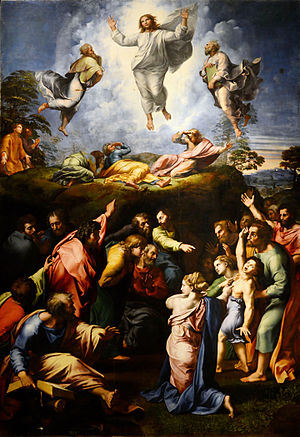 I was introduced to the Transfiguration of Our Lord when Raphael’s great painting of the event hit me between the eyes during my student travels in Rome. With the Feast of the Transfiguration coming during my church’s summer slump (and it wouldn’t have celebrated the feast anyway) I knew nothing about it. In many ways, I didn’t have to. The painting opened up a vision of a transfiguration of humanity beyond what I had thought possible. At the time, what faith I had wasn’t centered around any particular religious viewpoint but I was majoring in religion because I thought the subject dealt with the most important things in life. Seeing the painting was more of a religious awakening than I knew. I was, of course, impressed by the sublimity of the upper half of the canvas where Jesus is floating in the air with Moses and Elijah. But I was even more impressed by the inroads the transfigured light made into the lower half which is often interpreted as indicating sinful and benighted humanity. It has taken me years to see further into the significance of this chiaroscuro effect.
 Imaginary Visions of True Peace