A Cup of Cold Water

Jesus’ words about cutting off hands and feet and plucking out eyes in order to avoid unquenchable fire are pretty grim and can leave us feeling traumatized. (Mk. 9: 43–48) It is enough to make a preacher look for ways to make everybody feel better. For starters, I think I can safely say that this business of cutting off hands and feet and plucking out eyes is hyperbole and Jesus doesn’t expect or want us to do any such things. Even so, even if we take these words metaphorically, they are clearly metaphorical about giving up something that feels like a part of us, so we aren’t in for a free ride by any means.

Why the talk about stumbling blocks that lead to sin and the drastic solution of dismemberment? The French thinker René Girard is helpful for understanding what a stumbling-block is all about. The Greek word is skandalon. It refers to offense, scandalizing other people by our conduct or our words. In the preceding verses read as last Sunday’s Gospel, the disciples had argued about who was the greatest. Jesus then put a child among them and told them to become like this little child. (Mk. 9: 33–37) At the beginning of today’s reading, the disciples are complaining about somebody casting out demons in Jesus’ name, another example of arguing about who is the greatest, as they see this exorcist as a competitor while Jesus sees him as somebody else doing what needs to be done. (Mk. 9: 38–40) Girard suggested that when people become rivals, they become stumbling blocks to one another. They become entangled with one another, tripping and falling over each other. Children, such as the child Jesus placed among the contentious disciples, are very vulnerable to such a competitive environment in many ways. If they feel they have to compete to get attention in order to have their needs met, they copy the behavior that is modeled to them. More tragically, children are often “collateral damage” in the conflicts waged by their elders, whether it is in the family or large-scale warfare. A society permeated by people arguing and fighting about who is the greatest is hellish. It is a fire that never goes out. So we don’t have to think in terms of an afterlife, but it is worth mentioning that there can be no such rivalry in heaven so we do have to give it up if we are going to find heaven heavenly. Besides, the word translated as “hell” is Gehenna. Far from referring to the afterlife, Gehenna refers to a valley outside Jerusalem that Jeremiah and other prophets said was used for child sacrifice. (Jer. 19: 2–5) This image is most apt for the vulnerability of the “little ones” or “the least of these.” This term does not necessarily refer to children, although because Jesus had recently placed a child among the disciples, it is easy to think that. There is no question, however, that Jesus is referring to all vulnerable people, which certainly includes children.

These considerations would suggest that we need to cut off our rivalrous desires and throw them away so as to avoid the hell of rivalrous contention. The trouble is, we can’t really cut off our desires and throw them away. We are still human if we have one hand or one foot or one eye, but we aren’t human if we don’t have desires. And it isn’t that we have some bad desires we can throw away and some good desires that are keepers. We have desire. Period. So it isn’t a case of cutting off desire but directing it and, when necessary, redirecting it. Such redirection can feel like an amputation for those of us who are addicted to fighting over whether we are the greatest. We have a simple but powerful example of redirecting desire away from rivalry towards charity in the words sandwiched by the apostles’ complaint about the “unauthorized” exorcist and the exhortations to cut off hands and feet if they cause us to stumble. Here Jesus urges us to give a cup of cold water to anyone who bears the name of Christ. (Mk. 9: 41) Such redirection leaves us vulnerable to those who continue to play the hellish game, but Jesus has told us that the kingdom is about being among the least of all people, the most vulnerable. The more we are in touch with our own vulnerability, the more sympathy we have for the vulnerability of others, including the vulnerability of those who try to hide their vulnerability through rivalry. We need these cups of cold water to put out the fires.


On Vigilance

Jesus sternly admonished his disciples to listen when he said: “There is nothing outside a person that by going in can defile, but the things that come out are what defile.” (Mk. 7: 15) Surely Jesus wants us to sit up and take notice and think about this. We often worry about what we take into ourselves and there are good reasons for that. After all, there are foods that really are bad for us and there is much in the media that is also bad for us. In the broader conversation in this chapter in Mark, Jesus is calling attention to the ways we let certain externalities of observance distract us from inner and weightier matters. With the long history of censorship in many cultures, Jesus’ words raise the question of whether a preoccupation with what one reads or hears, although worthy of concern, doesn’t also distract one from the truth that is within. If the French thinker René Girard is right about the ongoing influence of the desires of other people on each one of us, then we are indeed ingesting much from our environment, some of it good, but some of it not so good. It’s hard enough to censor books; it is impossible to censor the impact of other peoples’s desires on each of us.

Jesus draws our attention away from what we take into ourselves to what we actually find within ourselves. What do we find there that might come out of us? Jesus says that it is from within the heart “that evil intentions come: fornication, theft, murder, adultery, avarice, wickedness, deceit, licentiousness, envy, slander, pride, folly.” (Mk. 7: 21-22) Most of us feel defiled when we find such things within ourselves, but Jesus is telling us that we aren’t defiled by the avarice and wickedness within unless we let it out. Then and only then are we defiled by these things. Did these things, or at least some of them, come from without? Maybe. Girard’s notion that we resonate with the desires of other people suggests that is likely the case. But that is not the issue. The question isn’t where these evil thoughts come from, but what we do with them.

In his Epistle, James applies these words that he himself heard straight from Jesus. The anger that we find within ourselves “does not produce God’s righteousness.” (James 1: 20) We should rid ourselves of the “sordidness and rank growth of wickedness, and welcome with meekness the implanted word that has the power to save your souls.” (James 1: 21) Because he heard the words of Jesus and planted them in his heart, James finds other, more positive things within that he can bring out instead of the wickedness inside. If we take in many dysfunctional desires from other people, it makes sense that we would also take in many noble desires as well, such as a desire to pull an ox or a child from a pit, or give a loaf of bread or fish instead of a stone. There are many other good things that can come out of us that make us and others good and holy. All the more reason to consider carefully what we say and do that other people will take in.

These reflections call to mind one of the most important ascetical practices of the early monastic movement: watchfulness, vigilance, the examination of thoughts. It was said of one desert monastic that he would examine his thoughts for an hour before going off to the Sunday worship gathering. Surely this practice was inspired by scripture passages such as this chapter in Mark. As Jesus’ warning suggests, this practice can be unpleasant, humbling, humiliating. But seeing what is within through watchfulness turns out to be a good way to keep what we see from coming out of us. One of the more puzzling stories from the desert movement is about a monastic who tells a troubled disciple that if he is not thinking of fornication, it means he is doing it. These words seem counter-intuitive and absurd, but this chapter in Mark gives us cause to think again. What if we don’t examine our thoughts to see what is within us? For one thing, we project what is within on others and demonize others for what is actually within us. For another, when we don’t examine that which is within us, these very thoughts can escape much more easily and we don’t even realize it because we are busy blaming other people for what we are doing without knowing it. Moses the Black, one of the most famous of the desert monastics, was asked to come to judge a delinquent monastic. He carried a leaky basket full of sand behind his back to the gathering. When questioned, he said that his sins were likewise falling behind him where he could not see them, and he was supposed to judge another. So it is that Moses the Black would counsel us, like Jesus, to remove the beam in my own eye before trying to remove a speck from the eye of another.

On Being a Mustard Shrub

The Parable of the Mustard Seed is one of the most famous parables of Jesus, one that gives us hope that a small beginning can have an impressive ending, or so we think. This notion of an impressive ending comes from the versions of this parable in Matthew and Luke. ((Mt. 13: 31–32; Lk. 13: 18–19) There, the mustard seed grows into a tree, although Matthew does call it a shrub that turns into a tree. Mark, most likely the earliest version, and closest to Jesus, simply says that the mustard seed grows into the “greatest of all shrubs.” (Mk. 4: 3-32) A shrub, even a sizeable one, doesn’t seem so impressive, especially when we realize that mustard shrubs were considered intrusive weeds in Jesus’ time. What is Jesus getting at? We can get a lot of help by looking at some contexts for the parable.

This parable seems almost certainly to be inspired by a similar parable in Ezekiel: “This is what the Sovereign Lord says: I myself will take a shoot from the very top of a cedar and plant it; I will break off a tender sprig from its topmost shoots and plant it on a high and lofty mountain. On the mountain heights of Israel I will plant it; it will produce branches and bear fruit and become a splendid cedar. Birds of every kind will nest in it; they will find shelter in the shade of its branches. (Ezek. 17: 22-23) With the prophet, we have Yahweh taking something small, a twig, and making something great and impressive out of it: a tree on a mountaintop that shelters birds. So it is easy to see why later versions of Jesus’ parable would move in this direction. But in Mark, the seed is smaller and less impressive than a twig, and the mustard shrub is much less impressive than the splendid cedar. Moreover, cedars are cultivated for their wood; mustard shrubs are weeds. A triumphalist vision in Ezekiel has been downsized quite a bit by Jesus. So again, what is Jesus getting at?

In Mark, the Parable of the Mustard Seed is immediately preceded by The Parable of the Growing Seed where, after seed is scattered on the ground, “the earth produces of itself, first the stalk, then the head, then the full grain in the head.” (Mk. 4: 26-29) In this parable, the growth seems natural, something that happens by itself. We sense the mystery of God’s creation that brings plants into being and makes them grow. The mustard shrub also grows naturally, but it is an intrusion that is planted intentionally, perhaps an image of the intrusiveness of God’s kingdom. And yet the mustard shrub is also an image of welcoming, a place for birds to build their nests, an image of inclusiveness from what we might call an outcast plant.

The two parables of plant growth are preceded by a more elaborate parable with much the same imagery: the Parable of the Sower. Although analogies of natural growth are there, the emphasis is on failure. Most of the seeds fall on rocky soil or among thorns or on the roadside and bear no fruit. This parable coincides with the disciples’ first signs of failure; they do not understand the parable. As the Gospel progresses, the failures of the disciples increase, culminating in the desertion at Gethsemane, Peter’s denials, and then the women running from the empty tomb, saying nothing to nobody. The seed falling on paths, rocky ground, or thorns looks like the disciples. We don’t even have a mustard shrub; we only have scattered seeds that don’t grow at all.

But God can create out of nothing. God did this in the beginning, and God does it again after Jesus’ Resurrection. (Note that the first word of Mark’s Gospel is arche, beginning.) And St. Paul says that, in Christ, “the new creation has come.” (2 Cor. 5: 17) In Jesus’ parables, what little seed did fall on good soil yielded thirty, sixty or a hundredfold. The mustard shrub was just enough for the birds of the air to come and make their nests. How did even this much come from such massive failure? We have a hint at the New Creation when, in the face of the disciples’ failures to accept his coming death, Jesus tells his disciples that they will be handed over to councils and beaten in synagogues and will stand before governors and kings because him. (Mk. 13: 9) This prophecy leaps out of the frame of the Gospel narrative to the witness of the apostles recorded in Acts. The Parable of the Mustard Seed leaps even further out of the frame. In the face of our human failure, there will still be an intrusive, unimpressive kingdom that most people don’t want, a kingdom like a shrub which opens its branches to God’s people to further, with Paul, Christ’s ministry of reconciliation. (2 Cor. 5: 18)

See also Sowing Parables in our Hearts

Unfinished Story

We all like a story that ends happily with the loose ends tied together in satisfying ways. It makes us feel good, especially if the good guys had to overcome the machinations of the bad guys and the bad guys got what they deserved. Likewise, a symphony that ends triumphantly raises our spirits. The only thing wrong with these things is that real life isn’t like that. Yes, there are happy and satisfying moments and what we might call mini-happy endings, but happily ever after isn’t a sure thing, as Sondheim showed in his musical Into the Woods where we see just how grim the ever after can be. (Among many other things, Cinderella’s marriage with Prince Charming is on the rocks.) These thoughts suggest that the feel-good happy endings are illusory. The hard reality of real life can feel all the harder for it. A more positive way to look at it is to take the happy endings eschatologically. In God’s good time, everything really will be worked out. There is much comfort in this hope and it is fundamental to the Christian vision, but sometimes we need more direct and realistic encouragement and hope along the way. Sometimes an ending to a story that doesn’t resolve everything or even anything, or a symphony that ends with chords that hang in the ear, is actually more comforting (The sixth and ninth symphonies of Ralph Vaughan Williams are good examples of this.)

Easter Sunday tends to be celebrated as the ultimate happy ending. Yes, Jesus suffered a horrible death, but he came through alive and well and happy and the gates of eternal life have been opened to everybody. But with a lectionary that gives us Mark’s Resurrection story every three years, we get something very different. It ends with a group of frightened women running away from the empty tomb in spite of the angel’s announcement of Jesus’ Resurrection. All this after a totally bleak account of a god-forsaken Christ dying on the cross. What kind of happy ending is this? From the earliest Christian centuries to the present day many have had trouble believing Mark would end his Gospel this way. That is why there are a couple of additions clumsily attached to the end that don’t even remotely match the style of Mark’s writing and outlook.

For those of us who feel better with a happy ending, Mark is a real downer. But the advantage of an unresolved ending is that it can give us pause to think about some things we might not think about if blinded by a happy ending. The frightened women running from the empty tomb make it clear that the strife indeed isn’t over and the battle isn’t done as many horrifying current events make clear. The women thought they would anoint the dead body of Jesus, but that didn’t happen. Ending the Gospel with the women anointing the body to match the anointing of Jesus’ head at the house of Simon the Leper just before the passion would have been a satisfying bittersweet ending. But we don’t ever get that. So what hope do we get from the frightened women?

For one thing, a big thing, if we don’t really know what to make of the Resurrection, if we aren’t sure what it really means for our lives, we can take heart from these women who also didn’t know what to make of it. If we feel flat-footed and flat-brained about the Resurrection, these women in their awkward, frightened flight were obviously flat-footed and flat-brained themselves. This can give us space to ask ourselves what it really does mean that Jesus is risen from the dead. How do we live with a Jesus who died but who isn’t dead after all and is very much alive here and now? When we ask ourselves these questions, the answers are hardly obvious and we are then in a position to let the questions linger rather than prematurely clutching at a fully resolved happy ending.

Mulling over these questions can help us notice that the other Gospels also leave unresolved cracks in their narrations of the Resurrection. In Matthew and Luke, where the women are reported to have told the other disciples about the empty tomb and the angel’s message, the disciples think the women are out of their minds. Nobody seems to recognize Jesus at first when he appears. Why? The moving story of the journey to Emmaus is especially illuminating. The two disciples on the road are downcast, not the least cheered up by the rumors of what the women had said. But at least they are asking questions and this gives Jesus the opportunity to lead them into further insight as to what has happened. The story of Jesus becoming recognizable in the breaking of the bread and then disappearing leaves us hanging, but it leaves room for more to come. These disciples who listened to Jesus as he opened the scriptures to them have much more to learn and to look forward to, even if they don’t know what all of it is.

The ending in Mark is so abrupt because it isn’t really the end. It is the beginning. Galilee is where the story began. The disciples are told to go back and make a new start and we are told to do the same. The obtuseness and cowardice of the disciples throughout the Gospel aren’t the last word after all. Jesus isn’t finished with them and he isn’t finished with us either. Forgiveness is sneaking in right when we weren’t expecting it. With the stage cleared of Jesus, the disciples, the women, we are all that is left with the angel to prod us on. This Gospel is our story now and it will never have an end any more than the Risen Christ has an end. Will we return to the beginning of the story and live it ourselves? Let us sit quietly with the risen Christ with all our puzzlement and disorientation and prayerfully let the Risen Lord fill our hearts and minds with the Risen Life.

Called to Repent

The calling of Jesus’ first four apostles in Mark is inspiring but it doesn’t make a lot of sense when we think about it. A complete stranger calls four complete strangers and they drop everything and follow him. (Mk. 1: 16–20) We can soften the improbability by noting that it is possible, even likely, that Jesus and these four men had sone acquaintance beforehand. but–let’s face it—answering a call from someone like Jesus just doesn’t make sense except maybe to the person who actually receives the call, and even then, the call tends to be a lot more compelling than sensible. At l east that’s what I still how I feel about my call to the monastic life. After all, a call from God tends to be disruptive to the life one has been living such as being a fisher on the shores of Lake Galilee. Does this call have anything to do with us?

We might try to distance ourselves from this calling by thinking that the apostles were exceptional people, but Mark and the other evangelists stress the ordinariness of the people called by Jesus. It’s professional religious people like ministers and monastics who should feel out of place with those first called. This ordinariness raises the suspicion that God, as Creator, calls everybody whom God has made. Such a call, then, is the norm, not an exception. This supposition is confirmed when St. Paul designates those called by God as members of an ekklesia, a word that means: “Those called out.” So all of us are called and the call makes no sense unless we accept that we are grounded in God as our creator, in which case God’s calling makes perfect, divine, sense. What else is involved with God’s calling of us?.

Jesus’ call of the four fishers follows straight upon Jesus call for repentance because the kingdom of God has come near. (Mk. 1: 15) What do we repent from? From fishing? Nothing wrong with that. As one who loves fish and seafood, I wouldn’t want all fishers to stop their work. Mark says that Jesus’ preaching began right after John had been put into prison. So persecuting prophets like John the Baptist is something we might want to repent of. But what if we are peaceful people who don’t persecute prophets, or think we don’t? In the Book of Jonah, the prophet calls on the Ninevites to repent—and they do! Since they were a violent society, one that had attacked Israel and destroyed the Northern kingdom, they had a lot of violence to repent of. But what if we aren’t invading other peoples’ countries? Jonah’s call for the Ninevites’s repentance circles back to Israel and the rest of us in a couple of ways. If Nineveh can repent surely Israel can repent; we can repent. More to the point, since Ninevites were violent enemies to Israel, who wants them to repent and become God’s people like us? Jonah didn’t want them. The call to witness to and welcome such strangers gets to the nub of what repentance is all about. It can be pretty disruptive to what we’re used to.

In his First Epistle to the Corinthians, Paul offers some cryptic directions for how we might repent: “those who have wives should live as if they do not; those who mourn, as if they did not; those who are happy, as if they were not; those who buy something, as if it were not theirs to keep; those who use the things of the world, as if not engrossed in them.” (1 Cor. 7: 29–31) Does this mean we should repent of marriage, shopping, mourning, or being happy? As Paul would say: “Me genoito!”—by no means! We can get some help with this passage by looking at the concept of mimetic desire on the part of the French thinker René Girard. Mimetic desire, as Girard conceives it, is the human tendency to want something, not because I want it but because somebody else wants it. This can lead to peaceful sharing but it can and does lead to violence. In this problematic passage in First Corinthians, Paul is showing his own profound insight into mimetic desire. It is bad enough to want what someone else has got just because that person has it and presumably wants to keep it. This scenario is greatly exacerbated when the person who has something purposely (though sometimes subconsciously) tries to inflame other peoples’ desire for what one has. Dostoevsky understood this problem profoundly. His intensely puzzling novel The Idiot becomes understandable when one realizes how Parfyon Semyonovich Rogozhin is stirring Prince Mjishkin’s desire for Natasha Philppovna in order to vindicate his own desire for her, and Aglaya Ivanova Epanchin, in turn, tries to intensify Natashya’s desire for the Prince, whom she had in hand until she played this game—all of this unfolds with tragic results. Paul would have us steer clear of this pitfall by being detached, not only from what we don’t have, but at least as much from what we do have. This misuse of mimetic desire is what Paul would have us repent of. This sort of detachment transforms the way we experience the world.

As Jesus’ ministry progresses, the disciples don’t look good, and Mark’s portrayal of them is the most negative. Perhaps the most egregious example of the disciples’ obtuseness is the way the disciples fight over who is the greatest in the face of Jesus’ predictions of his upcoming death and resurrection. Such infighting imitates the Ninevites rather than the Lord they are ostensibly following. Constant repentance, then, is needed to help us clarify what following Jesus is all about, and we have to expect it to take time. So let’s not waste any time getting started.

Not One Stone Upon Another

It is one of many signs that Jesus’ disciples still don’t “get it” when they ooh and ah about the beautiful temple that Herod has built. Haven’t they noticed that Jesus doesn’t see Herod as a model ruler? Did they notice that Jesus wrecked havoc in the temple? Did they think about what the gesture might mean? The chief priests most certainly were thinking very hard about it and their thoughts were very hard. If any of the above notions were going through their heads, they might not have been so startled when Jesus predicted that “not one stone will be left here upon another; all will be thrown down.” (Mk. 13: 2)

It is important to realize, as pretty much all biblical scholars have noted, that prophecy is not fortune telling about the future, but is a word of where the present trends are leading unless there is a change of course. For example, many prophets warned that the injustices in their time were destroying the social fabric and were going to lead to a violent end. Throughout his teaching, Jesus gave a threefold set of warnings: 1) Social injustices connected to the temple were unraveling the religious system. (The scribes and Pharisees “devour widows’ houses.” (Mk. 12: 40.) 2) The threat of rebelling against Rome will redound on the Jewish people. 3) The religious leaders and the imperial leaders were on course to commit lethal violence against Jesus, as he warned in the Parable of the Evil Workers in the Vineyard. (Mk. 12: 1–12)

We can see readily enough that the social violence is human violence through and through and it has nothing to do with God. Mark’s Gospel also tells a story of human collective violence directed at one person who is deemed responsible for the social crisis in Judea. If social ills of institutionalized violence and scapegoating are the work of humans and not God, what about the apocalyptic violence in Mark 13? Jesus does mention earthquakes, which are natural disasters and not God’s doing, but mostly Jesus warns of “wars and rumor of wars,” and nations rising against nation. (Mk. 13: 7–8) Once again, we have human acts, only on a grander scale. Here we have Jesus’ warning of the ineluctable results of staging a violent rebellion against Rome. This violence causes social ties to break down to the extent that “brother will betray brother to death, and a father his child, and children will rise against parents and have them put to death.” (Mk. 13: 12) Jesus then warns of being handed over to councils and then standing “before governors and kings.” (Mk. 13: 9) The chaotic violence circles back to collective violence against a few victims. The technical term for religious cataclysmic literature is “apocalypse,” which means unveiling. Many people think that apocalyptic literature reveals God, but actually it reveals the truth of human violence.

In this analysis of violence, I have been greatly helped by the French thinker René Girard who argued that from the dawn of civilization, there has been a tendency of humans to solve social problems by suddenly gaining up on a victim or a small group of victims with lethal results. The peace following each gruesome episode was so dramatic that it was seen as an “act of god.” It is no wonder that societies founded on collective violence would be sustained by ongoing social violence. There is no time to explain Girard’s arguments further, but it is worth noting that all the Gospels end with the story of the collective murder of Jesus while stressing the human action that caused it. Girard also warns us that although the Gospel Story has opened the way to renewing society through concern for previously overlooked victims, it also greases the breaks that collective violence had previously put on social crises with the result that such crises spin out of control with no end in sight. This is precisely what we see going on all around us as I speak.

Although Jesus’ warnings about violence include violence that one might suffer, such as the violence Jesus suffered and his followers would suffer in the future, the warnings mostly concern inflicting violence upon others. That is, he is warning his listeners to refrain from the violence of social injustice, the violence of collective violence against a victim, and the violence of social upheaval that will only escalate violence. There is much fully justified therapeutic concern for victims of violence, but the trauma of committing violence is also severe. In fact, on a spiritual level, it is more devastating. What is so tragic about the trauma of inflicting violence is that so often one thinks that it is violence that reveals God. Jesus is telling us that we need to make a 180-degree turn to see God. An oppressive social order where some people are perpetual victims is not a God-given order. As Matthew 25 show us clearly, God is seen only in the victims of such a social order. Others turn to the social chaos of social upheaval, proclaiming that God is in the violence. But in Mark, Jesus makes it clear that God has nothing to do with the violence. The designated disrupter of the social order is the one believed to be designated by God for death or exile. In Isaiah, the people thought that the “Suffering Servant” was “stricken by God.” (Is. 53: 4) Mark tells us at the end of the Gospel that God is seen in a man dying in agony and despair on a cross. Keeping our attention fixed there will be our only defense before the powerful, which isn’t much of a defense. But it is the only way we can point to God in a world that is falling apart. Any other way will leave us with not one stone left upon another.

For introductory essays on René Girard, see:

Violence and the Kingdom of God

Living Stones in the House of the Forgiving Victim

Living with our Shared Desires

On Not Offending the Vulnerable—Or Anybody Else

Jesus’ suggestions that we cut off a hand or a foot or tear out an eye are so shocking that we are pulled away from the previous verse where Jesus mildly says that “whoever is not against us is for us” and that anyone who gives a cup of water will be rewarded. (Mk. 9: 41) It is worth noting that a great many sayings and parables of Jesus take us out of our comfort zones. This particular hard saying takes the cake, a rock hard bad tasting cake at that. The standard way for a preacher to wriggle out of these hard sayings is to say that they are “hebraisms,” that is to say, hyperboles to get our attention. Maybe so, but let’s allow these verses to get our attention and see where they take us.

We get some help from the broader context of these sayings. Earlier in Mark 9, read as last week’s Gospel, Jesus tells his disciples that he will be “betrayed into human hands” and killed. The disciples respond to this warning by fighting about who is the greatest. Jesus responds to this infighting by putting a child among the disciples and saying that whoever welcomes this child welcomes him and the one who sent him. (Mk. 9: 37)

In this context, we can see that the disciples’ complaint about the person who is not “one of us” casting out demons is a renewal of the competitiveness on the part of the disciples. Casting out demons is something Jesus has told the disciples to do and now this other person is doing it. What’s the problem? Maybe the problem is that the disciples had just failed to exorcize a demon as Jesus was coming down from the mountain and they are jealous. Jesus gently rebukes them for their competitiveness by saying that anyone who is not against him is for him. The disciples aren’t the only show in town. Then Jesus echoes his commendation of the child by saying that whoever offers anyone a cup of water will be rewarded. That is, thinking about the needs of others, especially the most vulnerable, and doing something about it, leaves no room for competition.

Then come the hard sayings. Jesus warns the disciples (and us) about putting stumbling blocks before these little ones: the child in the midst of the disciples, the one who should be given a cup of water. It is precisely the competitive behavior that scandalizes the little ones, leading them to copy the behavior modeled by those larger and more powerful than they. Children playing cowboys and Indians, as in my day, or with GI Joe or Ninja toys more recently, may be cute, but aren’t they mimicking their elders too closely for comfort? When children see their elders fighting over who is the greatest, is it any wonder they do the same? The notion that it is better to be hurled into the sea with a millstone around the neck than to scandalize the little ones should make one think. It is worth noting that throwing people off of cliffs was a popular means of sacrificing. Being willing to cut off a hand or leg or gouge out an eye rather than scandalize a little one is drastic, but it makes it urgent that we sacrifice our competitiveness rather than scandalize the vulnerable. Indeed, lacking a limb or an eye (remember Odin?) causes one to be a “random” victim of sacrifice. Moreover, dismemberment is also a common method of sacrifice. (Remember Prajapati?) Of course, it would be simpler and less drastic to offer a cup of water, but if competitiveness through what René Girard called “mimetic rivalry” is a powerful addiction, as Girard suggested, our hands and feet are too caught up in rivalry to make even so simple a gesture.

This brings us to hell where the worm never dies and the fire never quenched. (Mk. 9: 48) It would indeed be better to have one hand rather than two that burn in hell for all eternity. But that isn’t what Jesus is talking about here. The word he uses is “Gehenna,” which means something different. Some scholars think it was a large garbage dump outside Jerusalem whose flames never stopped smouldering. More to the point, Gehenna was the valley where Jeremiah claimed that children were sacrificed to the pagan deities. It does seem fitting that such a cursed place would be turned into a refuse heap. Gehenna, then, is where our rivalrous battles end: a place where the vulnerable are sacrificed to fuel our battles. Maybe Jesus’ words about cutting off limbs is hyperbole, a set of “hebraisms,” but they are warning us of the consequences of our rivalrous ways. One of the clearest symptoms of mimetic rivalry is the sharp divide between us and them, a divide the contending disciples tried to make between themselves and the other person who exorcized people.

Jesus concludes his teaching by referring to salt. Salt was added to sacrifices by both Jews and Romans, but as in the use of the image in Matthew and Luke, salt refers to an inner quality, perhaps a willingness to sacrifice self rather than others. This willingness to sacrifice self is of great value and losing it would be much worse than losing an arm or a leg. Jesus tells us that the greatest value of the inner salt is to “be at peace with one another.” (Mk. 9: 49) Being at peace allows for offering a cup of water to one who has need of it, and such giving creates more peace. Indeed, Jesus himself gave up much more than a hand or a foot; he gave up his life to deliver us from the Gehenna of our own making.

God’s Kingdom in Two Small Coins

widow's miteThe widow who put “two small copper coins” in the temple treasury, all she had to live on, (Mk. 12: 42) has been held up by many preachers as a touching example of heart-warming generosity. Those of us who have come to notice the social and economic issues in the Gospels have seen some concerns that are rather chilling.

Highly troubling are the preceding verses where Jesus denounces the scribes who “devour widows’ houses.” The scribes of today wear state-of-the-art business suits, sit on prestigious boards, and make a great display of their almsgiving after defrauding vulnerable people with such practices as predatory loans. Although using economic power to defraud the vulnerable is not the same thing as passively receiving a penny from a poor widow, the juxtaposition of these references to widows raises questions. The questions become more worrisome when we recall how the prophets denounced those who oppressed widows and orphans almost every time they spoke out on social issues.

The very next verse on the other side of the story of the widow and her two coins raises even more urgent questions. In response to a disciple’s commenting on the great stones of the temple, Jesus says: “Not one stone will be left here upon another; all will be thrown down.” (Mk. 13: 1) This suggests that the poor widow is giving her last two coins for a bad cause. The Epistle to the Hebrews drives home this point when he says: “Christ did not enter a sanctuary made by human hands, a mere copy of the true one, but he entered into heaven itself, now to appear in the presence of God on our behalf.” (Heb. 9: 24) Jesus himself has become the Temple and there is no need for any other.

Is this poor widow a bad example, then? By no means. This poor widow reminds us of the widow who gave Elijah some of the last grains of meal that she had after which she expected to die with her son. (1 Kings 17: 12) Moreover, the poor widow’s generosity in giving everything she had echoes the story of the rich man who was also asked to give everything but went away sad because of his great wealth. Since giving everything is a sign of the Kingdom of God, the poor widow is a sign of the Kingdom while the rich man who went away sad and the rich who contributed lavishly to the temple treasury are not. On the other hand, the woman who poured a jar of ointment over Jesus’ head (Mk. 14: 3–9) was also giving most, if not all, she had. Another sign of the Kingdom.

The matter of a bad cause reminds us that generosity is required of those who depend on alms. We must be good causes. In a time when many “scribes” of today create charitable scams, it is important to use charity money in a charitable way. I feel this responsibility as a member of a monastic community as I remember where the money we spend comes from.

The Jar of meal from which the widow baked a cake for Elijah did not run out in spite of the long famine. Jesus, who also gave all of himself on the Cross, rose to new life, a new life of endless abundance that the widow who gave two small coins surely shares along with the woman who poured out a jar of oil over Jesus’ head. Will we be signs of God’s Kingdom like these two women?

On Carrying Crosses and Renouncing Them

sideAltarsIcons1Jesus’ insistence that we deny ourselves and take up our crosses and follow him (Mk. 8: 34) jolts us into thinking about what our priorities in life should be. Without being so jolted, we tend to deny other people, take up our favorite pastimes and follow whoever takes our fancy. However, we encounter a serious problem if and when we do take Jesus’ words to heart. We tend to get muddled over what constitutes a “cross” and how we should carry it. Because of this muddle, there is the danger that the cross will be trivialized. Carrying our own crosses is not about being a good sport if we catch the flu.
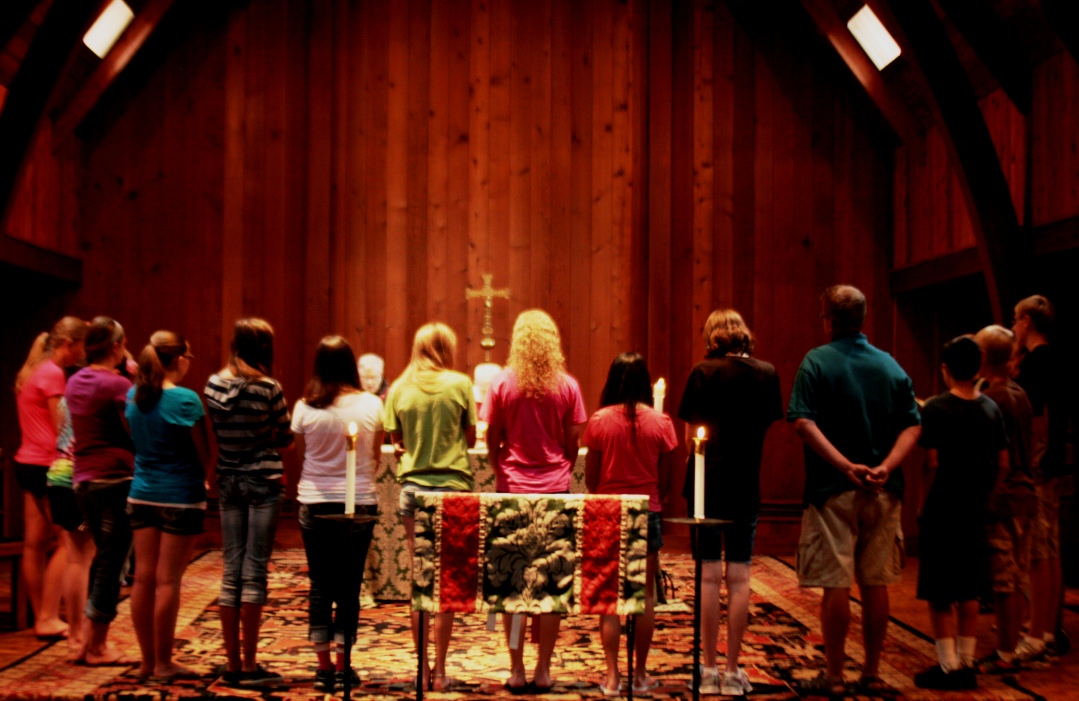
Fundamentally, the cross is about persecution. Jesus is telling his disciples that he expects to be crucified for the way he is confronting the religious and imperial authorities. The Servant in Isaiah was also persecuted by people who smote his back and plucked out his beard. (Is. 50: 6) More importantly, the cross is about not retaliating if one is persecuted, so being patient with Great Aunt Hattie who complains about every act of service is not so trivial. The combination of not retaliating and setting our faces like flint (Is. 50: 7) is precisely what Peter missed when he called Jesus the Messiah. That is why Jesus shut him up.

The biggest problem of waxing eloquently about carrying our crosses is that we overlook the danger, the likelihood, of being crosses for other people. We easily fool ourselves into thinking we are not persecuting others as long as we aren’t pulling beards or driving nails into someone’s hands and feet. But, in his epistle, James shows us how easy it is to be a persecutor. He says that the tongue, small as it is, is a fire that can set a whole forest ablaze and it even “sets on fire the cycle of nature.” (Jas. 3: 5–6) We both bless and curse others with this little member. (Jas. 3: 10) James is warning us how the contagion of collective violence such as that afflicted on Isaiah’s Servant and Jesus can afflict anyone by the agency of anyone through such use of the tongue. Language, the sign of civilization, is compromised from the start by its role in persecution. The more “civilized” we become through writing, the printing press, newspapers, the Internet and Twitter, the more quickly and efficiently peoples’ reputations are destroyed by firestorms set off by the tongue and its extensions the pen and the computer keyboard.

Instead of boasting about carrying crosses, we most need to busy ourselves with relieving others of the crosses we lay on them. Manipulating others into persecuting us to make them feel bad while making us feel good is really another way of persecuting others. As Isaiah’s Servant and Jesus show, crosses can come to us quickly if we speak out against persecution, since that is everybody’s favorite blood sport. Jesus warned the people of his time and us of our persecutory tendencies with his parable of the evil workers in the vineyard. (Mk 12:1-12) and by driving the money changers from the temple whose officials were exploiting the poor. (cf. Mark 12:41-44)

Following Jesus, then, is about both taking up our crosses and renouncing them. We take up our crosses by doing everything we can to stop persecution even if we suffer for it. But before going after other persecutors, we need to take the logs out of our eyes before taking the splinters out of the eyes of others. (Mt. 7: 5) Otherwise, our witness against persecution is likely to turn into persecution of the persecutors. This is why we can only take up the cross if we renounce using it as a weapon but rather use it as a Tree of Life for others.

Storms and Feedings

eucharist1For Proper 11 in Year B, the year of Mark, the Gospel has only two snippets. The first has Jesus taking his disciples to a deserted place only to be followed by crowds of people. Jesus has compassion on them “because they were like sheep without a shepherd.” (Mk. 6: 34) This reference to shepherding echoes the reading from Jeremiah where the prophet rails against the shepherds who destroy and scatter God’s sheep. (Jer. 23: 1) The other snippet comes at the end of chapter 6 where Jesus heals many people who are being brought to him.

Passed over are the Feeding of the Five Thousand and the stormy crossing of the Sea of Galilee where Jesus walks on the water and calms the storm. I can understand why the lectionary compilers made these cuts. There are six narratives of Jesus feeding a multitude in the wilderness in the four Gospels and many stormy crossings of the Sea of Galilee. These repetitions give us a sense of been there done that and there is only so much a preacher can say about them. I’m not going to say all that much about these stories, either. Rather, I’m going to use this week’s scattered Gospel as an opportunity to look a bit at the bigger picture in Mark’s narration.

In his pioneering study of the literary patterns in Mark, the great English theologian Austin Ferrer noted many doublets among other patterns in the Gospel. In Mark 6, we have the first feeding in the wilderness and the second stormy crossing. A second feeding of a crowd in the wilderness takes place at the beginning of chapter 8. Why these doublets? Ferrer notes that the first mass feeding takes place in Jewish territory and the second in Gentile territory. That is, Mark is foreshadowing the union of Jew and Gentile in the Christian missions that take place after Jesus’ death. Given this appearance of peaceful unity, I was startled that Robert Hamerton-Kelly said that these doublets are a multiplication of mimetic doubles that move towards the crucifixion of Jesus. Hamerton-Kelly is applying Girard’s thought to the Gospel where mimetic rivals become mirror images of each other. But when I thought further on the matter, it made sense to me. First, the two feedings happen separately. Jews and Gentiles have not yet been brought together. Second, preceding the first mass feeding is the first stormy crossing of the Sea towards Gentile territory. The second stormy crossing in the same direction occurs before the second mass feeding. The intertwining of stormy crossings with the two feedings suggest that uniting Jew and Gentile does not come easily. The episode with the Syro-Phoenician woman who Jesus curtly tried to dismiss precedes the second feeding, suggesting that Jesus may have had his own struggles in the matter. The disciples, of course, don’t understand the feedings at all.

In Ephesians, Paul writes about the union of Jew and Gentile as a done deal. He writes to the Ephesians that they are “no longer strangers and aliens” but are “members of the household of God.” (Eph, 2: 19) This union sounds easy and peaceful until we note that Jew and Gentile have “been brought near by the blood of Christ.” (Eph. 2: 13) That is, the storm of Jesus’ crucifixion brings the two peoples together. In Mark, along with the other Gospels, we see that the act of crucifying Jesus banded the Jews and Gentiles together for the first time. In Acts, Jews and Gentiles are again brought together through repentance and forgiveness. All this time, Jesus has been gently shepherding two separate flocks into one flock.

What may have looked like a pedantic look at literary structure in Mark actually leads us deeply into the midst of the storms that keep us humans apart from other humans. We live in these tensions as we seek to let the Good Shepherd lead us from far away to near at hand where we will feed each other in one great multitude.