
Jesus’ Escape to the Kingdom

crosswButterfliesThe Ascension is among the most puzzling festivals in the church calendar. The contradictory accounts of the event are a puzzle but one thing the accounts by Luke and John’s Gospel share is to connect Jesus’ departure with his sending the Holy Spirit. Jesus said the Holy Spirit would come to lead them into the truth. What truth did the disciples need that they hadn’t learned already from their teacher? Did Jesus have to leave before the disciples could hear the Holy Spirit?

During his ministry, Jesus warned his disciples three times that “he would be rejected by the elders, the chief priests, and the scribes, and be killed, and after three days rise again.” These warnings came precisely at the times the disciples thought that a Maccabean-like revolution against the Romans was just around the corner: when Peter proclaimed Jesus to be the Messiah, right after the Transfiguration, and when James and John asked if they will sit at Jesus’ right and left in his kingdom.

After his Resurrection, Jesus tried again to get across to the disciples what his kingdom was really all about. When Clopas glumly said that he and his companion had hoped that Jesus “was the one who was to redeem Israel,” Jesus, not yet recognized by them, rebuked them for their slowness of heart in believing what “the prophets have declared.” Then he “interpreted to them all the things about himself in all the scriptures.” Later, Jesus appeared to the twelve and explained that everything written about him in “the law of Moses, the prophets, and the psalms must be fulfilled. “Since the phrase “the Law and the Prophets” was used to refer to the whole Hebrew Bible, the special mention of the psalms is significant. The psalms include many laments over persecution from the standpoint of the victim. Jesus went on to say that when the scriptures say that the Messiah was “to suffer and to rise from the dead on the third day,” it means that “repentance and forgiveness of sins is to be proclaimed” in Jesus’ name to all nations, beginning from Jerusalem. Proclaiming repentance and forgiveness is a very different proposition from starting a revolt to restore the kingdom to Israel.

When, in spite of hearing this teaching for forty days, the disciples asked their Risen Lord: “Is this the time when you are going to restore the kingdom to Israel?” Jesus must have banged his head against the nearest tree and cried out: “I’m out of here!” This repeated question may have convinced Jesus that the disciples were never going to stop asking him to restore kingdom of Israel as long as he was walking on the earth with them. Maybe Jesus was planning all along to leave after forty days; maybe he planned to stick around indefinitely but this question was the last straw.

Jesus’s Ascension put paid to any notion of his leading a second Maccabean-type revolution. The disciples were left with no choice but to try doing what Jesus told them to do when he breathed on them and said: “Receive the Holy Spirit. If you forgive the sins of any, they are forgiven them; if you retain the sins of any, they are retained.” Jesus’ kingdom is to preach repentance and forgiveness to the whole world until everybody has repented, been forgiven, and has forgiven everybody.

How Are We Saved?

yellowTulips1The New Testament and two thousand years of Christian preaching has consistently proclaimed that the death and resurrection of Jesus Christ has opened the way of salvation for all humanity. Precisely how this mysterious, earthshaking event has done that   has raised more questions than answers. It is understandable that the focus would tend to be on the death of Jesus since the event is so dramatic and creates intense emotional effects in Jesus’ followers. However, understandings of the atonement of Jesus through this route have raised long-standing problems that cry out for a fresh approach. The growing realization that the killing of Jesus was just plain wrong on the part of many Christians, and not just those influenced by the thought of René Girard,  opens a way for a re-thinking of atonement theology that can support a deep spirituality grounded in God’s unconditional love for all people. As article I wrote for the Abbey Letter Saved By the Life of Jesus contributes to this re-thinking that actually reclaims the Gospel for us. It is included in the collection of articles in Come Let Us Adore. You can read it here.

A Risen Life Full of Forgiveness and Love

crosswButterfliesHere is my favorite thought experiment: Imagine that everybody around you ganged up on you, leveled incredible accusations against you, and rained savage blows on your body. Your friends either joined in the persecution or slunk away, too afraid to defend you. Your attackers pressed on until they had put you to a most painful death. Imagine further that, miraculously, you found yourself alive three days later. Having already died, you could hardly die again. You have become invincible. What would you do to the people who had mistreated you? How would you approach your cowardly friends?

Perhaps this thought experiment can give us an inkling of how amazing it is that, when this very miracle happened to Jesus, he did not retaliate, but instead, invited everybody to a big whooping party that will never end. After rising from the dead, Jesus continued to do what he was doing before he was killed: gather God’s people in peace by peaceful means only. That is, after his Resurrection, Jesus practiced what he preached in the Sermon on the Mount: return evil with good, hatred with love. The fullness of Jesus ‘forgiving love can be as earth-shattering as an earthquake or as gentle as stepping through a wall.

If Jesus were dead and there was a body in the tomb for the women to anoint, chances are that Jesus’ disciples would either have remained in hiding or they would have reacted to the violent act of the crucifixion with violence. But in Luke the young men in white asked the women: “Why seek the living among the dead?” That is, God did not will the death of Jesus, God willed life for Jesus because that is what God wills for each one of us. As long as we stop at Jesus’ death, we also stop at the grief and anger and that leads to violence. If we move on to the life of Jesus, than there isn’t the same room for grief and anger because Jesus is alive and wants us to be alive in Him.

In short order, Peter passes on the same absence of revenge of Jesus’ persecutors and fullness of forgiving love for them when he tells the people in Jerusalem precisely what they had done, sticking to the bare facts and not adding irrelevant insults the way we usually do in such situations. When Peter’s listeners were “cut to the heart” and asked: “What should we do?” Peter extended the invitation that he and the disciples had received from the Risen Lord: “Repent and be baptized every one of you in the name of Jesus Christ so that your sins may be forgiven; and you will receive the gift of the Holy Spirit.” This is a far cry from the response we get from most followers of a slain leader. Peter had heard the cock crow, repented and accepted Christ’s forgiveness and love. Peter was a weak human being like the rest of us. If Peter is like us, we can be like him.

See also Two Ways of Gathering and Violence and the Kingdom of God.

What Humans Willed: the Passion Story

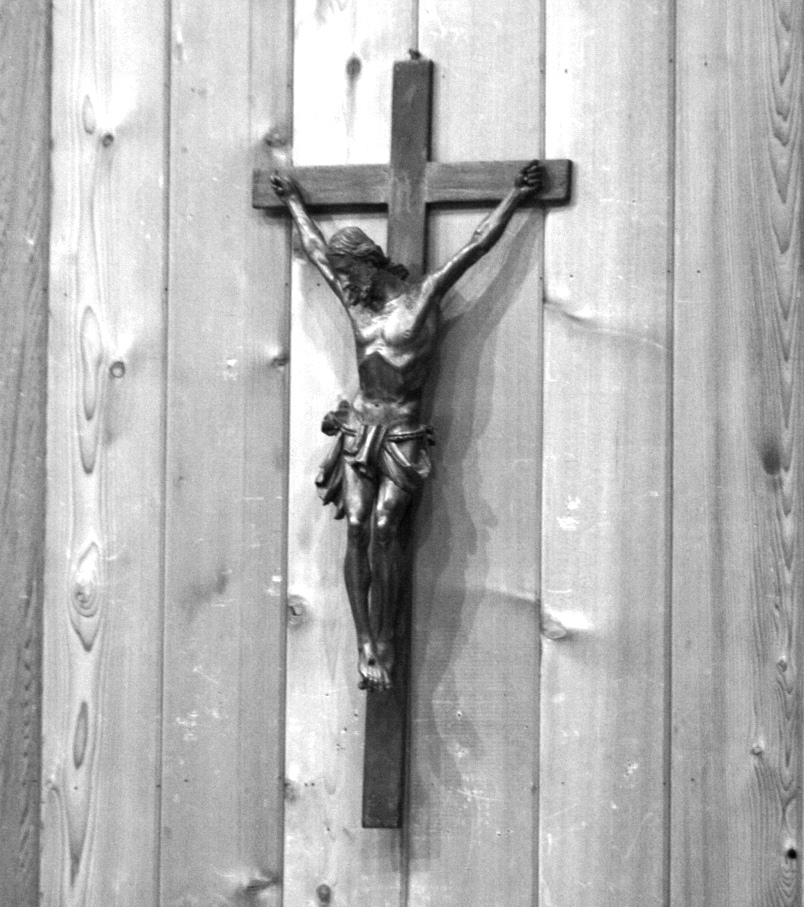
crucifix1At the abbey where I live, I preach at the Maundy Thursday liturgy and the Easter Vigil. I do not preach on Palm Sunday and Good Friday, the two liturgies where we chant the Passion. The Passion is long enough without added sermons and the Passion speaks for itself. That is, it speaks for itself as long as we don’t add things it does not say that undermine what the Passion does say.

To belabor what should be the obvious, the Passion Story tells us what human beings chose to do. Jesus chose to drive the money changers from the temple and teach the people there. The Jewish authorities chose to plot to have Jesus arrested and handed over to the Roman authorities. Judas chose to betray Jesus, thus facilitating the arrest and handing over. Pilate, to varying degrees in the four Gospels, vacillated but in the end chose to sentence Jesus to crucifixion. Meanwhile, the people who had cheered Jesus upon entering Jerusalem ended up crying for his crucifixion. The Roman centurions nailed Jesus to the cross where he died. The Passion narratives say nothing to suggest that anything that was done to Jesus, from the arrest to harassment and flogging to nailing him to the cross was in any way the will of God.

In all this, God does not do anything. Why do I bother to make a big point of this? The reason is that many Christians have suggested that God positively willed the sacrifice of Jesus for some cosmic purpose, usually because God was upset with wayward humans and was somehow incapable of forgiving humans unless somebody took the punishment for human sin. If Jesus, innocent of sin, should take the punishment, well and good. Well, not well and good. What kind of god demands punishment and doesn’t care who gets punished as long as somebody does? The Passion Story never says anything of the kind.

If God did not will Jesus’ violent death, what did God will? What was God’s plan? Jesus understood the heavenly Father’s plan to be that he Jesus knew that if he defeated Caiaphas and Pontius Pilate with force would only keep the world forever embroiled in retaliatory violence. The only way to avoid that was to gather people peacefully no matter the outcome, even if it meant death.

But Death, much as it was the plan of humans, was not God’s plan as a group of women found out early in the morning on the first day of the week.

See also Two Ways of Gathering


Crying out with Palm Branches in our Hands

AndrewPalmSunday1Jesus entered Jerusalem to the acclaim of crowds strewing branches before him and proclaiming him the king. A few days later, the same crowd gathered before Pilate to cry out for Jesus’ crucifixion. What happened?

Before answering this question, it is helpful to recall another crowd that went out into the desert to see John the Baptist. “What did you come out to see?” John asked them. “A reed blowing in the wind?” John suspects that people have come out in droves because people were coming out in droves. That is, it was the “in” thing to do. Fast forward a few months and we have a crowd at Herod’s palace supporting Salome’s request for John’s head on a dish. What did they come to see?

The post Ignominious Glory—Glorious Ignominy: a Doxology goes a long way in explaining this phenomenon. One can’t help but suspect that people are crying out because everybody else is crying out, no matter what the outcry is about. Advertising usually does not advertise the product but its alleged popularity. Political campaigns do the same thing. What would happen if people stopped to listen to what people were actually saying instead of crying out what they think everybody else is crying out?

It so happens that the Gospels do precisely this. The suggestion that the Gospels are Passion narratives with long introductions gives short shrift to what the Gospels are about. What these “long introductions” do is tell us at great length what Jesus actually said and what he taught. They also tell us what Jesus did before he was nailed to the cross, i.e. he healed people and cast out demons and he unilaterally forgave sins. These “long introductions” also tell us why the power brokers in Judea and Jerusalem wanted Jesus dead. By reading these “long introductions” to the Passion narrative, we are drawn away from crying out what everybody else is crying out and waving signs that only proclaim what the current fashion is believed to be. Instead, we are drawn into a very different social mimetic process, a process that builds up mutual respect between people, seeing people as they really are and as they really can become when they receive the unilateral forgiveness that Jesus gives them, a social process of not retaliating for wrongs done, a socially mimetic process of forgiving debts, of sharing what we can, of offering healing to others.

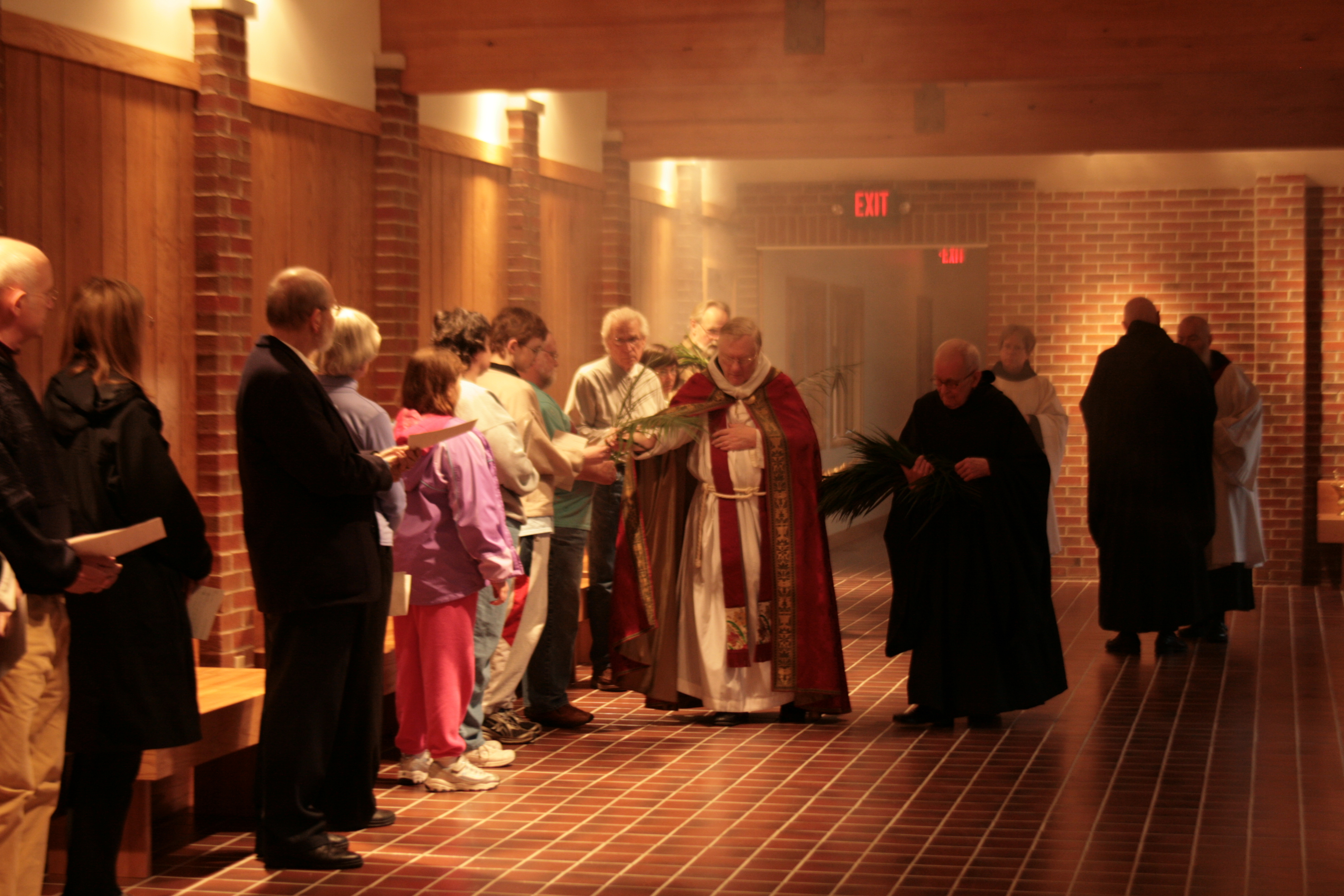
It is instructive that the Palm Sunday liturgy begins with everybody playing the part of the crowd welcoming Jesus with palms and then, a bit later, we hold these palms while acting the part of the crowd in crying out for Jesus’ death during the reading or chanting of the Passion. What we need to do afterward is return to the “long introductions” to see what the fuss was about and hopefully, hear the cock crow as did Peter.

I develop these ideas in my book Tools for Peace.

A Scandalous Woman as Extravagant as Jesus

churchDistanceBlossoms - CopyThe synoptic Gospels interlace Jesus’ disciples’ infighting as to who is the greatest with Jesus’ predictions that he will be handed over to the authorities to be crucified. The disciples consistently fail to understand or accept what Jesus is saying to them. Interestingly, the disciples suddenly come to an agreement when a woman enters the house of Simon the Leper in Bethany and pours an enormous amount of costly oil over Jesus. It is telling that it is a corporate condemnation of a marginal person that has united the disciples. To their chagrin, Jesus defends the woman, saying that she has prepared him for burial, precisely the destiny Jesus is facing and the disciples are denying. It is quite possible, however, that for Judas Iscariot, Jesus’ defense of the woman was the last straw. In both Gospels, Judas’ fateful interview with the chief priests follows immediately.

Curiously, Luke has a version of the same story that is detached from the passion narrative. That this woman had a bad name in the town suggests uneasiness with this woman and her extravagant actions. That she shamelessly washes Jesus’ feet with her tears doesn’t help matters. If the disciples were there, one wonders if they agreed with Simon in thinking that Jesus should have known that the woman was a sinner and therefore unworthy of offering such an extravagant gift.

John has a similar, but different account of the anointing of Jesus. The woman is Mary of Bethany and, far from being an intruder into somebody else’s house, she is herself the hostess along with her sister Martha. As in the Lucan story, Mary wipes Jesus’ feet with her hair. This time the gesture is all the more suggestive of things to come as John places the incident just before the Last Supper when Jesus of washes the feet of his disciples. This time, Judas alone objects to the waste. John goes on to say that Judas was upset, not because he cared for the poor, but because he wanted more money in the common treasury for him to steal. The question is: if the disciples unanimously censured the woman as they unanimously opposed Jesus’ predictions of his death, was Judas really the only betrayer? Chances are, Judas was saying out loud what the other disciples were thinking.

The parable of the Prodigal Father tells of the extravagant love of our heavenly father. Isaiah 43 proclaims God’s extravagant gesture of bringing God’s people through a desert overflowing with water. In Philippians, Paul insists that the cross and resurrection are so extravagant that all of his human qualifications are reduced to rubbish. Mary of Bethany shows the same extravagance, an extravagance that makes us uncomfortable to this day. This is the extravagance that embraces the cross and Jesus’ resurrected life and leads to truly caring about the poor and raising them up into a life of generosity for everyone.

The Prodigal Father and His Sons

???????????????????????????????????????????

The famous parable traditionally known as the Parable of the Prodigal Son (Lk. 15:11–32) is the quintessential illustration of pre-emptory forgiveness, one that closes the case on Jesus’ teaching on vengeance and forgiveness. This parable is better called “The Parable of the Prodigal Father and His Two Sons.” The opening of the parable draws a triangle: “There was a man who had two sons.” We expect tension out of a triangle, and we get it right off the bat when the younger son asks for his share of the property. The father accedes to his son’s request (demand?) and the younger son goes off with the proceeds. The elder son stays at home with his share of the property, at least geographically. What kind of father would be so foolish? Why would a young man leave a father who would give him whatever he wanted? Was it to get away from his brother? The stories about paired brothers in Genesis predispose us to suspect that the two brothers are mirror images of each other.

The parable goes on to say that the younger son “squandered his property.” Literally, he “scattered his substance.” That is, the younger son, while trying to forge an individual selfhood separate from his father and brother, completely loses himself in dissolute living. Geographical distance has not freed him from continuing to be a mirror image of his older brother. Then comes a famine and the social crisis that comes with it. Chances are that the scarcity was magnified by created scarcity. In such a social crisis, there must be a victim. A foreigner is particularly vulnerable to being a victim in such a crisis. The younger son fit the bill perfectly. He was deserted by everybody, in spite of all the money he spent on his women and carousing friends. Nobody was willing to take him in. He ended up as a servant who feeds the pigs (an unclean animal for Jews) and “no one gave him anything.” In this desperate situation, the younger son recalled how well-fed his father’s servants were, and he “came to himself.” Perhaps it was embarrassment that made him want to return as a servant, but perhaps he also didn’t want to re-enter the triangle with his father and brother.

The father’s ecstatic reception of the lost son and subsequent celebration blows apart the family triangle, leaving no room for mimetic strife. In contrast to the mimetic process that organizes society around a dispensable victim, the indispensable victim who is no longer lost has been found. The elder son, however, wanted to preserve the old triangle. His sour attitude suggests that he still needs to have his younger brother live irresponsibly. The elder brother’s universe would collapse if his younger brother began to play a responsible role in family affairs. No wonder the younger son ran away from a brother like that!

When the older brother keeps his distance, the father runs out to him with the same solicitude he showed the returning younger son. The elder son’s disingenuous accusation of not being allowed to celebrate is shown up for what it is. Apparently, the elder son never thought to celebrate with his friends until his father threw a party for that son of his. What the elder son has done is put himself into competition with his younger brother, when there is no need for competition. This sort of mimetic rivalry creates a stumbling block in the way of forgiveness. It remains to be seen whether or not the younger brother will forgive the elder for his unforgiving attitude.

We are likely to judge the younger brother for his callous irresponsibility and the elder brother for his amazing insensitivity. But if we do that, we find ourselves ensnared in the mimetic struggle between the two brothers, comparing them and taking sides until our own capacity for love is obscured and our capacity for celebration fizzles. The Prodigal Father does neither. He does not upbraid the younger son for leaving; neither does he upbraid his elder son for being such an insufferable prig. He only invites both of them to the party. Most of us have a hard time even wanting to be a father like that!

The parable ends with this challenge of forgiveness and unconditional love: Do we rise to the challenge of the Prodigal Father and renounce our irresponsibility and self-righteousness?

The Prophet Between the Fox and the Hen

turkeys1We often think of a prophet as a person who speaks the word of God such as Elijah and Isaiah do, but Jesus gives us a deeper definition of what a prophet at the climax of his diatribe against the scribes and Pharisees in Mathew: “so that upon you may come all the righteous blood shed on earth, from the blood of righteous Abel to the blood of Zechariah son of Barachiah, whom  you murdered between the sanctuary and the altar.” (Mt. 23:35) Here, the prophet is one who says not a word but speaks the Word of God nonetheless in the sense that Abel’s blood cries from the ground.

This diatribe is often cited as a proof that Jesus, at least at times, was violent. It is worth noting, however, that Jesus didn’t shoot an automatic rifle at anybody; he spoke truth to presumptive power with a two-edged sword for a tongue. More importantly, these harsh words are followed by Jesus’ wish that he could gather his “children together as a hen gathers her brood under her wings.” Here we see very clearly the Two Ways of Gathering outlined in my blog post of that title.

In Luke, the lament over Jerusalem is put in a different, but similar, context. Warned by some Pharisees that Herod wants to kill him, Jesus calls him “that fox.” (Lk. 13:32) In preaching on this Lukan text, Prior Aelred here at St. Gregory’s, drew out the comparison of the fox and the hen. In the face of a threatening fox, Aelred suggested that Jesus might have been a better protector by being a tougher animal, such as the Lion of Judah. But no, Jesus assumed the role of a vulnerable hen gathering her chicks. Aelred went on to extoll Vicki Soto and her colleagues at Sandy Hook who covered as many of their small pupils with their bodies as they could to protect them, a contemporary embodiment of Christ the vulnerable, protective hen.

A fox scatters, while a hen gathers. What if Jesus had chosen to be a lion to deal with that fox Herod? It occurs to me that a lion would scatter all foxes who might threaten the chicks. Sort of like a superhero crushing the bad guys so that good guys like us can get on with our lives. Aelred noted that Jesus the Hen is not a popular image in Christian lore as is the Lion of Judah. The problem is, if Jesus the Hen gathers, then not only is Jesus the Hen trying to gather the scribes and Pharisees,  but Herod and his court as well, thus robbing us of more favorite enemies.

Stumbling blocks in the Desert: the Temptations of Jesus

freshBread1When Jesus went out into the desert after his baptism, he became aware of the fundamental temptations he would have to fight throughout his life. James Alison helps us understand the social nature of these temptations by pointing out that “devil” (diabolous) means “divisive obstacle.” Such an obstacle requires two or more people to stumble over it. That is temptations are unavoidably social.

The social implications of the first temptation are spelled out in John 6 where Jesus feeds the multitude in the desert. The feeding is a sign of God’s willing of abundance (see Divinely Created Abundance) but bread, like any material good, exists in a social context.  The temptation presented here is to align bread with economic and political power. The people who have been fed fall into this temptation and try to seize Jesus and make him king (the glory of all the kingdoms of the word–see Ignominous Glory). Jesus had to resist the temptation, go off alone, and then return to preach about bread from heaven, bread that is a gift from God.

In the temptations, the devil taunts Jesus as being the “son of god.” Likewise, when Jesus casts demons out of people possessed by them, the demons call Jesus “the son of god.” Thinking back to the attempt to seize Jesus and make him king, Jesus’ ordering those he has healed to tell nobody makes a lot of sense. Jesus was focused on healing those who had need. The demons tried to politicize the healings to make them part of a thrust for social power. This dimension is particularly apparent in the name of the demon possessing the man of Gadara: Legion.

When Jesus predicts his imminent suffering and death, Peter is called a “satan” when he tries to dissuade Jesus from following that course. As with “devil,” the word “satan” means a stumbling block. Lacking support from his closest followers could only have multiplied Jesus’ difficulty in holding the course laid out by his heavenly father. How much better would it be to fling himself off the roof of the temple and force his heavenly father’s hand? The devil was right to quote the verses from Psalm 92. God would bear up the son of man, but not until the son of man had truly and deeply put himself into the unforced hands of the heavenly father by allowing himself to be handed over into the hands of angry sinful humans.

Like Jesus, we must be alert to where the stumbling blocks are in our relationships with other people and with God. Like Jesus, we must learn that the stumbling blocks are too heavy for human hands to lift and toss away. Like Jesus, we must turn to our heavenly father who is always waiting for us to ask him to toss the stumbling blocks away.

Outcasts at the Manger

altarXmasStar1We like to be insiders and hate to be outsiders, don’t we? Well, let’s look at some insiders and outsiders in the Christmas story. The people who stayed at the inn in Bethlehem were insiders. A betrothed couple and their newborn baby were outsiders. Shepherds were outsiders, hated and distrusted by all. So why would the angel of the Lord show such bad taste in revealing the birth of the Savior to them?

The Magi were highly-placed insiders in their own country, most likely top advisors of royalty. So why would they travel to another land where they were outsiders? If the star was up there for all to see, why did these foreigners from without and outcasts from within Jewish society respond when others did not?

The Magi, used to being insiders, went straight to the top, to the ultimate insider, King Herod, to inquire about which newborn child the star was indicating. Ironically, Herod was an Idumean, not a full-blooded Jew. He had power, but he was an outsider. Herod’s reaction to the Magi’s inquiry showed Herod to be an outsider to humanitarian feelings once he thought his power was threatened. Mixed racial background aside, being rich and powerful pushes one to the margins of society as much as the poverty of the despised shepherds.

These days, we easily see Herod as an outsider, an intrusive foreign element entering the story only to stir up trouble and grief. The shepherds and the Magi are insiders, like us. How did that happen?

There is a certain sleight of hand that turns us and certain chosen others into insiders when it suits us. Not only do we not wish to be outsiders, we don’t like to be challenged by outsiders. If we realize that the shepherds and Magi and the Holy Family themselves are outsiders, our identities are shaken at a deep level. If it is outsiders who appreciated the richness of the Christ Child, maybe the same thing happens today. After all, some nonbelievers care more about the poor than rich Christians and a Hindu early in the twentieth century believed in the Sermon on the Mount more than the Christians of his time.

The greatest irony is that Christ was born to save all people, to make insiders of all of us. The problem is, we don’t want to be insiders with those who are outsiders and we certainly don’t want outsiders to join us. After all, what would we do if there were no outsiders?