Unwrapping the Future

crecheThe yearly cycle of celebrations and commemorations adds solidarity to our experience of time. Christmas, a holiday especially laden with traditions, is a particularly strong anchor, assuring us that everything is as it should be for all eternity. Amen.

One of the traditions of Christmas, however, is the giving of charity. That is a very good thing, considering the needs for generosity, and it helps that once a year, people have a custom of dwelling on such matters. But the need for such charitable giving suggests that not everything is as it should be. If huge efforts by charitable organizations have to be made to assure that no child is deprived of a Christmas, then obviously there are serious social problems that need to be addressed. That is, this cozy traditional holiday poses a challenge for the future.

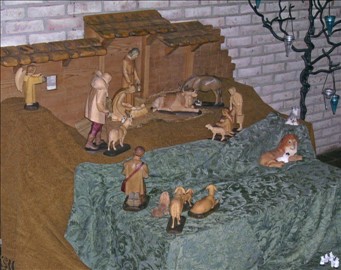
Manger scenes with the new-born Jesus lying in the straw tug the hearts of many and have been a focus of devotion since St. Francis of Assisi introduced the custom in the twelfth century.  But the whole point of this nativity story is that Jesus was born in the stable because nobody had room for his mother, father, and himself. This is not business as usual. It raises the question: do we really have room for Jesus in our lives? Do we really have room for all the children being born and for their families?

The angel announced to the shepherds proclaimed that this newborn child was the savior, the Lord who was going to usher in a new era of peace. That may sound innocent when we hear this read in church today, but at the time, the Caesar thought he was the savior and he didn’t have room for somebody else to do his job! Of course, he was a savior and keeper of the peace his way, with military and cultural might. The story of the shepherds, then, challenges us to consider who really is our savior and the model of peace for us. Do we keep peace the imperial way though violence to keep everybody in line? We don’t have to have imperial armies to take this approach. All it takes is a drive to control people, by force if necessary. Or do we follow peace Jesus’ way, through vulnerability as a newborn child all the way to the cross and then the Resurrection where Jesus creates peace through forgiveness.

A major cog in the engine of Caesar’s peace in Jesus’ neck of the woods was King Herod. Killing all the baby boys in Bethlehem may not look like a peaceful action, but Herod was keeping the peace, imperial style. Most of us may think Herod a bit extreme, but if we are willing to sacrifice anybody who seems to threaten our control of life, especially the young, we are going the way of Herod, the way of Caesar. Jesus, although he had the power to send legions of angels against Herod, remained vulnerable, dependent on human protection until the time came to suffer the fate the boys of Bethlehem suffered.

All of this may be a downer for a joyful holiday, but the good news is that Christmas is a yearly wakeup call for renewal of life, a renewal fueled by the divine energy of a human child born over two thousand years ago. Everything that was wrong with the world at the time is wrong with the world now and a lot more. We can keep on going in circles if we want, but we have the chance to step off the not-so-merry-go-round and embrace the Christ Child. We will find that the Christ Child has a gift for us. If we dare to open it up, it is a gift for an open future that we can have if we really want it.

See also, Celebrating the Prince of Peace and The Word Became Vulnerable Flesh

Jesus Explodes with Life: His Reply to the Sadducees

buddingTree1When the Sadducees approach Jesus in the temple with their question ridiculing resurrection from the dead, they are part of the collective violence surrounding Jesus. This is not a polite debate to entertain viewers on evening TV. The Pharisees have just asked their question to entrap Jesus and triangled in the Roman authorities to boot. Groups of people who normally hate each other but have united against Jesus.

Their question zeroes in on the practice of Levirate marriage, where the younger brother of a man who dies childless marries his brother’s widow. This practice presupposes that one is dead when one dies and that immortality is gained only through one’s offspring. Even this ploy fails in this case as all seven brothers die childless after having married this poor widow. No immortality there. Jesus is trapped. Or is he?

Jesus reply, referring to the words spoken by God through the burning bush, is universally admired for its clever exegesis of a text from Torah that the Sadducees would have to accept as authoritative. But there is much more here than declaring that God is a God of the living. In Raising Abel James Alison explodes this reply by saying that the power of God which the Sadducees do not understand “is that of being completely and entirely alive, living without any reference to death. There is no death in God. God has nothing to do with death, and for that reason facts which are obvious to us, like Abraham, Isaac and Jacob having been long dead at the time of Moses, simply do not exist for God. Let’s put this another way: for us ‘being alive’ means ‘not being dead;’ it’s a reality which is circumscribed by its opposite. For God this is simply not the case. For God being alive has nothing to do with death, and cannot even be contrasted with death.”

These words pack a wallop that throws us through at least seven spheres of being teeming with life. Alison is surely not suggesting that Abraham, Isaac and Jacob are counting the days off their celestial calendar! This is about quality of life, eternal life as Jesus means it in John’s Gospel.

Let us revisit the question with these stirring words in mind. There is a second way that marriage is used as a way to defeat death besides having offspring. Marriage is a means of restraining mimetic rivalry by placing the partner off limits to all others. Otherwise, everybody might kill everybody fighting over sexual partners. In the context of seven brothers, this is especially important and incest laws add extra restraint on the brothers of the bride who might be especially presupposed to rivalry. The premature death of the older brother changes the picture and suddenly the wife goes to the next brother in line. This is not a good way to win a game of mimetic rivalry, however, as the offspring still belongs to the older, the dead brother and not to the younger brother who is still alive. The Sadducees’ hypothetical case adds to the mockery by imagining that the seven brothers meet up with this poor widow in the resurrection and fight over her like dogs fighting over a bone, presumably with no end in sight. (The widow doesn’t matter much in this scheme of things.)

Jesus explodes all this by saying that there is no marrying or giving of marriage in Heaven. There is no bride to fight over after all. There is no longer anything whatever to fight over. Just try to imagine life without having something to fight about! The image of Jesus as the Bridegroom and the Church (that’s all of us) as the bride suggests that the intimacy of marriage is a good shared by all without need of restraints of any kind. Like the Sadducees, we are profoundly mistaken about the power of God as long as we cling to the rivalries of the seven brothers.

Cast Out by the Outcasts

altarDistance1Jesus encounters the ten lepers between Samaria and Galilee. Luke often uses geography to point to a spiritual landscape and this is a particularly apt example. Jesus meets ten marginal people in a marginal space. The broader geography is that Jesus has “set his face” to Jerusalem, the center of meaning and power, where he will be crucified.

But some outcasts are cast out more than others. One of the lepers was a Samaritan who would presumably be marginalized by his marginal companions. Sort of a double whammy.  In this marginal place, Jesus tells the lepers to go to the center of power, to the very people who have declared them unclean, for validation that they are clean. I can’t help but suspect that Jesus was being sarcastic, grumbling at the lepers to find out how they really want to be “healed.” When they suddenly find themselves clean, only the marginalized Samaritan returns to Jesus, who is still standing in the marginal space. That the other nine would go straight to the priests, at the center of power, is the strongest indication of how the Samaritan was treated by them. The Samaritan was healed, not only of leprosy, but of the social and religious system that required that some people be declared unclean so that others can be “clean.” This is the healing that the other nine former-lepers miss out on.

Jesus and marginality come up so many times in the Gospels, giving us the occasion to preach about it many times, that it starts to sound like a cliché. Instead of falling asleep, we need to wake up and really listen. Surely the Gospels hammer this theme so many times because we need to be healed of being hard of hearing.

This story prompts us to reflect on what we do when we find ourselves in marginal positions, having been cast out and declared unclean in some way. Do we band together with other outcasts in a constructive way? Or do we band together in resentment at the establishment? Does our little outcast group amount to a mini-establishment with people divided between clean and unclean? Do we run back to the establishment that exiled us if we get a chance to do so?

That only the Samaritan returned to Jesus to thank him raises the question of what causes gratitude and what hinders it. I suggest that a system that divides people between clean and unclean inhibits gratitude. When we live with this kind of mindset, we inevitably feel entitled to our advantages and delude ourselves into thinking we have earned them. We also inevitably feel that lepers have “earned” their marginalization. If returning to the center of power is what we want, then gratitude is the last thing we feel if we manage to do just that.

Of course, the Samaritan had to advantage of not having the same option of going to a priest to be declared clean as his fellow lepers did. Being cleansed wasn’t enough to take him out of the margins. Remaining in the margins gave him the opportunity to give Jesus another look and let Jesus be the one who decides if he is clean or not. Giving Jesus this sort of authority is an exhilarating thing to do. It is also dangerous. Jesus just might tell us that not only is each one of us clean, everybody else is also clean and we have to live without our lepers.

The Good Shepherd in the Desert

goodShepherdIf Jesus is the “living interpretive principle of scriptures, as James Alison says, then the Parable of the Good Shepherd who leaves the ninety-nine to search out the one lost sheep should be a powerful and accurate interpretive lens for other passages in scripture.

In the RoCa lectionary, this Gospel is coupled with a tense episode in Exodus 32. As he comes down the mountain with the tablets of the Ten Commandments, he finds that Aaron has set up a golden calf for the Israelites to worship. God tells Moses to get out of the way so that his wrath can “burn hot against them.” Doesn’t sound like a good shepherd.  Instead, it is Moses who acts out the part of the good shepherd by interceding with God, as Abraham did earlier to avert the divine wrath from the people. At the end of this same chapter, there is another narration of Moses coming down the mountain. This time, he is so furious he breaks the tablets and then rallies the Levites to his side to slay thee thousand people who were worshipping the golden calf. Although Moses claims to be doing God’s work, what we have is a narrative of human rather than divine violence. Moses doesn’t look like a good shepherd this time, but the morning after this monstrous slaughter, Moses intercedes with God to forgive the people although it is a bit late for the three thousand who were slain. This strange doubling of narrations seems to point to a debate in the Jewish tradition moving in the direction of unveiling God’s love for God’s people.

In 1 Corinthians 10, St. Paul refers to this incident by saying “we must not indulge in immorality as some of them did, and twenty-three thousand fell in a single day.” (He ups the death toll.) In isolation, this is about the chilliest verse in the Pauline epistles but in its sacramental context, it is much more in keeping with Jesus the Good Shepherd. Leading into this verse, Paul says that “we were baptized into Moses in the cloud and in the sea, and all ate the same supernatural food and all drank the same supernatural drink.” This, in turn, recalls the reinterpretation of the Flood in 1 Peter where the water corresponds to the baptism that delivered Noah and his family and delivers us now. The Genesis story clearly indicates a social meltdown with a few, probably the intended victims, escaping. The Exodus story refers to the social meltdown in Egypt that lead to the expulsion of the Israelites. In the desert, the Israelites had their own social meltdown centered around rivalry between Moses and Aaron. (Arnold Schönberg’s opera Moses and Aron portrays this rivalry with great insight.) For both Peter and Paul, baptism is the deliverance from the surrounding sacrificial society into the Kingdom centered on the Eucharist, the new way of gathering without need of victims and certainly not needed the slaughter of three thousand. Paul is not, then, warning his readers against a wrathful deity but against a wrathful society that will engulf them if they return to its sacrificial ways, just as a relapse into the wrathful society of Egypt lead to a meltdown in the camp and the deaths of thousands.

Jesus the Good Shepherd does not strike dead those who re-enter a sacrificial society that today manifests hardness of heart to the extent of trying to prevent fundamental ministries such as feeding the hungry. Instead, Jesus enters into the heart of the society to bring back all who are lost. Rather than starting a bloodbath, we should intercede for all such people as Moses did and follow Jesus in searching for the lost.

See also: The Communal Good Shepherd

The Communal Good Shepherd

goodShepherdThe parable of the lost sheep crystallizes the Gospel as only a few others do.  It reverses our usual outlook that naturally tends to think along utilitarian lines where, as Caiaphas suggested, it is better for one person to die than the whole nation should perish. From the dawn of time, sacrificial logic has worked the same way: one person dies so that the community can be at peace, at least for a time. Jesus coyly asks the question: “which of you, having a hundred sheep, wouldn’t leave the ninety-nine to look after the lost one?” The honest answer would be: Nobody. A lone shepherd couldn’t leave the ninety-nine without losing them and probably failing finding the lost one as well. And yet Jesus asks the question in such a way as to ridicule our normal way of thinking and then goes on to rhapsodize about the extravagant joy and celebration at finding the one lost sheep. It’s the same with the woman finding her lost coin. She throws a party that probably cost all ten of her coins.

This rejoicing over the lost sheep and the lost coin and the lost sinner shakes us up into realizing that it is not enough to renounce the sacrificial logic of Caiaphas. If we stop sacrificing people we think are expendable that is something but much more is asked of us. We are to actively and sacrificially care for the ones who are lost, who are considered expendable by society. In his Rule, Benedict writes powerfully about this parable in the context of a community dealing with a delinquent member. As I say in my book Tools for Peace, “Benedict captures the inner spirit of the Gospel by picturing the abbot throwing off any sense of abbatial dignity in much the same way the father of the prodigal son throws off his dignity by running out to greet the son he sees from afar.”

One might think that the good shepherd is sacrificing the ninety-nine sheep for the sake of the one. Maybe. But what really needs to happen is for the shepherd plus the ninety-nine to go after the lost sheep. In his chapters on dealing with a delinquent member of the community, Benedict turns the whole community into shepherds. Paradoxically, one of the ways (and a problematic one) is excommunication where all members must cooperate. It is important to realize this is intended as a means to reconciliation; sort of like a time out in a family which gives a trouble child an opportunity to reflect on his or her behavior. Moreover, the whole community shares the pain of the alienation. Benedict doesn’t leave it at that. He suggests that the abbot send wise monastics to comfort the excommunicated member and reason with him. Benedict then encourages the best remedy of all: prayer. This is a communal effort with the whole community praying for the one who is temporarily lost in the hope that this member will soon be found again. Reconciliation takes place in the monastic church, making this also a communal event.

Benedict gives us one example of living out a difficult scenario. In each instance, we have to find different means to the same end although Benedict’s techniques give us a sense of direction. In the Body of Christ, all of us are called upon to act the part of the good shepherd.

Human Swords, God’s Peace

vocationersAtTable1Jesus’ words that he came not to bring peace but a sword (Matthew) or division (Luke) are startling, coming from a man who is commonly referred to as “the Prince of Peace.” Does this mean that Jesus is a war-god of some sort after all? Since Jesus never used a sword and rebuked Peter from using one at Gethsemane, and died rather than call on legions of angels to defend him and beat up his enemies, and approached his disciples and even the persecutor Paul with forgiveness after rising from the dead, it is fair to assume that Jesus is not in the least encouraging swords and divisions, but is warning us that we will have both as long as we experience the world in terms of us vs. them.

The approach to scripture inspired by René Girard and colleagues such as Raymund Schwager and James Alison is strongly committed to an unequivocally loving God who seeks only peace as opposed to any two-faced Janus-like deity who is capriciously loving one moment and wrathful the next. This approach tends to interpret “wrath” associated with God as human projections that distort the truth of God’s unconditional love. Basic to Girard’s thinking is the conviction that humans tend to unify conflictive societies through scapegoating vulnerable victims with collective violence. Society has regained peace—for a time—but at a cost to at least one person. This sort of a peace simply has to be disrupted once and for all by a God who is unequivocally loving and who wishes that not even one person be lost. According to Girard, this is precisely what Jesus did by dying on the cross and exposing the reality of collective violence for what it is.

As a result, we now have a world where there is an ever heightening awareness of victims, but a serious lack of anywhere near a corresponding awareness of the need for forgiveness. Without forgiveness, awareness of victims increases resentment and escalated conflict. Since the awareness of victims does not allow collective violence to bring peace to a society, there is nothing to stop the escalation of violence. As resentment grows rampant, it infects every level of society including the family so that family counselors are in great demand to try and talk people into giving up their resentment against those closest to them. They often fail as much as conflict mediators in political hotspots and for the same reason. Resentment becomes a defining factor of many lives and defining factors are not easily given up. So it is that the coming of Jesus the forgiving victim has brought swords and divisions.

The offer of peace and forgiveness, for all of the divine love behind it, inevitably causes division between those who accept it and those who don’t. There are two possible reactions to such a choice and a unanimous conversion to God’s peace wasn’t in the cards then any more than it is today. (Of course we humans stack the deck heavily against peace.) For those of us who seriously try to choose peace, it is tempting to think we are on the “peaceful” side of this division but we need to realize that the Word, the forgiving victim, is a divisive two-edged sword “piercing to the division of soul and spirit” and “discerning the thoughts and intentions of the heart” as the author of Hebrews puts it. That is, the pure forgiveness of the divine victim shows up the least bit of resentment we allow ourselves to harbor in the farthest, darkest, corners of our souls.

The escalation of violence occurring right at the time of this writing is a sure cause of discouragement. What we can do is take hope, primarily for ourselves, but also for our personal relationships and for humanity as a whole that the offer of peace from the forgiving victim remains open to all of us at every time of day and night and this offer will never end no matter what we do with our swords and divisions.

Mary’s Blessedness, Everybody’s Blessedness

MaryMary has been both deified and vilified. It seems the main reason she has been vilified is precisely because she has been deified. The dogma of the Assumption of Mary into heaven, traditionally celebrated by Roman Catholics on this day, tends to suggest deification and thus provoke a corresponding denigration. Why should this particular Jewish girl be raised to such heights? Sound theology has always been clear that Mary was a human being and not a deity. Any glorification of her is a glorification of her divine son who gave his mother whatever glory that she has. Like the rest of the world, Christianity has had its superstars who are put on a pedestal and everybody on a pedestal draws detraction as a matter of course.

Mary’s real glory is that she was a human being every much as the rest of us. That is, she was and is a Jewish girl. Mary is, of course, inseparable from the Incarnation of the Word in her womb. Although Mary’s son was (and is) divine, Jesus was (and is) fully human, like you and me. In his excellent book Sheer Grace, Drasko Dizdar says that Mary, far from being a deity or demigod, “is the utterly and simply human subversion of this deification of human “archetypes” into the divine feminine.’” This is what the famous words of Mary in the Magnificat are all about when she says God “has cast down the mighty from their seats and has lifted up the lowly.” If such words simply mean other people become just as mighty as the ones who were cast down, then the words change nothing for humanity. The ones who are raised up are lowly and continue to be raised up only by remaining lowly. The proud are scattered in the “imagination of their hearts.” The rich are sent away empty because their hearts are too full of their desires to have room for God. What is so subversive about Mary, then, is her humanity. While other humans try to make themselves more than human by being movers and shakers, Mary is blessedly content to be human. As Dizdar says, Mary is a whole human being “as God has always intended the human creature to be as creature.”

Throughout, the Magnificat is a song of praise of God, not of Mary herself. All generations call her blessed because of what God has done. Mary only did what every human being should do, rarely as it actually happens: She said “Yes;” she didn’t say “Maybe,” or “No.” Saying “Yes” is what is so extraordinary about Mary. If this simple response makes her so singular among human beings, it only shows how the rest of us fail to be human beings. Far from isolating herself, Mary proclaims her solidarity with all God’s people, the promise made to all Abraham’s children.

Does all this relegate the belief in the Assumption of Mary to mere mythology that must be discarded in our modern age? Not at all, if we open our hearts to the Love God shows to the created world in its sheer materiality. Dizdar says that God’s love “is so concrete (‘body’) and complete (‘and’ soul’) that it draws into itself (‘assumes’) our happily (‘blessed’), sovereignly free (‘virgin’) and simple, created humanity “(‘Mary’), into the very life of God (‘heaven’).”  If we glorify Mary for an allegedly singular grace or denigrate her for allegedly getting “special treatment,” we only show how readily we project our rivalrous desires on Mary and God. Far from being a special grace, the Assumption is God’s invitation to all of us to enter the depths of our created humanity that God loves unconditionally.

Transfiguration of the Material World

transfigurationThe Transfiguration of Jesus on Mount Tabor is celebrated twice in the Church Year. The celebration on the last Sunday before Lent stresses the event’s preparation for the death and resurrection of Jesus. The celebration in August, being a standalone feast, can be seen as a celebration of Creation in all its materiality. Since there is no feast of the Creation, any celebration that points to our origins in God’s creative Desire is for the good.

That Jesus’ body and his clothing should be transfigured by a dazzling light is about as powerful a sign of the goodness of the material world as anything could be. The only fly in this primordial ointment is the suspicion that if the material world needed to be transfigured, then it wasn’t all that perfect to begin with. That is, the material world is impure, at least to some extent, and needs to be purified. Eastern Orthodox writers, however, suggest that it wasn’t that Jesus was transfigured on Mount Tabor, but that the disciples’ eyes were opened so that they could see the transfiguration that, for Jesus, was an ongoing reality.

The powerful and startling story of the transfiguration of Seraphim of Sarov emphatically illustrates this truth. Seraphim was discussing spiritual matters one night with his disciple Nicholas Motovilov when suddenly Nicholas saw his staretz engulfed in transfiguring light. When Nicholas remarked on this, Seraphim said he had not changed but Nicholas’ ability to see had changed. Not only that, but Nicholas, unknown to himself, was also shining in the same transfiguring light.

If we can see all of the material world from the simplest atoms to the grains of dirt to squirrels and cats to humans in the transfigured light in which they, we, are all created, we will not reach out to grasp anything out of a lust for ownership or push anything or anyone away with expulsion. (See Connecting our Desires.) The catch is that we must be transfigured ourselves in this same light in order to see the transfigured glory all about us.

This need brings us back to the second and more fundamental meaning of the Transfiguration: the redemption of the groaning created world (Rom.8) by the cross and resurrection of Jesus. If our vision of reality is occluded by society’s tendency to hold itself together through the victimization of others through ownership and/or expulsion as Egypt was under Pharaoh, then we will not see the transfigured truth of the world under the Risen forgiving Victim breathes the Paraclete through our eyes and mirror neurons to show us the truth. (See Mirroring Desires.)

Yes, God’s act(s) of Creation is the beginning of the universe but Creation is also each present time of the universe up to and including the present moment and Creation is the End of the universe in the sense of being its goal. It is God’s creative work in redemption all along that has alerted us to the truth of Creation, starting with the deliverance of a ragtag group of slaves expelled from Egypt, continuing with the return of the Jews from their Babylonian exile to the Resurrection of Jesus where Mary Magdalene enters a garden to recalls the Garden of Eden and mistakes the risen Jesus for the gardener.

May we open our eyes to see this renewed glory within ourselves and around us, a glory filled with God’s Desire for all Creation.

Mary and Martha at the Feet of Jesus

mary&Martha

The story of Mary and Martha of Bethany in Luke’s Gospel has often been interpreted as comparing the active life to the contemplative life. Many writers have suggested that the active life is good but the contemplative life is better. Those of you who have been following my blog where I have been developing the thought of René Girard and his colleagues will likely become a bit suspicious of a possible rivalry between the two sisters and a deeper suspicion of an interpretation that seems to foster rivalry between Christians who feel called to either a contemplative or active vocation, or a combination of both.

In placing this story directly after the parable of the Good Samaritan, it seems likely that Luke does not intend to put action and contemplation in conflict in any way. Instead, Luke is drawing a hidden harmony between the two. If God really is totally beyond rivalry of any kind, then God is not a rival with our neighbor for our affections and concern.

The many stories of sibling rivalry in the Bible incline us to look for it here, but in this case, we only half-find it. Martha is upset with Mary, but Mary shows no signs of being upset with Martha. Those who interpret this story as contrasting the active and contemplative lives take Jesus’ gentle reproach of Martha as indicating that she is distracted from him by her busywork. But if Jesus is not offended by Martha’s attention to work instead of him since Jesus does not put himself in rivalry with such work, then the words mean something else. I suggest that Jesus is pointing out that Martha is not distracted from Jesus by her work; she is distracted from her work by resentment of her sister. Mary, for her (better) part shows no sign of being distracted by Martha.

In his book Beneath the Veil of Strange Verses, Jeremiah Alberg suggests that Mary and Martha “represent two ways of reading the Gospel or two ways of listening to the Lord.” Martha represents us when we are offended by Jesus because he “does not help us with our projects, and that he does not command others to do the same.” In short, Martha is offended that Jesus does not “support” her. Mary, on the other hand, represents us when we sit at Jesus’ feet without offense, without asking to be “supported.” When we do that, we are held up by Jesus whether we realize it or not.

It isn’t a matter of being active or contemplative; it’s a matter of being focused on Jesus without resentment because Jesus has no resentment. In any case, the wisest commentators on this story suggest the Mary has need of Martha and Martha has need of Mary and a mixed life of action and contemplation is best. In the preceding parable, it was the Samaritan who was focused on Jesus through his focus on the victim while the priest and the Levite were focused on their standing in the community. If we are focused on Jesus, we will be attentive to our neighbor without rivalry or resentment, which will set us at Jesus’ feet.

Dispossessing a Town Possessed: The Gerasene Demoniac

peacePole1The story of the Gerasene demoniac and the herd of pigs running off a cliff bewilders modern readers. In his book The Scapegoat, René Girard offers an anthropological interpretation based on the concept of mimetic desire. According to this theory, the desires of all the people in any town, not just Geresa, are intertwined. That is all of the people are possessed by each other. If one person stands out as being “possessed,” that person is possessed by mimetic rivalries in the town that have reached (or sustain) a crisis level  that is pushed into one victim, the “designated patient,” to use the term of Ed Friedman.

When Jesus and his disciples arrive on the scene, they are not greeted by the mayor or any of the “normal” people; they are greeted by the demoniac who begs Jesus not to torment him (them). That the demon(s) gives its name as “Legion” confirms that this man is possessed by the community, including political possession of the Romans as possession by an invader increases the tensions within a local community. The demoniac is regularly chained but regularly breaks free in a pattern that mimics the repetition of ritual. That is to say, this pattern represents the town’s sense of stability, much as the incarceration of multitudes of black youths from the ghettos gives the US a similar sense of stability today. 

Jesus sends the demons into the herd of pigs that then runs off a cliff into the sea. We have here an interesting reversal of the scapegoating mechanism since usually it is the town that drives a single victim off the cliff, a fate Jesus has narrowly avoided himself. Upon seeing the formerly possessed clothed and in his right mind, the townspeople ask Jesus to leave. One would think that they would be happy to see a sick person cured and would ask Jesus to stay and cure everybody else of whatever ails them. But they don’t. Why? Because the people of the Gedarene region are not happy over being robbed of their victim. The demons requested that they not be expelled from the town because the people, possessed by their rivalries, wanted to remain possessed. When robbed of their victim, the possessed town implodes in its collective violence and becomes the sacrificial victim.

The anthropological dimension of this story can be seen more clearly by comparing it with the Samaritan woman at the well, which has none of these mythological trappings. It is the woman at the well, and not any of the other people of Sychar, who greet Jesus. The woman is alone at the most social place in town, an indication that the woman is the town’s scapegoat. There is no exorcism but the woman eventually becomes possessed by Jesus when she drinks the water he has to give, just as the Gerasene demoniac became possessed by Jesus. The woman goes to tell the townspeople about Jesus as the Gerasene demoniac was told to spread word of what Jesus had done in his own area. The story in Sychar has a happier ending in that the people come out to listen to Jesus, a mimetic process where they give up their collective victim in exchange for the water of rebirth that Jesus has to give. Perhaps this foretells a happier ending for Gerasa someday and a happier ending for our own society.