
 The disciples’ demand (not a request) that Jesus increase their faith, (Lk. 17: 5) with a hint of desperation that such a demand entails, seems to come out of nowhere when it begins the Gospel reading. So let us look at the preceding paragraph for some context.
That paragraph begins with Jesus’ ominous warning against being occasions of stumbling (scandals) for any of Jesus’ “little ones.” Unlike the parallels in the other synoptic Gospels, however, this warning is quickly followed by an admonition to rebuke those who cause stumbling but then to forgive them if they are penitent, even if it is seven times a day, which is a lot of forgiving.
So, the disciples aren’t having a problem believing in the Nicene Creed. They are having a problem accepting this demand to be forgiving on such an incredible scale. After all, if one repents seven times a day, how serious is the repentance? Forgiving like that often requires the patience of a saint and not even many of the saints I know anything about are as patient as that. The “faith” at issue here, then, seems best understood in the usual meaning in Jesus’ time which would stress fidelity to Jesus’ teachings and trust in his sanity in the face of such impossible demands. In the same fashion, we can understand “faith” as used in Habakkuk 2:4 as referring to remaining steadfast to Yahweh in the face of the human violence of social injustice in Israel and the violence of the Babylonian invaders. That is, in the face of people who cause much stumbling and need forgiveness almost nonstop.
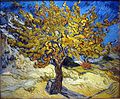
Unlike the parallels in Matthew and Mark, faith the size of a mustard seed is enough to move this mountain, perhaps the Temple Mount and its sacrificial system, from here to there. But mulberry trees have nothing to do with sacrifice. So why a mulberry tree in this version? A mulberry tree can be nice to have around but it an be a nuisance in some circumstances. When I was growing up, we had a mulberry tree on the edge of our property. The berries were a nice treat but they also stained the driveway a deep purple. Mulberry trees also have complex root systems that spread out a large distance just under the surface and they also send sinker roots deep into the soil. This may be one of the reasons my father used a tree removal service rather than faith to move the tree off from the property.
We an see the mulberry tree as an image of the intractability of the occasions for stumbling that we encounter on a daily basis. The image also stands for the tangle of our anger and frustration over being asked to forgive those who keep making us stumble over and over again. The close coupling of Jesus’ admonitions here suggests that all of us cause others to stumble about as much as we have occasion to forgive others for making us stumble. Faith the size of a mustard seed is enough to pull us out this tangle of scandal and stumbling and yet we have trouble having as much faith as that!
A brief parable follows. We are apt to think the master treating his slaves so harshly stands for God, but Jesus is asking: Whom among you would say to his slave to come sit down for dinner after a hard days’s work? The implication is that we are the ones who would like to have the power to order people about like that. But is that faithfulness to Christ? Looks more like a cause of stumbling to me. Jesus then shifts to the perspective of the slave who must not presume to be worthy of any reward, just as slaves were so considered in his time. In a similar parable in Luke 12, Jesus says that the master is the one who will wait on those slaves who eagerly await his return. In daily life, we often feel that we are slaves of those who cause trouble and so demand much attention and energy on our part and yet are the last to express any gratitude for what we do for them. We tend to resent such slavery and take refuge in vengeful anger and maybe some grudging forgiveness that makes us feel superior. But Jesus places himself in the position of the slave to those who stumble and makes others stumble, so that is where we will find Jesus if we have the faith the size of a mustard seed.
 There is only one simple qualification for being a disciple of Jesus: give up everything. That’s one whale of a qualification. So hard is this qualification that earnest Christians have thought of many ways to soften Jesus’ words without washing all meaning and challenge out of them. My New Testament professor at Nashotah House, O.C. Edwards, suggested that this qualification means we have to give up everything that comes between us and God. That is, if parents, children, spouses, friends, or fellow members of a community help us draw closer to God, we don’t have to give them up. The same would go for material possessions. Even Benedictine monks have to use things in this world in order to live so we can’t give up having anything at all. The trick is to use things in such a way that the work and recreation we do with them draws us closer to God rather than farther away.
 The first verses of today’s Gospel (Lk. 12: 32–34) pick up from where we left off last week. That reading ended with Jesus’ little parable about the rich fool who tore down his barns to build bigger barns (Lk. 12: 12–21) only to find that his life was being demanded of him. This reading begins with Jesus’ soothing admonition to “sell our possessions and give alms” and “make purses for yourselves that do not wear out, an unfailing treasure in heaven, where no thief comes near and no moth destroys.” (Lk. 12: 32-33) This is quite a contrast to two brothers fighting over an inheritance or a rich person gloating over fabulous amounts of wealth. Lest we think Jesus is asking us to make ourselves miserable, Jesus assures us that it is our heavenly Abba’s pleasure to give us a treasure that is the kingdom. If this treasure, the kingdom, is the Abba’s pleasure, then it is our pleasure as well.
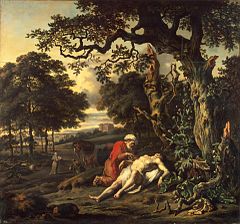 Many of us instinctively think that knowing is something we have in our heads, something we can recite, like a catechism. This is the sort of knowing that the lawyer demonstrates when he recites, correctly, the two great commandments when Jesus encourages him to answer his own question as to what he must do to inherit eternal life. (Lk. 10: 27) But then the lawyer shows a certain ignorance, a missing piece. He doesn’t know who or what his neighbor is. Jesus answers this question by telling a story that pinpoints exactly the missing piece in the lawyer’s cognition.
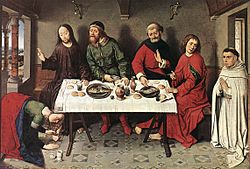 We have a tendency to think of salvation as a personal matter. To some extent it is, but the way salvation is presented in scripture, it is never personal in an individualistic sense. In the case of the famous story of “The Sinful Woman,” we easily focus on the woman whose dramatic action is enough to grab our attention. However, her act is a public drama. Moreover, in very few words, Luke paints the social context of the woman’s behavior. She is a “sinful woman.” We are not told the nature of her sinfulness, so that is not relevant to what we should learn from the story. Simon, Jesus’ host at the dinner, assumes that Jesus should have known that the woman was a sinner and he should not have allowed her to anoint and dry his feet with her hair, actions that further proved the woman’s sinfulness in Simon’s mind. Simon may have been expecting Jesus to have supernatural discernment, but he may have simply expected Jesus to know who had a bad reputation and who didn’t. In any case, it is a social judgment that has labeled this woman as sinful. That is, this woman shows all the signs of being the community scapegoat who helps everybody else feel good about themselves.
 Luke’s version of Jesus’ Resurrection is much the gentlest among the synoptic Gospels. No earthquakes and no women running off so afraid that they can tell nobody what they had seen at the empty tomb. The women were, indeed, terrified of the two men in “dazzling clothes” who appeared to them. But by the time, but before long they have remembered, with prompting from the men in white, Jesus’ words to them.
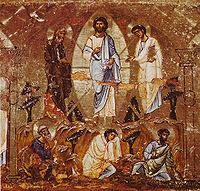 We celebrate the Transfiguration of Jesus at the end of Epiphany to prepare ourselves for Lent. This is a joyous feast where the Light of Mount Tabor should inspire us for the days of penance and then entering into the Paschal Mystery of Christ. However, there is a discordant element in the reading from St. Paul that I want to focus on. He, too, writes of the inspiring light of the Transfiguration, but he also writes about the veil over Moses’ face. This refers to the story in Exodus where Moses put a veil over his face when he came down from Mount Sinai with the tablets of the Law because his face shone too brightly for his fellow Israelites to look upon. (Ex. 34: 29–34) Paul goes on to say that the Jews remain veiled when they hear the words of the Law. In light of Holocaust, this verse causes much uneasiness, all the more so as it has been used to justify anti-Semitic attitudes and behaviors.
 At his baptism, Jesus heard a voice from Heaven saying: “You are my Son, the Beloved; with you I am well pleased.” (Luke 3: 22) These words ring out in Psalm 2, addressed to the king, the Messiah, who is being singled out from the nations that are raging together and rising up against the Lord and his anointed. Similar words are spoken to the Servant of Yahweh in Isaiah 42:1. Throughout these songs of the Suffering Servant, he is being called out of a violent society to become instead the victim of that society’s violence. Unlike the Psalmist who threatens the raging nations with a rod of iron, the Suffering Servant does not retaliate against the violence inflicted on him. Jesus begins his mission, then, with a powerful acclaim of unconditional love from his Heavenly Father, a sense of unconditional love he will offer to all who will listen.
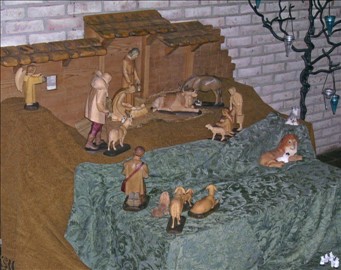
 Imaginary Visions of True Peace