The Work of a Slave

When Jesus washed the feet of his disciples, he stressed the importance of what he was doing. Likewise, when he passed the bread and the wine, he stressed the importance of what he was doing. Both acts were to be remembered and done in memory of Jesus. And both are to this day, although the footwashing is not anywhere near as common as the eating and drinking of the bread and wine.

What is it about the footwashing that has put it into a very low second place? Logistics may have something to do with it but a look at its meaning, the sign that Jesus is giving us, probably has a lot more to do with our not even talking about it all that much. In the Greco-Roman world, it was slaves who washed the feet of their masters and their masters’ guests. That Jesus would do the work of a slave must have been shocking at the time and still is, if we consider the implication that imitating Jesus’ act is not confined to literally washing the feet of others but entails acting as a slave to others. Fundamentally, being a slave means to be in the hands of another person. If we are supposed to put ourselves into the hands of others like this, what does this say about trying to enslave another human being? Jesus himself was about to put himself into the hands of others with the result that he would be crucified. If the disciples still remembered the anointing of the feet of Jesus by Mary of Bethany six days ago, that too would have added to their discomfort. This discomfort extends to the parallel versions of this story

The woman ( or women) in the Gospel stories poured out her very substance (the expense of the perfume or oil) in devotion to Jesus. Likewise, Jesus poured out his very self to his disciples in washing their feet just as he was about to pour out his life for all people to put an end to the violence that includes the enslaving of other people. In those Gospel stories, the women were commended as examples of discipleship. If Jesus thought these women were such good examples, it makes sense that Jesus was humble enough to learn from them and do for his disciples what the women had done for him. There is no indication in any variant of the story that the disciples were reconciled to what the women had done. Did Peter take umbrage at Jesus for washing his feet because he associated it with the women as much as he associated it with slavery?

With the bread and wine, Jesus again poured himself into the two elements just as he poured out his life on the cross. So it is that the footwashing and the Eucharist both mean the same thing. We have put up with the Eucharist more than the footwashing because we have been able to sidestep this meaning by arguing about the metaphysics of Jesus’ presence. But the real presence of Jesus is his pouring himself into the hands of others and through them, the hands of his heavenly Abba. Paul knew this very well but we also conveniently forget that the context of his recalling the Last Supper is to upbraid the Corinthians for violating its meaning through denigrating the weaker and poorer members of the assembly.

Jesus rebuked Peter for refusing to have his feet washed, warning him that he would have no share in him. (Jn. 13: 8) This warning converts Peter so powerfully that he goes overboard and asks to be washed all over. He has allowed Jesus to be a slave to him so that he could be a slave to Jesus and all people. This conversion did not prevent him from denying Jesus three times but it allowed him to hear the cock crow and then to affirm his love to the Resurrected Jesus three times. This is what both the footwashing and the Eucharist are all about.

Giving Everything and More

The meal at Bethany served by Martha seems to be an ordinary meal but in reality it is extraordinary. To begin with, John explicitly says that it is six days before Passover. This puts the meal in the context of the most solemn festival of the Jewish year. For another thing, Lazarus, the man Jesus raised from the dead, is present. The imminent offering of the paschal lamb and resurrection are both brought together. Even more extraordinary is the extravagant anointing of Jesus’ feet with precious perfume by Mary, the sister of Lazarus and Martha. Jesus interprets Mary’s action as a preparation for his burial, which he seems to expect is imminent, thus tying his death with the both the Passover and Resurrection. Judas’s protest over this “waste” shows that the hostility against Jesus has reached the inner circle of his disciples.

All four Gospels have a story of a woman who pours expensive ointment or perfume over Jesus, but the differences are striking. Matthew and Mark are very close parallels. Just before the Passover and Jesus’ Passion, an unnamed woman enters the house of Simon the Leper, who lives in Bethany, pours the ointment and dries Jesus’ feet with her hair. The disciples as a group protest the “waste.” This is much the same story as in John except the host is different. (Mt. 26: 6–13), Mk. 14: 3–9) Luke tells the same story except that it is placed much earlier in his Gospel and is not connected to the Passover and the Passion. (Lk. 7: 36–50) That the anonymous woman is called “a sinner” adds a sharp edge to the story. The host is Simon and he is identified as a Pharisee. He grumbles that Jesus should have known the woman was a sinner and elicits a famous parable on sin and repentance. The woman in Matthew and Mark, like the sinful woman in Luke, is so froward with Jesus that she too is considered a loose women if not a sinner. Mary of Bethany in John is more respectable and is a hostess rather than an intruder, which gives the story a very different feel from the other three, but this respectability makes the gesture all the more shocking. Respectable women don’t act this way.

It is intellectually interesting to piece together the symbolism in John and the relationships between the four versions of the story. If we let all of this seep deeply into us, it can be quite spiritually stimulating. But what really connects the women in all four versions is the extravagance of the woman which is warmly commended by Jesus. Even if we are shocked by these women (or woman), we should be even more shocked at ourselves over how little we care about Jesus. Are we like Simon the Pharisee who invited Jesus to his table but showed no affection? Are we like the apostles who complained about the waste? To this day, we tend to look down on this woman, thinking the worst of her, when Jesus would have us look up to her as an example of apostolic zeal. It is worth noting that in Luke Mary of Bethany is the one who sits at the feet of Jesus listening to this teaching while Martha (as in John) serves the meal. Here, Mary of Bethany shows her ardor but in a more contemplative way.

Isaiah proclaims God’s promise to “give water in the wilderness, rivers in the desert.” In this generosity, God is pouring Godself out as extravagantly as the women with the ointments, and surely God does need see this extravagance as“wasteful.” (Is. 43: 19–21) When Paul writes to the Philippians that he is pressing on toward the goal for the prize of the heavenly call of God in Christ Jesus,” his words gush out like ointment flowing out of control. (Phil. 3: 12–14) Bob Dylan expresses this gush in his song “Pressing on” which repeats these words over and over with greater and greater intensity that becomes overwhelming.

The women and Paul return the overflowing love of God back to God while the rest of us sit back and grumble at the unseemliness of it all. Do we not realize that the women who let their hair down and gush out their love for Jesus will also gush out that same commitment to Jesus who is present in the poor? Meanwhile, the complaining disciples, and especially Judas, don’t really mean to help the poor or anybody else. More importantly, do we not realize that on the Cross, Jesus’ blood will pour forth as did the ointment poured over him? It isn’t that all of us have to be as emotional as these women and Paul, but we do need to be as deeply committed to Jesus so as approach the deep commitment Jesus shows to us. We should take to heart Leonard Bernstein’s directions to a choir and orchestra: “Give me everything you’ve got, and then a crescendo.”

On Saving a Fig Tree

Both Matthew and Mark have brief stories of Jesus cursing a fig tree for not bearing fruit even though it is not the season for figs. The story is puzzling and some people think Jesus is just throwing a childish tantrum.

Fig trees, like vines, have much resonance throughout the Bible and the Gospels are almost certainly referring to some of the verses about them. In 1 Kings 4: 21 it says: “During Solomon’s lifetime Judah and Israel lived in safety, from Dan even to Beer-sheba, all of them under their vines and fig trees.” Micah prophesies that “they shall all sit under their own vines and under their own fig trees, and no one shall make them afraid; for the mouth of the Lord of hosts has spoken.” (Micah 4: 4) In contrast to these images of well-being, Jeremiah complains that “there are no grapes on the vine, nor figs on the fig tree; even the leaves are withered, and what I gave them has passed away from them.” (Jer, 8: 13) The fig tree appears to stand for Israel as a whole in these instances and they make Jesus’ curse of the fig tree understandable as a prophetic warning that Israel is on the verge of becoming irremediably fruitless.

In Luke, Jesus refers to two recent disasters:: Pilate’s mingling the blood of some Galileans with his sacrifices, and the collapse of the Tower of Siloam. (Lk. 13: 1–5) He scotches the blame game where we assume the victims deserve what they got, but warns the crowd that all will perish in an equally horrible way if they do not repent. Paul refers to a series of disasters at least as ghastly in First Corinthians: the Israelites fell, were destroyed by serpents, or destroyed by the Destroyer on account of sinful behavior. In both examples, there is a mixture of natural causes and human causes, both of which show Israel suffering disaster for failing to bear fruit, like the barren fig tree.

The small parable in Luke (Lk. 13: 6–9) gives us a different take on the fruitless fig tree. The owner is losing patience after three years without fruit and demands that the tree be cut down, but the gardener pleads for one more chance. The gardener will make an extra effort and see if that makes the tree bear some fruit. One wonders if this gardener will ever stop pleading for one more year, year after year. This is in dramatic contrast to the threatening words of imminent disaster the precede the parable.

Jesus’s cursing the fig tree for not bearing fruit and Jesus’ parable seem to work at cross purposes. Is there a resolution to this tension? The Old Testament reading adds weight to the gentler position in Luke. Yahweh, speaking to Moses out of the burning bush, promises to deliver the Israelites from Egypt and bring them to a land where they will find, among other things, fig trees, as Moses’s sermon in Deuteronomy promises. (Ex, 3: 8; Deut. 8: 8) Hosea spoke of Israel as “like the first fruit on the fig tree, in its first season.” (Hos. 9: 10) This initial commitment suggests that God will not give up on Israel easily, and probably not at all, no matter how barren the tree. We can ask ourselves: Are we like the owner who has given up on the fig tree that is human culture today, or are we like the gardener who will keep on trying when we fail to bear fruit year after year?

In his first Epistle, Peter says that Jesus bore our sins in his body on the tree. (1 Pet. 2: 24). Could this tree be the withered fig tree? In the parable in Luke, the gardener says he will put manure around the barren tree. Manure is considered a waste product, but farmers know that it brings fertility. Is Jesus, the stone rejected by the builders, (Ps. 118: 22; Lk. 20: 17) himself the manure that makes the withered tree bear fruit again as Gil Bailie and Paul Nuechterlein suggest? Are we willing to give of ourselves for the sake of others who seem to be as barren as the fig tree?

Living With Jesus’ Temptations

Every year, the first Sunday of Lent has us reflect on Jesus’ testing in the desert. In two of the three years, the Gospel narrates the three temptations presented by the devil. We have been over this terrain many times, but since we struggle with temptation and fall, each year we need to see what insight we might get from the way Jesus dealt with the three temptations. With the help of Luke’s ordering of the temptations, it is easier, compared with Matthew, to see the first two temptations as focused primarily on our relationship with the material world while the third is focused on our relationship with God.

This year, I realized that in the first temptation, it is the devil who offered the stones as raw material for bread. This ties into the second temptation where the devil claims that the kingdoms of this world are his to give. If the devil believes he owns the kingdoms, it is small wonder he thinks he owns the stones in the desert. So who gave the stones and the kingdoms to the devil? God? Hardly, as Jesus makes clear in his reply. The only other possibility is that humans have given the kingdoms and stones to the devil. What does that say about us? I can’t help but think of Jesus’ rhetorical question: “Is there anyone among you who, if your child asks for bread, will give a stone?” (Mt. 7: 9) But when we think of all the carbs, fat, sugar, and other junk that goes into so much food these days, aren’t we practically feeding each other stones? This thought leads to the suggestion that in offering the kingdoms and their authority, the devil is offering mountains of stones that threaten to bury us. And with the overwhelming social injustices in our country, not least the racist system that entangles all of us, our social relationships consist of throwing stones at each other rather than offering each other wholesome bread.

The first temptation is closely linked to the feedings in the wilderness narrated six times in the four Gospels. Significantly, Jesus does not pick up stones and turn them into bread; he takes a few loaves of bread and makes many loaves to feed the people. Jesus is not concerned with feeding himself; he is feeding others, and he is using the initial generosity of the disciples (or the boy with some loaves and fish in John) and extending that generosity. Generosity creates abundance while parsimoniousness creates scarcity. There is much we need besides bread alone to live on, and one of them is the willingness to share with others. The same principle applies to our relationships with kingdoms and their authorities. The stones that the devil offers feature sacrificial practices where the well-being of many is sacrificed for the benefit of the few. That is certainly the case where maximizing the bottom line in a business becomes an absolute value to the exclusion of everything else. It is tempting here to wax eloquently about the dictator of a certain country who has unleashed an invasion of another country, but we must not let that distract us from how we ourselves handle social and power relationships.

This brings us to the third temptation. As a promise of care and protection, Psalm 91 is among the most comforting in the Bible. That the devil should quote it to pervert the assurance that the angels will bear us up lest one dash a foot against a stone (Ps. 91: 12) is especially painful. When Jesus replies with Deuteronomy 6: 16: “Do not put the Lord your God to the test,” he gets to the heart of the matter. Yes, we are to trust in God’s providence but not in a way that focuses on self rather than God. We ourselves put God to the test in the same way if we assume we can do what we want and God will protect us from the consequences. The late Tom Truby, a good friend of mine, said in a sermon on this Gospel that our ecological situation is an example of this presumption. The demonic voice says: “Go ahead, jump into environmental free fall, nothing will happen to you.” With this attitude, we are testing God, expecting God to clean up our messes. Instead, we may dry up all the drinking water on the planet.

There came a time when Jesus indeed fell into the pit of death and needed to trust his heavenly Abba and the angels to catch him and raise him up. But far from self-centeredly making a spectacle of himself, Jesus gave his life for the sake of us all. If we think and care deeply for others, we will enter difficult and sometimes dangerous situations for their sake. This is what the psalm verse is about. God and the angels will protect us but, as with Jesus, the protection does not necessarily leave us unscathed in this life. After all, we are venturing into the Paschal Mystery. As material goods such as food and our social relationships need to be focused on the good of others, our dependence on God’s protection must be focused even more deeply in the same way. As Jesus depended on his heavenly Abba and the angels to sustain him during the temptations in the desert and throughout his life and death, so we also must depend on Jesus and his heavenly Abba.

A Brief Message for Ash Wednesday

I am tempted to feel that Ash Wednesday, Lent, and the Paschal Mystery of Passiontide and Eastertide have all been upstaged by world politics, most especially the Russian invasion of Ukraine. What are a few ashes on the forehead compared to armored tanks? The only way to answer the question is to receive the ashes and God’s gift of penitence that they symbolize and then receive the Body and Blood of our Lord in the bread and wine, which is to take into ourselves the Paschal Mystery. Jesus himself was shoved offstage by those who held center-stage and crucified outside the city. (Heb. 13: 12) That is, offstage has become the new center stage where we, too, follow Christ.

Where Are You Planted?

The last time I preached, Jesus announced the Jubilee of God. I suggested that we will likely find the rest of the Gospel filling out what such a Jubilee entails. If that is so, the blessings and woes at the beginning of the Sermon on the Plain (Lk. 6: 20–26) seem to be an odd way to have a jubilee. Usually we think that being rich and being well fed at meals filled with laughter and receiving lots of compliments is precisely how to have a jubilee. On the other hand, being poor and hungry while weeping and being reviled are all downers, but Jesus seems to suggest that these downers are what the jubilee is all about. As for Jesus himself, after he announced the Jubilee, he was spoken well of for about a minute and then it all tanked and he was driven out of the synagogue. So Jesus was already practicing his jubilee in terms of the Sermon on the Plain from the start of his ministry.

Obviously we need all the help we can get for understanding these troubling and puzzling words, so let’s see what we can glean from the first two readings. Jeremiah also talks about blessings and curses. Does he mean that God curses people God doesn’t like? The people that Jeremiah says are cursed “trust in mere mortals and make mere flesh their strength.” (Jer. 17: 5) Sounds like these people are cursing themselves by rejecting God. The contrast of a tree planted by the water and a tree planted in salt land suggest that blessings and curses are simply natural outcomes of being grounded in God or not being so grounded. Jesus, then, picking up on Jeremiah, would be suggesting that the poor and hungry are grounded in God and the rich and sated aren’t. If that is true, then maybe being rich is overrated and is not such a great cause for jubilee. It is worth noting that the Rich Young Man went away sad because he had many possessions.

The words of St. Paul from the end of his First Epistle to the Corinthians (1 Cor. 15: 12–20) with his anxious defense of the Resurrection suggest the possibility that the reversal takes place in the afterlife. Jesus does hint at that for the reviled and defamed. Maybe a better afterlife can also be some consolation for the poor and starving, but that does not otherwise help us cope with being poor and starving and slandered right now. And Jesus is saying that the poor are blessed now, not just later. The anxiety on Paul’s part is the denial of the resurrection on the part of some supposed followers. What’s the problem? If applying Jeremiah’s words to the Sermon on the Plain leads us to depend on God, we must depend on a living God, not a dead one. Only if Jesus is truly raised from the dead as the apostolic witness avers can Jesus be depended on right now.

So, the big take from Jeremiah and Paul is that we are blessed if we are grounded in God and we are unfortunate if we are not. That much is certainly true and has the advantage of being a pretty big loophole where there didn’t seem to be one: we don’t have to worry about having some economic resources and being well-fed as long as we are grounded in God. But maybe this loophole threatens to be a trap. Surely Jesus is warning us that the more we have, the less likely we are to depend on God.

At this point. I get the feeling I’m fretting that if I have one penny too many, I lose my blessing and become unfortunate. Same if I take one bite of food too many, laugh too much or get one compliment past my quota. There is no end to this spiral unless I stop and turn around. After all, these thoughts are all centered on self. There is no jubilee in such fretting and there is no depending on God either. But what if we think more about other people having something to eat and something to laugh about? What if we stop reviling other people and build them up by letting them know we appreciate them? Doesn’t this start to look a little more like the Jubilee announced by Jesus? If we take this approach, we start to see how we hinder these things and how our social system hinders them. This gives us cause to weep, but if weeping leads to making these things better, then we have turned tears into laughter. But the deeper mystery remains. Sometimes we don’t see the silver lining of being poor and starving, crying and being reviled and these things often happen as a result of doing the things listed above. Jesus is encouraging us by promising that the silver lining we cannot see is really there in the love we pour out for others. He should know, having gone through Gethsemane and the Cross. This is why we are blessed even in such times if we are grounded in the crucified and Risen Christ.

How About a Jubilee?

After celebrating the Baptism of Jesus and the Wedding at Cana with its Eucharistic overtones, Luke’s lectionary cycle takes us to visions of the Body of Christ as community, what Martin Luther King, Jr. whose birthday we celebrated this week, called “the Beloved Community. This theme is most appropriate for the octave for Christian unity.

The reading from Nehemiah 8 gives us a glimpse of the initiation of the body of worship that became the synagogue. Ezra reads the Law (the Torah) and includes explanation, which is the heart of synagogue worship to this day. Nehemiah and Ezra conclude with these comforting words: “This day is holy to our Lord; and do not be grieved, for the joy of the Lord is your strength.” (Neh. 8: 10) Unfortunately these two leaders also thought that social cohesion required the expulsion of all wives who are not sufficiently “pure” to be part of this emerging Jewish community, a recurring problem of creating unity through division.

In his first Epistle to the Corinthians, St. Paul counters the exclusionary behavior in this church with his famous analogy of the human body with the Church as the Body of Christ. This analogy gives us a powerful vision of unity in diversity with each part interacting with all the others. If one part of the body hurts, all parts hurt. This analogy also reminds of Martin Luther King Jr.’s famous words: “Nobody is free until we are all free.” The implication is that if we try to exert our “freedom” by expelling others, we are not free.

The Gospel reading from Luke portrays the opening of Jesus’ teaching ministry. As the forerunner John the Baptist quoted Isaiah’s words about Israel’s return from the Babylonian exile as God’s preparing a way for the people to return over rough country made smooth, Jesus began by quoting Isaiah’s words about what a settled people should do: Have a jubilee. The Jubilee was designed to make high economic mountains and low valleys more level; to give everybody a new start by cancelling crippling debts. This really was good news for the poor who particularly needed another start. But there is more: Isaiah also envisioned freeing captives and giving sight to the blind. Could it be that economic injustice makes all of us blind to what is really going on? In any case, Jesus is broadening the scope of the Jubilee to apply to everything we can do to strengthen community. To return to Paul’s analogy of the Church as Christ’s Body: it is as if some parts of the body swelled and caused other parts to shrink. Maybe the swollen parts thought that was a good deal, but the reality is that the whole body, not least the swollen parts, is sick when that happens. Economic issues are unmistakable in Luke but a Jubilee is about and for everybody. So how do all of us participate in the Jubilee? What about problems of exclusion? Martin Luther King, Jr. dreamed of a society where the exclusionary practices of race would no longer tear the nation and the churches apart. More important, King sought to achieve this end through reconciliation rather than through adversarial approaches. Isaiah had also proclaimed the freeing of captives. Besides re-evaluating our prison system, we should reflect on how we imprison each other and most of all ourselves in resentment and vengefulness.

The only words of Jesus that Luke quotes are: “Today this scripture has been fulfilled in your hearing.” (Lk. 4: 21) This is particularly startling. According to Leviticus, a Jubilee happened every seven years with a super Jubilee every seventy years. A Jubilee was something to look forward to, but Jesus is telling us to celebrate the Jubilee NOW. Not next week or tomorrow, but NOW. That puts all of us on the hot seat right now and calls us to consider what we can do NOW to participate in the Jubilee. Since Jesus’ quoting Isaiah is the beginning of Jesus’ public ministry, it stands to reason that the rest of the Gospel shows us ways to live the Jubilee. That is, Luke’s Gospel is a Jubilee Gospel. The famous Lukan parables of the Good Samaritan and the Prodigal Son give us powerful examples of what Jubilee looks like.

I will close with an example from a presentation by the black theologian Julia Robinson Moore in North Carolina whom I heard a few months ago. She said that a white parish with many descendants of slave owners offered an apology to her black congregation for their enslavement of the forebears of her congregation. This may not seem like much given the enormity of slavery’s cruelty, but Julia said the apology was both significant and meaningful for her and her congregation. Their acceptance of the apology is another act of Jubilee. Even if we start small, we can hope for an increase of sixty, eighty and a hundredfold.

NOTE: AN organization dedicated to relief of medical debt has just come to my attention. St. John’s, Midland, MI is currently running a campaign for debt relief in this area. https://ripmedicaldebt.org/

As Jesus Grew

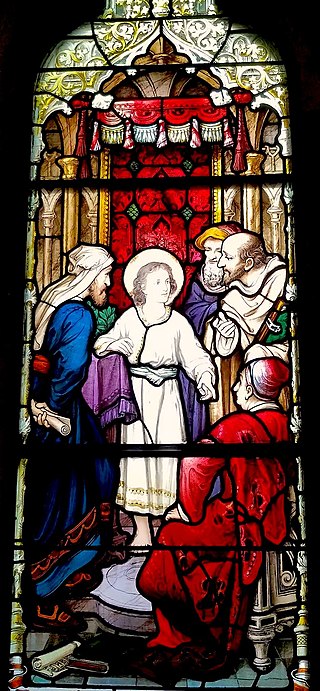
Church window at the Church of the Good Shepherd, Rosemont, PA

The story of Jesus in the Temple at the age of twelve (Lk. 2: 41–41) is unique in the New Testament in that, being the only story about Jesus as an adolescent, it is also the only text that gives us insight into Jesus as a developing person. The infancy narratives show Jesus as a vulnerable baby and stories of Jesus as an adult, thirty years of age, show a pretty steady portrait of Jesus although a few stories hint at some change in Jesus’ perspective, such as the story of the Canaanite woman. (Lk. 18: 1–9). The big turning point in Jesus’ life was the baptism when the heaven’s opened. This was clearly a powerful experience that oriented him for the rest of his life and solidified his identity. It is well-known that early adolescence is a time of transition and a growing sense of identity, and Luke shows us the beginnings of the identity that was firmed up by his baptism.

The biggest transition for an adolescent is to move from parental care and authority to a growing independence in calling the shots for one’s own life. This is a transition that both parents and children have to navigate. That Jesus’ parents assumed that their son had rejoined the caravan for the return trip from Jerusalem (a poor assumption) suggests that they were indeed letting go and giving their son some responsibility for himself. If Jesus had been younger, they would have made sure the boy was with them before the caravan left. As for Jesus, it is obvious that he made an independent decision on his own initiative. This independent choice led to a new dependence beyond his family as Jesus felt drawn to the temple and took advantage of the opportunity to learn and sharpen his own growing insights in conversation with the elders. Although Jesus would, as an adult, have an adversarial relationship with many of the same people, at this time in his life, Jesus asked questions, listened carefully, and weighed the answers for what they could teach him. As often happens with adolescents, Jesus seemed to assume that his parents would know where he would be, another poor assumption..

That Jesus was drawn to the temple and to conversation with the elders indicates that he had a growing sense of a vocation deeply involved with the religious tradition of his people and the time to begin preparing for it had come. When his parents found him, he showed himself to be firm in this growing sense of vocation when he said: “Did you not know that I must be in my Father’s house?” (Lk. 2: 49) Like many adolescents, Jesus failed to make himself understood to his parents. Not wishing to be a rebellious adolescent, Jesus returned to Nazareth and “was obedient to them.” (Lk. 2: 51)

The insights into adolescent psychology are pretty good for a writer who had no opportunity to take a course in developmental psychology, but that is not the point of the story. What is important, and something we should ponder, is that Jesus, as truly and fully human as well as divine, developed as a human being as every human being develops. As with everything else human, Jesus leads us through his own human experience in our own navigating of transitions in life.

God’s Christmas Gift

How can God possibly become a real and true human being? We don’t know. God knows, but God isn’t telling. That is probably because I can’t imagine God giving an answer that would be intelligible to humans. All we know is that God became a human being. Impossible, right? Well, if it really happened, then it isn’t really impossible; it just seems that way. And it is indeed impossible for humans. Only God can do this trick.

So what’s the big deal about God becoming a human being? The big deal, which is an infinitely big deal, is that humans can become God. Impossible! Well, yes. For humans it most certainly is impossible, notwithstanding the many people who have thought they could and failed for all their delusions. Once again, only God can do this trick.

Many Christians are astonished at the prospect although this belief goes back to the early Christian centuries and is enshrined in the second Epistle of St. Peter where Peter says that we become “partakers of the divine nature.” (2 Pet. 1:4) It sounds as presumptuous to some as it sounds impossible, and it is presumptuous and impossible if one thinks in terms of humans having divinity within themselves that they can tap into at will. (Hence the many failures.) But note that I said it is only God who can do this trick. And it doesn’t mean we become “god” in some sort of fusion. If we dissolve, there is no relationship between ourselves and God ,which is a prerequisite for participation in God’s nature. Becoming partakers of the divine nature is a gift which God makes possible by entering human nature and becoming a human being. The thing about a gift is that there must be both a giver and a receiver. So the question is: are we willing to receive the gift of God’s nature or not?

The question is pretty abstract in the terms discussed so far, but the story of Jesus’ birth in Luke brings the question down to earth. By setting the story in the context of the Roman Empire’s exertion of power through the census taken by Quirinius, Luke sets the stage for what the world is like, the world that will welcome Jesus and the gift of deification–or not. That the only shelter Joseph could find when Mary delivered her child was a stable, suggests that Jesus was not welcome to this world, a point made also in John’s Gospel. (Jn. 1: 11-12) The ubiquitous manger scenes make this setting very sweet and romantic, but if one were to feel the cold and smell the smells, it wouldn’t be so romantic. The story emphasizes the vulnerability of the child in spite of that child’s being God, capable of sharing his godhead with us. So far, only Mary and Joseph have welcomed the child into world and are taking care of him as well as they can. In contrast to this stark scene, we have the shepherds in the field seeing the Glory of the Lord and hearing the singing of the heavenly hosts. This reminds me of the double level in Revelation which draws the contrast between the human violence on earth and the rejoicing heavenly choruses in Heaven. For all their fear, the shepherds also receive the Christ Child. At this point, the only welcomers comes from the bottom of society, with the shepherds being the dregs. No red carpets from royalty or even a decent shelter offered by somebody of modest means. So if we think we are above the lowest rank of society, how about us? We should worry that it is easier for a camel to get through the eye of a needle than for a well-healed person to accept the gift of deification.

During Jesus’ life, we see much welcoming as crowds of people follow Jesus to receive healing and to listen to his words. Many of them are of the lowest classes but there are a few higher-ups who welcome Jesus, at least up to a point, with Simon the Leper being an example. But with the religious and political leadership, not so much. Religious and politicians should ponder this. When the Empire struck back after Jesus cleansed the temple, the welcome of just a few days before evaporated and Jesus died on the cross, alone, or almost alone. Not much of a welcome there.

There is more to welcoming God than welcoming a certain baby born in a stable some two thousand years ago. We can do this sentimentally in prayerful exercises and then get on with life. But if we really welcome God, we welcome everything Jesus said and did throughout his life. Which is to say we welcome the self-giving of God entering humanity, and we don’t try to become “god” on our own terms since welcoming God’s humanity involves welcoming our own. More challenging, we must welcome everybody else, even if they don’t welcome us, since Jesus welcomed them and still does. More challenging still, the gift of God’s nature means serving others, not asking them to serve us. Receiving the gift of God’s divinity gives us the gift of rejoicing with the heavenly hosts who sang to the shepherds, but it also gives us the gift of poverty and the vulnerability of a stable and then the vulnerability of the cross. The gift of participation in the divine nature is free, but it is also just as costly for us as it is for God.

Preparing the Way of the Lord

Advent is an odd sort of beginning for the liturgical year. In one respect , it is the beginning of the story of Jesus, starting with his conception and St. John the Baptist’s preaching as a forerunner of Jesus, but in another respect, Advent is thought to be about the end of the story, the end of the world with the “second coming” of Jesus. Or is it? John the Baptist is a transitionary character who points to a great good God will do without knowing what it is going to be. Might the “end” of the story really be another transition? Malachi’s image of God being like a refiner’s fire (Mal. 3:2) sounds ominous and violent, a perfect image for God burning up the world in a fit of anger. But a refiner’s fire is not destructive; it is constructive, even healing. As a refiner’s fire restores metals to their best condition, God’s refining fire purifies the sons of Levi so that they can offer their sacrifices. The refining fire is not an ending but a new beginning. In what other ways might the ministry of John the Baptist be a new beginning for us today?

Luke has John begin his preaching with a quote from Isaiah which stands by itself with no elaboration. John’s quote features the leveling of valleys and mountains in order to “prepare the way of the Lord.” The image of leveling can be threatening as it calls up fears of violent revolutionaries leveling everything to the ground out of anger and resentment. But this is not the kind of leveling Isaiah and John are envisioning. Isaiah was proclaiming the leveling of valleys and mountains in order to remove the obstacles between Babylonia and Jerusalem so that the Jews could return safely to their homeland. The way to prepare for the Lord, then, is to remove obstacles that we put between each other. In an online discussion of this reading, it was suggested that one way we smooth the way for others is to create barrier-free access for handicapped people although it was noted that we still have more progress to make since the distance of a barrier-free route can be quite extensive. In any case, this image gives us a small parable of the greater project of removing obstacles placed in the paths of the helpless. One way to do this would be to pass legislation that makes voting easier for people instead of harder. On paper or in a spoken sermon, removing barriers may sound like a calm action, but in reality, we are, first of all, removing obstacles in ourselves that cause us to stumble in the way of the Lord. Since we are likely to find that many of these obstacles have been mistaken for parts of ourselves instead of invasive infections, removing these obstacles may well feel like being refined by fire. Another way to say the same thing is to note that the Way of the Lord is from Empire whether in the household or a nation-state (Babylon) to Jerusalem, the freedom of a new beginning of life without obstacles between each other and God. Hence the importance of Luke meticulously listing the imperial rulers three times in the first three chapters of his Gospel.

In parallel to John’s introducing his ministry with an otherwise unelaborated quote from Isaiah, Luke has Jesus inaugurate his ministry with another quote from Isaiah: “The Spirit of the Lord is upon me, because he has anointed me to bring good news to the poor. He has sent me to proclaim release to the captives and recovery of sight to the blind to let the oppressed go free, to proclaim the year of the Lord’s favor.” We do well to place these two quotes side by side as they add up to a fuller program of preparing the way of the Lord by freeing the oppressed from the obstacles we place before them..

In John’s Gospel, John the Baptist famously said of his relationship with Jesus: “He must increase, but I must decrease.” (Jn. 3: 30) As my confessor of many years reminded me often, we must be like John the Baptist: decreasing so that Christ may increase within each of us. Letting Christ increase in us, of course has us decreasing ourselves by removing the obstacles in ourselves so as to prepare the way of the Lord.