Blueprint of the Kingdom

buddingTree1The blueprints for a building are a lot less exciting and interesting than the building itself. However, blueprints are useful for showing the fundamental shape and structure of the building at a glance. The readings for Epiphany 3A are more like a blueprint for the Kingdom of God than a tour of the Kingdom in its fleshed-out form.

In Mt. 4:17, Jesus says:  “Repent, for the kingdom of heaven has come near.” Repenting does not mean to make a laundry list of our little sins and try to stop doing them. Repenting means to turn around, to switch our minds and our hearts, to see life in a new way. This is the fundamental thrust of the Kingdom. But what specs can we get from the blueprint?

The quote from Isaiah, especially the part about Zebulun and Naphtali may not seem exciting but they show some important shapes in the blueprint. These places in Galilee are Gentile territory, lands of the enemies of Israel, lands that were occupied by the Assyrians in their invasion of Israel. The darkness has to do with the power and might of military occupation and enmity between peoples. Isaiah’s saying that God broke the rod of the oppressor as on the day of Midian suggests that God’s Kingdom will free us from military force that inevitably creates darkness. Reconciliation with the Gentiles involves forgiveness for past wrongs, even past atrocities such as those committed by the Assyrians and then the Romans in Jesus’ day. Matthew notes that Jesus moved to this area of Galilee after Herod’s arrest of John the Baptist, another instance of Roman oppression. One might feel this is not applicable to most of us because most of us are not high government officials or military leaders. However, all of us live either in a country bursting with military might or in a country that is in some way, perhaps economically, occupied by another. That means we need to turn away from anything that contributes to the enmity this situation creates and start breaking the yokes we impose on each other.

In First Corinthians, Paul gives us another example of darkness that is very close to everyday life for all of us. The church is in conflict with its members using slogans such as: “I belong to Apollos!” “I belong to Cephas!” One could say that this is war on a small scale but the darkness is the same as that created by the Assyrians and the Romans. Paul suggests that the light of the kingdom which Jesus is bringing near is to be “united in the same mind and the same purpose,” which for Paul is the mind of Christ, whose cross is foolishness for those who are perishing in the darkness of violence but is the power of God for those being saved.

The “power of God” doesn’t look much like power as we usually understand it. It isn’t exactly a large-scale military invasion like D-Day. In fact, it is quite the opposite. But the cross is power in the sense of shedding light in the darkness which John says the darkness cannot overcome. The light reveals the darkness of the military might of the Assyrians, the Romans and all else who imitate them. The light also reveals the hatred of victims for their oppressors, however understandable, for what it is: a wall of enmity that perpetuates divisions between people. As I struggle with my almost constant anger at many politicians in this country for their misuse of power and the public trust, I have to repent of this anger minute by minute.

Where does this darkness come from? Isaiah and Matthew are not portraying darkness as part of the created order in the sense that night time is natural. This is not darkness that God made, or in fact had anything to do with. This is darkness as a human creation. It is human beings who organize armies to oppress people or who tear congregations apart with petty party politics. This sort of behavior is highly contagious. The more people build walls or fight, the more people feel the need to build walls and fight.

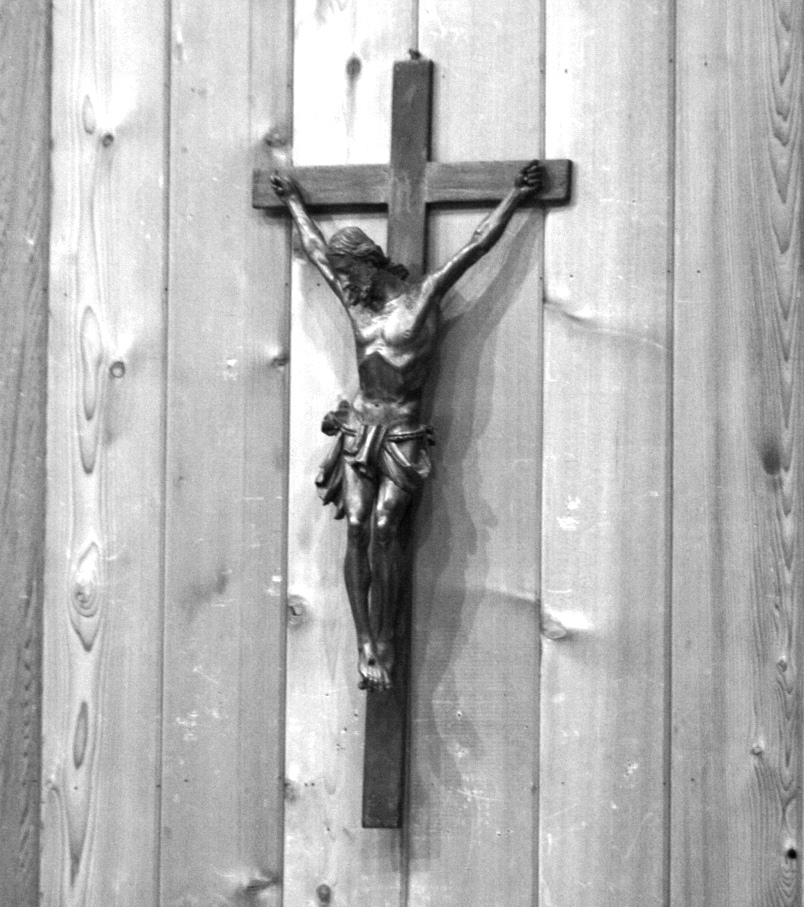
What does the Kingdom of God, founded on the foolishness of the cross look like? The blueprint we have in these readings doesn’t look like much, but then a crucified criminal in Roman times doesn’t look like much either. When we read just a bit further in Matthew, we enter the real-life rooms of the Kingdom outlined in the blueprint. We find many rooms, many mansions, all of which offer contagious possibilities such as being blessed for being poor or for being a peacemaker, or turning the other cheek or walking the extra mile, and then finding in these weaknesses the rock that supports the house of faith we are building against the storm of Rome and Assyria and the power brokers of our time.

Myth Become Fact

crosswButterfliesOne of the more memorable phrases culled from C.S. Lewis is Christ is “myth made fact.” The notion kind of sneaked up on Lewis during the process that lead to his conversion to Christianity.  An offhand remark by his friend T.D. Weldon, a fellow Oxford don and, like Lewis at the time an avowed atheist, made a deep impression on him over the years: “Rum thing, that stuff of Frazer’s about the Dying God. It almost looks as if it really happened once.” Of course, that is precisely the claim of the Gospels.

Lewis’ insight is worth comparing with René Girard’s view of Jesus in relation to mythology. Girard, of course, also studied Frazer’s writings about deities, mainly vegetative deities, dying and rising. Frazer, seems to have absorbed Jesus into the other myths, blurring the distinction between them. Girard, on the other hand, believes that both the myths and the Gospel accounts refer to real events. Here, he also differs from Lewis who seems to have thought of myths as something like cosmic poetry, dealing with timeless truths, such as the vegetative cycle in temperate climates where nature, like Persephone, dies and then rises again. For Girard, all myths, in their origins, are made fact.

Girard’s thesis of sacred violence asserts that social tensions in early societies were resolved, if they were resolved at all, by collective violence that was very real. Mythology then became something of a cover up of this event while still alluding to it. The rising from the dead in such mythology would be the deification of the victim who, in retrospect, was seen as the solution for the problem for which the victim was earlier blamed. Tying such mythology into the vegetative cycle raises suspicions for me that this development, if it did not originate in agricultural societies, was greatly furthered within them. After all, the claiming of land by a tribe would easily inspire other people to desire that land. In such a setting, social tensions leading to the victimage mechanism would happen much quicker than in hunter/gatherer societies. Girard’s thesis also suggests that the real cycle is not in nature but in human activity. That is, an act of collective violence holds a society together for only so long before it needs to happen again. The mythological cycle, then, is a vicious cycle.

For Girard, then, the Gospel narrative of Jesus dying and rising is not the historicization of a timeless truth, but an instantiation of a scenario that had been happening in reality, in time, since the dawn of humanity. What’s new about the Gospels is that the story is told straight out and the victim is claimed to be innocent and was unjustly murdered. For Girard, it isn’t so much a case of myth become fact as the truth behind myth revealed.

As a Christian, Lewis retained sympathy for the myths of dying and rising deities, regarding them as great poetry. Girard, of course, is not so affirming of mythology, as he sees it as obscuring the truth. However, Girard’s point of view does not necessarily mean that myths are bad poetry. Moral goodness and ascetic goodness are not equivalent, after all.

There is a deeper reason though for being open to Lewis’ sympathy. It was the pathos of a deity like Balder who was killed through collective violence that moved Lewis, and it was the same sensitivity that should make the passion of Jesus deeply moving as well. (Interestingly, Lewis went through a period where the dying pagan deities moved him more than the story of Christ; perhaps a residue of his resistance to conversion.) Although a myth such as that of Tiamat, who was blamed for Babylon’s primordial chaos and torn to pieces, does not try to inspire sympathy for a victim the way the Psalms of Lament do, we can see a woman victimized by the people who made a strenuous effort to avoid seeing what they were doing.

There is a deeper reason for sympathy for myth. Deplorable as the countless acts of collective violence were and continue to be, Girard’s thesis also demonstrates how profoundly people were caught up in this mechanism so that they could not escape without intervention from God. It is precisely this intervention from God to free humans in bondage that Paul celebrates time and again in his epistles. If we need this intervention from God in Christ, then we are hardly in a position to be judgmental against the first humans that fell into the same traps we do.


The Class Comedian

sideAltarsIcons1When I was in grade school, we had a class comedian. I took it for granted that there would be a boy in our class who would cut in with funny remarks that more often than not raised our teacher’s ire. It seemed normal to me that this would happen. I was glad to have a class comedian for a couple of reasons. One, he was entertaining. Since classes could be tedious at times, it was nice to have things lightened up from time to time. Two, there was a certain satisfaction in seeing one kid in our class being the one who got in trouble frequently as long as that person wasn’t me.

It so happened that the came when our comedian announced to our teacher and the class that he was moving to another school district and a few days later, he was gone. I remember consciously thinking that we would need a new class comedian and I even knew who it was going to be. I was right on both counts. The very boy I expected to move into the role did that just. (He had acted a bit the part of understudy before this.)

When I think back on all this, it becomes clear that the class comedian, although disruptive at times, was actually a nice kid. He was never mean to anybody as far as I can recall. He didn’t have much in the way of friends although I spent a little time with him. He deserved better in that respect. I knew his family was broken and that sort of thing leads to some children acting out. Much the same could be said for the boy who took over the role of comedian, although he had a bit more of an edge to his personality.

I suppose one might say my insight was a bit precocious; I really don’t know how many other kids in my class had that awareness, if any. On the other hand, any pride over this insight drops down precipitously as I admit that I consciously participated and inwardly affirmed this situation.

Like many children, I was not a stranger to scapegoating activity. I was myself the butt of scapegoating among these same children. That did not happen during class where I was very docile and obedient and rarely in danger of being on object of opprobrium from a teacher. My social adjustment as a child was not particularly smooth and it became harder when my strangeness got connected with my surname so that I was “the man from Mars.” Perhaps it made me feel better that someone else was the class scapegoat in certain respects. Maybe it made it easier for me to be docile because somebody else was acting out on my behalf.

A year or two later, there was a different scapegoat. He wasn’t a comedian or a disruptive presence. He was not as attractive as some kids. Somehow, he rubbed our teacher the wrong way and this boy never had a chance to make it right. I didn’t get the same satisfaction from this boy’s scapegoating; it was not entertaining and at some level it seemed unfair. I suppose I might have been more troubled if I didn’t happen to have a pretty good relationship with this teacher myself. I know see this favoritism as unfair and that I was overrated by this teacher, to detrimental effect in junior high where my limitations showed up. In many ways, he was a good teacher, but the pattern of there being a class scapegoat showed up with other classes he had. One of the most hurtful things that ever happened as a child was at the hands of the music teacher at our school who was also prone to scapegoating behavior. She singled me out for ridicule by showing the class a man on a flying carpet and telling the class that this was me, flying off to dreamland. Another example of a teacher being the scapegoater.

All of these reflections show how easy and insidious for a social group like a class in school, to instinctively gather unity through scapegoating one person or another. It is all the more disturbing to realize that teachers fall into the role of scapegoaters, reinforcing what the children are doing. We all need to get in touch with memories such as these to understand ourselves and to help us overcome the systemic needs that continue to haunt us

The Name of Names

crecheOne important feature of a name is that it identifies us and sets us apart from other people. Names do not just identify us individually; they also give us context, such as where we come from. Medieval names such as Francis of Assisi were like this. Names also identify the culture we live in and come depending on where we have German names, Japanese names or Scottish names such as mine. Within a national identity, our names tell others what families we come from such as the Smith family or the Bach family. Not only the surname but our first and middle names often repeat names used in the family. My baptismal name Robert is also my father’s name, for example. In mythology, deities tend to have names such as Zeus, Thor or Vishnu. These names designate distinctive personalities which are basically human, if writ large. The thing about names in all these cases is that each person who has a name, whether a dog, a human, or a deity is finite, a part of the world.

When it comes to speculating about what being may have created the world, we suddenly become very shy about names. We might use a term such as The Father Who Made us All or a term such as God which precludes having a particular name such as Zeus. When Moses asked the deity who spoke to him out of the burning bush for a name, the answer was Yahweh, which really was a non-name as it meant something along the lines of: “I am being what I am being.”

These considerations make the following verse from Luke’s Gospel astounding: “And at the end of eight days, when he was circumcised, he was called Jesus, the name given by the angel before he was conceived in the womb.” This boy was/is also the Logos who was with God in the beginning and without whom nothing was made that was made according to the Prolog to John’s Gospel. The term Logos is another example of not naming the unnameable creator of the universe and yet this same Person without a name “emptied himself” as Paul said in Philippians, so as to be born as a human being. As a human baby, the unnameable was named, a name stamping him with a particular culture and a particular family. The circumcision of this body is yet one more cultural marker.

So deep was the Word’s immersion in humanity, that he humbled himself and was “obedient unto death, even the death of a cross.” The result of this descent was that the crucified Logos was raised up and the ordinary Jewish name he bore has become “a name above every name,” a name to which all humans should bow. And yet it is because the unnameable became human and nameable that this name is so exalted and awesome to us, all the more awesome in that we resist the lowliness of the Logos through whom we ourselves were made.

Unwrapping the Future

crecheThe yearly cycle of celebrations and commemorations adds solidarity to our experience of time. Christmas, a holiday especially laden with traditions, is a particularly strong anchor, assuring us that everything is as it should be for all eternity. Amen.

One of the traditions of Christmas, however, is the giving of charity. That is a very good thing, considering the needs for generosity, and it helps that once a year, people have a custom of dwelling on such matters. But the need for such charitable giving suggests that not everything is as it should be. If huge efforts by charitable organizations have to be made to assure that no child is deprived of a Christmas, then obviously there are serious social problems that need to be addressed. That is, this cozy traditional holiday poses a challenge for the future.

Manger scenes with the new-born Jesus lying in the straw tug the hearts of many and have been a focus of devotion since St. Francis of Assisi introduced the custom in the twelfth century.  But the whole point of this nativity story is that Jesus was born in the stable because nobody had room for his mother, father, and himself. This is not business as usual. It raises the question: do we really have room for Jesus in our lives? Do we really have room for all the children being born and for their families?

The angel announced to the shepherds proclaimed that this newborn child was the savior, the Lord who was going to usher in a new era of peace. That may sound innocent when we hear this read in church today, but at the time, the Caesar thought he was the savior and he didn’t have room for somebody else to do his job! Of course, he was a savior and keeper of the peace his way, with military and cultural might. The story of the shepherds, then, challenges us to consider who really is our savior and the model of peace for us. Do we keep peace the imperial way though violence to keep everybody in line? We don’t have to have imperial armies to take this approach. All it takes is a drive to control people, by force if necessary. Or do we follow peace Jesus’ way, through vulnerability as a newborn child all the way to the cross and then the Resurrection where Jesus creates peace through forgiveness.

A major cog in the engine of Caesar’s peace in Jesus’ neck of the woods was King Herod. Killing all the baby boys in Bethlehem may not look like a peaceful action, but Herod was keeping the peace, imperial style. Most of us may think Herod a bit extreme, but if we are willing to sacrifice anybody who seems to threaten our control of life, especially the young, we are going the way of Herod, the way of Caesar. Jesus, although he had the power to send legions of angels against Herod, remained vulnerable, dependent on human protection until the time came to suffer the fate the boys of Bethlehem suffered.

All of this may be a downer for a joyful holiday, but the good news is that Christmas is a yearly wakeup call for renewal of life, a renewal fueled by the divine energy of a human child born over two thousand years ago. Everything that was wrong with the world at the time is wrong with the world now and a lot more. We can keep on going in circles if we want, but we have the chance to step off the not-so-merry-go-round and embrace the Christ Child. We will find that the Christ Child has a gift for us. If we dare to open it up, it is a gift for an open future that we can have if we really want it.

See also, Celebrating the Prince of Peace and The Word Became Vulnerable Flesh

I Me Me Mine

abyssEach of us knows what my own self is, right? Yeah, my self is right here, right inside of me, running my life. My self is who I am. What could be more obvious? “Everyone’s weaving it, coming on strong all the time!” Hmm. Who is doing the driving, who the weaving. “I-me-me-mine” is doing it according to George Harrison put it? So where is my self in all this?

If René Girard is right, then the human self is not in the midst of our desires, I-me-me-mine, where we tend to locate it. Rather, we derive our desires from the desires of other people and they from us. (See Mimetic Desire and Mimetic Rivalry) Well, we don’t want other people driving our desires or snatching ours away, so we fight back, insisting that I-me-me-mine is the one who wants whatever it is and others are copying I-me-me-mine. The problem is, the whatever-it-is falls away as a desire defining the self and the entire self of I-me-me-mine is embroiled with this rival. Some autonomy. So, I-me-me-mine will try refusing to desire what anybody else desires. This is resentment. Of course, resentment I-me-me-mine me into the enemy’s desire since opposition to a desire is as strong a driving motor as combat over the desire. (See Resentment)

This spiral of desire tilts I-me-me-mine to the abyss that shows this desiring self to be an illusion, a void. While reflecting on Chuang Tzu’s Taoist writings, Thomas Merton suggested that “it is the void that is our personality, and not our individuality that seems to be concrete and defined by present and past, etc.” This “not-I” is seen by Chuang Tzu and Thomas Merton as a source of freedom, but “we are completely enslaved by the illusory.” (Merton & the Tao)

In New Seeds of Contemplation Merton warns us that “every one of us is shadowed by an illusory person: a false self. This is the man I want myself to be who cannot exist, who cannot exist because God cannot know anything about him.” The false self a.k.a. I-me-me-mine, is constantly in rivalry with other false selves who have the same alias. “All through the night, all through the day, everyone’s saying it, flowing more freely than wine.” Like Merton, George Harrison warns us that an epidemic of desire threatens to flood the whole world.

We aren’t lost in this abyss of “not-I.” If we let go of the matrix of desires that I-me-me-mine clings to, than we find ourselves called by name. This calling voice asks us why we are persecuting him? Persecuting? We weren’t doing nuthin’. I-me-me-mine’s desire machine blinds us to what we are doing to other people, all of whom Christ identifies with.

When we answer with our names to the voice in the abyss, the self is still not-I, but that does not matter because the Persons of the Trinity are filling this void with their forgiving love that clarifies what all this forgiveness is about.

Well, Jesus did say something about dying in order to live.

Whose Axe? Whose Winnowing Fork?

220px-John_the_Baptist_Prokopiy_ChirinAfter centuries without a prophet, a wave of expectation flooded Judea and Galilee. A man dressed the way Elijah was dressed rode this wave and pushed it along with his boisterous preaching. “Repent, for the Kingdom of Heaven is near.” What sort of kingdom did he expect? The call to repent tells us only that we must turn from the direction we are going and move into a different direction. Question the ways we live and look for a different direction.

Two astounding prophecies by Isaiah offer us intriguing, inspiring, but puzzling hints about what the Kingdom might be when he urged us to turn “swords into plowshares” and “spears into pruning hooks” so that we “study war no more” as the spiritual says and that “the wolf shall live with the lamb.” So, now we have all of creation at peace? Not quite. Isaiah tells us that the “shoot from the stump of Jesse” will “smite the earth with the rod of his mouth, and with the breath of his lips he shall slay the wicked.” Apparently taming lions and tigers and bears is easier than taming predatory humans. In calling the Pharisees and Sadducees, “that brood of vipers,” and asking who told them to flee the “wrath to come” while an ax was “laid at the trees” and his successor would have “a winnowing fork in his hand” suggests that they were not as tamable as predatory animals. The predatory lenders of today seem just as untamable. However, surely the kingdom of Heaven was not wrath of this sort, even if John, like the prophets before him, thought such wrath might clear the way for Heaven’s Kingdom.

As soon as he is baptized by John, Jesus cries out precisely the same words: “Repent, for the Kingdom of Heaven is near.” By saying these same words, is he perhaps telling us that John the Baptist, of whom there is none greater born of woman, hasn’t quite set the right direction either. His baptism has taken him on a very different track: the Paschal Mystery. That may seem a bit anachronistic, but from the preaching the Sermon on the Mount on, Jesus takes the direction of absorbing violence rather than inflicting it. Not only does the Kingdom not consist of threshing out the bad guys with a winnowing fork and burning them, but such threshing doesn’t even pave the way to the kingdom. If anything, this violence only blocks the way for everybody as, in our righteous indignation against predatory lenders and their ilk, the axes and fires for burning chaff multiply. One might argue that Jesus himself had some choice words for the Sadducees and Pharisees. However, Jesus called them whitewashed tombs filled with people’s man’s bones. Jesus wasn’t chopping off their heads or burning them up; he was warning them about how dead they were. If Jesus isn’t a thunder deity carrying a battle axe, whose axe is laid to the tree?

In his lectionary commentary, Paul Nuechterlein provocatively suggests that the axe is wielded by us. It isn’t God but we who are chopping down trees all over the world. That is indeed what happened on Mount Calvary. Moreover, according to Isaiah, it is from the stump that new life emerged. So, whose wrath should we flee? Ours. What should we run to? How about the chopped stump from which the new Tree of Life is growing?

Eucharist (3): Discerning the Body

eucharist1St. Paul solemnizes his recounting of Jesus’ breaking bread and passing the cup of wine by saying that he is passing on to the Corinthians what he had received from the Lord. The words Paul uses here are specialized terms for receiving and passing on a sacred tradition. The only other time Paul uses these terms is to testify to Jesus’ Resurrection appearances. Resurrection and eating and drinking to “proclaim the Lord’s death until he comes” go together. After all, does not the Lord come every time we eat the bread and drink the wine?

These solemn words are an island of peace and tranquility in the middle of a storm of human passions amounting to farce. Preceding them is Paul’s denunciation of the insensitive and chaotic eating habits where some people bring opulent meals to church and eat in front of poorer members who have little or nothing to eat. The deterioration of the sharing in the wilderness that began in John’s Gospel has only gotten worse. After holding up Jesus’ shared meal as a model, Paul warns against eating and drinking judgment by “not discerning the body.” Paul may be warning us not to fail to discern Christ’s body in the bread, but he is not thinking in individualistic terms. Christ’s body surely refers to the church and, given the context, Paul is concerned with failure to recognize this corporate body in the way we share, or fail to share what we have with the community. In his fit of tempter, Paul seems to suggest that the Body and Blood of Christ make people sick cause some to die. But considering how strongly Paul insists on God’s freed Gift of grace, Christ Body and Blood can only be more free grace and forgiveness. However, when we fail to see the Body and Blood in Christ in others, sickness, hunger and many more social ills will abound.

With a church in shambles, is the miracle of the Feeding in the Wilderness a distant memory? I noted in the first article in this series that memory is not just recalling something in our heads. Memory is making present. When we eat the death of Jesus, we enter into our own discord that tears the Body apart with cries such as “I am of Cephas!” “I am of Apollos!”  When we eat the Resurrection of Jesus, we eat the forgiveness with which Jesus greeted is disciples to gather them back together. We also eat the feeding in the wilderness and Jesus’ Desire to heal the people brought to him.

We are not left as orphans who have to try to stuff some ideal of human relating into our heads. We are invited to act with others the human drama of entering into God’s Desire for ourselves and all others. Most important, we are fed with the substance of God’s desire to quicken us on the way.

 Eucharist (1): Christ our Passover

Eucharist (2): Feeding in the Desert

Eucharist (2): Feeding in the Desert

eucharist1The feedings of the multitude in the wilderness give us a vision of the new life that baptism initiates us into and which the Eucharist sustains. (See Divinely Created Abundance) The multiplication of food through both divine and human generosity is quite the opposite of the accusatory, slave-driving society of Egypt or the chaotic violence before the Flood. All six Gospel accounts remind the reader of God’s gift of manna in the desert after the escape from Egypt. It is John’s Gospel that makes this connection most explicit. Just as the manna needed to be renewed each day, we need to be renewed by the Eucharist on a daily, or at least weekly, basis.

It is also John’s Gospel which warns us of how easily we fall away from living by mutually gifting back into contention and rivalry. First, John says that after declaring Jesus the prophet who was to come, the crowd tried to seize Jesus and make him king. Jesus had not modeled a way to rule over other people. Quite the opposite. Jesus had modeled a way of self-giving without rivalry. This is the way of life that should rule us. Making Jesus a political ruler could only drag him and his followers (us) back into the violently competitive life that baptism delivers us from. Then, the people (i.e. us) murmur against Jesus when he tells us that he himself is the bread come down from heaven. We murmur a lot more when Jesus says that we must eat his body and drink his blood. Murmuring is the very same word used of the Jews who contended with Moses and God in the desert.

We could take the murmuring as referring to the bitter arguments over the Christian centuries as to whether or how Christ can be present in the bread and wine. It seems to me that we should take Jesus at his word here and accept that he feeds us with his death and resurrected life. That’s the hard point; not the metaphysics of the “real presence.” We balk at the idea that Jesus’ death and his ongoing resurrected life can feed us. It’s like Jesus body and blood are poison to the kind of life we’re accustomed to living, which they are.

It is typical of John’s slantwise means of conveying the Gospel that he puts Jesus’ discourses about eating his body and drinking his blood in a context outside of the meal in the upper room. This has the advantage of stressing the ongoing nutrition Jesus offers in the Eucharist. Curiously, this separation also seems to spiritualize the Eucharist in terms of Jesus dwelling in us to give us life, but this comes with a shocker that English translations cannot convey. The Greek word for “eat” is trogein, a very strong verb that doesn’t mean dining nicely with good manners. It means to chew, gnash, grind. Jesus comes right in our faces with our eating as a sacrificial act. We are to be painfully mindful of the sacrificial way of life we left back in Egypt but, unfortunately find ourselves carrying with us through the desert.

The sixth chapter of John ends with most of Jesus’ followers leaving because of these hard words. By being food that nourishes us by reminding ourselves of how sacrificial we tend to be, Jesus is indeed refusing to be the king who fixes everybody else’s wagons that we want him to be. We have wandered far from the community of sharing and giving that began this chapter, the place where Jesus wants us to be.

See Eucharist (1) See Eucharist (3)