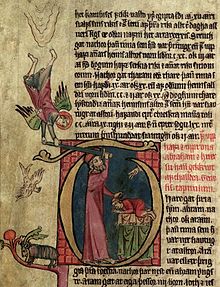
 When the story of the near-sacrifice of Isaac was first told to me in Sunday school, the teacher prefaced the story by saying that in biblical times there were people who made sacrifices to “god” and some people even sacrificed their own children, but God decided to teach Abraham that he should not do that. The story was troubling but it was comforting to know that God did not want such an awful thing. Between that and being told around the same time the story about Jesus inviting the children to come to him did much to instill in me a trust in God as deeply loving from an early age. Since then, I’ve come across many learned scholars who think such an interpretation of the Isaac story is simplistic. Who’s right?
Christian exegetes in the early Christian centuries softened the story to some extent through a Christological interpretation where Isaac is an antitype of Christ, the Son who was willing to lay down his life. Such an understanding continued in folk tradition where the English Miracle plays dramatized the story of a pleading child wondering if he really was that naughty and then becoming reconciled to his fate.
Such an approach is still troubling but it makes some effort to draw back from the notion of an violent and arbitrary “god” who really would make such a command to Abraham. Unfortunately, later medieval and Reformation theologians shifted the emphasis back to Abraham and his anguished “obedience.” Such an emphasis falls deeply into the tragic pitfall of a sacrificial atonement. While even St. Anselm, who set in motion this theological tendency, still emphasized the Son’s love of humanity in laying down his life, Luther and Calvin emphasized the Father’s sacrifice of his Son with severe violence with the Father taking his anger over human sin out on his Son. Martin Luther, for example was very stern in saying that in no way was it legitimate for Abraham (or us) to question what God orders, no matter how unethical the command. In Fear and Trembling, Søren Kierkegaard’s pseudonymous author calls this kind of obedience “the teleological suspension of the ethical.” Many think Kierkegaard supported that position but in fact, this suspension of the ethical is not faith. Abraham is a “knight of faith” because he does not kill his son but receives him back from God. This treatise then is actually Kierkegaard’s first salvo in dismantling a sacrificial understanding of atonement such as Luther’s. The highly convoluted arguments of this book end up in roughly the same place as my Sunday School teacher.
The French thinker René Girard is very helpful in helping us deal with this troubling story. He theorizes that since the dawn of humanity, societies have dealt with systemic conflict through uniting against a victim who is blamed for the crisis. This initial act of mob violence, repeated time and again was institutionalized into rites of sacrifice. Children were frequently among the victims. The Maya, for example, thought that the children’s tears would bring much-needed rain. This social factor is a startling contrast to the narrative of Abraham where he and Isaac are alone save for a pair of servants. Girard would have us see Abraham’s dilemma in terms of his surrounding culture where everybody else was sacrificing their children so that it seemed the religious thing to do. For Girard, God breaks through the collective so that Abraham, as an individual hears God’s true desire, not as an individual genius, but as a human related both to God and to Isaac and the many offspring in faith that he would beget through Isaac. So Girard also agrees with my Sunday school teacher.
When Paul says: “Therefore, do not let sin exercise dominion in your mortal bodies, to make you obey their passions” (Rom 6: 12) we tend to understand these words as lone individuals each struggling against our sinful hangups. But for Paul, the dominion of sin is the human culture that perpetuates itself through collective murder and sacrifice. This is the Gospel story Paul preached: not a story about individuals who sin, but a society that swarms with violent passion in troubled times. Such as our own time. This is why the end of sin is death. Literally.
Before the movers and shakers and the crowd coalesced to put Jesus to death, Jesus told us that; “whoever gives even a cup of cold water to one of these little ones in the name of a disciple—truly I tell you, none of these will lose their reward.” (Mt. 10: 42) Simple. It doesn’t take a professor with several degrees to understand it. And yet, the “little ones,” not just children but vulnerable people in many inner cities, do not get a cup of water that is not dangerously contaminated. Flint, Michigan is everywhere. This is the power of sin’s dominion that holds society in thrall. Jesus is telling us, as God told Abraham, that we should not sacrifice our “little ones,” but we should nurture them. Like Abraham, we have to move out of the crowd that continues to sacrifice children and then regather with those who will bring drinkable water to those who need it. My Sunday school teacher got it right.
See also: Abraham out on Highway 61
For an extensive discussion on the story, including the quote from Martin Luther, see:
Girardian Reflections on the Lectionary, Proper 8, Year A
For an introduction to René Girard, see: Violence and the Kingdom of God
and Living Stones in the House of the Forgiving Victim
 The Holy Spirit is the most obscure of the three Persons of the Trinity, not that the other Persons aren’t mysterious as well. One reason is that the Son is said to show the Father, and the Holy Spirit is said to show the Son, but that leaves nobody to show the Holy Spirit. So obscure is the Holy Spirit that it is difficult to think of the Holy Spirit as a Person at all. It is not uncommon to hear the Holy Spirit referred to as “it,” although both masculine and feminine pronouns also fall far short of the Holy Spirit’s personhood.
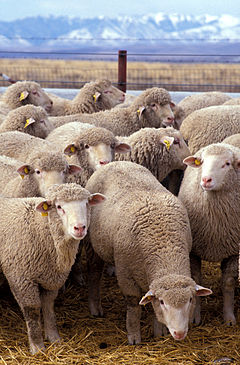 The Good Shepherd is a reassuring image. The shepherd is in charge and the sheep follow the shepherd’s guidance. When thieves and robbers and wolves come to threaten the sheep, the shepherd deals with them in no uncertain terms. Jesus’ claim to be the gate, the way in and out of the fold, gives us another reassuring image: some of us are in and certain other people are out, just the way it should be.
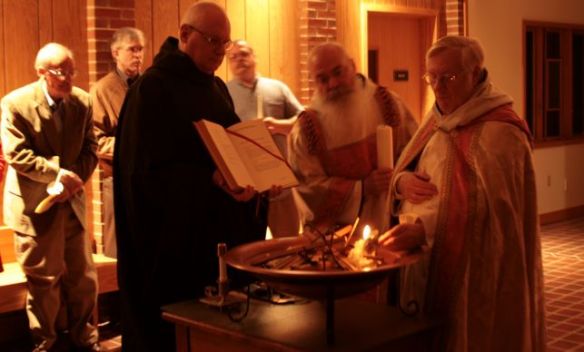 Matthew says there was an earthquake when the angel of the Lord came down, rolled away the stone of an empty tomb and sat on it. Both the earthquake and the empty tomb give us apt images for the way we experience Easter this year.
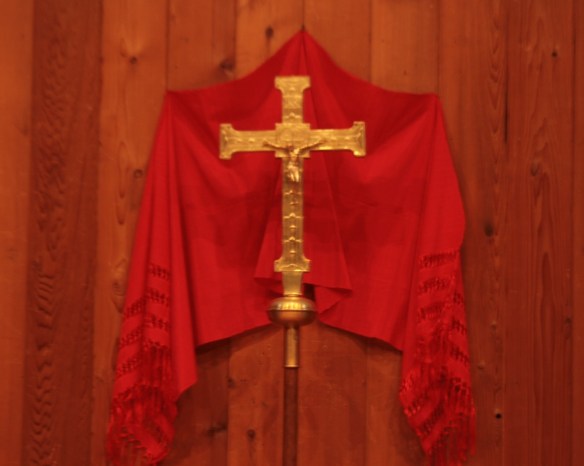 Lent is the season when we think of making sacrifices, usually small ones, like giving up a pleasure or two. This Lent, we have been called upon to make many large sacrifices because of the COVID-19 virus. The social distancing needed to slow the spread of the disease entails giving up many very good things that we take for granted. I can’t even go out and get a haircut when I need one. The disappointments through canceled events are many. For me, it’s a concert I was looking forward to and, more disappointing, a speaking engagement where I was going to present a paper I had worked on for many hours. I’m sure many others have had greater disappointments than that. It must be hard, for example for children not to be able to play freely with their friends and to be separated from grandparents. One of the greatest renunciations for committed Christians is, ironically, Church. Usually, going to Church is something one increases during Lent, but the social distancing called for right now has worshipers staying home and making do with online services. I would think this would make worship a self-emptying process as the familiar sacred space and the people one is usually with would not be there except on a computer screen.
 Recently, I read the Scythe Trilogy by Neal Shusterman. (For Girardians: Shusterman has shown much insight into mimetic desire and scapegoating in his many young adult novels.) This trilogy envisions a future where a massive computer called The Thunderhead runs the world: coordinating work, managing the healing of sick and injured people, everything except for one thing. Since people no longer die of natural causes, the population is lessened somewhat by the institution of Scythes who randomly kill people gently and without malice. This is called gleaning. The Scythes and the Thunderhead are separate and do not interact. What would a trilogy like this have to do with the Annunciation of Our Lady?
 At the end of Epiphany, we celebrate the Transfiguration of Our Lord to prepare for Lent. The vision of the glorified Christ is supposed to cheer us up for the grim days of penance and the grimmer days of following Jesus through his Passion. The Transfiguration also prepares us for Easter as it gives us a foretaste of the glorified body of the risen Lord.
 When we dip our fingers in a holy water stoup as a reminder of our baptism, how much do we really remember? Do we stop to think that the water is as explosive as the bread we receive at the Eucharist?
 The story of the Magi’s visit to the newborn Christ Child in Matthew is one of the archetypes of the Christmas season. Most popularly, the Magi are the archetypes of giving because of the gifts they brought to the Christ Child and they are often credited with being responsible for the exchanges of gifts customary during the Christmas season, even among people who otherwise have nothing to do with Christianity.
 Imaginary Visions of True Peace