
 There are many stories of kings who go about their kingdom in disguise, usually as a beggar. In such cases, whatever a subject of the king should do to that “beggar” would literally be done to the king himself. This may not have happened much in real life but it did happen when God became a true human being. Whatever anyone did for or to a certain itinerant preacher in Palestine was indeed done to God. It is important to note that in neither scenario did anyone consciously see the king or see God; one saw the beggar or the itinerant preacher.
The concluding parable of Matthew 25, the final teaching of Jesus in that Gospel, shows Christ as a king going about in disguise. Or does it? Neither the “sheep” who are welcomed into the Kingdom nor the “goats” who are sent to “the bad place” thought they were either serving or rejecting their heavenly king. What both the sheep and the goats saw—or failed to see—were vulnerable people who were starving or naked or in prison. This teaching has inspired a spirituality of “seeing” Jesus in vulnerable people, the rejects of society, the ones who are normally seen as the “goats,” if seen at all. But what is at stake is seeing the people, seeing their vulnerability, and showing one has seen them by serving them. After St. Martin had famously cut his cloak in half to give half to a freezing man, he had a dream of Jesus wearing that half of the cloak. But at the time, what Martin saw was the freezing man, and that was enough.
In his new book Stranger God: Meeting Jesus in Disguise, the therapist Richard Beck explores the ways of seeing and not seeing vulnerable people. He suggests that Jesus is prodding us to widen our affections beyond the friends and family we are comfortable with and move beyond our comfort zones. Beck covers several obstacles to such expansion, among them disgust, contempt and fear. Then comes the rub: how do we expand our affections? Beck searched through many books on spirituality for an answer until he came across the teaching of the Little Way” in the writings of St. Thérèse of Lisieux. Beck says that this “little way” seems simple until one tries it. The “little way” begins with noticing. Thérèse says that she noticed that some sisters in her Carmelite convent were saintly and popular and other sisters were difficult and ignored as much as possible: a separation of sheep and goats. Thérèse then had to move beyond her comfort zone and seek out the neglected, difficult sisters. It happens that Fr. Anthony, my novice master, taught us the “little way” of St. Thérèse as a means of teaching us how to live the Benedictine life which also depends on attending to the same details of everyday life in community. I particularly remember Fr. Anthony’s reading about Thérèse pushing the wheelchair of a crabby sister who constantly complained about every little bump in the way. When Benedict instructs us to pay particular attention to the sick and the poor in reference to Matthew 25, Benedict is telling us that being obedient to Christ entails being obedient to the needs of vulnerable people.
Edifying as this teaching of serving Christ through serving vulnerable people is, the grim sending away of the “goats” who failed to serve the vulnerable is disturbing. One way to understand this grim ending is to suggest that if our hearts shrink to the vanishing point so that we become permanently blind to the plight of vulnerable people, we end up in our own darkness. This is a salutary warning. But perhaps these “goats,” like the crabby sister in the wheelchair, are people who also need to be served through the “little way.” I wonder if it might be emotionally easier to feed a hungry person than to care for a person who denies food to the hungry. It seems to me that any “sheep,” like the Lamb of God, would want to save all of the “goats.”
[These thoughts are developed in a blog post by Lindsey Lopez-Paris and a sermon in 2014 by Tom Truby titled “The World Makes Sheep and Goats.]
 The denunciations by prophets like Micah of the rulers “who abhor justice and pervert all equity” (Mic. 3:9) and Jesus’ denunciations of Pharisees in Matthew 23 tend to curl our mouths in a snide smile as we think about how much better we are than they. But while Jesus is still warming up for his fiery words to come, he slows down and says: “Call no one your father on earth, for you have one Father—the one in heaven. Nor are you to be called instructors, for you have one instructor, the Messiah.” (Mt. 23: 9–10) When Jesus goes on with words of woe for the scribes and Pharisees, we are apt to conveniently shove these words aside, but, I think we should linger over them a bit before enjoying the scolding of “other” people.
 I have discussed the Parable of the Evil Workers in the Vineyard in my book Moving and Resting in God’s Desire where I suggest that Jesus was warning his listeners of impending collective violence. I also have used this parable as Exhibit A for René Girard’s thesis that humans have a tendency to establish culture in the midst of social crisis through rounding on a victim who is killed or expelled. This time I want to take the parable in a different direction.
 I am not going to write much on this Sunday’s Gospel. I have already done that on my blog post
  Some people question the need to set aside a day to honor Mary, often out of fear that such a remembrance detracts from her son. The ready answer is that it is not possible to focus on Mary without focusing on her son. The title “Mother of God,” exalted as it sounds, does precisely that. Being a mother immediately puts her in relationship with her son and her son in relationship with her. Since Mary was a human mother, Jesus, born of Mary’s womb, was fully a human being. Since Christianity recognizes Jesus to be fully God as well, it follows that being the mother of the human child Jesus entails being the Mother of God.
 It is highly significant that Elijah did not find God in the wind, the earthquake, or the fire, but only in a “sound of sheer silence.” (1 Kg 19:12) It happens that Elijah had just run away from fire and storm when he heard this sound of silence. Since Elijah had just “won” the battle with the priests of Baal, one might have thought that God had spoken through wind and fire that time, but the result of “winning” that contest was needing to run for his life because Jezebel was out to get him. So it seems God had not spoken in the wind and fire on Mount Carmel after all. If we stop the story with the “sound of sheer silence,” we are edified, but when we read on to the words Elijah heard, we are seriously troubled. At least I am. Elijah is told to anoint Elisha to be his successor prophet. So far so good. But Elijah is also told to anoint Jehu son of Nimshi to be king of Israel. The narrative of Jehu’s cold-blooded coup d’état is chilling to say the least. (2 Kg. 9) More chilling are the words Elijah heard: “Whoever escapes from the sword of Hazael, Jehu shall kill; and whoever escapes from the sword of Jehu, Elisha shall kill.” (1 Kg. 19: 17) After the violent rivalry between Elijah and the priests of Baal, we get the crossfire of the violent rivalry between Hazael and the House of Ahab: more storm and fire. I have a hard time hearing this storm in the “sound of sheer silence.”
 Jesus’ invitation to come to him with our burdens so that he can give us rest and take his easy yoke upon ourselves sounds like an irresistible blessing. But the troubling words skipped by the lectionary suggest that Jesus’ offer is highly resistible. Here, he bemoans the rejection of Chorazin, Bethsaida and Capernaum. Given the horrifying hardness of heart shown in the story of Sodom and Gomorrah’s destruction, it boggles the mind that Jesus thought those people might have responded better than the people of Capernaum who witnessed Jesus’ first miracles of healing.
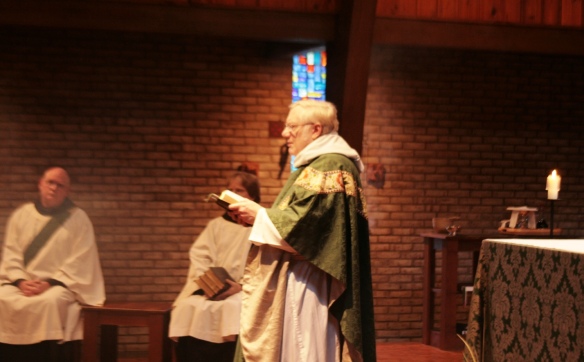 In the final chapter of John’s Gospel, Jesus asks Peter three times: “Simon son of John, do you love me?” Peter has to answer three times that he loves Jesus and then listen to Jesus tell him three times: “Feed my sheep.” (Jn. 21: 15-17) This three-fold question and response is commonly interpreted as Peter undoing his three-fold betrayal of Jesus in the court of the high priest. I agree, but with the caveat that Peter’s betrayal goes further back. At Gethsemane, when Jesus had been seized by the temple police, Peter drew a sword and cut off the right ear of one of the high priest’s servants. This may look like loyalty to most people, but not to Jesus, who said: “Put your sword back into its sheath. Am I not to drink the cup that the Father has given me?” (Jn. 18: 11) That is, Peter had betrayed what Jesus really lived for and was about to die for. As he had at Caesarea Philippi, Peter had acted as a “satan,” a stumbling block to Jesus’ commitment to non-violence, even at the cost of his life. In declaring his love for Jesus three times, Peter declared his love for what Jesus lived for and died for. It is with this love that Peter was told to feed his sheep.
 The Trinity is often presented as a puzzle: How can one be three and three be one? Mathematicians haven’t come up with any answers to that, so let’s treat the Trinity as a mystery to live, not a puzzle to solve. After all, it was through living the Mystery that the apostles preached a Triune God.
