Gathering to Give Life to Victims

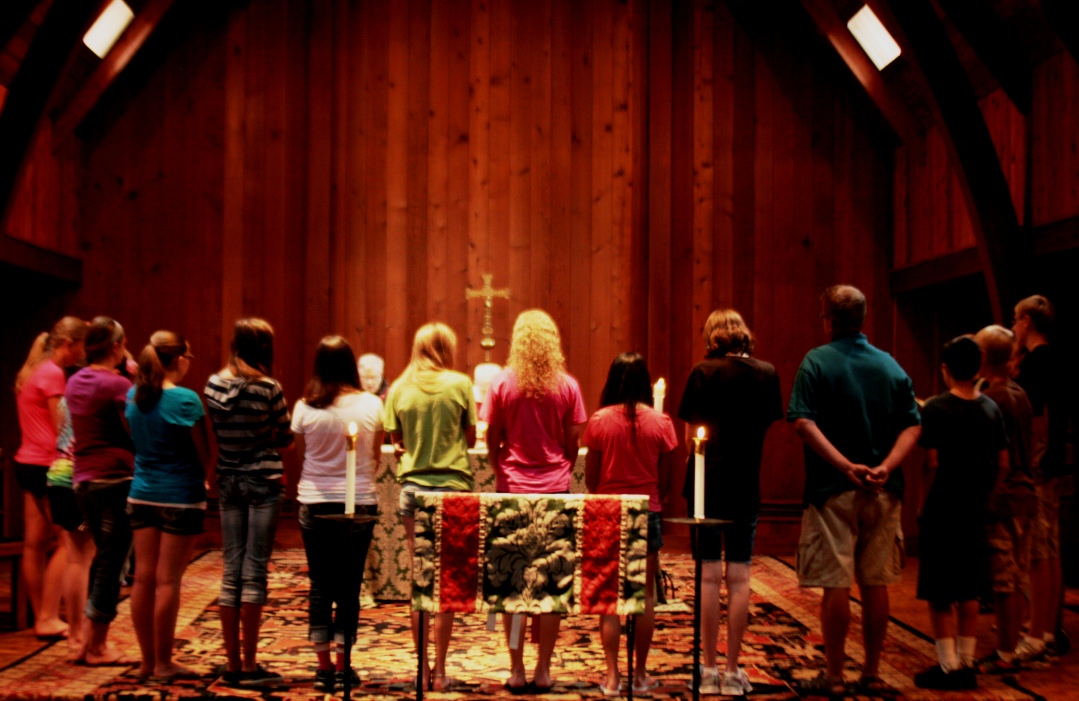
eucharist1Since the dawn of humanity, humans have gathered most quickly and powerfully around a victim. (See Two Ways of Gathering and Violence and the Kingdom of God.) Just think of how quickly we gravitate around whoever is currently seen to be to blame for whatever is going wrong in the world today. This gathering, however, is always at the expense of at least one person or group of people. A similar and yet very different gathering around a victim occurred when the eleven disciples saw the risen Jesus in Galilee and “worshiped him.” (Mt. 28:17) The huge, even infinite difference in this gathering is that the victim is alive and is gathering people around victims, “the least of those who are members of [his] family.” (Mt. 25:40) Ever since, Christians have gathered in worship around Jesus and his fellow victims, primarily in the Divine Office and the Eucharist.

The Divine Office is structured prayer that is uses the Psalter and other biblical canticles as the primary vehicle of prayer. Much can be said of the psalms but the thing that jumps out at anyone who prays them with any frequency is the many outcries of victims. “They surrounded me like bees; they blazed like a fire of thorns; in the name of the Lord I cut them off!  I was pushed hard, so that I was falling, but the Lord helped me.” (Ps. 118: 11-13) Verses such as these raise the question of whether we gather “like bees” around another person, or if we are entering the circle of bees in solidarity with the victim. Being a victim tempts us to anger, bitterness and violence. “Cutting off” our assailants in “the name of the Lord” is the reflex reaction, but is the opposite of what Jesus himself did in the same position. These rough verses help us renew our awareness of our own violent reactions to being victimized, even (especially!) petty matters such as being slighted by another. If we focus on Jesus when we are in the place of the victim, we find that the Lord has made the rejected stone the “chief cornerstone” that is “marvelous in our eyes.”

In the Eucharist, we gather around an altar which has been transformed into a table where, instead of laying out a sacrificial victim for slaughter, we place a piece of bread and a cup of wine to share among those present. We do this in memory of Jesus’ Last Supper, suffering, death, and Resurrection. The Greek word anamnesis does not mean a mere memory but to make present. That is, we enter the place of the victim with Jesus when we gather around the table. In so gathering, we feed on Jesus’ forgiveness of us for our own victimization are our challenged by this forgiveness to give this same life to others, both in terms of physical needs and emotional and spiritual sustenance. (See Miserable Gospel)

In his Rule, St. Benedict says that prayer should be made with “utmost humility and sincere devotion.” Entering the place of the victim with Jesus leads to both humility and devotion, attitudes that allow us to follow Benedict’s admonition that we sing the psalms (and also break bread in the Eucharist) “in such a way that our minds are in harmony with our voices.” (I develop these thoughts on the Divine Office in Tools for Peace)

The Prophet Between the Fox and the Hen

turkeys1We often think of a prophet as a person who speaks the word of God such as Elijah and Isaiah do, but Jesus gives us a deeper definition of what a prophet at the climax of his diatribe against the scribes and Pharisees in Mathew: “so that upon you may come all the righteous blood shed on earth, from the blood of righteous Abel to the blood of Zechariah son of Barachiah, whom  you murdered between the sanctuary and the altar.” (Mt. 23:35) Here, the prophet is one who says not a word but speaks the Word of God nonetheless in the sense that Abel’s blood cries from the ground.

This diatribe is often cited as a proof that Jesus, at least at times, was violent. It is worth noting, however, that Jesus didn’t shoot an automatic rifle at anybody; he spoke truth to presumptive power with a two-edged sword for a tongue. More importantly, these harsh words are followed by Jesus’ wish that he could gather his “children together as a hen gathers her brood under her wings.” Here we see very clearly the Two Ways of Gathering outlined in my blog post of that title.

In Luke, the lament over Jerusalem is put in a different, but similar, context. Warned by some Pharisees that Herod wants to kill him, Jesus calls him “that fox.” (Lk. 13:32) In preaching on this Lukan text, Prior Aelred here at St. Gregory’s, drew out the comparison of the fox and the hen. In the face of a threatening fox, Aelred suggested that Jesus might have been a better protector by being a tougher animal, such as the Lion of Judah. But no, Jesus assumed the role of a vulnerable hen gathering her chicks. Aelred went on to extoll Vicki Soto and her colleagues at Sandy Hook who covered as many of their small pupils with their bodies as they could to protect them, a contemporary embodiment of Christ the vulnerable, protective hen.

A fox scatters, while a hen gathers. What if Jesus had chosen to be a lion to deal with that fox Herod? It occurs to me that a lion would scatter all foxes who might threaten the chicks. Sort of like a superhero crushing the bad guys so that good guys like us can get on with our lives. Aelred noted that Jesus the Hen is not a popular image in Christian lore as is the Lion of Judah. The problem is, if Jesus the Hen gathers, then not only is Jesus the Hen trying to gather the scribes and Pharisees,  but Herod and his court as well, thus robbing us of more favorite enemies.

Stumbling blocks in the Desert: the Temptations of Jesus

freshBread1When Jesus went out into the desert after his baptism, he became aware of the fundamental temptations he would have to fight throughout his life. James Alison helps us understand the social nature of these temptations by pointing out that “devil” (diabolous) means “divisive obstacle.” Such an obstacle requires two or more people to stumble over it. That is temptations are unavoidably social.

The social implications of the first temptation are spelled out in John 6 where Jesus feeds the multitude in the desert. The feeding is a sign of God’s willing of abundance (see Divinely Created Abundance) but bread, like any material good, exists in a social context.  The temptation presented here is to align bread with economic and political power. The people who have been fed fall into this temptation and try to seize Jesus and make him king (the glory of all the kingdoms of the word–see Ignominous Glory). Jesus had to resist the temptation, go off alone, and then return to preach about bread from heaven, bread that is a gift from God.

In the temptations, the devil taunts Jesus as being the “son of god.” Likewise, when Jesus casts demons out of people possessed by them, the demons call Jesus “the son of god.” Thinking back to the attempt to seize Jesus and make him king, Jesus’ ordering those he has healed to tell nobody makes a lot of sense. Jesus was focused on healing those who had need. The demons tried to politicize the healings to make them part of a thrust for social power. This dimension is particularly apparent in the name of the demon possessing the man of Gadara: Legion.

When Jesus predicts his imminent suffering and death, Peter is called a “satan” when he tries to dissuade Jesus from following that course. As with “devil,” the word “satan” means a stumbling block. Lacking support from his closest followers could only have multiplied Jesus’ difficulty in holding the course laid out by his heavenly father. How much better would it be to fling himself off the roof of the temple and force his heavenly father’s hand? The devil was right to quote the verses from Psalm 92. God would bear up the son of man, but not until the son of man had truly and deeply put himself into the unforced hands of the heavenly father by allowing himself to be handed over into the hands of angry sinful humans.

Like Jesus, we must be alert to where the stumbling blocks are in our relationships with other people and with God. Like Jesus, we must learn that the stumbling blocks are too heavy for human hands to lift and toss away. Like Jesus, we must turn to our heavenly father who is always waiting for us to ask him to toss the stumbling blocks away.

Turning on Ash Wednesday

altarDistance1As we begin the season of penitence on Ash Wednesday, we do well to put penance in a context beyond our individual selves. René Girard’s concept of mimetic desire tells us that our “individual selves” are merely an illusion; our desires are unavoidably caught up in the desires of other people. (see Human See, Human Want) With that being the case, cleaning up our “own” desires simply does not do the job.  Instead, we must clean up the desires we share with others, and that means relating to others.

Early in his great poem “As Wednesday,” T.S. Eliot zeroes in on healing shared desire by following the first lines about hoping to turn his life: “Desiring this man’s gift and that man’s scope/I no longer strive to strive towards such things.” That is, the tenth commandment about coveting includes coveting the God-given gifts of others and their insights. If we turn from our entanglements with the desires of others, we will affirm and rejoice in their gifts and insights and in doing so, will awaken to the gifts and insights that we have within us to give to others.

In Matthew’s Gospel, Jesus follows his teaching on renouncing mimetic rivalry (turn the other cheek, etc.) with a solemn caution against using “good” actions such as repenting, fasting, almsgiving, and praying as occasions for competing with others so as to desire gifts and insights of others.  If we practice piety “in order to be seen by others,” then our piety is locked in our competition with others and not on God. That is why God cannot reward such piety which isn’t piety at all. The Desert Monastics also found themselves falling into the trap of competitive asceticism. On of the reasons Benedict, in his Rule, asks his monastics to tell the abbot about their Lenten disciplines is to put the practice of each into the context of building community. All this is compiling treasure on earth just as much as fattening our bank accounts.

The alternative to “praying in secret” may seem to be individualistic but it is really a matter of being an individual before God, which is a different thing. (An individualist flaunts his or her individuality over/against others—another thrust in a life of fencing.) Rather, “praying in secret” grounds each of us in God so that we can rejoice in God’s giftedness of others and ourselves. More important, it is precisely in the midst of these admonitions against flaunting our piety that Jesus teaches us the Our Father which reaches its climax with the petition that God forgive us as we forgive others.

As we turn again back to God, let us look at the turnings we must do in our relationships, realizing that unhealthiness in our relationships is not the same thing as the unhealthiness we may see in ourselves as individuals, although there is a relationship between the two. With T.S. Eliot, let us not even try to want the gifts of others but instead turn to the gifts we have to give to others.

For more about Lent in the Rule of St. Benedict in dialogue with Girard, read Tools for Peace

A Way of Meeting with Others

commonRoomOne of the more remarkable and attractive chapters in the Rule of St. Benedict is Chapter Two: “Summoning the Brothers [and Sisters] for Counsel.” Although Benedict was not so democratic as to have matters put up to a majority vote (as most modern monastic constitutions are), Benedict considered it essential that the abbot listen to all members of the community before making a decision. In my time as abbot of my community, I am profoundly grateful for the suggestions and cautions from my fellow monks on numerous occasions. Most writings on the Rule remind us that the first word is “Listen.” Much is made of the need to listen to God and to then to others, especially the superior, as a means of listening to God. Here, Benedict reminds the abbot to listen to the community. Given the toxic atmosphere of much debate in political and religious matters, I cannot stress enough to importance of listening as a first principle to healing the exchange of thoughts and opinions.

We can make it easier for others to listen to us by expressing ourselves in a way that makes it easier for them to listen. Benedict says that we will do this if we “express [our] opinions with all humility, and not presume to defend [our] own views obstinately.” If we take a moment to think about how hard it is to listen to a person who does the opposite of what Benedict enjoins here, we will see the importance of this admonition. More important, when we express our views humbly and without obstinacy, it is easier to be focused on the issue rather than our relationships with other people which, in the course of debate, tend to become more competitive than constructive. Benedict would have us discern the right thing to do, not strive to gain the most debating points.

Even more startling than the foregoing: Benedict says that the reason the whole community should be called together is because “the Lord often reveals what is better to the younger.” This is not an over-idealization of young people, but is a salutary reminder that the points of view of marginal people, which includes the young, may prove to be vital to a right discernment. Our tendency is to push those we consider marginal to the margins, usually while assuming that we are not marginal.

Issues such as gun control and immigration reform being debated right now are complicated and require careful thinking and expression that is most fruitfully done humbly with a heart that listens to ourselves, to others, and to God.

These ideas are developed at greater length in my book Tools for Peace.

Strange Wedding

wineTableFeast1The Wedding at Cana of Galilee is a beautiful story of celebration. The only problem is the story makes no sense, perhaps because celebration is infinitely beyond sense.

Foremost among the oddities is the scarce presence of the groom and no mention of the bride. The effect of Jesus being at the center of the story and no bride mentioned has the effect of putting us into the position of the bride of Jesus as Isaiah said: “As the bridegroom rejoices over the bride, so shall your God rejoice over you. (Is. 62:5)” The scarcity of wine (probably humanly created—Cana was a poor village—looks ahead to the scarcity of bread in the wilderness. Both times, Jesus counters scarcity with extravagant abundance.

The six stone jars are supposed to hold water for purification. That would be a lot of purity, but the jars are empty. Well, purity laws and rituals tend to divide humans arbitrarily into clean and unclean. That is, purity always creates a scarcity of purity, especially of pure people. Quite the opposite of God’s marriage with all God’s people.

The water with which the attendants fill the jars suggests baptism, as does the water at the well in Samaria, another story with nuptial overtones. The wine is a festive drink but it also looks toward Jesus’ death as does the bread in the wilderness. The story of Jesus driving the money changers out of the temple, the event that drove the Jewish leaders in Jerusalem to plot the death of Jesus, further suggests that the water and wine refer to the Passion.

Dostoevsky makes powerful use of this story in Brothers Karamazov. The great staretz (spiritual father) Zossima has just died. When his corpse follows the normal course of nature and creates a stink, many of the people are scandalized, including Zossima’s youthful follower, Alyosha. Late at night, the stricken Alyosha  is praying in the hermitage where the body lies in state. Another monk is reading the story of the Marriage of Cana. The room expands to take in a vast celebration. Then Alyosha sees Zossima rejoicing. The elder says to him: “We are rejoicing . . . we are drinking new wine, the wine of great joy. See how many guests there are?” “He [Jesus] became like us out of love, and he is rejoicing with us, transforming water into wine, that the joy of the guests may not end. He is waiting for new guests, he is ceaselessly calling new guests.”

Cana was a backwater in a backwater, a place of no significance. The temple in Jerusalem was the center of Jewish religion and culture. As with the outcasts at the manger, the party is in the backwater, not the center. In this new center, Jesus calls all of us to the party, the party that transforms the body and blood of Jesus into bread and wine of feasting and rejoicing, a party open to all of us. . Jesus has indeed saved the best wine until last.

See blog posts Humanly Created Scarcity, Divinely Created Abundance, and Outcasts at the Manger and article Violence and the Kingdom of God for more comments on Brothers Karamazov.